Monday, June 27, 2011

Jason Starr: The Pack

As everyone who's been reading this blog for long, I'm a stout admiref of Jason Starr. He writes tough and bleak noir with warmth towards his sociopathic protagonists and antiheroes. He doesn't much revert to mere pastiche of noir clichés and I think he's one of the best examples of how noir can be meaningful literature, both as art and entertainment. It's a small wonder Starr isn't better known.

His later books have gotten more a thriller-like aura, with more pages and bigger issues. There have been talks about big movie adaptations (I seem to have heard about David Fincher buying the option to Panic Attack) and I certainly hope there will be a HUGE movie from his newest novel, The Pack, which I just finished late last night. It's a crime novel like all his earlier novels, but it's also a horror novel. It's also a social satire, in which Starr gets to depict his usual pathetic sociopaths and everyday psychopaths. The middle-class life that Starr writes about is full of anxieties, uncertanties and loneliness. When something bad happens, there's no one out there for you. You're always on your own. Except for a few lunatics, who pray on your bare soul.

In The Pack this theme gets very real, as the protagonist, Simon Burns, ends up in a pack of werewolves. They are very cool guys, seemingly getting along well with their masculinities, taking crap from no one, especially their exes and employees, and Simon, recently fired from his job and spending frustrating life as a stay-home-dad, feels suddenly a burst of new energy. The feeling is misleading, but I'm not telling you more. Starr puts some new twist to the werewolf angle and there's some nice irony in how the werewolf leader combines the utter masculinity and an urge to kill. Jason Starr talks about the theme more in Spinetingler's interview here.

But then again, there's some padding. I can't get away from that. There's too much telling about how someone feels or behaves and about the reasons for that behaviour. Fake ID and Nothing Personal and all the other early novels by Starr have no padding. Is this the price we have to pay to get bigger recognition for a great writer like Jason Starr?

Tuesday, June 21, 2011

Tuesday's Overlooked Films: Hell's Hinges, The Terror of Tiny Town, The Phantom Empire, Les Petroleuses

We had our annual Summer meeting of the Finnish Western Society last Saturday. We (seven guys) were at a log cabin in Karkkila, a small town somewhere near Helsinki, and watched at least three western films in the whole. One we watched in part, and one we took a look at.

The best of films was no doubt William S. Hart's silent western, Hell's Hinges (1916). It's a solemn religious drama, in which Hart is a heartless killer who falls in love with a young woman and says goodbye to his past. Hart is very believable as a ruthless assassin. Despite being in black and white and silent, this was the only film that held our interest throughout its whole run. (Well, not everyone's. Someone said: "Next one will have to be a colour film!") I'd really love to see more of Hart's films.

The cult favourites, The Terror of Tiny Town and The Phantom Empire, however wore us out. The first one, famous for its all-midget cast, was way too traditional. Replace the midgets with grown-ups, and I'm sure not many would remember the film, let alone watch it. The Phantom Empire we couldn't make ourselves to watch through. It's just not suited to watch in entirety. I'm sure it would work better with a 20-minute episode every week, just as it was meant to be screened. Both films are better as ideas than as finished products.

The French film, Les Petroleuses/Frenchie King from the early seventies, has the advantage of sporting two very beautiful women in the lead, namely Brigitte Bardot and Claudia Cardinale. We couldn't come to an agreement which one is more beautiful. But the film is sadly a spectacle of disjointed events, some very colourful and mildly funny. There's just no coherence to it, which goes on to show that the French prefer spectacle to story-telling. Still, Bardot is very hot in her black outfit, and Cardinale is very, very lovely.

We also took a glimpse at an abysmally bad The Wackiest Wagon Train in the West that was put together from the episodes of Dusty's Trail. That's a TV show I'll never want to see. We lasted about 15 minutes.

I don't know if Todd Mason is making his usual round-up, since there's only one guest post in his blog here. Maybe there's more to come.

Friday, June 17, 2011

Friday's Forgotten Book: James Hadley Chase: Sucker Punch

Here's a link to an old post about James Hadley Chase's Sucker Punch. More forgotten books at Todd Mason's blog here.

Tuesday, June 14, 2011

Tuesday's Overlooked Film: At Close Range

I found this small classic from the eighties I'd never seen in a thrift store. It was an old VHS cassette, but it cost only 20 cents, so I thought I'd grab it. I'm glad I did, since it's a pretty decent film, although not a masterpiece.

At Close Range is a piece or rural noir, with young Sean Penn as the son and Christopher Walken as the father and also as the leader of a ruthless gang of criminals who operate in a small Pennsylvania town. Penn and Walken don't really know each other in the beginning of the film, as Penn lives with his mother (played by wonderfully understated Millie Perkins) and the family tries to reject the father. Penn leads an unhappy life with his mother and gets attracted to his father's exuberant way of life. Complications ensue, and the ending is a tragedy. There are other familiar faces in the crowd: Mary Stuart Masterson as Penn's girlfriend, Christopher Penn as the brother of Sean (as in real life), Crispin Glover as one of Penn's friends lured by the criminal life, David Straithairn and Tracey Walter as members of the gang. There's also Kiefer Sutherland, but I recognized him only in the last scenes.

There are lots of nice touches here and there and some of the scenes are very well done. Some of the small-town scenery and atmosphere reminded me of Twin Peaks. The climax is gripping, with lots of stylishly done shootings. The story about a father and a son allying and then fighting fiercely each other has overtones of a classical tragedy. There's still a feel of distance that might leave you cold. I'm sure this doesn't work well on the small screen. My main grudge, though, is that while Walken is an excellent actor, I just don't buy him as the leader of a Hicksville gang of criminals. Yet the film goes on to show that not all the Hollywood films of the eighties supported the Reagan-era ideology of keeping families under the Father's Rule, as critic Robin Wood has claimed.

The director of At Close Range, James Foley, has an interesting filmography, with lots of noirish films, but seems like he's never done a really good film, though Glengarry Glen Ross comes very close. Some say After Dark, My Sweet is one of the best Jim Thompson films, but I'm not sure if I've seen it.

More overlooked films here.

Monday, June 13, 2011

New books out: Duane Swierczynski, Ken Bruen, JP Koskinen

I just won't stop putting out new titles! I received my translator's copies of Duane Swierczynski's The Blonde last Friday, alongside with Ken Bruen's London Boulevard and the Finnish writer, JP Koskinen's Eilispäivän sankarit (The Heroes of Yesterday), which I both had a hand in.

Here's Ossi Hiekkala's great cover for Swierczynski's book. The book is Vaaleaverikkö in Finnish, which is a literal translation. We would've gone for Blondi, but we didn't want the book to get mixed up with Joyce Carol Oates's Marilyn book. The cover wasn't an easy one. We wanted to avoid the easy Sin City banality of this cover, but doing a dramatic cover without any weapons or some such proved very difficult. I think Ossi did a fine job.

As for the Bruen, I only picked the book, located the agent and started the negotiations (and found the translator for it). Koskinen's book I commissioned, but I never edited it (someone else did. It's about an old criminal who's been inside for the last 30 years, and when he's finally getting out, he doesn't understand shit about the new world. It's a very touching book, with some heavy-duty violence and black humor.

This is a nice job, but the titles have been selling too poorly, so it looks like I won't be doing it anymore. There's still Jason Starr's Fake ID coming out, hopefully next year. (Hopefully especially, since it's my translation.)

More on the titles here, alongside with some other books.

Wednesday, June 08, 2011

Tuesday's Overlooked Film: The First Charge of the Machete

Since Todd Mason asked, I thought I'd post at least a link to an earlier film post. So this old post about a Cuban avantgarde action film will have to do as a Tuesday's Overlooked Film post.

Monday, June 06, 2011

A new mag out

As you all know, I've been doing lots of different fictionmaggish zines for years now, Isku being the main venue. One of the others has been the decidedly haphazard Jännityslukemisto (Suspense Magazine or some such in English). In it I've published only stories that haven't been good enough to be published anywhere else. I decided to pull the plug on this one, but I had enough stories to do a fourth issue - and it's out now, with the print run of 20! Here's the cover. I think the photo in the cover is from an ad from an outdoor magazine (and it's taken with a cellphone camera!). The blurb below shouts: "Hellishly good killing action!" or some such nonsense. The logo of the magazine is taken from an old Finnish pulp mag of the same name (something I've done before, with Isku and Seikkailukertomuksia and Ässä).

The writers in the issue are me (with two stories!), Heikki Nevala (who just debuted with his horror collection Arvet/Scars from Turbator), Petri Hirvonen (who's done lots of stories for my mags) and Harri Erkki with a vintage porn story from a magazine called Cocktail. There are also two anonymous humorous horror stories - I found them on my old computer, without any note who'd written or sent them. But since they were meant for publication, I couldn't see any harm printing them. My stories are both hardboiled crime, the other one being a humorous parody originally written in the eighties and the other one being an experiment, told in imperative: "Look at the papers again. Shoot. Turn around when the corpse falls to the floor", et cetera. I tried to write this story already some years ago, but nothing came of it. When I started putting the Jännityslukemisto issue together, I decided I'd finish this, regardless of the coherent story and what I'd already written. I think it came out alright.

Here's in Finnish what I wrote about the stories in Facebook:

Heikki Nevala: Auki vain öisin (Heikin vanha novelli, jonka hän heitti ekaksi tarjokkaaksi Verenhimoon, mutta olimme sitten kumpikin sitä mieltä, että hän kirjoittaa uuden, ja se iilimatojuttu onkin tosi hyvä)
Petri Hirvonen: Kuolettava keikka (jos oikein muistan, Petri kirjoitti tämä kasarityylistä actionia edustavan novellin suomi-pulpin jättikirjaan, jota kokosin Book Studiolle viitisen vuotta sitten; kirjaa ei koskaan tehty ja novelli unohtui vuosiksi)
anonyymi: Metsästäjän hetki (jonkun kauan sitten minulle lähettämä kauhunovelli; tiedostossa ei ollut mitään kirjoittajan nimeä ja tiedostomuotokin oli txt)
Lena Erichs eli Harri Erkki: Kuinka mies vietellään (Harri Erkin seksinovelli Cocktailista vuodelta 1972, jonka piti alun perin nähdä päivänvalo uudestaan Mälli-lehdessä, jonka piti olla vanhojen miestenlehtien parodia; sitä ei kuitenkaan tehty, mutta kun tämä oli jo puhtaaksikirjoitettu, niin pitihän se johonkin laittaa)
Juri Nummelin: Paperi (kokeilu, jota yritin jo vuosia sitten, mutta jonka kirjoitin vasta nyt vähän väkisin loppuun, kauheasti juonta tai johdonmukaisuutta ajattelematta: miten kirjoitetaan kovaksikeitetty rikosnovelli imperatiivissa, siis käskymuodossa: "Ammu. Käänny kun ruumis kaatuu maahan" jne.)
nimetön: Tuopillinen tummaa (sama juttu kuin edellä, saman kirjoittajan tekemä, ei itse asiassa mikään huono juttu, mutta tarpeettoman vitsikäs kauhutarina)
Juri Nummelin: 25 donaa (puolen sivun absurdi pläjäys, jonka alkumuoto on teinivuosina kirjoitettu yksityisetsiväparodia; kirjoitin nyt uudestaan blogiini tekemän englanninkielisen version perusteella)

Sunday, June 05, 2011

Wild fantasy from yesteryear, but by whom?

"Thousands of flaming torches, reflected from countless carbuncles, filled the king’s palace with marvellous iridescent light. Along the white marble walls, on benches covered in purple, the warriors languished, beautiful young boys kneeling before them to offer them succulent fruits, foaming wines. Boisterous and merry, the men greeted with a roar of laughter anybody who ventured to amuse the company with ribaldry and antics.
In the centre of the hall, dark-eyed handmaidens swayed in lustful dance, like fl owers floating in the spring breeze.
Other maidens stood around the dancers, accompanying their graceful movements with clashing cymbals and wailing flutes. More fiery than the torches were the handmaidens’ eyes - more than wines they stirred the men."

Any guesses where this citation is from?

Thursday, June 02, 2011

Joseph Millard's graphic novel

Joe Millard's rare and early paperback-sized graphic novel is available now on Kindle. Jeff Vorzimmer has uploaded the first chapter to be viewed for free on Scribd here. Millard, who later on wrote lots of Westerns, including the ones with "The Man-With-No-Name", did also the art, at least that's how I figure it. Am I right about this? I don't find any mention on the artist on the site.

Friday, May 27, 2011

Friday's Forgotten Book: James Reasoner: Diamondback

This isn't supposed to be a forgotten book, since it's out available on Kindle and different other formats. You can also buy a trade paperback edition of it, if I understood correctly. James Reasoner's Diamondback was never commercially or traditionally published, so I think it figures here - and taking part in this meme I have a reason to finally write about it.

There's a story behind James's book: he wrote it on spec to a paperback publisher that had published his first novel, Texas Wind (which is great unto itself). The publisher went bankrupt though, before the manuscript was bought (or at least that's how I figured it; I may be a bit skimpy on details), and James's book didn't see the light of day. I think he tried to sell it to different publishers throughout the years, but without success. At one point he sent it to me. We'd talked about over e-mail about his career and writings and I'd already published one of James's early short stories in my zine, Isku (which was a print magazine at the time, now a webzine). I think there was some talk about getting Diamondback out in Finnish. (If I wanted to lose all of my money, this is exactly what I'd do: start publishing a series of translations of trunk novels!)

Then came the fire. James's and Livia's house burned down. I was devastated when I saw James's blog post about the fire. I was very, very glad to be able to help: I had two or three James's early short stories on my computer, plus Diamondback. James was glad to get them back - all of his files had been destroyed in the fire.

I wanted to do something more to help. But how? I was here on the other side of the planet. Then it came to me: I'll publish Diamondback and give the money to James.

I'd noticed lots of authors and publishers had started using Lulu and other PoD sites. I figured this might be the best solution: I'll do the layouts, put the book on sale and James will get the money. I thought it might be good to spice up the book a bit. I asked Bill Crider if he could do a foreword - sure enough, he did one. I asked Duane Spurlock (whom I knew through the WesternPulps e-mail group), knowing he had done some illustrations, whether he might want to do the cover. And sure enough, he did one. See the result above. I even asked for blurbs. I think I got one from Allan Guthrie, saying "James Reasoner is one of my favourite writers".

Everything was ready. Then I started downloading the thing on Lulu. Nothing came of it. To this day, I don't know what caused it. The file that Lulu would've used to print the book was too small in size - I think my computer is ("was" actually) missing a driver or something like that. Whatever it was, I was so frustrated I didn't know what to do. (My layout software is pirated, which is probably something I shouldn't confess, but that might explain the problems.)

So, basically I had a great book in my hands, but I couldn't do anything with it. I tried to think of other options. One of them was to do a small print run of books and try to sell them, but it would've cost too much, so nothing came of that.

I was very relieved to notice that James has now put Diamondback on sale on Kindle - and if I understood correctly, Bill's foreword to the book is included. And here, for the first time, in public is Duane Spurlock's cover for James Reasoner's Diamondback. (I'm so sorry for the bad quality of the picture. If possible, I'll change it. I think it's on my old computer, this is just taken with my cell phone of a print-out I did. The colours are misleading.)

Oh, what's the book about? It's a great action novel in the mold of classic men's adventure series, but with a dash of social conscience thrown in. James has written some very good short stories about the Mexican immigrants and the same theme is visible here. The opening is great:

It was the heat, Tom Sloane had decided, that brought out the killing violence in people.

He was uncomfortable, sitting on the hard, cracked ground, but at least the sun had gone down several hours earlier, taking with it the broiling hundred-degree-plus temperatures. It looked like the heat wave was never going to break, and in the last two weeks, Sloane had seen more incidents of violence than he usually did in two months. Husbands and wives and children abusing each other, nervous hold-up men gunning down clerks in convenience stores, perfect strangers exchanging gunfire over an imagined insult on the freeway . . . Sloane was no stranger to violence, but it made him tired to think about it. He did what he could, and that was all any man could do.

As you all know, James is very good in action scenes and the same goes here:

Sloane was barely aware of Angela's muffled scream as the tip of the knife came up to meet his punch. He changed the trajectory of it a fraction, and the blade caught his coat sleeve and ripped it savagely. That threw the punch off, making it glance almost harmlessly against Arturo's shoulder.

The nose was the place to go for. In its damaged state, it would be the weakest link in the chain. Sloane feinted, drawing another thrust of the knife, then stepped inside and peppered Arturo's face with quick bursts of his fists. The man let out a howl and took an involuntary step backward, blood starting to show on his bandages. Sloane followed, grabbing his right wrist and hanging on. The left one was bandaged also, where Sloane had kicked it in the Red Bull, and he knew it would be worthless to Arturo. Sloane jerked and twisted again on the other wrist, and the knife fell to the floor, landing without a sound on the thick carpet.
Sloane let go of the wrist and backhanded his opponent. Another blow to the belly doubled him over. Sloane clasped his hands and brought them down on Arturo's neck, driving him to the floor. Dazed, the Mexican's scrabbling fingers found the knife and snatched it up. He put his other hand down for balance and tried to lever himself up.
Sloane kicked the arm out from under him.
So, what else do you need? Check out this link and order Diamondback to your Kindle or whatever reading device you're holding.

Here's the link to other Forgotten Book entries at Patti Abbott's blog.

Tuesday, May 24, 2011

Tuesday's Overlooked Film: Meek's Cutoff

This quiet Western movie has been mainly on film festival circuit and I saw it two weeks ago in a Finnish film festival. It's an indie Western that doesn't much resemble any other Western movie I can think of.

Meek's Cutoff is a simple story of some dozen settlers who are going somewhere in middle of the desert. They are escorted by a man called Meek, who seems to be as lost as everyone else in this film, even though he thinks he knows all the time where they are. The settlers meet an Indian and capture him and think he can show them the nearest waterspot.

The film is very quiet and slow. There are lots of scenes where people just work and don't say anything. In the scenes with people that are far away their dialogue is only barely heard, and some of the important plot points take place during those scenes! (Put the subtitles on, if you're watching this on DVD.) The climactic scenes are also pretty slow with long shots. There's all the time some tension on, though - this is not a boring film. (Must admit, thought, that I took a nap during the screening. I can blame only the viewing hour, from 5.00 p.m. on. I'll always fall asleep during those two or three hours.)

The ending is cryptic. It feels like there's something you just can't grasp, some inner meaning that just doesn't want to come out. The director Kelly Reinhardt has said though that the ending came about because they ran out of money! Yet there's something intriguing about the ending.

I recommend Meek's Cutoff, but don't expect any chases on horseback, fighting with Injuns or any other Western stuff. Nothing blows up real good. Some critics have compared this to the French director Robert Bresson, but I can't find any deep religious symbolism in Meek's Cutoff (unless the image of lost settlers is a religious symbol in itself). You might compare this to the Western films of Monte Hellman, but Hellman's films are B-westerns on the surface, this isn't. I kinda wished, though, this would've been more cryptic, more difficult to decipher - yet I find myself in some trouble saying something definite about it. Will have to see this again.

More Overlooked Films at Todd Mason's blog here.

Saturday, May 21, 2011

My novel will be out

I'll be a real writer next Fall! Just heard yesterday that a small Finnish publishing house will put my historical science fiction/religious satire/horror/hardboiled crime -novel out some time after the Summer. This is a manuscript I've been working on and off from the early nineties (and, if you want to, already in the late eighties, since this is loosely, very loosely based on the first short story I published in 1988!). I don't know what kept me at it, but now I'm glad there was that something!

The working title for the book is "Gotterdammerung" (has been already from the afore-mentioned short story), but it doesn't fit the contents of the book, so I'll have to come up with something.

Friday, May 20, 2011

Erotic fiction

Kate Laity and the beginner's guide to the erotic fiction here.

Thursday, May 19, 2011

Mellors and me

Over at Facebook a friend of mine posted this link about different Lady Chatterley covers. I pointed out that this Argentinian cover was my favourite and said I could even use it as profile picture if someone put eyeglassed in it and made the person bald. Another friend of mine did what was asked, with hilarious results.

New pulp magazine

Moonstone Books launching a new magazine.

Wednesday, May 18, 2011

Xanadu!

I've never seen Xanadu, but Vince Keenan's blog post about it is very funny and actually thought-provoking.

Tuesday, May 17, 2011

Winslow's Savages

I just read
Don Winslow's
SAVAGES.

It's fucking good.

You better believe it.

Like a treatment for a Tarantino flick
written by a sharp sociologist.

Out now in Finnish
as RAAKALAISET.

Monday, May 16, 2011

A new book out, once again!

Earlier today I picked up my new book. Sigh, you say, once again? Yes, once again! This is a small pamphlet I edited and wrote a foreword (and published). It's a collection of three short stories (there weren't more) by "Jaska Autero", who was, I believe, a pseudonym. I don't know who he is, and from the stories it seems he was two different writers, since one of the stories differs so much from the others. The stories are horror and science fiction set in the Finnish Continuation War against the Soviet Union. The horror and SF aspects make the stories almost unique and while they certainly are not great literature, they are interesting forays into a pretty uncharted genre.

The stories are called "Kostaja/The Avenger", "Olin kuollut mies/I Was a Dead Man" and "Salainen ase/The Secret Weapon". They were all originally published in the Seikkailujen Maailma magazine in 1944, when the war was already coming to an end (and Finland's defeat). The cover illustration is by an unknown artist and it accompanied the "Salainen ase" story. Here's my foreword to the book (in Finnish).

Saturday, May 14, 2011

Jeff VanderMeer on Finnish SF/fantasy

American writer Jeff VanderMeer was on a tour in Finland with his wife some weeks ago (I don't know why the word about this never reached me, they even dropped by in Turku where I live to meet people in the SF fandom, but I think that's totally my own fault) and interviewed lots of people. Here's his final essay on the state of SF and fantasy in Finland: "Right now, many of these writers remain just tantalizing possibilities for English-language readers, but it may not remain that way for long. We can’t be certain which of these Finnish writers you’ll be reading in the future, but we are certain you’ll come to know many of their names much better very soon." Lots of great people I know and have worked with and I can't but say VanderMeer is right.

Edit: here's also an interview with the Tähtivaeltaja editor Toni Jerrman. 

Monday, May 09, 2011

Finnish publisher Kari Lindgren dead

My friend, author Tapani Bagge notified me that one of the last large personalities in Finnish publishing, Kari Lindgren, died recently after suffering from a strange disease for three years. This is a big blow to Finnish publishing, since Kari Lindgren did lots of books the other publishers didn't want to touch or didn't know how to handle them. Without Lindgren it's possible we might've never had translations from Joe R. Lansdale, Gerald Petievich, Lawrence Block, Richard Stark... He also did lots of vintage noir and hardboiled crime: Dorothy B. Hughes, Marc Behm, Margaret Millar (whose Like an Angel, one of the best crime novels ever, was published by Lindgren), Dashiell Hammett, Fredric Brown, Ross Macdonald and others, with some classic cozies thrown in.

One of Macdonald's early novels, Blue City, was also one of the last books Lindgren published. It's sad to see him go, but unfortunately his demise was expected.

Lindgren started out in publishing in the middle eighties, with his company called Viihdeviikarit. He wasn't always very good to come up with good names for his outfits, as Viihdeviikarit means roughly "Entertainment Dudes". Viihdeviikarit was a strict paperback publisher, with lots of titles coming out each month. They did many Westerns, from the USA, the Great Britain and Germany (the Lassiter sex paperbacks). Some of the Westerns were Finnish in origin, i.e. the Hulkkonen series by Kari Nenonen, and some others. They also published war and crime paperbacks and some porn.  In the early nineties Lindgren changed the name to Book Studio and reformatted his line: the books became larger trade paperbacks and the lines got classier, with interesting new authors and well-chosen classics, alongside some more obscure titles. He also published lots of movie tie-ins, which the bigger publishers do very rarely.

In the early 2000s, the large publisher Gummerus bought Book Studio, which eventually caused Lindgren to leave and start a new business. This time it became BookKari, under which Lindgren worked out some interesting books, but it was clear his energy was fading. One of the books was Synnyimme lähtemään ("Born to Leave"), in 2006, by Pate Riikonen, who later turned out to be Tapani Bagge and Harri István Mäki, who later on collaborated on a book I commissioned for the Arktinen Banaani publishers.

We worked together on some books. I did my first short story collection for Lindgren. This was a collection of the Finnish singer-songwriter Reino Helismaa's early stories, called ..ja Reikärauta-Brown ("..and Six-Shooter-Brown" or some such). I also copied some short stories and serials by Mauri Sariola for Lindgren to be published as books, and I proposed my translation of Jason Starr's Fake ID for him. He was interested, but for some reason or another he passed. (The book is now coming out from Arktinen Banaani.) We talked about other books and I compiled another set of Helismaa's adventure and crime stories, but Lindgren didn't live long enough to do the book. I also compiled a huge collection of Finnish pulp fiction stories (with a good grant), but nothing came of it. This was sadder news to Tapani though than me, since Lindgren published Tapani's first adult crime novel, Puhaltaja (The Jack), in 2002, with some other books of his and always offered translation work for him. Tapani said he lost a friend.

Friday, May 06, 2011

My book of outdoor stories out next week

The last book for this Spring (well, not exactly the last, but close) is this collection of Finnish outdoor stories, called Outoja jälkiä/Strange Tracks. The stories in the book range from the late 19th century to 2007 and Juha-Pekka Koskinen's weird horror story. It's a strange bunch, but I'm glad I made it - more obscure writers have been rescued! This differs from your usual outdoor story collection in that I've included some pulp magazine stories in, for example adventure and crime stories by Seppo Tuisku and Antero Aulamo.

Thursday, May 05, 2011

Finnish SF scene

My friend Jukka Halme talks with Jeff VanderMeer about the state of Finnish science fiction, especially about Johanna Sinisalo and her Birdbrain, just now out in the US, and Hannu Rajaniemi and his phenomenally successful The Quantum Thief.

Tuesday, May 03, 2011

Tuesday's Overlooked Film: The Fabulous World of Jules Verne

I lured Kauto, my 6-year old son, to watch an ancient black & white Czech animation from an ancient VHS. To my surprise, Kauto watched the whole movie with me! It was Karel Zeman's Vynález zkázy from 1958, known in Finland as Salaisuuksien saari (The Island of Secrets) and in the English-speaking world as The Fabulous World of Jules Verne (or Invention for Destruction). It's the film version of one of Jules Verne's lesser-known novels, Face au drapeau AKA Facing the Flag (in Finland as Isänmaan lippu). Zeman is best known for his animation collage in which he uses live actors mixed with stop-motion animation and the original illustrations for Jules Verne's novels. It's very beautiful, as if the fictional world of Verne comes out alive on screen. As an adventure, The Fabulous World of Jules Verne is slow-moving, but it also contains lots of beauty. It's the beauty of a silent cinema, of something happening for the first time and the thrilling sensation we get out of it. Zeman is one of the great artists of cinema.

Here are the opening credits. Seems like you can watch the whole film on YouTube. (More overlooked films at Todd Mason's blog here.)

Monday, May 02, 2011

Where's Lucky Luke?

The Official Blog of the Western Fictioneers, Professional Authors of Traditional Western Novels and Short Stories lists Top Ten Western comics. See the list here. Seems pretty nostalgic to me, but what's missing almost completely are the European comics. There are Blueberry (on 10) and Ken Parker (tie on 21), but where's Lucky Luke, where's Tex Willer, where's Cocco Bill, where's Yakari, Buddy Longway, Jerry Spring, Oumpah-pah... I know, I know, not many of these have been available in English, but here's hoping they will be!

Edit: a friend of mine pointed out there are more European comics included: Alejandro Jodorowsky's Bouncer on 19, Victor de la Fuente's Amargo on 20, Hermann and Greg's much-praised Comanche (tie on 25) and Giraud's and Charlier's (known for Blueberry) Jim Cutlass (tie on 32). 

Friday, April 29, 2011

Logicomix

The Logicomix graphic novel (which I believe is available in English) has been getting high praise from just about everyone here in Finland. The premise is interesting: it's a metatextual rendering of the history of mathematical, exact logic. It's told from many perspectives: the artists discussing the book under construction and Bertrand Russell telling about his life in a public speech, with the story moving forwards and backwards in time. The examples of logic Russell gives in his speech are also played out in the present time, with the artists discussing them. 

Logicomix is a fluent read, but I got the feeling it's also overhyped. The art is a bit stale (the artists are said to have collaborated earlier on the Babar animated TV show...) and while there's a lot of stuff going on all the time, with many important mathematical thinkers and philosophers popping in and popping out, I didn't realize what the fuss was about. (Plus I didn't understand many of the dilemmas presented, which may explain why I wasn't as fascinated as some others.) The stuff with Ludwig Wittgenstein was probably the most powerful. But I'd say if you're interested at all in the mathematics or the history of philosophical logic, you should try Logicomix. I just wish it would've been more original, more courageous. As a graphic novel, it's way behind Spiegelman's Maus, anything by Will Eisner, Alan Moore's and Eddie Campbell's From Hell etc. 

Thursday, April 28, 2011

Controversy over Ace Atkins's forth-coming Spenser books

Ace Atkins and TV writer Michael Brandman will be continuing Robert B. Parker's Spenser books. This has caused a lot of controversy at the Rara-Avis e-mail list, with people shouting "couldn't they at least wait until the body was cool? I mean, shit, Parker hasn't been dead two years". From my perspective, I can't see any harm someone writing more mediocre books that read pretty fast and tell about nothing. I mean, I've never been able to understand what's behind Parker's success and cult status. I don't want to hear stuff like "you just had to be there" or "Spenser's voice is unique" (which it doesn't really seem to me), I want to hear solid analysis.

Wednesday, April 27, 2011

Interview with Woodrell

Apart from just about everyone else, I'm not a big Daniel Woodrell fan, but do check out this interview with him.

Sunday, April 17, 2011

Finns getting a right-wing parliament

It was an election day today. Finland voted for a new parliament and decided that what we need is a bunch of over thirty right-wing nuts to deal with such complicated things as the EU monetary crisis, the global immigration and such. Here's a BBC article. Finland follows the route of many European countries, for which I'm very, very sad. Seems like Barack Obama is the only good guy right now. (I'm sure many of my American readers disagree with me on this.)

Wednesday, April 13, 2011

Antti Tuomainen strikes a deal

Marvellous news from my writer friend, Antti Tuomainen, the noir man extraordinaire! Beware of the Finnish noir apocalypse!

Tuesday, April 12, 2011

Tuesday's Overlooked Film: The Concrete Jungle

The Concrete Jungle is the US title for Joseph Losey's The Criminal (1960). It's a very, very tough crime film, reminiscent of the best, the most hysterical film noirs à la Kiss Me Deadly or Brute Force. Very hardboiled (and not very unlike Sean Connery) Stanley Baker is the head character, a career criminal just getting out from the prison and already developing his next big gig. Everything goes well and they get 40,000 pounds, but afterwards Baker's criss-crossed, in the best tradition of the genre. The ending is very grim, which means it's very good. Some of the scenes are so hysterical you want to jump up and shout: "Stop!"

There are some problems with the film: there's too much music, some of the scenes are a bit stagey and there are some inconsistencies in the script, but all in all, a lovably dark crime film from one of the masters. There are some things here Joseph Losey couldn't have done if he hadn't left the USA after being blacklisted: the homosexuality of the inmates is not hinted at, it's plainly shown (even though there are no kisses here or even a mention of the relationships), and the violence is harsh and brutal. Here's a good review of the DVD. Check it out, if you can.

More Overlooked Films at Todd Mason's blog here.

Wednesday, April 06, 2011

Little Red Riding Hood on View-Master

I'm unpacking feverishly and coming up with very weird items in my collection of sorts. Here's one, a folder for the View-Master discs containing the story of Little Red Riding Hood (in Finnish language, if anyone's wondering). Can't find the year this was published. I know I have somewhere a similar folder for Tarzan discs, will have to post a picture of the folder and its photos, provided I'll ever find it.

Tuesday, April 05, 2011

Brian Garfield on Donald Westlake

Long interview with Brian Garfield about his long-time friend, Donald Westlake.

Monday, April 04, 2011

Cape Cod Noir

This reminds me of the idea I pitched to Akashic two years ago: the Helsinki Noir anthology. Thanks to Kevin Wignall, I got a very good line-up for the thing. I'll have to dig it up and refresh it.

Sunday, April 03, 2011

Gil Brewer's bibliography

Just a quick note: here's a pretty complete bibliography for Gil Brewer's short story fiction, with some discoveries (i.e. Gil Brewer wrote some short stories as by Jack Holland).

Saturday, April 02, 2011

We just moved

We carried almost all of our possessions to our new apartment - our new home! - today and we are all pretty tired. Kauto threw up after eating almost only candy and snacks all day and this new place is a mess, with all the 6,000 books lying around, in boxes, on tables, on shelves, everywhere. Plus all the clothes, Elina's vintage dresses, 120 shoes... and I'm not someone to blame her, since I've got at least 100 T-shirts and what not. We've talked about opening a bottle of Moët & Chandon when the move is over, but it's not over yet. Wish us luck!

Tuesday, March 29, 2011

Simon Lelic's Rupture

I read the Finnish translation of Simon Lelic's Rupture (A Thousand Cuts seems to be the US title) book and wrote a review of it for the Helsingin Sanomat newspaper. I liked it quite a bit, but not enough to keep it on my shelves. It's a frightening tale of a teacher who kills four pupils, one teacher and then himself. Lelic, whose debut novel this is, writes the first half of the book mostly through fragments and witness testimonies which makes for a compelling read, but the second half is marred by a didactic tone and an ending that's way too upbeat. It's simplistic and makes one hope Lelic wouldn't have pulled his punches this way.

Recommended, though, if you're into serious British crime writing or the topic of school shootings. It's interesting to me, since I've been having these dreams of... writing something about school shootings (a publisher actually once proposed I'd write a novel of a school shooting, but nothing came of it).

Saturday, March 26, 2011

Moomins, those satanists

Instead of a proper post*, here's a link to a hilariously inane "article" on Moomins, the great fairytale novels of Tove Jansson, the Finnish writer. I really love it when my both children love them just as much as I've always done.

* We just sold our apartment, are prepared to move to a bigger one and I should be packing all of my books, I had a writer's block that lasted a week and now that I'm over with it, I should concentrate fully on writing the architecture book. 


Edit: it came to my knowledge some minutes ago that the Landover Baptist Church is a parody. Well, they fooled me, that's for sure. 

Friday, March 18, 2011

Three books in two weeks!

I'm not sure anymore whether I got any new books out last Fall. At least three books were delayed - which of course lead to the situation where they suddenly come out with a burst. Last week the collection of articles dealing with the copyright debate that I edited came out, and this week the reference work to the contemporary historical novelists came out. And as if this wasn't enough, I got a call from the publisher that the vampire anthology is just out of the printers! Yikes! Three books in two weeks! (Must be said, though, that none of these is written by me, they are just anthologies and compilations. I did ten or so entries for the reference book, but I'm "only" credited as one of the three authors, the other two being Sari Polvinen and Jukka Halme.)

There's still one book coming out this Spring that was supposed to be published last Fall - it's the collection of the Finnish outdoor and hunting stories I edited. It'll probably come out next month.

I'll post later more details about these books.

Wednesday, March 16, 2011

Michael Koryta's A Welcome Grave

You might remember I lost this book for at least a week and my reading experience was a bit ruffled by the incident, but it was still a very good book, a good example of the recent private eye fiction that doesn't have any of the noirish clichés of the private eye fiction that still marr the image of the hardboiled gumshoe in people's eyes. Very few of these books have been translated in Finnish, which means many have the wrong image of the new PI novels.

Okay, to the book. The setting is very intriguing and fresh: someone kills brutally the guy who "stole" Lincoln Perry's (Perry being Koryta's PI hero) girlfriend many years ago and married her. Lincoln Perry is the first suspect, since he's known to have  fought with the deceased. The wife knows the dead man had a son and someone should notify him about the death of his father. Perry finds the son quite easily, but in the middle of the night, in a gazebo somewhere, the son pulls the trigger and kills himself.

And then I lost the book.

And then I found it. (Or actually Elina, my wife, found it while cleaning.)

But I got back on the track. A Welcome Grave is one of those touching and tragic PI novels in the mould of Ross Macdonald or Jonathan Valin. The webs of history and family life are very complex in this book. At times I felt there was a bit too much dwelling on Perry's love life and he has a mildly weird sidekick (a trait I don't really like in new PI fiction), but I'm not really complaining. The climax is quite shattering and full of action. This would make a nice film. My only complaint is that Lincoln Perry is not as memorable characther as someone like Philip Marlowe or Dan Fortune. Maybe that's the point: the people around the PI are the story.

Oh, here's Koryta's website.

Tuesday, March 15, 2011

Tuesday's Overlooked Film: The Marquise of O

In Arthur Penn's seminal private eye film, Night Moves, Gene Hackman says that watching an Eric Rohmer film is like watching paint dry on the wall. Hackman is not a nice man in the film, so everything he says should be approached with caution.

Especially when Rohmer makes films as beautiful and stunning as his (only?) historical film, The Marquise of O (1976; the same year as Penn's film!). It's based on a story by Heinrich "Mikael Kohlhaas" von Kleist and it's about a widow who gets mysteriously pregnant after being saved from some village savages by a Russian count (played by Bruno Ganz). The sets are very well done, the compositions are beautiful (I believe Rohmer has stolen some images from the famous paintings of the era; see the image on the left), the dialogue is very funny in its pompousness and German strictness, and the story is moving. What more can you possibly want? The film is absolutely hypnotic, even without music (yes, this is an European art film without any music). My only gripe with the film is that the ending, the last line of the film seems a bit too ironical.

More Overlooked Films here.

PS. And oh, I could also mention The Jack Bull, a rather recent TV western I watched some weeks ago, because it's based on "Mikael Kohlhaas", von Kleist's best-known story. The transition of the 16th century Europe to the late 19th century Wild West is made quite well, but I didn't buy John Cusack as a Western character, for some reason or another. Recommended otherwise.

Friday, March 11, 2011

Friday's Forgotten Book: Patricia Highsmith's A Game for the Living

It's been a while since I last read something by Patricia Highsmith. I haven't read enough of her work to call myself a fan, but I've liked what I've read. For some reason or another, it's almost twenty years since I've read any of the Tom Ripleys.

But I have a book project for which I'm supposed to read some Highsmith. I grabbed one of the Finnish translations from the shelf, but it proved to be one of her weaker books - or at least that's what I think. It was A Game for the Living from 1959, translated literally as Peli eläville in 2000. It's set in Mexico which makes it resemble some of Margaret Millar's work, but Millar seems quite liberal compared to Highsmith when it comes to her depiction of the Mexicans. Highsmith's view of them is racist: the Mexicans are stupid, arrogant, child-like, corrupt, violent, acting on a whim. One of the whims is a deadly one: a beautiful woman who's affiliated with many artists is killed brutally and the two men with whom she was in love with begin to act out their own guilts.

This seemed interesting at first, but then it bogged down to a mediocre thriller, with too many scenes in which the lead men were just suffering. The climax wasn't very grabbing, I'm sorry to say. It has to be said, though, that I had some difficulties to concentrate in reading the book - I had to read some other stuff at the same time and that always eats the experience. I'd be interested to hear about other opinions on the book.

Other Forgotten Books for this Friday can be found here at Patti Abbott's great blog.

Tuesday, March 08, 2011

Tuesday's Overlooked Film: Pirates of the 20th Century

Seems like I'm doing only these Overlooked meme posts nowadays... (And I keep forgetting the blogger's rule No. 1: don't complain about why you haven't posted and why the stuff you post is lame.) I'll try to remedy that, with posts coming on Michael Koryta's A Welcome Grave (I found it!) and James Reasoner's long-lost novel Diamondback. Okay, back to the meme.

Pirates of the 20th Century (1980) is possibly the only Soviet karate film ever made. And it is possibly the only full-blown action film ever made in the Soviet Union. There have been some actioneers along the way, starting from the early 1920's (and Civil War films like Red Imps that resemble American Westerns very much) and moving well to the 1980's. But Pirates of the 20th Century is something of an anomaly: there's no social or political message to be seen, there really are some karate and diving scenes, with some tough violence. All in all, the film resembles the James Bonds and at times even the Hong Kong karate flicks of the seventies. The Soviet public wanted this stuff so badly the film received over 100,000,000 viewers!

It's not a bad film. It's stagey at times and the characters are not much more than cardboard sketches. There are some scenes in which you can only wonder what the script writers were thinking, and the climax is way too easy. There's some heavy-duty violence against women (whipping with a bamboo stick on a bare back, for example), which is surprising. The music is mostly Italian-styled funkjazz. The only Soviet angle thing is probably that there are no lonely heroes: these guys act as a group in which there are no hierarchies. (Okay, the bad guys, the pirates of the title, are mercenaries who've worked in places like South Africa and Angola, which places them with the imperialist gang.) The film is entertaining throughout, though, and if there's a copy available I suggest you grab it: this is one of a kind. I believe the film is on out DVD. Below are the opening credits and the climax, without English subtitles, though. (More Overlooked films at Todd Mason's blog.)


Wednesday, March 02, 2011

Tuesday's... er, Wednesday's Overlooked Film: Manifesto

Honestly, I was going to post this already yesterday, on Tuesday, but I never got around to doing it, so I'll do it now and send a link to Todd Mason who collects all the posts on this meme here.

Okay, to the point. I'll be short about this. Dušan Makavejev was the often controversial Yugoslavian director of the late sixties and early seventies, with his politico-pornographical essays Sweet Movie and WR, but he more or less vanished from sight after those films. He's been making films still in the 1990's, even though the results haven't been up there with his early films.

However, Manifesto from 1988 which I saw recently on the big screen is a very funny rendering of an Émile Zola short story, set in an unidentifed country just after the First World War, with people trying to kill the (hilariously stupid) king. It's full of sexual exhilaration and the film boasts with surreal ideas. It's incoherent, but always hilarious, with some good actors (Simon Callow, Eric Stoltz, Alfred Molina). It's not as experimental or as political as Makavejev's old films, but the fact that the lead woman in the film is very firm in getting her sexual satisfaction is enough for me to make the film political. Actually the erotic content, mixed with absurd comedy, with some mild domination thrown in, made me think of my own sleaze paperback, Lausteen himokämppä (and its sequel, which I, by the way, finished writing the other day).

What's interesting is that this was a Cannon Group film, produced by the Israeli duo of Menahem Golan and Yoram Globus. They made some artsy films, at least one by Robert Altman and possibly others. I don't have time to look for the other titles now...

Tuesday, March 01, 2011

Little interview with JT Ellison

Some years ago I published a small flash fiction story, called "Madonna in the Grass", by American writer JT Ellison in one of my mags, Ässä. So it was nice to notice she made it pretty big with her Nashville-set Taylor Jackson series. Especially nice was that Taylor Jackson also made it to Finland. Her first novel with Jackson, All the Pretty Girls, came out in Finnish before Christmas. I managed to find a copy, though the MIRA paperbacks have a very short shelf life and they are not available everywhere, and I read the book during the holidays. I'm not big into serial killer, but I thought All the Pretty Girls was entertaining and pretty plausible in its solutions. A fast, solid read.

I sent some questions to JT and got some answers back - the thing that usually happens with interviews, right? Okay, here's the Q&A.

Was it always clear to you that you'd write about a woman character?

Yes. From the very beginning, I wanted to have a strong female lead, one that was strong without being strident, who commanded the respect of her peers not from fear, but because she’d earned it. A female Lucas Davenport, that was my goal. Half cop, half rock star. On a deeper level, I see Taylor as Athena, the warrior goddess of Nashville. She is the city’s protector in every way. A hero.

But having a strong male lead was important to me as well. That’s why Baldwin has such a big role in the story from the get go.

Taylor Jackson is not the main character and actually not all the time very crucial to what's happening in the book? Why is that?

Taylor is definitely the main character of the book, she’s just working on a secondary investigation. That’s just the way the story played out in this first book. Because she is a police office with Metro Nashville, she can’t go jetting off to other jurisdictions to follow the Southern Strangler. John Baldwin is the profiler tasked with finding the Southern Strangler, but Taylor’s role in that investigation has to be focused on the Nashville aspects only. Real cops can’t move into other jurisdictions without a lot of paperwork and headaches. I thought it would be fun to show what it’s really like for a cop dealing with a multi-state investigation.

You've published six books about Taylor Jackson? What's happened to her after the first book (mind you, I haven't read them before this). What's going to happen to her later?

Taylor faces all sorts of challenges in the following five novels. In 14, she’s investigating the case of a long dormant serial killer who seemingly has returned from the dead. In JUDAS KISS, she’s working a single murder of a young mother, and dealing with a major invasion of her privacy that results in her being demoted. In THE COLD ROOM, she’s up against another serial killer, The Conductor, and chases him across Europe with a new character to the series, James “Memphis” Highsmythe, from New Scotland Yard. THE IMMORTALS has her back in Nashville hunting for a killer who’s tied to the occult, and the newest book, out March 1 in the US, SO CLOSE THE HAND OF DEATH, sees her up against her nemesis from 14, the Pretender. The girl has a full plate. I’ve just finished the seventh, WHERE ALL THE DEAD LIE, (Oct 1) which is more of a gothic suspense than my usual thriller. No killers to hunt, just Taylor, working through some rather serious issues.

Do you have any other series characters or one-off books in mind?

Yes, I do. I’m starting a new series right now, but I’m not ready to talk about it yet.

There are quite a lot police procedural influences in the book, which I found refreshing. Could you name some of your influences in that genre?

I’m a big fan of John Sandford. He’s the one that got me going on police procedurals. Tess Gerritsen, Alex Kava, Erica Spindler, Karin Slaughter, John Connolly and Lee Child all inspire me too. I breathlessly await their new books.

In your earlier web-published stories, there were more noir and hardboiled influences in sight. Will you go back to those influences someday?

I find that most of my short stories have the darker, noir feel to them. I love experimenting though, love to stretch my wings and try new genres. I absolutely have some more noir up my sleeve.

How do you see the future of books and publishing? You made it big from the webzines to Harlequin/Mira, but that leap is not possible to everyone.

I am quite bullish on the future of publishing. We’re in flux, yes, with the advent of ebooks and their popularity. But readers will always want a well-crafted, well-told story, and publishers will continue to bring those stories to them. I was very blessed to have an excellent agent who had a plan for me, and followed through on that. I know it doesn’t always happen that way. My work is more commercial in nature, I think, and that’s what helped springboard me to the place I am now.

How about e-books and all that?

Love them. I have a Nook Color and think it’s the bomb. I hate that they’re putting bookstores out of business though. It’s painful to watch. I adore going to bookstores, feeling the weight of the books in my hand. But I travel so much that an ereader is a great solution for me. I read probably 50% of my books on the Nook now.

BTW, seems like JT's "Madonna in the Grass" is available as an e-book, with some other short stories of hers. Check the collection Sweet Little Lies out here. And JT has also another book out in Finnish, check it out here. It's called Lumikkimurhat (as in "The Snow White Killings").

Friday, February 25, 2011

Essay on Shaft

I've never been a fan of Shaft, but this longish essay or article on the origin of the character was fascinating. Check it out!

Check out also the Friday's Forgotten Books on Patti Abbott's blog here!

Tuesday, February 22, 2011

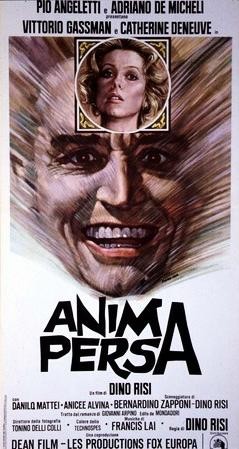
Tuesday's Overlooked Film: Anima Persa

The Finnish Film Archive showed last night a very interesting Italian film that's not very well known: Dino Risi's Anima Persa (1977) that seems like it's not been shown in the English-speaking countries (there's a title for it in the IMDB, but with the caption "undefined", whatever that means). The film falls somewhere between an artsy film and a giallo film with some shock moments, but it's no Mario Bava or Dario Argento. It's no Fellini, either. Dino Risi was a skillful comedy director from the late fourties on and this shows with many funny and humorous moments, even though the pervasive feel in the film is the feel of the thread, the fear and the absurd. The dirty town of Venice is one of the main players in the movie, as is the decayed Renaissance palace these people live in. Vittorio Gassman, the former leading man of the Italian romantic comedies, is simply marvellous as the engineer who keeps his wife - the beautiful Catherine Deneuve - in tight leash. Highly recommended.

Two other films seen recently, from the small screen:

Antoine Fuqua: Training Day: a very interesting, but at times highly implausible take on what cops do when no one sees them. Seems to be the peak of Fuqua's career, though.

Ron Shelton: Dark Blue: an interesting take on the same theme, with a historic view, as can be expected from James Ellroy whose screen story this is based on. (Did Ellroy write a non-fiction piece on Rodney King or was he planning a novel on the subject? Then he must've sold the treatment to the producers.) Suffers greatly from Shelton's slack direction and Terence Blanchard's cliché-ridden film noir soundtrack with howling saxophones.

More Overlooked Films at Todd Mason's blog here.

Thursday, February 17, 2011

Winterbottom's Killer Inside Me

Michael Winterbottom's controversial rendering of Jim Thompson's famous paperback original, The Killer Inside Me, didn't seem to make much impact in Finland. Maybe we're so used to looking at helpless women getting beaten and kicked to death we don't care. Many commentators here said the film is lame.

I watched the film recently on DVD and have to wonder: lame? what the fuck? I didn't see anything lame about this - it was a very powerful and unsettling experience, even though I'm pretty accustomed to read about rapes and beatings.

Winterbottom's film is very close to Thompson, but stays away from going into killer Lou Ford's head. He's seen from the outside, his own comments in the voice-over narration don't do much to deepen what we already see. I think this might be what makes the film lame to others. They want to see some crazy stuff happening, the guy going really insane and saying "boo!" and thinking perverse thoughts all the time. This stuff doesn't happen here - it would be just too easy and public-pleasing - and I really think this is the best way to film Jim Thompson.

I realized watching this that's it's been almost 20 years, since I read Thompson's novel. About time to revisit it, especially when the film made some things clearer that I hadn't understood the first time around. But I do remember that I wrote a review of the then new Finnish translation and compared it to Ellis's American Psycho and Donna Tartt's The Secret History, under the headline "The American Nihilism", and came to the conclusion that Thompson outwins both Ellis and Tartt in the harshness of his vision.

Friday, February 11, 2011

Friday's Forgotten Book: Max Brand: Jim Silver, hjälten från Arizona

Don't have time to do a proper Forgotten Book entry, so a photo of a Max Brand translated in Finland, but published in Swedish will have to do.

The book was published by Schildts (still in business, after all these years, but doing mainly books in Finnish) in 1949. It was a part of their Pocket-serie series that had 23 books in it. It was one of the first real paperback series published in Finland. They had also one other Jim Silver book in the line. I don't know who the cover illustrator is, but the art is pretty nice.

The title of the book means "Jim Silver, the hero from Arizona" and the book belongs to the Silvertip series. I have no way of knowing if the Swedish translation is abridged or done from a condensed version of the original magazine version, as I don't really read Swedish. Actually I'm going to throw the book away (if no one comes to rescue), since, well, we are moving and something needs to be thrown away. I already started from a book club edition of a Tess Gerritsen novel.

More Forgotten Books here, at George Kelley's blog!

Thursday, February 10, 2011

My working bibliography: Nummeliniana

I celebrated my 10-year career as a writer two weeks ago.* Beside the big party I threw, I also published a small leaflet containing my working bibliography. (Working in the sense not complete, something that others can build upon.) The book is called Nummeliniana. I collected all my published books, all my self-published novels and leaflets and all the stuff I've published in my own fictionmags, such as Isku and Seikkailukertomuksia**. I dug out some pretty obscure stuff, which I'd completely forgotten myself. I also included all the small leaflets and booklets I've done through my own publishing outfit called Abraxas. Many of these are without the ISBN code, which makes them rather unvisible to other bibliographers. There are items that have had a print run of 10 or 20 or even 5. Even if someone would start collecting my stuff, he/she wouldn't find some of the Abraxas books/leaflets very easily (especially as I suspect some of the stuff I've given away have been thrown away).

There's a bit of self-irony in this, but I'm not sure if it's readily visible. I'm being pompous here on purpose. If there's someone out there interested in obtaining this, let me know. I'm selling these for two euros each.

* With "writer" I mean author, the writer of published books. As a freelance writer and a contributor to various magazines I've been almost 25 years.
** Isku = Punch; Seikkailukertomuksia = Adventure Stories.

Wednesday, February 09, 2011

Roger Smith's Mixed Blood

I stayed up late last night finishing Roger Smith's South African thriller Mixed Blood. Only thing I can say is "vow!" What a mix of relentless, suddenly outbursting violence, harsh language and terse narration, high-octane suspense and heart-throbbing sentiment, with the added of bonus of a Dickensian cast of obscene and absurd characters! Highly, highly recommended. Not a wasted scene in sight - and what a noir ending! Will be interesting to see if they can use the scene in the forth-coming film (starring Samuel Jackson - well, actually his character is a minor one in Smith's book).

Can't recommend this highly enough and I immediately started working towards getting the book translated in Finnish. (I'm sure there's a big publisher who's already started bidding on the book. Which would be nice.)

Tuesday, February 08, 2011

Tuesday's Overlooked Film: A Force of One

The idea of me commenting on a Chuck Norris film is something mind-boggling, but when I found a vintage Norris film A Force of One on VHS for 10 cents, I just couldn't resist buying it. But the fact remains: every time I've tried to watch a Norris film, I've found them to be boring as hell. But I noticed this was scripted by Ernest Tidyman, who wrote the original novel and the script for Shaft. Well, that may not be a recommendation to all - it's not necessarily to me, since I've never much cared for Shaft. (And the other films scripted by Tidyman - The French Connection and High Plains Drifter - have always been a bit overrated to me.)

Okay, beginning to sound like I shouldn't be writing this entry, but A Force of One actually is a somewhat interesting film, with themes of betrayal and parenthood (Norris is a father to a black kid!). It's more interesting during the first thirty minutes, when it resembles a realistic cop film, with the drug stake-outs, tough cop dialogue, relationships between cops and such, but then it gets only weird and pretty stupid, when the cops are being taught karate - to fight the bad guy, who kills cops with kung fu (or some such). I lost interest and started to leaf through some old magazines I'd gotten hold of and the film rolled on. I don't actually know what happened in the end. Someone died and Chuck Norris had a love affair with another cop.

I started to watch another old VHS cassette, Mel Brooks's 12 Chairs. I'm not sure if even that's an overlooked film being largely unfunny. (But probably the only US film made from a Soviet novel. Any other contenders? The original Twelve Chairs was written by Ilya Ilf and Yevgeni Petrov.)

More overlooked films over here.

Friday, February 04, 2011

Friday's Forgotten Books: Operation Sex by Kimberly Kemp and an unknown sleaze book by Gerald Kramer

For just the fun of it, I picked up recently two old sex paperbacks (in Finnish translation) and read them. The first one of them I actually said to my wife was research, since I'm writing a sex novel set in a roadside motel, and the Finnish title of the book I read was Seksimotelli/Sex Motel (the original title is said to be Swap Motel, though). If I could pick up an obscure reference to use, I'd be more than happy!

The other book I read was Operation: Sex by "Kimberly Kemp" (Operaatio seksi in Finnish), who was really Gilbert Fox. He used this pseudonym in other novels as well. I find this information on him at the Lesbian Pulp Fiction Collective site: "Gilbert Fox (b. 1917) was a friend of Harry Shorten, the founder of Midwood Books, and the author of over 100 titles for the line using the pseudonyms Kimberley Kemp and Dallas Mayo for his lesbian novels and Paul Russo for his heterosexual novels." The book was published originally by Midwood in 1962 and features actually quite a nice cover. The prices for the book seem to be quite high! The Finnish translation should go for less than five euros.

Operation: Sex is a fast read. It's a spy novel, in which a beautiful dancer Colleen Mead is asked to act as an undercover agent and take part in a mysterious flight. There's a mystery man in the plane as well, and also a very beautiful woman who starts to flirt with Colleen, but also takes something out of the mystery man's pockets when the plane crashes down in the sea. The women are rescued by a famous playboy cruising around in his orgy-filled yacht. There's a bit of everything in this: some spy action, some lesbian scenes, some mild domination, a near-rape scene in the end... As I said, it's a quick read, but there's really nothing much to think about.

For some reason I found Gerald Kramer's Seksimotelli more interesting. It's bibliographically challenging, since I can't find any publishing info for it. Gerald Kramer, whoever he was, did write porn and sleaze for publishers like Midwood, as this blog proves. I took a look at Abebooks and was able to come up with this short bibliography. Anyone know more about Kramer?

Seksimotelli/Swap Motel is a loosely narrated tale of a young man who owns a small roadside motel. He gets into weird escapades: in the beginning of the book, there's a young couple coming into the hotel, with the man being obnoxious and abrasive while flirting and the girl resisting. The young man peeks into their room and witnesses bad sex after which the couple falls into sleep. As the motel owner has the gift of hypnotism, he goes in and hypnotizes the woman and starts to caress her tits. The young guy is then lured into a strange plot: the husband comes in several days later and says that if he won't come to a party with him to hypnotize more people to have sex, he goes public with the hypnotism stuff. Some even more weird escapades follow. This is a picaresque novel for the free-wheelin' sixties. There's not much sense in it, but it's fun in a sort of depraved way. The motel owner is a heel, but he's a sympathetic heel, who feels sorry for the cruel jokes his victims are inflicted upon. One of the weird details in the book is the code word the guy uses trying to get the girl of his dreams: Kropotkin, the name of the famous Russian anarchist. This goes on to prove that there's more than meets the eye in the American sleaze literature of the sixties.

One detail for my Finnish readers: as an euphemism for "penis/dick/kyrpä/kikkeli" the Finnish translator (the pseudonymous Kaino V.T. Sievänen) uses quite often the humorous and not so exciting word "kikuli".

The Finnish books were published in the sleazy Cocktail paperback series in the early seventies. The publisher came from Turku where I live and they also published the porn magazine with the same name.

Other Forgotten Book entries collected in Todd Mason's blog here.

Thursday, February 03, 2011

Coleman's and Bruen's Tower

Reed Farrel Coleman is one of my favourite new private eye writers - he has a great sense of tragedy, place and noir. I've read less of Ken Bruen's work, but what I've read has been good, especially London Boulevard (that's coming out in Finnish in a few months; see to it that you read this book). So their joint effort, Tower (out in 2009 from Busted Flush Press) was bound to be good - and my God, it is very good! It's both tragically and hilariously violent, very elliptic in style and narration (and actually pretty hard to follow at times) and there's also a nice twist or two in the middle. It's clear both writers had a good time writing this. See Cullen Callagher's review at Pulp Serenade.

Granted, I had some trouble getting into the flow of the narrative and I thought the ending could've been stronger, but I don't mind, since the other stuff is so good. No wonder this has been popular and victorious: it won Macavity for best novel and was nominated thus: Anthony: best original paperback, Spinetingler Magazine Best Novel: Legends, Book of the Year: Foreward Reviews, Crimespree Magazine: Best Novel of 2009.

Tuesday, February 01, 2011

Tuesday's Overlooked Film: Dreams That Money Can Buy

I've had this film on DVD for years on loan from a friend of mine, but I had some time to watch only now. I'd read about the film quite a lot and I'd been interested in it for a long time, but the film proved to be somewhat disappointing.

This is spelled out in the excellent brochure that comes with the British Film Institute DVD: the film is "neither intellectual enough for an art film, nor entertaining enough to be popular". But the story behind the film is more interesting than what we see on screen. Dreams That Money Can Buy was supervised by Hans Richter, German avantgarde filmmaker whose abstract animations are part of the canon of the experimental cinema. The film was made in the US as an indie production and the point was to make an experimental film that could be played in more conventional forums, not only in art galleries and places like that. Richter got other European Surrealists and other artists to go along in the project - the list is breath-taking: Marcel Duchamp, Man Ray, Fernard Léger, Alexander Calder and Max Ernst. This is not only abstract animation, the episodes are made all in different styles and techiques. (I won't provide links to all the artists, I'm sure you know who they are. At least you should!)

The problems are visible almost the minute the film starts: the actors are clumsy, the voice-over narration (used also in dialogue) is clumsy. Not all of the episodes are interesting either. I recognized Max Ernst himself in his own episode, "Desire", that followed the Surrealist dogma of resembling a dream, but his episode left me cold. This was a far cry from any Luis Buñuel film. (Buñuel always did things in a very realist way, shooting at eye-sight and not using weird editing techniques - this keeps even his most Surrealist films very watchable.) Fernand Léger's episode, "The Girl with the Prefabricated Heart", was a love story told with shop-window dummies - must've been a fresh idea at the time, but it's been done so many times since that Léger's film seemed dated. The song to go with it, sung by Libby Holman and Josh White, was quite funny, with its Surrealist lyrics, but all too long.

Man Ray's spoofy and jokey "Ruth, Roses and Revolvers" was about the film media making people act against their own will, but again, not very interesting. Marcel Duchamp's "Discs" was one of weirdest episodes, but also one of the best: it has different discs rotating, facing the viewer, and shots of a nude descending the stairs (Duchamp's best-known Cubist painting). The film also refers to Duchamp's earlier film, Anemic Cinema. The music was by John Cage (more on that later). Alexander Calder, famous for his beautiful mobiles, had two episodes. The first one was just about his mobiles moving around, and it was not even very well photographed. The other episode, "Circus", was done with some of his moving toy-like figures. Charming, but not very interesting as a movie - not enough story.

The film ends with Hans Richter's film noir parody, "Narcissus". A guy notices his face turns blue during a poker game. A nightmare starts, he runs away from other people and other things, everything seems scary. This episode also suffers from stilted acting and voice-over, but it's still one of the most interesting things in the film. David Lynch is said to like the film and it's easy to see that he's taken things especially out of Richter's episode.

As for the music in Dreams, it's done by modernist composers, like Darius Milhaud and Louis Applebaum. Their music has suffered in the hands of time, though: it just doesn't like modern anymore. John Cage is an exception here, his short composition for Duchamp's hypnotic film supports the images and sounds fresh even today. Interesting to note, though, that Paul Bowles, the writer of The Sheltering Sky, wrote the compositions for two films, Ernst's and Calder's.

The BFI disc has also three short films by Hans Richter, from the 1920's. They are interesting, but suffer from the lack of music on the soundtrack. There's a hypnotic quality to these, though. The middle one, Ghosts Before Breakfast (1928), shows the love the Surrealists had for the crime and adventure fiction, and the last one, Everyday (1929), has some contribution from Sergei Eisenstein - there are some shots in the film that might be outtakes from an Eisenstein film.

Here's the link to other contributions to the Tuesday meme.

Here's Duchamp's and Cage's "Discs" from the film:

True Grit: a dime novel

Graphic novel version of the Coens' True Grit. Looks good to me.