Showing posts with label neo-noir. Show all posts

Tuesday, January 15, 2019

Sam Hawken: Missing

I really liked Hawken's earlier novel, Juaréz Dance, in all its minimalism. During the last Christmas holiday, I read his later novel, Missing, which is also set in Texan-Mexican milieu. I have heard that his critical view of Mexico is not necessarily true or honest, but it makes for a gripping read. Missing is about a former Marine, who leads a pretty quiet life in Laredo, Texas. Things get sour, when his half-Mexican daughter and her Mexican friend disappear after a concert. The book starts slowly, develops slowly and builds into a violent, shattering climax that leaves you gasping for air. What's more important is that the book is also believable, with relatable characters.

A lengthier post to follow, on Jason Starr and Jordan Harper - or two posts.

Tuesday, December 11, 2018

Tuesday's Overlooked Film: Time of the Heathen (1962)

Okay, this is not an overlooked film, it's forgotten to the point of being almost non-existent. I saw the movie on 35 mm film in the screening of the Finnish Film Archive, and I bet my money it's one of the very few remaining prints of the film in all the world, since there are no signs of the film having been shown anywhere in decades. Yet it's a very interesting and occasionally a very good movie.

Time of the Heathen (Ruoho nousee jälleen in Finnish, meaning "Grass Will Rise Again") is the sole film directed by Peter Kass. The film had its premiere in 1962. Kass wasn't a nobody: he was already a director in Broadway, and later on he became known as a trainer of actors. But his film is a total obscurity. To this day, I would know nothing about the film unless it were for the Finnish film critic Tapani Maskula who has mentioned the film to me from time to time. He said he was the only critic in Finland in the mid-sixties who wrote a review of the film.

The film was shown for some 40 people on Monday night here in Turku, where I live, and the film proved to be very exciting and intriguing. It's a very short film, some 75 minutes long, shot probably on 16 mm and widened to 35 mm for distribution. It's black and white, same sort of high-contrast and stark material that Night of the Living Dead and other indie films of the sixties were shot on. (Didn't Romero also shoot on 16 mm?) Time of the Heathen was probably a university project, since the music, composed by Lejaren Hiller, was performed by the Illinois University students' orchestra. Most of the actors are amateur and they don't have any other films to their credit, except for John Heffernan who's in the lead, and Ethel Ayler who has a small but significant role as a African-American servant. Then again she didn't perform in cinema again for ten years (then she was seen in Come Back Charleston Blue).

Heffernan plays a lone man called Gaunt, who's walking somewhere on the countryside, looking and acting strange and citing the Bible, when the sheriff stops him (hence the title, from the Book of Hezekiel). Gaunt comes across an African-American boy, and together they witness a rape attempt by a young white man that leads to the death of the servant. The racist and violent father of the rapist is going to accuse Gaunt of killing the woman, but Gaunt and the young boy flee to the woods.

The story is very simple, but there are enough twists to keep this interesting for the first 30 or 40 minutes. Then the story takes a turn and becomes even more simpler, reducing the story to a minimalist level, and then comes a flashback scene that's almost a complete experimental movie inside the film! It's in colour and at times very striking. It reveals Gaunt's traumatic past during the World War II (won't give it away, though) and broadens the film's thematic scope to greater levels. This is no mere man-on-the-run story.

The experimental scene was done by Ed Emshwiller, who also produced, shot and edited the movie. Emshwiller or Emsh is better known as a science fiction illustrator, but he also did lots of experimental shorts and other films (and a friend of mine recognized artist George Dumpson in a small role - Emshwiller has made a documentary on Sampson's art!). The experimental colour scene comes accompanied by computer-generated (or electronic, it as yet unclear*) music composed and performed by Lejaren Hiller, who's probably best known for his collaboration with John Cage. This is quite an early film to use electronic music. The scene works very well inside the film, because it's made clearly for Time of the Heathen and not as a separate piece of art that's just attached to the film.

Hope this is enough to convince you Time of the Heathen is an interesting film. It has neo-noir touches here and there, and as my friend pointed out, it's actually one long chase scene, so there's also action if you're into that sort of thing. There are some clumsy scenes from time to time, and I thought the script had some inconsistencies, but I'm willing to forget them. Amateur actors perform quite well, which is no miracle, given that Kass was a director on Broadway. The harsh country milieu (the film was probably shot in Illinois, though I'm not sure - it was said in the ending credits, but I forgot already) adds very refreshing scenery to the film, and this almost feels like a precursor to movies like Winter's Bone. Tapani Maskula who hadn't seen the film over 50 years was there in the screening, and he said after the film that it could be shot even today. The themes are still there: war, racism, hatred.

The problem is only that you can't see this film. It has never been released on VHS, DVD or Blu-Ray. It was shown on Finnish TV in 1968, but I don't know of any other screenings. If you know a film or video print exists, keep noise about it. Demand it be shown and eventually digitized. Ask John Heffernan (who's still alive and active) to be guest at your film festival. (Sadly, Peter Kass and Emsh are dead. The film was mentioned in Kass's obituaries, but it was clear not one of the writers had seen it.) Here's hoping this blog post starts the Time of the Heathen renaissance!

* There's indeed unclarity as to what kind of music was used in the film. I think the opening credits say Hiller did "computer-generated music" (or sounds) for this, but when another friend of mine got interested in this and wrote the University of Illinois about it, he received this answer:

"Hiller, like many early Electronic Music composers, was rather practical. He used sounds in compositions that were originally written for inclusion in other pieces. He composed a tape loop of percussive concrete sounds for the film, "Time of the Heathen." These sounds were never used in the film, though Hiller did include them as an optional third cue in the suite from "Time of the Heathen." (...) First, I believe the music created for the film "Time of the Heathen" was created by Hiller in 1961 within the Experimental Music Studio at Stiven House, and was realized with electronic sounds (from analog waveform generators) and possibly some musique concrète sources (of which Hiller was fond of using), not computer generated."

Tuesday, July 04, 2017

Tuesday's Overlooked Film: Small Crimes

Evan Katz's Small Crimes (2017) is an excellent neo-noir film after Dave Zeltserman's novel of the same name. Nicolaj Coster-Waldau plays Joe Denton, an ex-cop who's been six years in jail for maiming the D.A. with a knife. In the beginning of the film, we see him get out and try to redeem his bad deeds and getting in touch with his two daughters. We see him getting mixed up with his old colleagues in crime, both cops and criminals, we see him being asked to do some favours, we see him getting trapped. There's no escaping the past. Whatever Joe does, it only tightens the rope around his neck. Near the end, it seems he's getting out - but that impression doesn't last for long. This is noir at its noirest, and there are no mystic serial killers or any of that Nordic Noir shit around. What I especially liked about the film is that there's no back story, you have to be alert to see what's been happening.

Small Crimes is available in Netflix.

Had the crime paperback series I was editing for a Finnish publisher six or seven years ago, I would've definitely included Zeltserman's novel in the series. I would've also picked up Zeltserman's Killer, which is even better, if you ask me. Both books come highly recommended.

I hope there are more Overlooked Films coming to Todd Mason's blog here.

Tuesday, October 25, 2016

Tuesday's Overlooked Film: Dennis Hauck: Too Late (2016)

Dennis Hauck's first feature-length film is Too Late that premiered earlier this year. It's an exceptional film, filmed on 35 mm film and shown only on film. I don't know if there will be a DVD or Blu-Ray later on or if the film will be available on streaming sites, but I guess not. (Oh, it's available on iTunes.)

I was lucky to have the opportunity to see the film last week. While Too Late is not a masterpiece, it's an interesting film in its own right, while it's also an interesting experiment, as it consists only of five shots, each 20 minute long. (The length of a film reel.) This is not done actually very consistently, as there are some scenes with split screens, and there are some edits in the end, but all in all Too Late is a marvelous technical experiment.

Too Late is also a crime film, a neo-noir, if you will. John Hawkes is very good playing a private detective getting caught up in his own past, and there are some other known actors in small roles, like Robert Forster, Jeff Fahey (whom I didn't recognize), Joanna Cassidy and some others. The story is about a stripper working at a seedy club and getting to know some intimate secrets of the owner - or is it...? It's a bit like David Lynch and also a bit like Quentin Tarantino and his Pulp Fiction and Reservoir Dogs: the story moves back and forth in time and you have to be careful to really understand what's going on.

The major problem with the film is that it's too talkative. The 20-minute shots get caught up in people talking, and nothing much happens on screen. There's also the familiar problem with many experimental movies: you don't really invest much interest in these people. It's more a like game, though the surprise twist in end feels more touching than anything else in the film.

Still, Too Late is a very worthwhile film and if you have the opportunity, check it out.

More Overlooked Films at Todd Mason's blog. (I hope there will be more Films.)

Wednesday, September 09, 2015

Jason Starr: Twisted City

Jason Starr has long been one of my favourite writers, and I can't help but fall in love with his plots. I picked up his Twisted City that I hadn't previously read and showed the back cover copy to my wife, grinning widely and saying: "This sure sounds like my kind of book!" It says: "Times are tough for David Miller, a journalist for a second-rate financial magazine who hates his boss, is tired of supporting his girlfriend's partying lifestyle and recently lost his sister to cancer. But things are about to get much worse."

David loses his wallet in a bar after a failed attempt at picking up a woman, and some days later a woman calls him and says she's got his wallet. David goes to a seedy neighborhood and meets Sue, who seems to be a junkie. She's asking lots of money for David's wallet. David goes to a bank to raise money and when he gets back, he's attacked by Sue's maniacally jealous boyfriend. After that, things really go wrong. It's a hell of a ride for David, and while everything's pretty dark and hopeless for our hero, you can't but laugh at his tribulations. Everything goes worse no matter what David does, even though there's one chance he could make things right, but he blows it too. The end is really, really nasty.

Jason Starr writes and plots with ease, and he's deceptive. Every time you think you miss a hole in the plot, it gets explained. The book moves with a breakneck pace and there's no empty page. This is a brilliant noir novel, once again. It's a damn shame my efforts to get Starr translated in Finnish have proven futile, but I'm still trying.

I read the 2005 printing from No Exit with a pretty bland cover, but their new covers for Starr's backlist are so stupendous (see above) I'm almost thinking I'd buy the whole set.

Friday, June 26, 2015

Ten best noir novels of the 21st century

Eric Beetner has a pretty good list. I've read five (Starr, Phillips, Zeltserman, Rector, Max Phillips), and also two of the ones bubbling under (Megan Abbott and James Sallis).

Tuesday, May 12, 2015

Tuesday's Overlooked Movie: a few Finnish neo-noirs

Some weeks ago The Festival of Finnish Cinema showed some Finnish films that can be labeled as neo-noir. This was continuation from the last year's theme of Finnish film noir. Last year only films from the studio era were shown, now the films were mainly from the eighties and nineties, with one film from 1978 and one from 2011.

Kaurismäki: Crime and Punishment
The first one shown was Aki Kaurismäki's debut feature based on Dostoyevsky's Crime and Punishment. The film was made in 1983 and already shows the sureness of Kaurismäki. His style has changed somewhat after this, but it's still clearly his film. The spare narration, tight frames and the matter-of-factness of the dialogue are pure Kaurismäki. The film, taking place in Helsinki in the 1980s, is a bit like B-movie shot in only a few days, but it still packs quite a punch and remains one of Kaurismäki's best up to this day. Kaurismäki has some other films that could be labeled as neo-noir, such as Ariel, Hamlet Goes Business (even though it's pure comedy from the start) and I Hired a Contract Killer, in which a quiet man (Jean-Pierre Leaud) asks a hired killer to finish him off. There's also the TV movie Dirty Hands made from Sartre's play, which might also qualify, but I haven't seen it. 

Pauli Pentti produced and co-scripted and worked as assistant director in many of Kaurismäki's films, and he directed two neo-noirs in the eighties. Both were shown at the festival. Pimeys odottaa (Darkness Awaits, 1985) is perhaps the most quintessential Finnish neo-noir, strange drama of a young man who gets caught up in scheming and betrayal. The story unfolds a bit uneasily, but there's still lots of interest in the urbane film. Macbeth, made almost hand in hand with Kaurismäki Hamlet Goes Business in 1987, takes Shakespeare's nasty little tale into the late eighties' Helsinki. Macbeth in the film is the leader of the gang of criminals who rob empty houses and gas stations at the sea-side. The film is nicely photographed, but it's unfortunately marred by unclear narration of events. If you don't know the story beforehand, it's possible you don't really understand what goes on in Pentti's Macbeth

Pekka Hyytiäinen was an indie director, who made only three feature-length films two of which were shown at the festival. His first, Kirje (The Letter, 1978), was his most successful, as it was seen by 600 people when it opened! There are interesting elements in this psychological thriller, but the film is so slow there's actually no tension at all. Only glimpses of what was to come are seen on screen. Hyytiäinen's next, strangely titled 50-minute i + i (1981), is much more interesting. It's almost a collage of experiences in the life of a young man who's morbidly interested in suicide and dying. There's no coherent story line and it's difficult to tell what's going on in the film, as some of the film stock was almost destroyed by the laboratory, but the scenes were used nevertheless. i + i was seen by some 400 people in the premiere week after which it vanished almost completely. 

Hyytiäinen's best film, MP - minä pelkään (I Am Scared, 1983) was shown afterwards in the Finnish Film Archive's series, and it's ten or even hundred times more powerful than i + i. It's a dystopian horror tale set in a near future. There's possibly a war going on somewhere of which there are some really strange news on TV. A small family is trying to have a vacation at their summer cabin, and the reality and the dreams and nightmares of the family mingle with each other. MP is a very experimental film with some haunting imagery. It's an uneven piece of work (especially the actors are not up to their tasks), yet unlike any other film made in Finland, still it was seen only by some 300 people in 1983. After it was dug out from the archives some five years ago, it's been seen by more people than during its few weeks in the 1980s.

Tallinnan pimeys (The Darkness in Tallinn, 1993) by Ilkka Järvi-Laturi is more a suspense film than a proper neo-noir, but it was shown nevertheless, as it is not often seen and it's not out on DVD. I didn't watch the film at this time, but I saw when it came out. It's a well done caper movie set in Tallinn just after Estonia declared independence from Russia. Ilkka Järvi-Laturi's debut movie Kotia päin (Homeward, 1989) is also worth a look if you're interested in Finnish neo-noir, as is his History Is Made at Night (1999), but it's also so bad it practically ruined his career and he hasn't directed since. 

All the previous films were over 20 years old, but there was still one neo-noir more from 2011: Martón Jelinko's indie film Pystyssä (Indebted) that wasn't shown in Turku during its premiere week, so this was its proper premiere in this city. Jelinko, a Hungarian-born film-maker working in Finland, was at the screening and told how this movie was made with only 8,000 euros and how it was distributed without any funding from the Finnish Film Foundation (that's almost the only way to get your film properly distributed here). Jelinko also told his biggest influence in making Indebted was Nicholas Winding Refn's Pusher trilogy, which to my mind is a recommendation. Indebted tells the story of two young women, the other working for a crime gang, the other working as a prostitute to pay her bills. It's hard-hitting movie with a recklessly moving camera and some tough violence. The ending is bleak, as befits a neo-noir movie. Indebted is not going to be released on DVD or Blu-Ray, but you can watch it at Indieflix. Comes highly recommended by me. 

There could've been more neo-noirs to be shown in the festival, but there were time and schedule restrictions. Some films, such as Veikko Aaltonen's two or three stylish and hard-hitting crime films, were shown during earlier festivals. I mention some other films in the post on studio-era film noirs; link at the top of this post.

More Overlooked Movies here

Thursday, February 12, 2015

Dan Gilroy: Nightcrawler

I've been saying this a lot lately: Hollywood handles neonoir pretty well these days. Just look at this list: Prisoners, Mud, The Place Beyond the Pines, Killing Them Softly, Out of the Furnace... Also End of Watch and A Walk Among the Tombstones prove my point. Even True Detective (a show I still have to write about) comes from under Ellroy's shadow.

One of these very good neonoirs from Hollywood is Dan Gilroy's Nightcrawler that I finally saw the other night. I liked it a great deal - I knew going in I'd like it a great deal. It's a perfect case of noir: you know from the first minute everything is going terribly wrong, but you just can't turn your eyes away. (But saying this doesn't give away the film's superbly ironic ending.) Jake Gyllenhaal is masterful as a narcissistic sociopath who believes the neo-capitalist bullshit about how one can achieve anything if he just takes everything passionately.

Highly recommended. No easy solutions in this film, nor any genre trappings.

Thursday, January 30, 2014

What did I say about noir in Hollywood in the 2010s?

Remember what I said about new noir films in Hollywood? See my post on Denis Villeneuve's Prisoners here.

I stumbled on a post at Hardboiled Wonderland listing the best crime films of the last year. Seems there are more noir or at least noirish crime films out there than I first realized. I hated The Counselor, but Jedidiah Ayres writes interestingly on other films he mentions. (Of course not all the films are Hollywood, but nevertheless.)

Thursday, January 16, 2014

Denis Villeneuve: Prisoners

I just saw this in a movie theater (a press screening) and I was totally overwhelmed! What a movie!

The story about two missing kids and their families going through a heart-breaking and violent tragedy might play out sentimental and simplistic, but Denis Villeneuve, in his first Hollywood outing, keeps things both fragile and rough at the same time. You can feel the tension in the pictures, in the actors' movements, in the saddening Pennsylvania milieu the film takes place in... Although there are some things that were done less or more slackly, I'll give this five stars out of five.

It must've started out with Winter's Bone. There have been lots of recent interesting and touching films that have crimes in them, but are not crime films per se: Place Beyond the Pines, Paperboy, Mud, Take Shelter, End of Watch... There are also Andrew Dominik's admirable Killing Them Softly and William Friedkin's sick but funny Killer Joe, not to mention Nicolas Winding Refn's Drive and Only God Forgives and Harmony Korine's Spring Breakers.

Noir thrives in Hollywood.

Saturday, August 10, 2013

Negative reviews on e-books?

I've been reading some stuff on my Kindle, mainly stuff I've picked free from Amazon, new gritty and noirish crime fiction from both side of Atlantic. I've liked a lot some of the stuff I've acquired, for instance Juaréz Dance by Sam Hawken and Tony Black's bleak novella The Storm Without (of which I didn't do a blog post). I also liked Lawrence Block's short story "Keller on the Spot" quite a bit.

But I've recently dropped two novels by new noir writers I was reading on Kindle. The other one was sloppily written and edited, and the other one had ridiculous characters and the police work depicted in the book wasn't believable. I was going to post a review of the books, but then I got to thinking I wouldn't be doing much of a service to the writers and their publishers (the other one of the two writers has just a book out from a small publisher working actively in the neo-noir business). Then I got to thinking that as a critic that's just what I should be doing: pointing out what these writers and their publishers are not doing very well and keeping readers out of the bad or mediocre stuff, but then I got to thinking again and then I decided not to post.

What do you think? I'm really an outsider in these circles, since I'm essentially a foreigner to all American, British and Scottish writers mining this area, but then again, someone might benefit from my point of view.

Friday, July 26, 2013

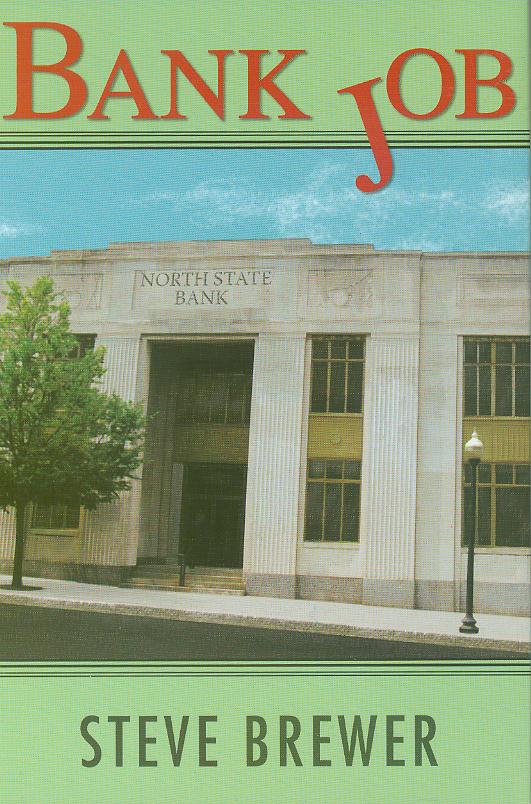
Steve Brewer: Bank Job


I just finished this hardboiled thriller reminiscent of Elmore Leonard's work the other day. It was the first book I read by Steve Brewer, but I liked it well enough to read more of his books later on.

Bank Job (2005) is one of those books that start rapidly, race along with a good speed and develop into a satisfying climax. Three low-life criminals are on a crime spree doing stupid things. One of them gets hit by a whiskey bottle during an attempt to rob a liquor store. The guys end up in a lonely house with an old couple living in it. The old guy of the house has a secret up his sleeve, and much action and mayhem ensue. There's plenty of violence that really hurts, and there are also some sudden twists and turns.

Brewer creates memorable characters with just few touches, a bit of dialogue, descriptions of how people move, act, keep a book in their hands. It's quite nice that the lead character is someone over 60. The young hoodlums are also depicted very nicely, they are fully human though they are quite worthless and almost evil. The plot moves on with a nice pace and slows down only in the last 20 or 30 pages. Comes highly recommended, even with the very stale front cover.

Edit: Oops! I meant to publish this on Saturday, but I accidentally pushed the Publish button and can't take it out anymore. So it's two book posts on the same day, but I don't really think anyone minds. 

Thursday, June 20, 2013

John Connolly: Dark Hollow

Dark Hollow was the first book I've ever read by John Connolly, even though I've known about him for quite some time now. I remember Kevin Wignall being very surprised about the fact that Connolly hasn't been translated in Finnish, he's pretty big in the UK.

Though he's an UK author, his books - at least some of them - are set in the US. Dark Hollow stars his private eye anti-hero Charlie "Bird" Parker, who encounters serial killers in the books. Maybe that's why I haven't been very interested in Connolly's work, as serial killers are pretty much a bore to me. (Especially in a series. How could that possibly happen?)

But Dark Hollow was strong enough to warrant more reading from him. The book was too long, though, especially in the beginning where it took over 50 pages to get the story even started and almost 100 pages to get the backstory out of the way. I don't really care for that kind of thing, even though Connolly clearly thinks Charlie Parker's own traumatic story needs to be told and retold. There was some padding also after the story got going (and I'm not sure whether Connolly got all his sideplots going and whether they were necessary, then again I'm not very good at analysing plots), but the story still kept my interest going. And it was epic, like with Ross Macdonald or James Ellroy, with the hidden crimes being committed decades ago and still reflecting their dark nature into the present day. Some of the scenes are very suspenseful, almost out of a horror novel. Connolly can create a monster that feels human. 

I'll intend to read more John Connolly. 

Wednesday, June 12, 2013

Spring Breakers


Harmony Korine's Spring Breakers is the quintessential neo-noir movie for the 2010's. Why? Because it's a perfect dissection of the society of the spectacle and the futile dreams of the said society we live in. There's no psychological motivation to drive the action, because the psychological motives don't move us anymore. There are only some meaningless ulterior motives, like money, which makes your pussy wet.

And all this is crusted with the abrasive music of Skrillex and the hyper-active editing of YouTube-era party videos.

Tuesday, May 21, 2013

Tuesday's Overlooked Movie: Femme Fatale (2002)

Femme Fatale is one of the latest efforts by Brian De Palma, whose films I've generally liked, with some exceptions. This wasn't one of those exceptions.

Femme Fatale was made in France, possibly because De Palma couldn't raise the money in the USA. There's certain Europeanness in the film, so I'm not sure if it suits the American taste. There's something that reminds me of a Luc Besson or a Jan Kounen in this.

The film is full of technical trickstery and magistery that's characteristic of De Palma: camera drives, odd angles, long shots, shots through different filters, all that. The plot - what I could make of it - was suited to the feverish camera work. Femme fatale of the title is a career criminal, sexy as hell (played by Rebecca Rominj, who looks a bit too much the early 2000's, but I don't mind), who's on the loose from her fellow gangsters. The plot is full of twists one just can't see coming - and the last one is actually pretty absurd, but I think it fits the general mood of the film. There's some thematics on voyeurism that's also characteristic of De Palma, but I'm not sure what De Palma wants to say with the film. People - especially women - are being watched and this watching becomes more mechanistic via surveillance cameras and such, but then what? Women can also take advantage of them being watched, but it's unclear what kind of nature De Palma is saying this vantage point could be. This kind of uncertainty of thematics is also characteristic of De Palma.

More Overlooked Films at Todd Mason's blog here. (For once I managed to do this in time!)

Tuesday, April 09, 2013

Sam Hawken: Juaréz Dance

It's been a long time since I read a book I really wanted to devour. There have been some I've liked, but they haven't been books I didn't want to leave alone. I didn't want to leave Sam Hawken's Juaréz Dance alone. I wanted to get back to it as soon as I possibly could. And for some reason or another, it was possible this last weekend.

The protagonist of Juaréz Dance is an American hired assassin working for a Mexican drug lord. The guy, named Cooper, is a very skilled in what he does, but everything seems to go a bit wrong when the drug lord asks Cooper to bodyguard him. Cooper's still effective, but there's something nagging him all the time.

Hawken writes mean, minimalist, behaviorist prose that doesn't much give away what the people - mainly it's about Cooper all the time - think or feel. I really love this kind of writing. There are wonderful passages of time just passing, of a boredom that comes from waiting by a pool in an empty backyard of a luxurious villa. I could see this being directed by Jim Jarmusch, and I kept comparing it to one of the best books I've read, Kevin Wignall's Who Is Conrad Hirst? 

The last pages of the book are not as good as the previous 240 ones (this is something Hawken says bothered his agent, so the book wound up being self-published), but I'm not really complaining. If I were still picking up books to be translated in Finnish, I'd pick this up.

Purchase the book here. I mean, seriously, do it. This guy means business. (Sorry, the book seems to be available only as an e-book. I didn't mind.)

Hawken has also two other novels, Tequila Sunset and Dead Women of Juaréz. I mean to read them as well.

Tuesday, January 08, 2013

Tuesday's Overlooked Movies: Tough Guys Don't Dance

I just watched Tough Guys Don't Dance from a VHS cassette I found free in a thrift store. I'd seen it when it was new and I remember even writing a review of sorts about it, but I really don't recall anything I said. I have a vague feeling I liked the film, but other than some reflections on scenes here and there I didn't remember anything about it. I'm not even sure if I've read Mailer's novel, but again I have a nagging feeling in the back of my head saying I read it at the time.

If I liked the film the first time, I certainly liked it less this time. The film drags heavily at points and is too dialogue-ridden and some of the actors are pretty bad. The film is not very focused and gets confusing at times. There are some very bad moments (the famous "Oh man! Oh God!" scene, for example). This all said, there's something in Tough Guys Don't Dance that makes me want to proclaim it one of the precursors of the modern neo-noir films. The same delirious feeling permeating Mailer's film is also found in films like Romeo Is Bleeding (the Peter Medak one, not the later one) or Coens' The Big Lebowski. Scenes are disjointed, the characters are campily overacting, everyone is using cocaine and talking nonsense, womens' heads are cut off mercilessly, everyone's overusing sex to get to their goals. Maybe Mailer was truly ahead of his time?

One thing I remember thinking about Mailer's film is that it reminded me of David Lynch's Blue Velvet (very important early neo-noir film, that). There's a secret in the woods and there's also Isabella Rossellini (Lynch uses her much better, there's not much to do for her in Mailer's film). There's also Angelo Badalamenti's score, but that's about it. I sure didn't get the same feeling watching the movie now.

Mailer's film has one asset not enough films have: Lawrence Tierney. He's simply great in this and he has great lines ("I just deep-sixed two heads"), though he's pretty thin thematically - but that's Norman Mailer's fault. 

More Overlooked Movies at Todd Mason's blog.

Tuesday, December 04, 2012

Tuesday's Overlooked Movie: The Way of the Gun

Christopher McQuarrie wrote the much-admired The Usual Suspects and much was expected from him after that, but it seems to have taken five years before he got to make another film - for some reason or another, he hasn't made another film with Bryan Singer, who, as we well know, has gone on to make successful films (though they haven't interested me as much as The Usual Suspects). 

McQuarrie wrote and directed The Way of the Gun in 2000 and it seems to have vanished somewhat. There's much to blame in the film itself: the lead characters are not sympathetic (or even interesting) in the least, not even in the you-hate-them-but-can't-turn-your-eyes-away way, and the plot seems forced and pretty difficult to follow at times. The film also begins with a scene that has nothing to do with the rest of the film. 

But at the core The Way of the Gun is actually a pretty good neo-noir film about two almost sociopathic criminals who try to make it big kidnapping a surrogate woman pregnant to a shady millionaire and his cold wife. There's not a good human in the film as everyone is only trying to make things profitable for themselves. In the end, though, some of the characters try to make better, but it proves to be futile. The theme of honour comes to the fore, but in the film there's no sense trying to be honourable. 

The climax with its long shoot-out at a Mexican bordello is reminiscent of Peckinpah and The Wild Bunch. The thematics of the film remind one of Peckinpah, but there's something lacking. Maybe by 2000, one just couldn't handle the thematics of honour and betrayal with confidence. And confidence is something that McQuarrie's direction is lacking, though there are some good moments throughout the film. One thing has to be said in the film's favour: James Caan is simply wonderful as an older heavy. 

More Overlooked Movies at Todd Mason's blog

Thursday, November 22, 2012

Megan Abbott: The End of Everything, pt. 2

The End of Everything is a very beautiful book, hauntingly written - it was actually pretty hard to get into the rhythm of Megan Abbott's writing, its clipped sentences, repetitions and allusions. I found the book demanded some quiet around it, you couldn't read it in passing, just a few pages at a time, you had to concentrate.

As Megan has herself pointed out, there's a strong link to Twin Peaks in The End of Everything. There's the friendship of two young girls in a small town, and suddenly another one disappears, for apparently no reason.

This is a quiet crime novel, almost not a crime novel at all (the Picador edition I read seems to make that quite clear what with the cover). There's only one person killed in the course of the book (I'm not sure if this is a spoiler or not). Up to the middle, the reader hasn't a clue of what's been going on. The secrets stay hidden until the very last pages - and linger on even after the book is over. The sexual tension in the book is almost overwhelming, but there's no actual erotic content in the book. You can't make a mistake this is a book written by a feminist, but Abbott doesn't shy away from showing how awful women and girls can be.

Strongly recommended. I'll be interviewing Megan shortly (after I've read Dare Me, that is) for a Finnish magazine, I'll post the results here as well.

Monday, November 19, 2012

Modern Noir

Great Pinterest board by Brian Lindenmuth on Modern Noir. Lots of great books and lots of books I haven't read (some I haven't even heard of). Some I managed to get translated in Finnish.