Sunday, April 30, 2006

Fanny face?


From the latest issue of Pirkka (the magazine for customers of the large department store chain).

Away From the Anguish


Back to The Return of the Greater Dada Issue of Blinkity Blank. This is totally untranslatable, but the first line goes: "Away from the anguish".

Click it to see a bigger image.

Thursday, April 27, 2006

The Smut Peddler: the movie


I had a chance to see the only known copy of Warner Rose's The Smut Peddler (USA 1965) that tells about a making of a sex magazine in the mid-sixties. It's an awful film, there's nothing to be sad about the fact that all the copies of the film are believed to be destroyed. (The trailer exists and it's much better than the actual film, since it's 1:25 h shorter.) The copy is in the dens of the Finnish Film Archive and it's in a pretty good shape.

It seems that someone has gotten hold of two approximately 20 minutes of footage that shows nudie pictures being taken in Vienna and Paris. These have nothing of interest, except that some of the girls are quite good-looking. These are linked together via a story of a journalist interviewing of two former staff writers of "Dream Girl", the famous nudie magazine that was run by a man called D.G. Rawlins ("goes for DeGenerate", someone says in the film).

Dream Girl was famous for its outrageous photos. For example, there's a scene in which a girl attacks another, strangles her, tries to shove her head into a hot oven and pulls her teeth out. There's an odd discrepancy between these scenes and the footage about nudie pictures which are very cute. Behind all this there was a sadist lesbian editor, who insisted torture being shown in Dream Girl.

She also liked to "enjoy" the girls after D.G. Rawlins had taken them. (This particular scene is accompanied by a stupid march song, as if there was something funny about a girl being raped.)The sets are poor, the actors are poor, to say the least, and there's nothing of a decent plot here. There's some mild satire, but all in all a pretty sad film. The magazine's office consisted of a desk and a phone.

The other commentator (not the Finnish one, who must've seen the same copy) here is wrong, because there's simply no "slightly frightening, heavily-made up man who calls himself The Smut Peddler" in the film. He appears only in the trailer.

The script writer of the film was, if I remember the credits correctly, Herbert Coleman, but he must be some other fellow than the Coleman who worked as an assistant director and producer in some of Hitchcock's films.

Edit: see also the sequel post to this. 

Wednesday, April 26, 2006

Stuff

Finished the damn book. What's the big deal, huh? The guy can't write, he can't plot, he can't even surprise me. Not that I would've cared.

***

Today I had to write about postmodernism and postmodernist films for teens. I didn't go very deep into the thematics of postmodern.

***

Päivän paras uutinen: Ari Valjakka lähtee Turun Sanomista. Olen kuullut huhuja, että hän olisi halunnut lähteä jo kauan sitten, mutta kukaan ei ole halunnut hänen paikalleen. Ilmeisesti lehden omistajista ei oikein pidetä. Toivottavasti uusi päätoimittaja pistää vähän vipinää lehteen.

Tuesday, April 25, 2006

Three Versions of Judas


I mentioned in a comment on my friend pHinn's blog that Jorge Luis Borges has a story that precedes the current enthusiasm about Judas's gospel. I had finally some time to look this up. The story "Three Versions of Judas" has no Finnish translation (at least none I know of), but it's easily available in the English translation of Ficciones, one of Borges's most famous collections of short stories and essays.

As is often the case with Borges, it's not entirely clear whether the Judas story is real or whether he made it all up. Nevertheless, Borges's "hero" is one Nils Runeberg who wrote in 1904 a thing called Kristus och Judas. His masterpiece, according to Borges, is Den hemlige Fralsaren (in the Grove edition I have it's written as "Dem", which is most certainly wrong; I don't know if the mistake was already in Borges's original). Runeberg was refuted by all the confessions, says Borges, when he said that Judas "intuited the secret divinity and the terrible purpose of Jesus". "Judas", writes Borges, "the disciple of the Word, could lower himself to the role of informer (the worst transgression dishonor abides), and welcome the fire which can not be extinguished." Runeberg derives his ideas from Thomas De Quincey (who did exist) who said in 1857 that "Judas had betrayed Jesus Christ in order to force him to declare his divinity and thus set off a vast rebellion against the yoke of Rome". It was Runeberg's task to give De Quincey's idea the "metaphysical vindication".

Borges muses by having Runeberg think that the act of treachery was not necessary, since everyone knew Jesus who performed miracles before thousands and preached daily in public (I've often wondered about this: you'd think the Romans did know what Jesus looked like). Thus the treachery of Judas was "a predestined deed which has its mysterious place in the economy of the Redemption". Runeberg/Borges continues that it's really Judas Iscariot who was sacrificed, not Jesus Christ.

Borges continues his fancy in quite length and I won't go into that. Let me just say that this is a very delightful and thoughtful piece and it's a small wonder no one has pointed it out. (And I must thank Robert Elkin on the Rara-Avis e-mail group for mentioning this. I'd read the story or a description of it somewhere, but couldn't remember details.)

PS. Well, it's mentioned at least here and here. Read the story here.

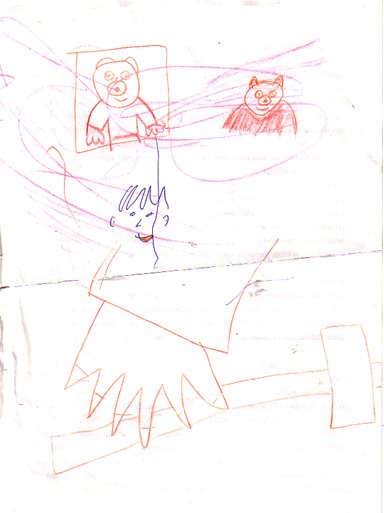
Another drawing


Here's an older picture that I found lying somewhere on the floor. I don't know why I drew an ax. It's Kauto in the middle. Those are his two bear friends. The colouring is again by Kauto. He should apply for a job at Marvel or DC, don't you think?

Family portrait


I wanted to save a drawing I made for Kauto who likes to watch people drawing. (Then he colours the drawings with his skill that's known in a whole world.) This is about my whole family - included are Kauto, Ottilia, Elina and me. We don't have those animals, I'm sorry to say. I think they were drawn afterwards by Elina. The flowers are by me.

Kauto ripped the drawing apart some time later and I had to throw it away. Here you can watch it till the cows come home. (Not a very appropriate phrase to use here...)

Monday, April 24, 2006

Back to work


At the moment I should start writing about the New Wave films - for 12-year olds! Not an easy feat, to describe something like Antonioni's La Notte... or Godard's Week-End.

Sunday, April 23, 2006

Palahniuk bores my ass off

I haven't been reading much of anything for the past couple days. Reason is with Chuck Palahniuk. I promised to write a review of Fight Club, but I loathe the book. The film was irritating, but the book is way too overwritten and overthought for me. The guy wants too much to be this very hard, very cynical, very tough unsentimental writer, but I can name two dozen tougher and more cynical writers who actually can tell a story. I'd like to drop the book, but I'll have to keep my promise.

Friday, April 21, 2006

Work update, pt. 1648

Started again working on Pulpografia Britannica, as I wrote earlier. I just agreed that I'll write articles both on Hank Jason and James Hadley Chase for the Ruumiin Kulttuuri (= Body Culture) magazine that The Finnish Whodunit Society publishes. It's Chase's centennary year. He's a boring writer, but then again I make my living writing about boring authors.

Also started on the movie book for the 12-14 year olds. That's how I figured it when I looked at what I'd written before. It couldn't be for any younger ones. I took some insights on how to write for kids from couple of recentish books - the other one was the Finnish history for 10-14-year olds, with fictional stories and lots of nice illos thrown in, and the other one was a history of art. They were both very good. I should start contacting publishers. (Which is always the hardest part, especially when the publishers won't respond to queries. Frustrating - you know what I mean?)

Just today - Kauto had slept pretty badly and I didn't feel like doing any serious stuff - I opened The Dostoyevsky Reel with Joe Novak, my P.I. hero, and began Finlandisizing it. It felt pretty weird (Joe Novak is now Harri Tanner and I'm not sure yet if he'll be a P.I. from now on), but somehow necessary to get it published somehow. I'll do similar changes to my horror-quasi-religious-cop-conspiracy novel The Blood Orgy of the Void God. Maybe I'll have to change the title on that one. Won't give up Dostoyevsky, though.

I also started a new short story. Just began from scratch and an opening sentence: "Look at the papers again." It will be narrated in imperative in a somewhat Ellroyesque manner. That's all I know at the moment. I've been toying with the idea for quite a while. I don't know if it works, but I want to know.

Thursday, April 20, 2006

Mikael Rosengren päivää

(This is a meme. In Finnish only.)

Tosikolta tulleen meemin antia: Nimeni on Mikael Rosengren, 33. Asun Hämeenlinnassa ja työskentelen toimittajana. Harrastan penkkiurheilua eikä minulla ole lapsia. Hiukseni olen viimeksi värjännyt vihreiksi ja silmäni ovat siniset. Pidän suuresti mahtipontisesta oopperahevistä tyyliin Nightwish ja Evanescence, mutta diggaan myös vanhaa soulia ja funkia - viimeksi kuuntelin Roy Ayersia. Minua kuvaisi parhaiten ehkä sana "maailmanlaajuinen".

Wednesday, April 19, 2006

Hank Janson: The Deadly Horse-race


Finished the Hank Jason/Janson The Deadly Horse-race last night. It was pretty OK to the middle, then it started to drag badly. There was suddenly too much dialogue and everything got too explanatory.

The "best" part was when it was revealed that the Chinese commies blackmailed American junkies to sell heroin cheap to kiddies by denying them their coke unless they sell the quota first! You'd think they'd just use the coke that's for sale instead of trying to sell it for 25 cents per kilo (or whatever the ridiculous price was).

The Finnish publisher used a McGinnis illo with this. I don't know in which book this first appeared. But facing the danger of being called male chauvinist I'll say: Man, what a curve! what a back! The Finnish title "Lootuskukka" means "Lotus Flower" and refers to one of the Chinese characters - a counter spy, very luscious-looking female. The headline says: "National destruction faces the United States!"

Monday, April 17, 2006

The Untouchables


Is this a classic? I really don't know. I saw Brian De Palma's (who seems to be underrated today - perhaps because of his switch to blockbusters?) gangster film in 1987 when it came out and didn't think much of it. I hadn't seen it since and when it was on Finnish TV last night, I watched it (and rather surprisingly Elina watched it with me, even though she doesn't normally care for crime films). I seem to remember that that was the consensus at the time: nice output, but mediocre story.

Now I thought it was a better film, but not without flaws, some of them major. The characters never come alive, especially the sidekicks (why bother having Andy Garcia in the movie when he gets only one scene to himself and nothing much else?) and the women (I didn't even notice Eliot Ness's wife was pregnant until they suddenly had a baby!). The storyline is not memorable and the dialogue isn't really what you'd think David Mamet would've written. Where's the staccato when you need it?!

The biggest problem seems to be that there's not depth in the story. That's a big problem with many of De Palma's films, but here you'd want some insight into the history of Volstead act and prohibition. What's bugging Capone? What's behind the Sean Connery character? What's everything gotta do with immigrants and migration to the US? These should've been touched on, even slightly.

But then again there are some breath-taking moments. I wanted to burst out screaming in the famous baby carriage scene. It's De Palma at his best. The attack at the bridge is also very good. There are other great touches throughout the film - De Palma makes one of the best pans in the whole industry. Ennio Morricone's theme song is brilliant (but in some of the pieces you could hear too well that the drum sound is strictly eighties: very slight, but still mixed on top of everything else). Giorgio Armani's clothes weren't too overtly eighties, though, which is a plus, if you ask me. (And I do know that the eighties are very hot at the moment.)

So, is it a classic? Ask me again in 2025.

PS. Near the end, there's a scene in which Eliot Ness/Kevin Costner drops one of the bad guys from the roof. De Palma cuts to the man falling, then shows Costner shouting something, then cuts again to the bad guy screaming in a close-up and then to him falling to ground. I said to Elina: "That wasn't necessary. I'd've switched to another scene already from the actual pushing."

Hank Janson's Lust for Vengeance

Once we got home, I rushed to open the computer and dug out Hubin's crime fiction bibliography (on CD) and checked who'd written the Hank Janson book Lust for Vengeance of which I write down below. It seems that the writer behind the pseudonym is not known. Maybe the info is found in a later edition of Hubin's bibliography, but I can't check that. Nevertheless, the book is from 1965.

I'm now reading another Janson title, Deadly Horse-Race (1967). That one is by Harry Hobson and it involves Red China's attempt to crash USA by dumping very cheap heroin in the market. The mob and everyone else goes crazy and only Hank Janson can save the day. Lust for Vengeance was a better book.

Note also that the British paperbacker Angus Wells died during the Easter. There's not much translated from him - only two possible westerns as by Charles R. Pike, but since that was a house name, I don't really know if it is him.

Sunday, April 16, 2006

From Al Guthrie to Hank Jason


We are on Easter holiday by Elina's parents' house. The rest of the bunch is out on the drive somewhere and the weather is simply beautiful, but I've been sick enough with flu to stick inside.

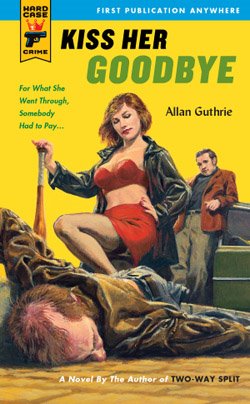
Due to sickness, I've been able to lie down and read. I finished Allan Guthrie's paperback thriller Kiss Her Goodbye from Hard Case Crime two nights ago. It's a great piece, very relentless and full of action, even though I thought that there were four of five pages too much of interrogations. I wanted to move along. But very good nevertheless - very grim to the bitter end.

It was fun to compare the real British (Scottish, actually) hardboiled novel set in the UK with the pseudo-American hardboiled crime novel by a British author: after Guthrie I decided to get back to my "Pulpografia Britannica" project and headed for a Hank Janson title, Lust for Vengeance. They are called Hank Jason in Finland, though - I don't really know why.

I don't know who actually wrote the book in question, but I don't think it's one of the original Hank Janson books that Stephen Frances penned in the fifties. I believe it's by Harry Hobson. He was at least a better writer than James Moffat (who's best known for his Skinhead books as by Richard Allen). The thing moves along pretty quickly and it's an entertaining read, even though the on-going escapade with every woman Hank meets gets pretty tiresome. The climax wasn't much - I don't really know why. Maybe I just wanted to get over with it.

In case you don't know, Hank Janson (I think him as "Jason" all the time) is a Chicago-based crime reporter who acts more like a private eye. There's no hint of realism or social attitudes that elevate the writings of, say, Chandler or Hammett and the pseudo-Americanisms are too obvious, but the books are fun to read. Jason/Janson drinks a bottle of Scotch in no time and doesn't even get drunk and all the women think him cute. He drives a Jaguar and no one sees he's tailing the baddies. In this book, he spends a week in a cage with no drink or food and manages to escape by sheer force. Yeah, right. But there's always a soft spot in me for books full of clichés.

I don't think Hank Janson were ever brought to the US. Maybe they thought no one would think them as real. That's the main point in them, though.

Thursday, April 13, 2006

Nice couple


I was at the university library earlier today and browsed through some old Finnish pulps and a volume of the skin mag, Cocktail, from 1974. I mentioned this earlier, but didn't elaborate. I've been corresponding with a veteran pulpster* who contributed also to Cocktail. I was checking upon his stories and have already made a deal that I can reprint one of his old skin stories (more about this project later on). He wasn't particularly proud of having written this kind of stuff and I promised not to give away his name.

This here thing is a photo from Cocktail. Strange one, indeed: they look like they're in some Just Married photo, and yet they are naked! The old black & white porn is something weird. I don't know why really, but although it's sure far more realisting than today's PhotoShop sex fantasies it strikes me as ugly and grotesque. The fun part of reading old pornography in the university library wore out pretty soon!

One strange thing more: I found a story by a guy called Alf Bester. Now, is this the Alf Bester, the writer of Stars My Destination and The Demolished Man? Can it be? Sure it can, but I haven't seen any evidence of him having written pornography. The story in Cocktail was set in Mallorca, though, and Bester did earn his living writing travel articles...

* Well, not really a pulpster, since he started in the late sixties. He wrote nearly everything for the slicks and men's mags and also some pretty obscure ones, such as the marvellously titled Isojen Poikien Kuvaristikot (= The Crossword Puzzles for Adults). He has also written lots of SF for the Finnish fanzines under an alias and received actually quite a lot of fandom prizes.)

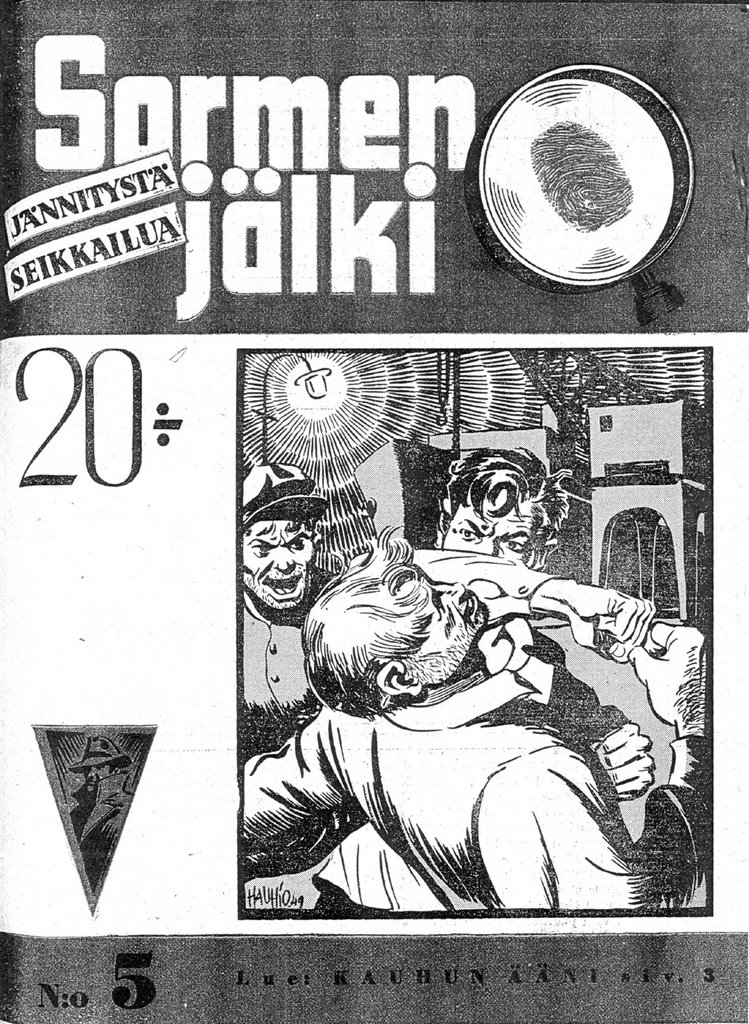
The Finnish pulp magazine, Sormenjälki


Sormenjälki (= Fingerprint) was one of the short-lived Finnish pulp magazines just after the war. It was started in 1949, but lived to see only two years. Here's one of the covers for 1949 - it's by the Finnish pulp stalwart, Ami Hauhio. Great action!

The magazine was at first edited by Selim Tapola, who also wrote adventure and crime yarns under his own name and also as Jori Tervanto. He did some juveniles, too. Later in 1949 the publisher himself wanted to cut expenses and started to edit the mag, which was a pity, since he clearly had no clue and no contacts with the writers. The stories were anonymous from this point on.

Sormenjälki, pt. 2


Getting into financial trouble in the early 1950, Sormenjälki had to reduce size. This experiment in sadistic pulp erotica was in 2/1950. It was only issue, though, that was reduced to an almost digest-size.

Seikkailulehti


The Sormenjälki magazine was transformed into Seikkailulehti (= The Adventure Magazine) in the issue 3/1950. The covers got classier and some colour, but the artist never rose to the ranks of Ami Hauhio. The stories were still anonymous, which is always a kiss of death. The magazine folded in 6/1950.
(Sorry about a b&w scan, I had to take xeroxes at the library. I've never seen this magazine for sale.)

Charles M. Schulz in a Finnish pulp


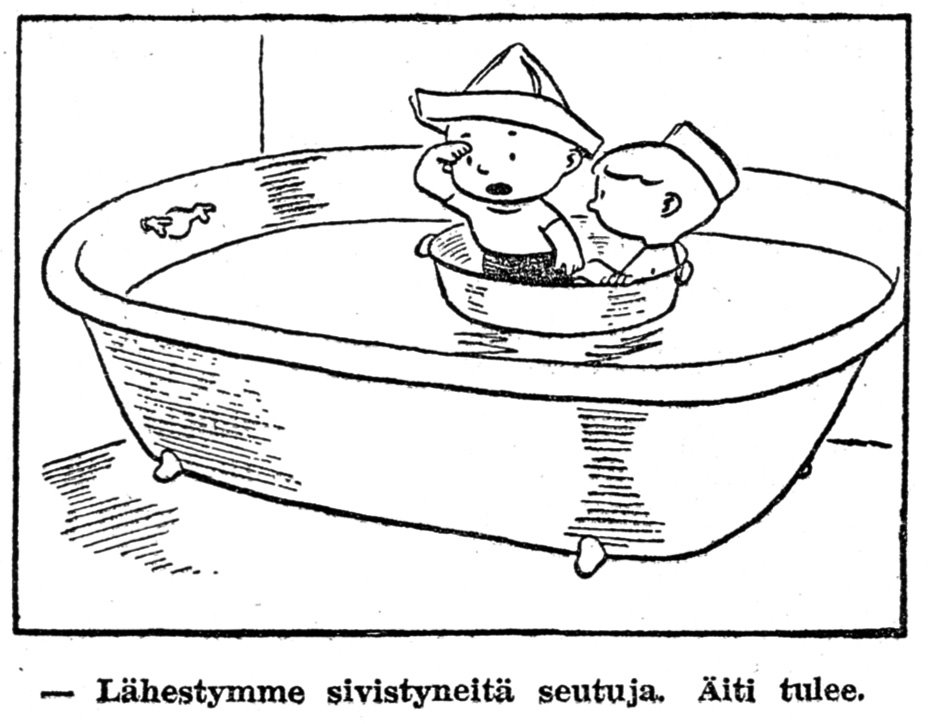
I found this cartoon from one of the Finnish pulps I was looking into today at the university library. I think (and believe I'm 100 % right) that it's by Charles M. Schulz. I believe he drew cartoons for Saturday Evening Post before he developed Peanuts and Charlie Brown.

The boy says: "We are coming near the civilization. Mommy's coming."