Wednesday, September 30, 2015

Swedish paperback covers

I found some Swedish paperbacks and other books in our house's trash bin. Took them out, but decided that I had no use for them, so tossed them back. I scanned the covers, included are some tidbits on the books and writers.
Two crime covers for American paperbacks.
The right one is by the great Bertil Hegland. 

James Morris was, if I recall, the pseudonym of Niels Meyn (in the other photo),
under which he wrote a series of Tarzan copies with Jukan.
I don't know who Jack Morris was.
Alibi-magazinet was a Swedish digest-sized fictionmag,
devoted to crime stories. Each issue had one story.

Niels Meyn was a Danish author, mainly of children's books.
This scifi title means "Around the World in 80 Hours".
See his Wikipedia page here.

Vernon Warren wrote pseudo-American private eye books
in the fifties, his hero was called Brandon. Not quite bad, actually,
I've read one and would possibly read another.

Tuesday, September 29, 2015

Tuesday's Overlooked Film: Black Rainbow (1989)


I watched this unknown gem from a VHS cassette I bought from a thrift store. The quality of the cassette was better than could be expected, no one had probably watched the film before me, which kind of makes me sad.

Black Rainbow tells about a medium (Rosanna Arquette) and her alcoholic father (Jason Robards), who travel somewhere in the forgotten parts of the United States, and put up shows where Arquette takes contact with the dead people, normally the loved ones of the members of the audience. Two things take place: Arquette starts talking with the dead persons who are not yet dead, and someone starts killing them at the same time. The premise is clever and it's pretty well developed, taking the story to directions one wouldn't easily guess. There are some very good scenes between Arquette and Robards, and some of the scenes from the clairvoyance show are silently thrilling, getting close to horror. Tom Hulce plays a reporter, who suddenly starts to believe in Arquette's powers. The main actors are believable.

Black Rainbow was directed by the English Mike Hodges. Hodges has done some very good films, like Get Carter and Croupier. Then he has done some outrageous camp classics, such as Flash Gordon (though it was done intentionally, I'm sure). Black Rainbow is surely one of his better films, a serious look at abuse and exploitation, not only at the clairvoyance shows, but also on a larger scale. It's a pity the film is not better known, as it didn't get a proper release at the time (Hodges seems to be suffering from this even now, since the same thing happened to Croupier). The film has been released on DVD, but some of the editions are no better than a VHS cassette.

More Overlooked Films at Todd Mason's blog here (as soon as he gets the post done, I'm sure).

Friday, September 18, 2015

Friday's Forgotten Book: Martin M. Goldsmith: Detour (1939)

The film made from Martin M. Goldsmith's novel Detour is far from forgotten. Detour by Edgar G. Ulmer from 1945 is actually one of the better-known film noirs of its era, though it's been erroneously labeled as an extra-cheap quickie. It's now known that Ulmer exaggerated his tight budget and claimed the film was shot in a week, although it took longer than that. This is all well explained even in the Wikipedia article for the film. It also states that the film was shown regularly on television throughout the sixties and seventies, which explains why it was picked up by the first American critics of film noir, such as Paul Schrader, when other equally interesting films were neglected.

But the original novel by Martin M. Goldsmith is a different story altogether. The book was published in 1939 by Macaulay (a lending library publisher, if I'm not mistaken) and getting no reprints until the small press did it in 2005. This is astonishing, given the quality of the book. It's a moving tale of two persons living during the depression, trying to make ends meet. The other one, Alexander Roth, is a violinist trying to get to Hollywood to meet his girl friend living in Los Angeles. The girl, Sue Harvey, is a wanna-be actress, who hates her agent and is working in a diner. Alexander hitches his way across the continent, looking like a bum. He's picked up by a strange man, who has lots of cash and smokes joints. The man dies in his sleep and Alexander is left on nothing. He suspects that if he notifies the police, no one would believe he's innocent. He takes the money and the car, but meets a strange girl, named Vera. Vera reveals he also travelled with the dead man and hence know Alexander is not who he says he is. Vera is one of the meanest bitches in written word, and I'm not saying this lightly. The way Goldsmith paints her with words just makes your blood go chilly. The hate and lack of interest in anything (but money) ooze from her.

The first edition from 1939

Alex Roth is an amiable young man, if not something of a bore, and Goldsmith gives him a plausible voice. Sue, on the other hand, is not so amiable. She's a bit of a gold-digger, but also very earnest at that. The novel is written in terse and hardboiled vernacular, and the story races along smoothly largely through point-of-view narration. The depression era with all its worn-out ramblers comes alive in the pages of the book. When the film was made in 1945, the story of Sue Harvey was dropped alongside with references to sex and drugs. The book ends in an open note, in the end of the film the police pick up Al (changed from Alexander). Otherwise the film is pretty faithful.

Detour was republished, as I said, by a small publisher called O'Bryan House. They seem to have done only two books, according to this. Detour has its share of formatting errors, seems like they haven't done enough editing for the scanned text. Nevertheless, this was a very welcome reprint, a forgotten classic that should stay in print.

Here's Bill Pronzini on Goldsmith's two other crime novels, and here's Steve Lewis's review of Detour. And here's (also on Mystery*File) the foreword by Richard Doody for the O'Bryan House reprint.

More Forgotten Books for Friday found at Todd Mason's blog!


Tuesday, September 15, 2015

Megan Abbott on why women love crime

This nice essay by Megan Abbott is related to the wonderful-looking collection The Women Crime Writers, edited by Sarah Weinman, that just came out. And Abbott's essay is worth reading as well.

Sarah Weinman was wondering in one of her Crime Lady e-mails whether there have been substantial female domestic suspense writers outside the US and UK. I got to thinking about this (lazily, I must admit), and I haven't come up with any contenders. Many female Finnish crime writers of the time period of Weinman's book dabbled mostly in puzzle mysteries, but there must be some. Anyone?

Wednesday, September 09, 2015

Jason Starr: Twisted City

Jason Starr has long been one of my favourite writers, and I can't help but fall in love with his plots. I picked up his Twisted City that I hadn't previously read and showed the back cover copy to my wife, grinning widely and saying: "This sure sounds like my kind of book!" It says: "Times are tough for David Miller, a journalist for a second-rate financial magazine who hates his boss, is tired of supporting his girlfriend's partying lifestyle and recently lost his sister to cancer. But things are about to get much worse."

David loses his wallet in a bar after a failed attempt at picking up a woman, and some days later a woman calls him and says she's got his wallet. David goes to a seedy neighborhood and meets Sue, who seems to be a junkie. She's asking lots of money for David's wallet. David goes to a bank to raise money and when he gets back, he's attacked by Sue's maniacally jealous boyfriend. After that, things really go wrong. It's a hell of a ride for David, and while everything's pretty dark and hopeless for our hero, you can't but laugh at his tribulations. Everything goes worse no matter what David does, even though there's one chance he could make things right, but he blows it too. The end is really, really nasty.

Jason Starr writes and plots with ease, and he's deceptive. Every time you think you miss a hole in the plot, it gets explained. The book moves with a breakneck pace and there's no empty page. This is a brilliant noir novel, once again. It's a damn shame my efforts to get Starr translated in Finnish have proven futile, but I'm still trying.

I read the 2005 printing from No Exit with a pretty bland cover, but their new covers for Starr's backlist are so stupendous (see above) I'm almost thinking I'd buy the whole set.

Thursday, September 03, 2015

Cornell Woolrich's "It Had to Be Murder" and Hal Jeffries

I read Cornell Woolrich's short story "It Had to Be Murder" yesterday due to my book project on books (and seemingly short stories also) that were filmed. Woolrich's story (that, by the way, doesn't differ so much from Hitchcock's subsequent film Rear Window as is usually thought) was published in Dime Detective in February, 1942. It features Hal Jeffries (L.B. "Jeff" Jeffries in the film) as the hero, stuck in a wheelchair just like James Stewart in the film. Stewart's Jeffries is a photographer, but Woolrich doesn't give his hero any professional traits, but he knows the police and the lieutenant is his personal friend. The ending climax is a bit different from the film, as Jeffries of the short story doesn't have the photographic equipment Stewart uses in the film to distract Raymond Burr's Thorwald. One notable difference: Jeffries's hired help is an African-American man, not Thelma Ritter of the film.

I just got to thinking Woolrich may have written more stories that feature Hal Jeffries. There's something about the story to make me think he was familiar to the readers of Dime Detective. I can't find any info on this, however. There's no Hal Jeffries in the series index at the Crime, Mystery, & Gangster Fiction Magazine Index, so I'm must surely wrong, but I'd really appreciate if someone could confirm.

Tuesday, August 25, 2015

Tuesday's Overlooked Movie: Split Second (1992)

Split Second is a B- or C-grade action/horror flick that should've been made in the eighties, but it came out only in 1992. For some reason or another, the film came to Finnish cinema theaters and I managed to see it. I remember thinking it was somewhat entertaining, but I also remember everyone else saying it was pure crap.

I picked the VHS up free from a thrift store and wanting to see something light, I decided to watch Split Second. It didn't very well hold up my interest this time, even though I'm ready to admit it was still somewhat entertaining. I found myself Googling bits of info on the film and its director, Tony Maylam, on my phone throughout the film, so I wasn't actually glued to the screen.

The story takes place in a near future, and the climate change has made London flood all over the place. An alien is on a killing spree and leaving mysterious signs behind, and tough loner cop Rutger Hauer is the only one who realizes they are not up against an ordinary man. The signs aren't however satisfactorily explained, maybe they were just a red herring. There's some banter between Hauer and his partner, a nerdy young guy who's just fresh from the academy (some fresh ideas in the film, huh?), but overall it's disappointing. Hauer's cop acts at times like an incompetent moron. I'm not sure I would assign him to any case. The alien, when it finally reveals itself, is quite poorly and badly made. Editing and shooting in darkness help a little, but not much. The monster in this film should've been huge! If I were rating this, I'd give it a ** or even *½.

However, I got to thinking that Split Second might have influenced my writing, at least on a subconscious level. My debut novel (well, my commercially published debut novel), called Jumalten tuho in Finnish (meaning "Twilight of the Gods") is about an alien (not a space alien, though, more like a monster from Christianity's darkest secrets) on a killing spree, ripping its victims wide open. There's also a tough cop almost alone working on a case. Of course there are dozens of films and books written about similar stuff, but maybe I saw Split Second during a sensitive phase (insert smiley here). If I saw it in 1992, that's about the same time I started writing the short story that gradually became my novel.

Tuesday, August 18, 2015

Lionel Shriver's We Need to Talk About Kevin as domestic suspense


Domestic suspense is a sub-genre that I've been long interested in. I've earlier dubbed it female noir, but I've never really been satisfied with that moniker, so "domestic suspense", coined by mystery maven Sarah Weinman, comes really handy. Weinman writes in her website dedicated to her excellent anthology Troubled Daughters, Twisted Wives:

It’s a genre of books published between World War II and the height of the Cold War, written by women primarily about the concerns and fears of women of the day. These novels and stories operate on the ground level, peer into marriages whose hairline fractures will crack wide open, turn ordinary household chores into potential for terror, and transform fears about motherhood into horrifying reality. They deal with class and race, sexism and economic disparity, but they have little need to show off that breadth.
Instead, they turn our most deep-seated worries into narrative gold, delving into the dark side of human behavior that threatens to come out with the dinner dishes, the laundry, or taking care of a child. They are about ordinary, everyday life, and that’s what makes these novels of domestic suspense so frightening. The nerves they hit are really fault lines.

I recently read, due to a book project I've been working, Lionel Shriver's best-selling novel We Need to Talk About Kevin. I saw the film earlier, and I liked both a great deal. They are somewhat different, the film being a condensed version of the slightly too long novel, but very effective nonetheless. I got to thinking that Shriver's novel is a very good example of contemporary domestic suspense: it's about the concerns and fears of women, it operates on the ground level, peers into a marriage whose hairline fractures will crack open, et cetera. You get the drift. The suspense, the horror of the novel comes out with the dinner dishes, the laundry and especially taking care of a child. And this particular child is horrendous.

I won't spoil the book (or the film), there's enough information on it in the web, but even though I'd seen the film earlier, I was very captivated by the novel and its slowly unfolding secrets, to the very end.

Thursday, August 06, 2015

The crime fiction issue of the Human Journal

Seems interesting, at least the lengthy interview with Michael Connelly. There's also an article about John P. Marquand's Mr. Moto series. Check it out here!

By the way, I got this link from one of Sarah Weinman's delightfully informative posts on her The Crime Lady e-mail list. Do subscribe to it here! 

Monday, July 27, 2015

For a Raymond Chandler completist

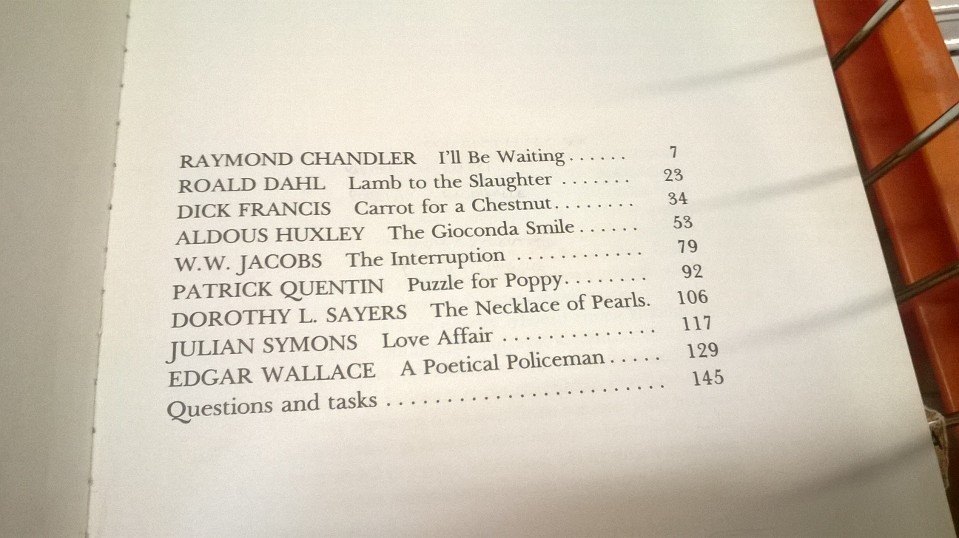
Raymond Chandler just had a birthday couple days back. Here's a book I ran into, looks like a must have for any Chandler completist. It's a Finnish school book for students of English language, published in 1986, with a pulp magazine story by Chandler up front! The texts are in original English, though they may have been slightly edited. There's also the table of contents, it seems like a nice collection of varied crime stories. I don't know who did the cover.

Monday, July 20, 2015

Randy Johnson

Only now I notice this. Naturally I never met Randy Johnson, but his blog and Facebook posts sure felt like he was a nice buy. Certainly he was knowledgeable and supportive. Here's to him!

PS. Sorry for not posting anything on my own for the past months or so. Even during the holidays I find myself swamped with work. 

Friday, June 26, 2015

Ten best noir novels of the 21st century

Eric Beetner has a pretty good list. I've read five (Starr, Phillips, Zeltserman, Rector, Max Phillips), and also two of the ones bubbling under (Megan Abbott and James Sallis).

Tuesday, June 23, 2015

Megan Abbott interviewing Patti Abbott

I really loved this small item: Megan Abbott interviewing her mother, Patricia Abbott, on their family reading habits, her (Megan's) tuition into crime fiction and lots of other matters. I still have Patricia's first novel, Concrete Angel, to read, but I will in the near future.

Monday, June 22, 2015

True Detective's opening credits

I know this is starting today in the US and also in different streaming sites around the world, but I'll be lagging behind, I know. Just watched these credits today and all I can say is "vow!" Leonard Cohen's song is also very nice, atmospheric and gripping.


True Detective Season 2 Main Titles from Patrick Clair on Vimeo.

Sunday, June 14, 2015

Three flash stories by David Terrenoire

Been working my ass off lately, since I was commissioned to a write a non-fiction book in a month. The Spring of 2015 was otherwise a lazy Spring, I got only three books out, one of these being a self-published pamphlety thing. The other two were a reprint of an old erotic old short story by a Finnish writer called Larin-Kyösti and a collection of Reino Helismaa's adventure stories. There's also a recent collection of my stories written as by Jaakko Ensio, with private eye Mikko Jarmo as the hero, but it's only POD and the stories are light-weight fun at best. I have some two books coming still during the Summer, the other being a collection of jokes I edited and the collected works of Mikael X. Messi, my pornographic alter ego. More on this later.

Didn't mean to brag about my work, instead I was going to say a word about this: I just sent a book by David Terrenoire to the printers. It's a small, 16-page collection of his flash stories, called Hyvä naapurusto, after his story "A Family Neighborhood". Two of the stories, "Sacrifice and the ACC" and "The Fire", were earlier published in my crime fiction mag, Isku, but "A Family Neighborhood" hasn't been available in Finnish prior to this. "The Fire" was also published in Kaikki valehtelevat, the collection of the translated short stories that came out in Isku, and "Sacrifice and the ACC" is still coming out in a small book I put together from the stories I ran in Ässä, my flash fiction magazine. (More on that later.)

David Terrenoire is a very good writer whom I'd like to see getting more praise. His only novel Beneath a Panamanian Moon is a nice thriller, but we'd love to see more. He's very good at short lengths also, as these stories prove. Mind you, these stories were first published in the web in now-defunct on-line fiction mags, and I don't think you can find any of them anywhere. I was very happy to send two of the stories to David himself, as he'd lost his files they were contained in. (One of the stories I had only in Finnish translation, which was too bad.)

The cover is by me. I snatched the photograph from an old Finnish arms and ammunition mag I found in the trash bin.

I've got some other weird stuff cooking also. I've got a collection of Finnish aviation stories coming out, with four stories by one Maunu Jorva, about whom I know nothing, except that he wrote four expertly done aviation pulp stories in 1941.

Tuesday, May 12, 2015

Tuesday's Overlooked Movie: a few Finnish neo-noirs

Some weeks ago The Festival of Finnish Cinema showed some Finnish films that can be labeled as neo-noir. This was continuation from the last year's theme of Finnish film noir. Last year only films from the studio era were shown, now the films were mainly from the eighties and nineties, with one film from 1978 and one from 2011.

Kaurismäki: Crime and Punishment
The first one shown was Aki Kaurismäki's debut feature based on Dostoyevsky's Crime and Punishment. The film was made in 1983 and already shows the sureness of Kaurismäki. His style has changed somewhat after this, but it's still clearly his film. The spare narration, tight frames and the matter-of-factness of the dialogue are pure Kaurismäki. The film, taking place in Helsinki in the 1980s, is a bit like B-movie shot in only a few days, but it still packs quite a punch and remains one of Kaurismäki's best up to this day. Kaurismäki has some other films that could be labeled as neo-noir, such as Ariel, Hamlet Goes Business (even though it's pure comedy from the start) and I Hired a Contract Killer, in which a quiet man (Jean-Pierre Leaud) asks a hired killer to finish him off. There's also the TV movie Dirty Hands made from Sartre's play, which might also qualify, but I haven't seen it. 

Pauli Pentti produced and co-scripted and worked as assistant director in many of Kaurismäki's films, and he directed two neo-noirs in the eighties. Both were shown at the festival. Pimeys odottaa (Darkness Awaits, 1985) is perhaps the most quintessential Finnish neo-noir, strange drama of a young man who gets caught up in scheming and betrayal. The story unfolds a bit uneasily, but there's still lots of interest in the urbane film. Macbeth, made almost hand in hand with Kaurismäki Hamlet Goes Business in 1987, takes Shakespeare's nasty little tale into the late eighties' Helsinki. Macbeth in the film is the leader of the gang of criminals who rob empty houses and gas stations at the sea-side. The film is nicely photographed, but it's unfortunately marred by unclear narration of events. If you don't know the story beforehand, it's possible you don't really understand what goes on in Pentti's Macbeth

Pekka Hyytiäinen was an indie director, who made only three feature-length films two of which were shown at the festival. His first, Kirje (The Letter, 1978), was his most successful, as it was seen by 600 people when it opened! There are interesting elements in this psychological thriller, but the film is so slow there's actually no tension at all. Only glimpses of what was to come are seen on screen. Hyytiäinen's next, strangely titled 50-minute i + i (1981), is much more interesting. It's almost a collage of experiences in the life of a young man who's morbidly interested in suicide and dying. There's no coherent story line and it's difficult to tell what's going on in the film, as some of the film stock was almost destroyed by the laboratory, but the scenes were used nevertheless. i + i was seen by some 400 people in the premiere week after which it vanished almost completely. 

Hyytiäinen's best film, MP - minä pelkään (I Am Scared, 1983) was shown afterwards in the Finnish Film Archive's series, and it's ten or even hundred times more powerful than i + i. It's a dystopian horror tale set in a near future. There's possibly a war going on somewhere of which there are some really strange news on TV. A small family is trying to have a vacation at their summer cabin, and the reality and the dreams and nightmares of the family mingle with each other. MP is a very experimental film with some haunting imagery. It's an uneven piece of work (especially the actors are not up to their tasks), yet unlike any other film made in Finland, still it was seen only by some 300 people in 1983. After it was dug out from the archives some five years ago, it's been seen by more people than during its few weeks in the 1980s.

Tallinnan pimeys (The Darkness in Tallinn, 1993) by Ilkka Järvi-Laturi is more a suspense film than a proper neo-noir, but it was shown nevertheless, as it is not often seen and it's not out on DVD. I didn't watch the film at this time, but I saw when it came out. It's a well done caper movie set in Tallinn just after Estonia declared independence from Russia. Ilkka Järvi-Laturi's debut movie Kotia päin (Homeward, 1989) is also worth a look if you're interested in Finnish neo-noir, as is his History Is Made at Night (1999), but it's also so bad it practically ruined his career and he hasn't directed since. 

All the previous films were over 20 years old, but there was still one neo-noir more from 2011: Martón Jelinko's indie film Pystyssä (Indebted) that wasn't shown in Turku during its premiere week, so this was its proper premiere in this city. Jelinko, a Hungarian-born film-maker working in Finland, was at the screening and told how this movie was made with only 8,000 euros and how it was distributed without any funding from the Finnish Film Foundation (that's almost the only way to get your film properly distributed here). Jelinko also told his biggest influence in making Indebted was Nicholas Winding Refn's Pusher trilogy, which to my mind is a recommendation. Indebted tells the story of two young women, the other working for a crime gang, the other working as a prostitute to pay her bills. It's hard-hitting movie with a recklessly moving camera and some tough violence. The ending is bleak, as befits a neo-noir movie. Indebted is not going to be released on DVD or Blu-Ray, but you can watch it at Indieflix. Comes highly recommended by me. 

There could've been more neo-noirs to be shown in the festival, but there were time and schedule restrictions. Some films, such as Veikko Aaltonen's two or three stylish and hard-hitting crime films, were shown during earlier festivals. I mention some other films in the post on studio-era film noirs; link at the top of this post.

More Overlooked Movies here

Saturday, May 09, 2015

The new English translation of Linna's Unknown Soldiers

Remember I wrote about Väinö Linna's war novel Tuntematon sotilas AKA The Unknown Soldier a while back? Check it out here. I mentioned at the end of my blog post that the new English translation by Liesl Yamaguchi is on its way. It's been out some weeks now, and the first reviews have come out. Here's the first one, from Independent. It's not overtly positive, but there's not much contextualizing in the review. The critic writes like it's a new book. And I had no problem with the multitude of characters, maybe it's because the critic is too accustomed to the habit of new novels introducing the characters a tad too carefully?

There's also the issue of the slang being translated in another language. It's never easy. The Adventures of Huckleberry Finn was translated in the seventies so that the African-Americans spoke the Turku region dialect (which to many sounds funny), the same with cockney in Stoker's Dracula. It's annoying and distracting and only mildly funny. So one can understand the difficulties the translator of Linna's war novel had to come over, since there are so many dialects in the book.

But do note that the new translation is called Unknown Soldiers, not "The Soldier", as the previous, reportedly bad piece of work. I was told, by the way, that the earlier translation should've been better. Alex Matson, whom I mention in my earlier post, wanted his name left out from the book after the publishers botched his work and cut several pieces from the text.

Monday, May 04, 2015

A Most Violent Year

I'd be a rich man, if I was given a nickel every time I hear someone say that they don't make movies for adults anymore. How about trying some of these new crime films, like Prisoners or Mud or A Most Violent Year?

The last one, directed by J.C. Chandor, is a very serious film taking place in 1981, with Oscar Isaac playing a business man trying to make it big and keeping it honest, even though he's married to a mob princess. The police are interested in what he's doing, and someone is hijacking his gas trucks. There's only little violence, only one car chase, but plenty of tension and threat hovering over our hero - who's not a hero in the least, but he's no scumbag either. There's lots of interesting ambivalence in the people of the film, and in the end we are not wiser. There's a clever twist in the end, which you may or may not notice.

Chandor writes and directs with ease and sureness, which makes me want to check out his earlier films, All Is Lost (with no other actors than Robert Redford) and Margin Call.

Tuesday, April 28, 2015

Stacks of crime books found in a trash bin

Been busy as hell. But I found some extra time when a friend of mine alerted me that her father, writer and critic, had to throw out his English-language crime novels. My friend said I might be interested, the books are in the trash bin of their house and easily available. I jumped on my bike and rode over to the other side of the town.

Lo and behold! There were some 200 books, mostly hardcover, in the trash bin, lots of American and British authors, with some very interesting writers included. I climbed in the bin and started unloading the books. There were so many I phoned a friend of mine who's a taxi driver. He said he's close by and can come to pick the books and take them to our house. When I got back home, I started going through the books. I picked up all the hardboiled and noir books, alongside with the thrillers, and let my friend have all the cozy ones. I didn't know all the books or the writers, but here are my stacks. What say you? Any stinkers in there I should get rid of?

There is a story behind the books. The writer (whom I actually also konw) has worked as a reader for a publisher in Finland and these (or at least most of them) were books that the foreign publishers and authors' agents had sent to Finland for a translation. I think almost none of these books ended up in being published, with the exception of Robert B. Parker's Poodle Springs (and that's the first edition). You note there's a small stack of Black Lizards in one of the photos. In one of them was a note from the Finnish publisher: "Could you read these and comment if they make any sense? They feel like pulp paperbacks."

Some of the books are ARCs, but I don't mind. I notice there are some rarities, like a book by Tom Kakonis, and William DeAndrea's The Werewolf Murders. I believe the Black Lizards aren't very common. Haven't checked these particular titles, though. Even the cozies included lots of uncommon titles, for example lots of first editions of British crime novels published in hardcover by Hale.

I hurt my left leg climbing out of the trash bin, so these didn't come free.