Friday, October 08, 2010

Two film noirs: Born to Kill and Out of the Past

The great film noir series of the Finnish Broadcasting Association has allowed me to see films I'd never seen before and revisit some of the old favourites. Robert Wise's Born to Kill (1947) was one of the former and Jacques Tourneur's Out of the Past (1947; both from the same year!) represents the latter group of films. I enjoyed both, but Born to Kill was somewhat of a disappointment.

Wise's film has a cult reputation as being one of the most hardboiled and hard-hitting films of the late fourties. It stars the great late Lawrence Tierney who looks as mean as it gets. And here's the problem with the film: Tierney is just too bad and mean and mean-looking and I find it very hard to believe those women would fall for him. Well, of course the leading lady, played by Claire Trevor, would fall for him, as she is a sociopath by nature, but Tierney's psychopathic stare would scare away all the other ladies, especially Trevor's kid sister with whom Tierney gets married. Very nice battle scenes in the film, though. Tierney sure knew how to throw a punch.

Born to Kill is based on James Gunn's novel Deadlier Than the Male. I have the book, but haven't read it. I'd really like to hear comments on it, if there's anyone reading this who's read the book.

Jacques Tourneur's Out of the Past is one of the classics of the film noir genre, and it should be: the balance between the bitter hardboiled tone and the soft fatalistic romance is deftly handled. Robert Mitchum is great as the fall guy who doesn't much want to get out. And Jane Greer - man, I wouldn't want to get out the set-up either. The dialogue is full of clever one-liners and witty banter.

But the plot? Could someone please tell me what happened in the film? I've seen the film at least four times and I've read Geoffrey Homes's novel the film is based on (albeit in the late eighties, and only once), so I think I should know. But I'm not sure I do.

Friday, October 01, 2010

Kevin Wignall's book out just now

Published so far only in Finnish: Kevin Wignall's newest novel, The Dark Flag, as Lipun varjo ("The Shadow of a Flag"). Published by Arktinen Banaani, translated by Mika Tiirinen. The cover is by Ossi Hiekkala.

Will post more stuff about the book in the near future. Suffice to say that Kevin will appear at the Turku Book Fair on Saturday, at 13.30 (or somewhere around there, you'll have to check). I referred to the book earlier on this blog, perhaps unnecessarily not giving away the title and the author.

Tuesday, September 28, 2010

Trailer for True Grit

I'm very much looking forward to seeing the Coen brothers' rendering of True Grit, Charles Portis's hilarious, violent and touching Western novel. (For some reason I'm thinking it as a film version of the book, not just a new version of the John Wayne film.) But this trailer seems a bit too serious to me - Portis's novel is much funnier than what we see here. Maybe it's the music.

Or then it's just the trailer.


Friday, September 24, 2010

Friday's Forgotten Book: Gordon Davis: Hell Harbor: Battle for Cherbourg


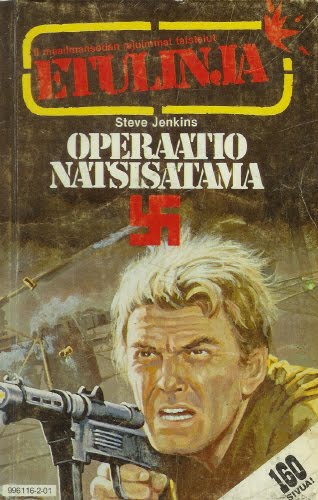
I bought some old paperbacks from an old used book store in Forssa that was closing down and selling everything out with half a cover price. One of the books was a war paperback that I've never taken a closer look at. It was by "Steve Jenkins", called Operaatio natsisatama (Operation Nazi Harbour; stupid title if there ever was one). It was published by Viihdeviikarit, one of the last cheapo paperback publishers in Finland, in their Etulinja/Frontline series in the early eighties. The book was left lying on the floor with some other books, but then one night, pretty tired of the historical novels I've been reading for a reference book project I picked the book up and started to read it. It was fluent and fast reading, with lots of dialogue and pretty good action scenes and one or two sex scenes: good old-fashioned disposable trash. I got more interested in the book and started Googling.

No "Steve Jenkins". No war paperback was ever published under that by-line. Googling more I found out that this might've been published originally under some other name - and then I found out that the Etulinja series this was published in held also another book with the main character called Mahoney. That book, called Kuoleman juna/Death Train, was written by one Gordon Davis. And bingo! Gordon Davis is a pseudonym used exclusively by Leonard AKA Len Levinson, a paperback hack working mainly in the seventies and eighties, and the book called Operaatio natsisatama was also written by him and erroneously published in Finland under the "Steve Jenkins" by-line. (Why this? We can only guess.) The original title is Hell Harbor.

The books were a part in Levinson's Sergeant series, which conveniently happens to have a Wikipedia article, even though Levinson doesn't merit one. There's not a lot of information on him anywhere in the web. If anyone knows more, I'd be interested to hear. Has there been an interview with him in Gary Lovisi's Paperback Parade or some such? Levinson was born in 1935, that much Lee Server says in his encyclopedia of pulp fiction writers. Server raises Levinson's non-genre paperback, The Last Buffoon (1980) as "Leonard Jordan", from the pile and says it's an interesting account of the life of a paperback hack. Anyone read that?

Elina's blog

My wife Elina has just started her own blog. Take a look here. The blog, called Hopeapeili (Silver Mirror; an old Finnish fashion mag), will be largely about vintage fashion and it's in Finnish.

Tuesday, September 21, 2010

Herschell Gordon Lewis's third novel?


A friend of mine here in Finland is going to interview the notorious horror/camp director Herschell Gordon Lewis. I mentioned to him that Lewis also wrote novelizations of some of his films and that there were reprints of two of them, Two Thousand Maniacs and Blood Feast. Both came originally from Novel Books in 1963 and 1964, retrospectively, and the reprints came from Fantaco in the late eighties (the cover of the other one on the left).

But I seem to remember there was a third one. I've seen the cover for it somwhere in the web, but can't find it again anywhere. The copies of the original editions seem to be very rare (none in Abebooks at least), but I'm sure there was a third one. Now, can anyone confirm this and tell me what the title of the third HGL novelization was? For some reason I seem to remember it was Monster A-Go-Go, but my friend tells me Lewis has discredited the film so that there wouldn't be much point in him having written a novelization of it. The Wikipedia article on Lewis doesn't mention any of the novels.

Why am I interested in this? I asked my friend to ask Lewis if he would allow doing translations of his novels in Finnish!


EDIT: another friend of mine located the book. It's Color Me Blood Red (Novel Books 1964); see the cover on the left. It's mentioned in this thread of horror movie novelizations and tie-ins. The photo of the book isn't very good, I'm sorry to say.

Friday, September 17, 2010

Seikkailukertomuksia/Adventure Stories zine out


As you well may remember, I've been publishing some fictionmaggish fanzines of my own. I decided to move Isku and Pulp to the web, but Seikkailukertomuksia (Adventure Stories) still keeps coming in print. The fourth issue came out of the printers today and boasts a stellar cover by Anssi Rauhala. It's for an old Orientalist story by one Kaarlo Julkunen from the early twenties, called "Dzarir and Nechedil".

Other writers are Pietari Virtanen with a wonderful adventure story set in the 1950's Spain, Garnett Elliott with "Rendezvous on Zombie Island" from the Blazing Adventures webzine (which seems to be down), and me, with a fourth issue of my Pesäri saga. It's set entirely in a never-never-land, even though the setting resembles Finland of the bronze age of Kalevala. Well, then again it doesn't, and I'll very carefully advise you not to point out any historical errors in the stories. I thought the fourth story would end Pesäri's story, but it seems I'll have to publish yet another issue of Seikkailukertomuksia for the Pesäri saga to reach the end. (Even though I think writing this kind of pulpy trash only as rehearsing how the stories are narrated and how the pace the story, I'm kind of proud bringing the influence of Richard Stark's Parker books into the sword & sorcery stuff.)

The package is five euros. If you're interested, just post a comment.

Edgar G. Ulmer's Detour


I'm sure this confession won't rise my street cred in the world of the noir aficionados: I saw Edgar Ulmer's Detour for the first time just two nights ago. "What?" you say. "One of the most famous and notorious of all film noirs, and you haven't seen it?! How's that even possible?" I've been quiet about it and just kept on nodding, when someone has mentioned the film. "Yeah, that was interesting." Add a hesitant smile.

The Finnish Broadcast Association's Teema channel has started a series of classic film noir, and Detour was the second film in the string (with an old favourite, Murder, My Sweet being the first one). It's a great series, with some rarities in the bunch. My only gripe is that they stop in the mid-fifties. What about Murder by Contract, for example? One may argue there were great noir films in the sixties (Blast of Silence, Siegel's The Killers, Point Blank, Madigan etc.). And what about the noir films of the seventies: Klute, Chinatown, Hickey & Boggs, Night Moves..? Here's hoping they'll continue on to these - and maybe even the eighties' neo-noir films and the high-adrenaline postmodern noir of the 1990's and 2000's: Reservoir Dogs, Little Odessa, Bound, The Woman Chaser (which has never been released in Finnish), etc.

Okay, back to Detour. As everyone (well, I guess "everyone" applies here) knows, it's a very poor B-film, shot with $20,000 in a week, about a guy who's lifting his way to Hollywood from New York and ends up in trouble. If something is noir, then Detour is: there's no escaping your fate, whatever it is, and usually you fate is you'll die, probably sooner than later. Ann Savage as a hitch-hiker really makes the film: one of the scariest motherfucking sociopaths on any side of the Atlantic ocean. Period. And furthermore, she's not pretty in the least. She's actually quite ugly, if you ask me, and her style is awful. Her hair doesn't fit her at all, yet she keeps combing at it, like it would help. I don't know if this is something Ulmer set out to do or if it came only by accident. The way Tom Neal's character can't get away from Ann Savage is not out of this life: it's a nightmare that one can't escape out of. Unless by accident. That is your fate. Just accept it.

There are an awful lot of scenes in Detour that take place inside a car, with a camera shooting out of the front window. There's lots of voice-over narration. Yet none of this feels stilted. Detour is pure cinema, and I really don't know how Ulmer managed to break all of his poor film's financial restrictions. I sure am happy to finally have seen this.

I haven't Martin Goldsmith's novel that this is based on, but I know someone who has it and I'll be loaning it.

The Finnish Hobbit

Wanna see something different? GeekTyrant has found out someone has posted the entire Finnish miniseries based on The Lord of the Rings called Hobitit (The Hobbits) on YouTube. This was actually a stageplay before being turned into a TV series, and I seem to remember (this was almost 20 years ago) that many of my friends saw the stageplay and liked it. This seems a bit too cheap, however, and some of the actors are laughably miscast, like Taneli Mäkelä, the strong silent type of contemporary Finnish cinema, as Frodo. Kari Väänänen as Gollum mangles his face in an abrasive manner. And what's with the slap bass jazz in the background when he's seen changing into the green-faced monstrosity?

Some of the posts on YouTube have English subtitles, but not all of them. See the GeekTyrant link; here's one of them with subtitles.


Tuesday, September 14, 2010

Tapani Maskula's novel Houkutuslintu


The legendary film critic from Turku and a personal friend, Tapani Maskula, is now also a novelist. His first novel, Houkutuslintu ("Decoy" might be a good translation), came out earlier today from Turbator for which I've edited lots of anthologies. Houkutuslintu is an old-fashioned romp through the town of Turku in the late thirties and early fourties, with smugglers, loose women and speak-easies. I've yet to read the book, but I'm sure it's enjoyable.

The cover is great. It's by Anssi Rauhala, who also did the cover for my Sherlock Holmes anthology. (Sorry for the bad photo, just took it with my cell phone.)

Tuesday, August 31, 2010

Toni Johnson-Woods on Carter Brown

I interviewed the Australian scholar Toni Johnson-Woods about her book project on Australian paperback crime fictioneer, Carter Brown. I posted the interview in Finnish here, here are the Q&A. Toni's blog on Aussie pulp fiction is here.

Just what are you doing regards to Carter Brown?

Carter Brown is part of a larger project of mine. In 2007 I received a grant from the Australian Research Council to document the spread of Australian “popular” (more often called pulp) fiction of the 1950s throughout the world. Carter Brown was one of the most widespread authors. Carter Brown is really Alan Geoffrey Yates who wrote nearly 300 books as Carter Brown between 1951 and 1985.
What got you attracted to Carter Brown in the first place?

Carter Brown is the person about whom I talk the most because he is probably the best known of all Australian writers. It started, as most research projects do, from a very simple question – who is Australia’s most *popular* author…my colleagues at the University of Queensland and I were having a cup of tea asking this question. Someone said “Carter Brown”. I’d never heard of him so I went to our national library and discovered that he’d written nearly 300 novels. After ten years of studying Australian literature I couldn’t believe that I hadn’t heard his name mentioned once. Then I dug a little deeper and found dozens of Australian writers had written thousands of books in the 1950s — romances, westerns, and crime. And yet not one academic in Australia had investigated them more fully. So I decided it was time for the academy to get a bit of a wakeup call.

What's interesting about Brown to modern readers? Does he still hold up?

He is of interest to readers because his stories are so representative of the time in which they were written. The language, fashions, technology, consumerism, representations of women, women and sex are all snapshots into the various decades. For instance, the earliest stories are very hardboiled and reflect the James Hadley Chase style of fiction – mean streets, political corruption and dangerous dames. Later the stories are much more light-hearted and poke fun at the “heroes”. The final stories are pretty much sex and sadism. I prefer the light-hearted funny ones and they still are amusing.

Why was he so popular around the world?

I think it was the funny Carter Browns who amused people all over the world. It seems that some humour does transcend national boundaries. My favourite character is Mavis Seidlitz who is a ditzy blonde – she
is like a detective Lucille Ball. I think his steady stream of fiction meant that a publisher could rely on a new title every
month to fill the bookshelves and so maybe it was just because he was there.

How could he be so prolific?

Yates never owned the name “Carter Brown” – it was owned by the publisher Horwitz. So when the owner Stanley Horwitz sold the licence for Carter Brown to Signet in the USA, he signed at 10 books a year deal. So if Yates wanted to earn money he had to supply those ten books. It was a harrowing deal—as often Yates was writing a current book, editing his last book and plotting his next one. He confessed that he took Dexedrine (which was legal then) and would write the whole book in 48 hours. The book then was edited by the Sydney offices of Horwitz, they sent the edited version to the USA where their editorial team fixed mistakes and then the manuscript was sent back to Australia for approval. Can you image the pressure? So from 1957 – 1985 he was writing between 6 and 10 books a year. Most of the earlier “books” were really short – about 34 pages -- and he wrote two of those a month.
I spoke with Yates’ widow last year and she said he didn’t even have a full collection of his books. So I’m unsure if there is a complete collection anywhere in the world. Even the Australian National Library, our legal repository, does not have all of his books.

What can you tell us about your research about Brown in Finland? Did you find any explanation why there was so much of Australian stuff published here?

I was in Finland to present a paper on Carter Brown at the annual SHARP conference. I focused on my findings in Nordic countries; earlier this year I was in Copenhagen and Oslo (I didn’t have time to visit Sweden). I spent the first week in the Finnish National Library; and I spent some time with some enthusiastic collectors. Finland has a unique relationship with Carter Brown because it was the FIRST overseas country to translate him—between 1957 and 1985 Finland published 140 Carter Browns…second only to France (222 books). Finland also has different covers to those in Denmark, Norway and Sweden: it reused the Australian covers. This suggests that Finland had an agreement with Horwitz (the Australian publisher) and not with Signet (the US publisher). Why or how this happened is still unknown. Unfortunately the Horwitz archives are not available and the company was sold last year so we
will probably never know.

Any interesting anecdotes you can share about CB?

Australia’s popular crime writer Peter Corris tells how he used to steal Carter Browns from his local newsagency. He says Carter Brown influenced his writing style. Mickey Spillane trashed Carter Brown on American television once – apparently Spillane had been drinking and Yates found it amusing. Yates had been writing about the USA for half a dozen years before he finally visited there. He was very popular in Japan – and his Japanese covers are the most beautiful of all I think. His material was turned into two French films (both are pretty ordinary). Richard O’Brien of The Rocky Horror Picture Show fame has written a musical, The Stripper, based on the CB book of the same name. It is supposed to be playing in the UK at the moment.

You've read some other Australian writers and I've understood they are pretty bad compared to Carter Brown. Is this true?

Yes. Because CB was so successful a rival publishing company started Larry Kent. Kent lacks the humour of CB. He is just a little too violent for my taste. Marc Brody’s stories are just poorly written and an effort to read. Carl Dekker has an interesting “hook” each story is written in a different location – again, the writing is pretty poor. The best of the ‘second’ string CB is K T McCall – the author is supposed to be the girlfriend of Johnny Buchanan, but really the series was written by two women.

Could you name some other interesting Australian writers?

I believe that Australian Peter Temple is one of the leading crime fiction writers in the world today. But as to the fiction of the 1950s – I find myself more engaged by the westerns—Marshall Grover, Emerson Dodge…there are dozens of them. I think I’ve read way too many crime fiction novels and so I find

Why was there so much pulp and paperback publishing in Australia? Could you share some of that history?

In 1939 the Australian government imposed taxes on non-essential imports such as books. After the war was finished the taxes were not lifted and so Sydney publishers found a gap in the book market. Previously the majority of cheap fiction had come from America – Australia hadn’t developed its own publishing ethos. Suddenly there was a ready market for cheap fiction – these publishers desperately looked for authors who could write genre fiction (romances, westerns, crime, science fiction) quickly. They wanted to fill the stands at railways with reading material each month. As there weren’t that many experienced writers, the publishers asked all sorts of people to write. The result was that anyone who could provide enough words got published – hence the poor quality of some of the material. Still it provided extra income for railway workers, accountants, teachers and those willing to spend their weekends writing at their kitchen table. Many of the writers I interviewed admitted that they wanted the extra money to buy a house. It was the post-World War Two boom in Australia.

What's next after your CB book is completed? More Australian pulp?

After I’ve finished the CB book (which has taken me about three years) I am going to publish a complete list of all of the Australian authors and editions I have found—that should be a couple of volumes. At least that’s what I hope. My next big project is to trace all the Australian westerns published around the world. Western fiction is the least researched of all ‘pulp’ fictions.

The pictures are Finnish editions of Carter Browns, the latter two are with original Australian covers.

Monday, August 30, 2010

My other new webzine out

I moved some time ago my crime fiction fanzine, Isku, to the web here. Now I moved my other fanzine, Pulp, to the web. It's in here. Everything is in Finnish, but there are some Australian paperback covers, which you might be interested in.

Pulp-lehden nettiversio luettavissa nyt täältä! Artikkeleissa australialainen kioskikirjallisuus, H. Ahtelan kauhunovellikokoelma Dégénéré (1918), Kari Suomalaisen jännärit ja Aake Jermon rikosromaanit.

Monday, August 23, 2010

Monday's Forgotten Film: The Big Town


Neo-noir isn't a genre only for the 2000's. They made neo-noir films already back in the 1980's, films that were knowingly full of neon lights, femme fatales, crooks with guns, heroes with raincoats, set in the fifties or the sixties, with the soundtrack blasting jazz or old rock'n'roll. Heck, someone might say that Chinatown and Dick Richards's Chandler film Farewell My Lovely with Mitchum as Philip Marlowe were neo-noir films.

One of the neo-noir films from the late eighties is now pretty forgotten The Big Town (1987). It seems forgotten even though it boasts a stellar line-up of actors: Matt Dillon, Diane Lane, Tommy Lee Jones, Tom Skerritt, Bruce Dern... I watched this just now, since I bought it very cheap on VHS. I'd seen the film when it was new, and I'm pretty sure I wrote a review of it for a local newspaper (I was 15 at the time, so the review might not have been very good). I remember thinking that it was a mediocre film even at the time, but for some reason it has stuck with me. I liked going back to it, even though I think the film is still mediocre. Matt Dillon and Diane Lane are very attractive and the theme of a young rookie invading the dice scene of a big town - here Chicago - is always alluring. But some of the motives behind the people's actions in the film remain unclear and the film drags in the middle. TV director Ben Bolt doesn't get everything out of the events and the scenes just keep on following each other. He also doesn't get the best out of the actors and lets some rule the scene, especially Bruce Dern, who just shouts and yells. (Incidentally, I also saw Silent Running with Dern and the same thing there, too. He almost ruined the whole film.)

The Big Town is based on a novel by Clark Howard, called The Arm from 1967. I haven't read the novel, but I'm sure his style and voice bring more depth to the story that otherwise remains pretty bland, as his short stories are very, very good. I wish someone who's read the book would comment on how it differs from the film.

Wednesday, August 18, 2010

Rare Clint Eastwood western


Over a week ago, at the annual Summer meeting of the Finnish Western Society, paradoxically called "pukkujoulut ("Lidl Christmas" or something like that), held in Oulu we watched a rare Western movie from the fifties that's reportedly never been released on VHS or DVD. Ambush at Cimarron Pass (1958) would be totally forgotten these days if it didn't star the young Clint Eastwood in his first film to get a screen credit. He's billed third in the opening credits, but there was a rerelease - probably later in the sixties, after his Italian Westerns - in which he was credited first.

The film is not a B-picture, as someone might have an urge to call it. It's more like a cheap A-western, shot in black & white Cinemascope (or actually Regalscope). The film was written by prolific pulpster and later prolific B-picture writer John K. Butler (whose Steve Midnight stories from the Dime Detective are very good), and I think this shows in the dialogue. It's very crispy at times: "What happened to him? He's much nicer now than before." "The Indians made him nice."

Otherwise the film's virtues pretty much end there. Eastwood isn't very good - he plays a young, hot-headed Southerner, who's in with a ragtag crowd of other Southerners who haven't given up the fight after the Civil War. Eastwood grins uncomfortably through the film, and one won't give him a long future on silver screen. Scott Brady, the first-billed star of the flick, plays a Yankee officer who leads a small gang of soldiers. They end up ambushed by some Indians - we never see much of them and they act pretty stupidly. (Which is of course a Western cliché, but these guys are really dumb. And there's not too many close-ups of them. Maybe their contract with the studio didn't say anything about the close-ups. Actually there are not too many close-ups of other actors either.)

My biggest problem with the film - beside that it's wooden and doesn't pack much suspense - is how the only female character is portrayed very stupidly. Her whole family is slaughtered, even to the smallest kid, and yet she tries to hit on all the men she sees, with a greedy lust in her eyes. Maybe she's gone into a severe shock after traumatic events? And yeah, okay, the film ends more abruptly than anything I've seen in a long time.

Eastwood has been reported saying that Ambush at Cimarron Pass is "the lousiest Western ever made". In this interview he says the film almost destroyed his career, because he thought he never wanted to act again. (His wife talked him out of the decision, and then came Rawhide.) Is it because of Eastwood the film has never been released on video? Has he put a ban on it? It seems the film can be seen occasionally on something called Western Channel. Our version was taped from a small Finnish cable channel in the mid-eighties and transferred to DVD. We had a great time watching the film, as we had a small cinema at our use. I bet there are not that many people alive who have seen this on silver screen.

There's a long comment on IMDb here, which contradicts a lot of things I've said here. It is true that I fell asleep in the middle and maybe all the good parts came during those 5-10 minutes. See also this blog post. Seems like there's an illegal download doable from here.

Monday, August 16, 2010

My books this Fall

This is a note I posted on Facebook: it's about my forth-coming books.

Koska Helsingin Sanomat ei maininnut minua sanallakaan ensi syksyn kirjojen listauksissa, ajattelin edes täällä kerrata ne muutamat opukset, joita olen ollut väsäämässä ja joiden on tarkoitus ilmestyä ensi syksynä. Totta kai on niin, että osasta näistä ei tiedä ketkään muut kuin minä ja kustantaja; lisäksi osalla kirjoja ei ole vielä käyttökelpoista nimeä, mutta - osittain - senhän takia tämä Facebook on olemassa, että voi markkinoida omia tekemisiään. Mukana ovat lisäksi kolme dekkaria, joiden ilmestymisessä minulla on ollut osani. Tai mainitaankin ne ensiksi, koska niiden markkinoinnista saan rahaa.

Tapani Bagge ja Harri István Mäki: Paha paikka. Arktinen Banaani.
Kevin Wignall: Lipun varjo (Dark Flag). Arktinen Banaani.
Ken Bruen: London Boulevard. Arktinen Banaani (saattaa siirtyä ensi keväälle riippuen siitä, milloin kirjasta tehty Colin Farrell/Keira Knightley -elokuva tulee Suomeen).

Omat kirjani:

Artikkelikokoelma tekijänoikeuksista. Toim. yhdessä Jussi Förbomin kanssa. Avain/BTJ.
Historiallisen romaanin taitajia 2. Yhdessä Jukka Halmeen ja Sari Polvisen kanssa. Avain/BTJ.
Vanhojen erätarinoiden kokoelma. Turbator.
Vanhojen suomalaisten kauhunovellien valikoima. Faros.

On puhuttu myös Marton Taigan scifi-tarinoiden kokoelmasta, mutta en tiedä, ehtiikö se ilmestyä syksyksi. Lisäksi jos suinkin ehdin, laitan kasaan ja kansien sisään myös monta vuotta tekeillä olleen Outsider-artikkelikokoelman.

Jotkut ovat sitä mieltä, että tällainen toiminta - kirjojen kasailu - ei ole kirjailijuutta, vaan pelkkää toimittajuutta. Mene ja tiedä: toisaalta minulla on myös omia proosahankkeita koko ajan.

Friday, August 13, 2010

Two new private eye novels: Coleman and Winslow


I've been reading some new private eye novels, as I'm writing an article on them (my research ain't what it used to be and seems like I'll have to do only with some interviews, but such is life). There was a boom in private eye fiction from, say, 2005 on, at the same time new interest in hardboiled and noir came forth, but it seems like the economic depression and the publishing crisis almost made the boom diminish and many writers are now publishing with smaller outfits or doing self-publications.

Still there are new interesting books. Don Winslow and Reed Farrel Coleman aren't exactly new, but both bring fresh voices to the genre that's been deemed defunct several times after Raymond Chandler's death. This is the case especially with Coleman, whose Moe Prager books are very touching and moving, even though there's not much action and Moe Prager is a pretty ordinary guy. It's just that his life is full of mistakes, lies, secrets and agony. The private eye's tragedic life has become a bit of a cliché nowadays (look for example at Declan Hughes's Ed Loy books or Russel McLean's The Good Son), but Coleman makes the theme much more real than many of his contemporaries. The Moe Prager books form an epos, starting from the seventies, ending up in the present day, and the newest one, Empty Ever After, is just as good as any in the series. (It's maybe slightly better than the previous one, Soul Patch, which suffered a bit from Moe Prager's stream of consciousness; I thought those bits were unnecessary.)

Don Winslow's Boone Daniels is a different case altogether. He's not doomed or tragedic, he only wants to surf. To make some money, he works as a reluctant private eye from time to time. He first appeared in The Dawn Patrol, which I recently read and liked quite a bit, even though there was too much of Robert B. Parker in it. I don't really care for the macho posturing about the honour code and all that, even though Boone Daniels keeps his mouth shut about these things more than Spenser. I liked the bits about the cultural and geographical history of surfing in California. There could've been more action in the book, though.

Thursday, August 12, 2010

Shamus nominations

The nominations for the Shamus awards in private eye fiction. Congrats to everyone nominated!

Best Hardcover PI Novel
The Silent Hour by Michael Koryta (Minotaur/St. Martin's)
Where the Dead Lay by David Levien (Doubleday)
Locked In by Marcia Muller (Grand Central)
Schemers by Bill Pronzini (Forge)
My Soul to Take by Yrsa Sigurdardottir (William Morrow)

Best First PI Novel
Loser’s Town by Daniel Depp (Simon & Schuster)
The Last Gig by Norman Green (Minotaur/St. Martin's)
The Good Son by Russel D. McLean (Minotaur/St. Martin's)
Faces of the Gone by Brad Parks (Minotaur/St. Martin's)
Chinatown Angel by A.E. Roman (Minotaur/St. Martin's)

Best Paperback Original PI Novel
Dark Side of the Morgue by Raymond Benson (Leisure Books)
Sinner’s Ball by Ira Berkowitz (Three Rivers Press)
Red Blooded Murder by Laura Caldwell (Mira)
Vengeance Road by Rick Mofina (Mira)
Body Blows by Marc Strange (Dundurn)

Best PI Short Story
"The Dark Island" by Brendan DuBois, Boston Noir (Akashic)
"Deadline Edition" by S.L. Franklin, Alfred Hitchcock Mystery Magazine, April 2009
“Blazin' on Broadway" by Gary Phillips, Phoenix Noir (Akashic)
"Suicide Bonds" by Tim L. Williams, Ellery Queen Mystery Magazine, March/April 2009
"Julius Katz" by Dave Zeltserman, Ellery Queen Mystery Magazine, September/October 2009

Wednesday, August 11, 2010

First review of my sleaze novel!


Miina Supinen, known and respected writer, says of Lausteen himokämppä / The Lust Cabin of Lauste:

"Kiitos Lausteen himokämpästä. Se oli hyvä! Ei kiihoitusmielessä ihan mun heiniä, mutta ihailin ammattilaisen työtä. Sujuvaa tekstiä ja dialogi oli tosi napakkaa. Se Rimma Kovankon hahmo oli musta kuvattu harvinaisen hyvin. Oli hyvä veto kuvata kaunista naista sillä tavalla, ettei yhtään kertaa käytä sellaisia ilmauksia kuin kaunis tai hyvännäköinen. Muutenkin koko tyyppiin jäi sopivasti salaperäisyyttä."

"Thanks for The Lust Cabin of Lauste! It was good! Maybe not my cup of tea in the excitement sense, but I admired the work of a professional. Fast reading and the dialogue was really crispy. The Rimma Kovanko's character was very well done. It was a good thing you described a beautiful woman without using words like beautiful or good-looking. And the whole character stayed nicely secretive in the end."

Tuesday, August 10, 2010

On my 12-hour novel


As you recall, last Friday I wrote a 17,000-word novel in 12 hours. Some thoughts on the process follow.

I can't believe how someone like Barry Malzberg or Arthur J. Burks have been able to write more in a day. (Remember this: Malzberg wrote a 60,000-word novel in 16 hours.) Writing for so long feverishly was very, very tiring. I got my back sore and my stomach almost started to cramp. And those guys wrote with a typewriter, not with new laptops! (Okay, Burks may have dictated.) And how's anyone been able to continue producing those lengths for days and days in a row?

But I proved myself that something like this is indeed possible. You have to remember that the Finnish 17,000 words should be something like 26,000 words in English, as we don't have the "a's" or "the's" or "from's" or any of those in our language. So, the NaNoWriMo challenge of 50,000 words in a month mutates into 35,000 words in Finnish.

Yeah, okay, NaNoWriMo? What's the point writing 50,000 words in a month, when one can do that, say, over a weekend? (Maybe one of these weekends I'll do exactly that.)

There's just one point: how could those guys I mentioned above write stuff that they were able to sell? I haven't as yet tried to read what I wrote last Friday, but I'm pretty sure I wouldn't be able to sell it. Well, maybe to a ultra-cheap paperback publisher like Vega Books or PEC or Epic, but not anywhere else. (And in this day and age, the answer is simple: nowhere.) Some of the early pulpsters were able to do only one copy and sell it. Arthur J. Burks was one of them. He is said to have written a story in a bar, walk to the office of a magazine and come back to the bar with the money in his hand. I'm sure I'll have to go through my story many, many times, before I'm happy with it.

Is it just experience and practice? As you know, I haven't published any fiction commercially. My two short novels are self-publications and my few short stories have come out in fanzines. I have two novel manuscripts sitting in the office of a publisher, but so far nothing has happened. So one might think I could do a better story in one sitting in, say, 2020, after I've written more of this stuff.

Wait. I'll be almost 50 by then. Even at 38 I got the feeling I should've been in a better shape for the writing session.

Someone might ask, why I wrote the thing in 12 hours. Why didn't I write it in 16 or 18 hours? Because I was going to step in a train at nine p.m. and leave to Oulu (a city in northern Finland, many, many miles away). I could've started earlier, but I had met a friend of mine over a couple of ciders and beers just on Thursday night and had gone to sleep a bit too late. My bad. I could've started on 8 a.m. or even earlier had I slept more. There were also some interferences during the day: a friend of mine called about our trip to Oulu, I had to go the post office to post some books (it took only 15 minutes at most, since we live very near the office), I had to buy some food and prepare the dinner, since I'd forgotten to buy a microwave dinner. So actually I had only 11 hours to finish the novel.

I posted the progression on my word count in Facebook. I seem to have written the first 2,000 words in one hour and then almost 3,000 words in two hours. Then I seem to have slowed down, but the overall writing speed was 1,500 words per one hour. I got into problems in the last pages: I wrote: "15 203 words and I'm stuck in a dead end. One hour and twenty minutes before the train leaves." Then I wrote: "Still 30 minutes and I'll have to come up with a sad ending. [As befits a private eye novel.] 'Everything was in vain.' 'Stuff that dreams are made of.' Oh, I already used that one."

I wrote the last lines in six minutes. I got them done 25 minutes before the train left. You can imagine I left in a hurry. And I was sweating like a pig during the last two hours. (A friend of mine actually came to pick me up and he laughed when he saw me having just stepped out of the shower: "Are we leaving or not?")

The story, the style? You can pretty much guess the style is hardboiled and pulpy. The main character of the novel is my private eye hero Joe Novak. He gets mixed up in two intrigues at the same time: an old Nazi comes to Los Angeles to avenge the wrongs Novak did to him during the WWII, plus a beautiful young lady asks him to bodyguard her when she's trying to recover a lost Inca treasure from the bottom of the sea. The story is set somewhere in the mid-sixties. I'm not sure if the two separate storylines mingle together seamlessly - I'll have to read the whole thing to find out. But of course this kind of thing is easier to write with 1,500 words per hour than serious literary fiction, even though it is very difficult to keep various things going at the same time. (Someone might actually say that that's what's difficult.)

There's just that the book got a bit too violent and grim. I had had the storyline about the German Nazi avenging the wrongs in my head for a long time, but I had been thinking that there wouldn't be much violence and the book would be more about the sentimental and sad feelings about how revenge isn't going to do anyone any good and how these old men (I was thinking I'd set the story in later times, say in the 1980's) aren't actually able to fight anymore. But no. The story got totally out of my hands, with lots of explosions, shootings and sadistic violence. Which kind of makes me sad - this is not the book I meant to write.

But I'm not complaining. I did what I set out to do: write at least a 15,000-word novel (or novella) within one day. I was able to do it and am sure I'll be able to do it again.

(The book in the picture is an Epic Book from the early sixties, just to show which kind of publisher would possibly touch the manuscript I wrote.)

Friday, August 06, 2010

I did it!

16 902 words in almost 12 hours! Nonstop action, Inca gold, nazis, mad doctors, femme fatale and a private eye!

Thursday, August 05, 2010

I'm gonna be a real pulp fiction writer tomorrow

Something I've wanted to do for a very, very long time: I'm going to write a novel tomorrow. Yes, tomorrow. I'll start after I've had breakfast and stop only for eating and showering. My goal is to write a novel (or rather a novella) of 15,000 to 20,000 words, so it's something Harry Whittington might've done to be published as an other side of an Ace Double. (Or perhaps a bit shorter.)

I remember I tried to do this already in the eighties, when I was a teenager. I'd read how Chandler had written the screenplay for The Blue Dahlia and I dreamed of a hotel room with only me and my typewriter. Nothing came out of it. I tried again in the nineties. I bought a bottle of whiskey, but that certainly didn't help my writing. I don't think I got anywhere with that.

But now I know more about writing and all that comes along with it. At least I know better not to touch alcohol during the process. And I'll be at home alone, since Elina and Kauto left just now to visit Elina's parents. It's a great benefit.

What will the book be about? It will be a Joe Novak novel, about my private eye hero, whose sometimes pathetic adventures I've been chronicating for almost 20 years. He appears in my self-published novel Outoa huminaa, Joe Novak and in a dozen short stories. (One of these days I'll do a collection.) The story will be based around this unused cover Jukka Murtosaari did for a magazine I never got around to doing - I guess one of those guys is Joe Novak. I'll take the lettering out and smack the illo on the book cover. As for the actual plot, I've been carrying an idea with me for some time now and I think this is the best time to use it.

So, wish me good luck! I'll be on Facebook giving away the word counts during the day.

PS. Don't forget Barry Malzberg's 60,000-word novel written in one day! And he didn't have to resort to self-publishing!

Tuesday, August 03, 2010

My sleaze novel


Seems like I'm more prolific nowadays doing self-published books than doing "real" books for "real" publishers. This, Lausteen himokämppä, is my second novel, an attempt at an old-fashioned sleaze paperback. "Attempt", because it turned out to be nastier than many of the old school sleaze books, like the ones written by Lawrence Block or Robert Silverberg. At times this approaches a hardcore sex novel of the later decades, but the sex scenes are always plot-related.

But Lausteen himokämppä is also a crime novel, just like many of the sleaze paperbacks Westlake, Silverberg and the other writers wrote in the late fifties and early sixties for publishers like Midwood. This is about three police officers in Turku, Finland, trying to outscheme each other. They have all fallen - not in love - for a Russian woman living in the suburb of Lauste, who seems to be working the night shift. There are many outbursts of irrational violence, which I hope shows the influence of early Charles Willeford and Jason Starr.

The word count falls under 20,000, and the format is a small paperback. The cover illustration is from an old pantyhose package. The cover didn't turn out as well as I'd hoped, but maybe it suits the retro sleaze feeling - the Finnish sex paperbacks of bygone days were far from professional products! (The same feeling is captured also in the end where the sex scene gets too convoluted and the dildo is in and out at the same time!)

Note that I'm using a pseudonym here. I don't know why, maybe I got ashamed - I've said for years that even the dirtiest smut must be published under your own name! "Mikael Messi" is a so-called porn name: take your second first name and the name of the street you lived in when you were a kid. The "X" is just a joke, but it's also an allusion to the pseudonym John Jakes used in his sex novels: J. X. Williams.

The book is available straight from me for 7 euros. You won't find this in any bookstore!

And oh, the title: Lausteen himokämppä might be translated as "The Lust Cabin of Lauste".

Sunday, August 01, 2010

Still on Jason Pinter's The Mark

I forgot to say in my earlier posting about Jason Pinter's first novel, The Mark, that I read it in Finnish translation, as Merkitty mies. The Finnish edition might actually be a bit hard to find, since it'a Mira book (basically a Harlequin, since Mira is an imprint of Harlequin) and the Mira books are for sale only for a short time and libraries don't pack them. As Merkitty mies was published some time last year, you won't find it from anywhere else than the used book stores. Which might be difficult, since the Rautakirja chain of kiosks are usually ordered to destroy the unsold books.

Old Finnish fantasy and science fiction


More on the books I read during our vacation trip:

We carried Aili Somersalo's Mestaritontun seikkailut with us to read it to kids before bedtime. It didn't go very well (Kauto especially got bored with it) and the book is still unread. I was reading it also to myself, because I've been interested in the book for quite a while: it was originally published in 1919 and is a classic piece of Finnish fantasy. Well, it's a fairy tale and not fantasy by strict genre standards, but there is still a good touch of high adventure and romance in the book. The book tells about Mestaritonttu (Master Tomte or something to that effect), who decides to take a leave from the Fairyland where he's been serving as the king's master. He wanders around, ends up in a strange place and gets mixed up in a fight between some witches and the king of the sea. There's also a maiden who's under a spell and locked up in a stone.

If there were a tradition of publishing reprints old Finnish fantasy, this should go high up in the list. It's been reprinted many times, but as it's a bit slow, young kids won't necessarily like it nowadays, and the reprint should be targeted at mature readers who are interested in the history of the genre. And one could hope the text for the reprint would be taken from the first edition of the book, published under the pseudonym Aili Tarvas. The cover shown above is by Onni Mansnerus, who did the illos for the 1940's reprint. They are very nice.

There were fantasy elements also in the short stories of the author who's best known as Larin-Kyösti. [The article behind the link is actually in English, take a look!] I had an old collection of his short stories with me and I read some of the ones that were more genre-oriented. I don't think Larin-Kyösti had any particular genre in mind, but there were elements of fantasy and fairy tale in many of the stories, and I got to thinking one could do a collection of fairy tales and fantasy stories of old Finnish writers, of those who were are not normally linked to either genre. Of Larin-Kyösti's stories, particularly "Metsän henki / The Spirit of the Forest" would work perfectly in this kind of a book. Of the other stories, "Paholaisen soitto / The Devil's Music" is a fast-paced fantasy of the Devil visiting a church.

Into Jyläskoski was a pretty obscure Finnish writer who worked casually from the 1950's to the 1970's (publishing then one non-fiction book about booze smuggling in Finland). I've seen one or two of his short stories in various old Finnish fictionmags, but he was never a full-time writer. He published two novels in his lifetime, and one of them was a science fiction novel, called Marsion radiolentäjät / The Radio Pilots of Mars. It was published in 1955 with good illustrations by Olli Ålander. It's a pretty boring YA book, but it has a storyline one could use in a writing project and set a story of a set of stories in the same universe: the Martians have come to Earth in the early 20th century and have decided to reside in the Himalaya mountains. From there they abduct people to help them with their further attacks.

In Jyläskoski's book three young kids are abducted in the beginning of the novel and as they are all radio amateurs, the Martians put them to work as radists. There's not much sense in the book (it's never really shown what actual threat the Martians pose to people on Earth) and as it's also slow-paced, it was pretty tasking to read it to the end, but I struggled.

I also had Jalmari Vaula's fairy tale Udina from the late 1940's with me, but I never got around to reading it. Last winter I read Vaula's paleofiction novel, Kuolemanlaakson kurimuksessa / The Death Valley Maze (1952) and despite its silliness I enjoyed its fast pace and no-nonsense story telling. Now I'll have to get back to reading work-related stuff, which, unfortunately, means Robert Harris and Arturo Perez-Reverte. Hopefully Isabel Allende's novels are better.

Sorry, no pictures from Into Jyläskoski's Martian novel - the Photoshop program won't open anymore in our computer! I'll try to get something worked out, and I'll write a longer piece on the book later on (in Finnish).

Thursday, July 29, 2010

Jason Pinter's The Mark and John Rector's The Cold Kiss

As this is a literary blog and not really about my personal life and what I've been doing lately (it used to be, but as I've grown older and wiser [hah!], I've decided to go for an alternative), it has to suffice that I write about the books that I read during our 1½-week trip through Finland. Well, let me say this: we went first to Mänttä to visit my relatives, swam in the lake nearly all the time and visited the Mänttä Kuvataideviikot art thing, and then we went to Nokia to visit my dad and went to the Särkänniemi amusement park and Ottilia made me go to the new Motogee thing and I have to say I almost started to cry when it finally - after 28 seconds - ended. And then we went to Pori to visit my mother and just tried to chill out - which is near impossible in this temperature. (Over 25 Celsius all the time and no rain.)

Okay, the books. Jason Pinter is one of the newer thriller writers who hark back to the older traditions of the genre and don't write high tech thrillers à la Tom Clancy or don't go for the huge historical conspiracies like Dan Brown and his followers. The Mark, his first novel from 2007, is very reminiscent of the wrong man thrillers of the 1930's and 1940's. In fact, the novel could be labelled "noir", unless one wants grimness and an unhappy ending from one's noir. In The Mark Pinter creates his series character, journalist Henry Parker, who's involved accidentally in killing a police officer and becomes a most wanted criminal. Parker decides to solve the case before the police catch him, just like many heroes of the films from the thirties and fourties.

There's much to like in the book: the narrative is catchy, the pace is good, the description about journalism and journalists is good (Pinter is a journalist himself) and there's not much padding. I thought however that there were some implausibilities that nagged me from the halfway on, and the romance felt a bit forced and clichéd. I notice now - after having finished the book over a week ago - that I don't remember much about the book. But I guess that's one of the criteria of entertainment: you don't want to think too much about it. Me, I could've wished for more.

John Rector's debut novel, The Cold Kiss (out now from Forge in hardcover), was more to my taste: a noir novel that has the grimness that's required in noir. Rector's minimalistic style and the plot reminded me very much of the classic noir paperbacks of the fifties and writers like Day Keene, Gil Brewer and Richard Deming. Of course Rector, writing in the 2000's, is more open about sex, drugs and violence than his predecessors, but the picture he paints about human evil is no less chilling than with Keene or the other writers. The Cold Kiss is essentially a thriller set in a snowbound roadside motel where there are only a few people, one of them seemingly dead.

One of the best things about The Cold Kiss is how Rector reveals facts about his characters little by little. You get to know them and feel for them and even when they are not the best of people, you have to sympathize for them and hope the best for them. Even though they seem pretty stupid and do unnecessarily nasty things.

I can't much say about the plot, since there are lots of twists early on. I can say, though, that mentioning Scott Smith in the back cover copy gives too much about what will happen in the book. These things said, I must admit that the book is just a bit too long, maybe by 20 or 30 pages. I also guessed who the bad guy in the book is - there are too few characters in the novel. And the ending could've also been just a bit grimmer. There's a hint of ambivalence in the end, but I could've wished for more. Let's make it clear, though: an excellent debut.

Monday, July 26, 2010

Review of the Isku webzine

Paula Arvas reviews the first issue of the electronic Isku here. (In Finnish, of course.) She writes:

Iskuun tutustuminen [kannattaa] aloittaa vaikkapa ottamalla käteen kuppi kahvia ja lukemalla Kevin Wignallin hieno novelli "Kuolema", joka on alunperin ilmestynytEllery Queen's Mystery Magazinessa.

In English:

You get acquainted with Isku best with having a cup of coffee and reading Kevin Wignall's fine short story "A Death" that was originally published in the Ellery Queen Mystery Magazine.

Sunday, July 25, 2010

Safe back from the trip

Just wanted to let you know that we came back from our trip that eventually lasted more than a week. I'll be posting something about it - perhaps some photos and reports about the books I read during the trip, including a thorough essay on John Rector's debut novel The Cold Kiss.

Wednesday, July 14, 2010

John Quinn's Terminator novel


I finished Justin Cronin's massive vampire novel The Passage (Ensimmäinen siirtokunta in Finnish) yesterday and wrote a review of it for the local newspaper. I enjoyed the novel quite a bit and can recommend it; now, suffice to say that any friend of long, epic western novel should try The Passage.

After finishing the 850-page The Passage I wanted to read something quick. I had recently found a free copy of an eighties' men's adventure paperback, John Quinn's The Kill Squad (1983) - or actually the Finnish translation of it, called Nitistäjä ja salamurhaajat (1985). Since Quinn's hero Rod Gavin is called Terminator after the "best" men's adventure fashion, calling him Nitistäjä in Finnish doesn't really work, since it sounds like he's hiding in the bushes and shoots in the back. The other two Quinn translations, Silicon Valley Laughter/Kamikazemurhaaja and Mercenary Kill/Viimeinen isku, don't carry the Nitistäjä label. The author behind the John Quinn pseudonym is presumably Dennis Rodriguez, who's probably written lots of these kind of books.

Okay, back to the book. I read the book in one hour or so, which is a virtue in itself. As for the other virtues in the book...

The book's kinda episodic and there's not much plot, basically just scenes put together. The premise is kinda interesting: a group of terrorists hides behind the survivalist group working somewhere in Arkansas, seemingly scheming to kill president Reagan (why in Arkansas of all places is never clear) and seemingly getting instructions from someone in the US federal state organization. The book's also kinda erotic or even pornographic, as almost every baddie in the book seems to get sexual satisfaction from beating up and killing women. In the end, the book's kinda clichéd. Kinda?

I started to think about Rod Gavin, the Terminator of the title. What right does he have to use the Terminator label? He doesn't do anything in the book. If he really were the Terminator, he'd be able to prevent at least some of the killings and slayings in the book, don't you think? Instead he's hit in the head and while he's unconscious, two thugs torture and kill a nice young lady. (Okay, he does kill them later, but that doesn't much help the young lady.) Similar thing happens also later in the book. Only in the end, he gets to shoot some of the baddies, but it comes all too late after several innocents have been maimed. To my surprise, I began to hope Mike Hammer would step in and start hitting some teeth with his gun. Rod Gavin is a wimp, if you ask me!

Here's another review of the book at Johnny LaRue's Crane Shot. He seems to basically agree with me.

The Finnish cover of the paperback seems to be an exact copy of the original one, which is kinda rare in the history of the Finnish paperback publishing.

Wednesday, July 07, 2010

Summertime Blues

I know, I know, it is pretty boring to post just to say is busy and will be busy and will be having a vacation, but that's what I'm gonna do right now. My daughter came to Finland to spend the summer with us and we are doing a bit of travelling, so there won't be much to write.

But, ah man, there's been a lot to write about. I just don't know where I'm spending my time (on Facebook, maybe?), but some things I've been meaning to write about but haven't:

1) the Red Riding trilogy: superb rendering of David Peace's book quartet: serial killing put in the social context (I really was meaning to write a long essay about this, but suffice to say that T. Jefferson Parker did this thing better in his California Joe; brilliant nevertheless)

2) Robert Harris's Rome novels: utter bores, don't waste your time on them

3) a Mexican wrestling movie from the early seventies I watched with some friends of mine: forgot the title, but the movie was hilarious, just like the sixties Batman TV show

4) Arturo Perez-Reverte's novels on Captain Alatriste: just can't get hooked on them, even though they are said to be popular and hark back to the golden days of the adventure novels, give me a Thomas B. Costain any day over Perez-Reverte!

I know I'm forgetting something. I just know it.

I'm reading Justin Cronin's celebrated vampire novel The Passage (Ensimmäisten siirtokunta in Finnish) and liking it a great deal, but

Monday, June 28, 2010

A foreword to a new book

I just posted a foreword to my new (still forth-coming) book. It's a book with the famous illustrator Kari Suomalainen's collected fiction, three crime short stories from the late thirties and a YA crime novel from 1948 put together. You can read it here. (In Finnish, understandably.) I liked doing the book, but it seems there are some complications with the publisher about the foreword, so we'll have to see what the outcome is.

I have a longer version of the foreword, but I'm saving it for some other time.

Wednesday, June 23, 2010

My new webzine: first issue out


I've been pretty quiet around here for a week or so, as I've been concentrating on another blog project: the web version of my crime fiction magazine, Isku. And it's out now! You can see the first issue here. It is of course in Finnish, but I'm sure you'll recognize some of the writers: Keith Rawson, Kevin Wignall and Anthony Neil Smith. There are also two new Finnish short stories and a vintage story by Matti Kid Hytönen. It's from 1988 and was originally published in the short-lived crime fiction mag called RikosPalat (Crime Pieces, or something along those lines, in English).

My idea is to put out two issues each year, so the next one will be out somewhere around Christmas. Probably on Christmas Eve, if I know me well enough...

There's one thing missing from this issue of Isku: there's no Joe Novak. I used to have a new Novak story in each issue, but I think I got pretty bored with him. Or then I just didn't have enough time. I have some unpublished Novak stories sitting in my computer, but I think they are a bit too long for this kind of webzine. I'll have to see what to do with them. (Ahem... seems like the Thrilling Detective link above is a bit dated. Will have to fix that. Not even a mention of the novel It's a Weird Buzz, Joe Novak! APB! APB!)

Monday, June 21, 2010

Tapani Bagge's Kasvot tuulilasissa


My friend Tapani Bagge's newest book is a little paperback called Kasvot tuulilasissa/The Face in the Windshield. It came out from Turbator (the same publishing outfit that did my Sherlock Holmes book) and carries a brilliant cover illustration by Anssi Rauhala - who also did the Holmes cover.

Kasvot tuulilasissa is about Onni Syrjänen, who's a lawyer down on his luck and willing to take almost any job. Hence he gets to search for a missing daughter of a known crime boss. Syrjänen finds her pretty easily, as corpses don't much walk... The book speeds on like a bullet and Syrjänen visits almost every city in Finland, in search for a missing cocaine loot. There's lots of violence and black humour and also a feel for common man, like in all the books by Tapani Bagge. I recommend this highly, if you want to spend an entertaining hour. Reading the 15,000 words (thereabout) doesn't take much longer. This is what paperbacks are supposed to be like!
As a reminder: Onni Syrjänen can be read also in English, as Thrilling Detective has two stories of his escapades in translation. Check out here and here!

Wednesday, June 09, 2010

My Sherlock Holmes book


I promised to say something about the collection of Finnish Sherlock Holmes stories I edited. The book will be out next Tuesday, with this great cover by Anssi Rauhala. I posted my short foreword and the table of contents here, on one of my other blogs, and here is also the afterword Petri Salin wrote for the book - it's about the world of Holmes pastiches.

This is the first time this kind of book has been done in Finland. I don't know why, since Holmes pastiches are pretty popular in the UK and the USA. Holmes has been loved by the Finns for almost 100 years now, you'd think someone would've come up with this idea before. I got the idea when I noticed that Petri Salin, a writer of great skill and flair for old school adventure and crime, had a Holmes story in one of the issues of the Usva magazine. Then I noticed he had one even earlier in the nineties, in the science fiction magazine, Portti. And then I found two Finnish Holmes parodies in a Finnish pulp mag from the fourties, the other story being an anonymous "Sherlock Holmes in Finland" (Holmes gets lost in Finland and a Finn helps him out using his common sense) and the other being a parody by pulp writer Tuuri Heporauta (under the pseudonym of Ilkka Pilkka), with the hero's name altered into Herlock Sholmes. Then I knew I had to do this book. And I knew it would be a mix of old and new.

It wasn't very hard to get people to write for this book. Almost everyone I asked was enthusiastic, and that shows. The stories I got are very good and I'm sure not many would recognize them being not written by Doyle. Some of the stories are of course parodies, especially the one written by Jari Tammi, in which Holmes seemingly gets spanked with a whip by two young ladies.... There's also one SF/horror story set in an alternate history, written by Anne Leinonen.

Thanks to Risto Raitio I got some great old stories thrown in. And I really like the play that concludes the book: Sherlock Mopsi, written by one Arvo Salmivaara, a totally forgotten writer of plays and radio plays from the thirties and fourties. Sherlock Mopsi is very funny, and I sure hope someone will pick it up from this!

I sure hope this book will find its audience. It was fun to do and I'm sure it shows! Holmes, mainly due to the Downey film, has been regaining his stature lately, and two other Finnish publishers are bringing out new Holmes books this Summer: from Teos we will have the collection of Doyle's all Holmes stories and from Bookkari will come a new edition of the Holmes stories written by Adrian Doyle and John Dickson Carr.

Tuesday, June 08, 2010

Margaret Millar's Tom Aragon novels


As I mentioned earlier, I was writing an article on Margaret Millar for a forth-coming book 100 American Crime Writers (or something along those lines, I'm forgetting the exact title - or then it is just that!). I was going to do a Forgotten Friday post last Friday on two of Millar's later novels, but I never got around to doing it, so I'll post it now.

Or actually I'm just copy-pasting what I wrote on the Tom Aragon books in my article.
Tom Aragon was one of the few series characters Millar wrote about, and actually the only in her late career. There were couple short-lived series characters in her early books, but her mature phase (from around 1950 to the mid-sixties) hasn't any.

Millar's late phase is also worthy of note, even though her books from the seventies and eighties don't rise to the level of her classics. A good example is Ask For Me Tomorrow (1976) that is also one of her most traditional crime novels. The hero of the book is a young lawyer called Tom Aragon, who's called for help to search for a missing first husband. The book takes the reader on tour to Mexico, especially the poor wasteland of Baja California. Millar draws memorable characters of people living in destitude and their struggle to survive which often turns into quest for the impossible. Millar is very good at depicting Americans trying to find the American Dream, to rise from rags to riches, and their dishonesty towards themselves.

Ask For Me Tomorrow is not one of Millar's best, and neither is The Murder of Miranda (1979), which also stars Tom Aragon. Both books are a bit uneasy mixtures of social satire and the private eye genre. Millar is not very good writing humorous scenes (which is paradoxical, since her earlier books were full of satire), and the books change the point of view rather clumsily. The best parts are those with Aragon, but in these scenes Millar shows the influence of her husband - they could've well been written by Ross Macdonald (which of course is a compliment). The last of the three Tom Aragon novels, Mermaid (1982), is about Aragon searching for a mildly retarted runaway girl.

Do you think I'm right saying that Kenneth Millar had an influence on his wife, Margaret? I think I sensed the Ross Macdonald vibe in Ask For Me Tomorrow even when I read it in the mid-eighties, when I was 15 or 16. There are similar themes and plotlines, with the private eye figure (sure, Aragon is not a private eye, but still close and he acts like one) travelling from place to place and unravelling the mysteries of the past. Of course Ross Macdonald had died by the time Ask For Me Tomorrow was published, but one could possibly imagine that it was based on an outline Macdonald had made.

And, oh, the editor of the book
100 American Crime Writers, Steven Powell, maintains a crime-related blog here at the Venetian Vase. Take a look.

Wednesday, June 02, 2010

Sherlock Holmes in Finland


Here's the cover for my newest book, an anthology I edited called Sherlock Holmes in Finland. There are fourteen short stories and one play (!) in it, a mix of new and old. The play is from 1936, called Sherlock Mopsi, from a forgotten writer called Arvo Salmivaara. It's hilarious.

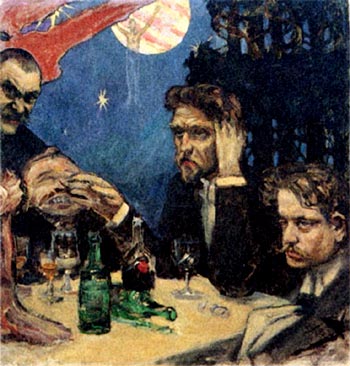
But I'll post more details later; the book will be out on Friday, 11st. The cover (which is simply great) is by Anssi Rauhala and you can see by taking a look at this how it refers to the famous painting by the Finnish artist Axel Gallén-Kallela.

Tuesday, June 01, 2010

Two Finnish pulp magazine covers


I took two (well, pretty lousy) snapshots of two Finnish fiction mag covers earlier today at the university library, where I was researching stuff for a book. (Have to say I got ideas for half a dozen books.) Here they are, both are from the Lukemista Kaikille/Reading For Everyone magazine that was published by Ilmarinen from the twenties to 1960.

The first one is by Martti Masala, who was really versatile and talented. He did lots of illustrations for the Ilmarinen publishers, week by week, and I'm sure he burned out, since he vanished from sight in the late fourties. Not much is known about him, but his illustrations are knock-outs.

The second one is by Poika Vesanto, about whom Timo Kokkila and Ville Hänninen made a good book a year ago.

Monday, May 31, 2010

Greek film noir pastiche Singapore Sling


Well, to call Singapore Sling a pastiche is a weird way to put it. Certainly, there's a lot of pastiche and parody of film noir in Singapore Sling, but it's a very far cry from your usual neo-noir. Singapore Sling is a disturbing stageplay of great perversity.

Directed by Nikos Nikolaidis, Singapore Sling starts with two women dressep up in sexy lingerie digging a grave and burying a man in there. It rains heavily down on this grim scene. It actually rains almost all the time through the film - one of the film noir touches in the film, an obvious allusion to The Big Sleep. These two women are a mother and a daughter living alone in a big mansion, talking about the killing of someone called Laura, a mysterious young woman who showed up in their house one stormy night. They restage the scene of killing her from time to time, as a foreplay to sex between them. From this point on, you know this film is not for everybody.

There's also a private eye (or a cop, it's never fully explained) who's looking for the same young woman, Laura (another illusion, this time to Vera Caspary's novel and Otto Preminger's film). The film uses a flashback technique to explain what has happened to the private eye, but everything is not fully out in the open. It's possible that Laura was a false identity to the young woman and she used it to escape the law - she seems to have killed someone. The private eye comes to the women's house, wounded from a gun shot, and is instantly taken into the weird sex roleplays the mother and daughter engage themselves in. There's a lot of bondage, whipping, vomiting, peeing and such in the film, and it's not very pleasant to watch, even though it's done with style, with a great detail in the costumes and such. The film is often quite funny, though, so it's not only disturbing. There's also less gore than one might imagine. Weird thing is that the private eye's private parts are never shown, even though the director doesn't shy away from showing a mother whipping her own daughter or the mummified father having sex with the same daughter.

There's just that the film seems a bit empty in retrospect. What's it about? What is the director trying to tell us? There are quite a lot of metanarrational techniques in the screenplay, and it's clear not everything we are shown really happens, but in the end the film seems just another postmodern pastiche ripe with empty irony.

Singapore Sling came out in 1990 and won some awards at film festivals, mainly for its direction and photography, which are very stylish. Then the film became more obscure and it vanished from sight, to be released on DVD in 2009.

Saturday, May 29, 2010

Salted coffee à la Lew Archer

For years I've been thinking that there's a scene in one of Ross Macdonald's Lew Archer novels, where Archer asks someone - a chef or some such - to put salt in coffee that's been forgotten on a coffee machine and reheat it. The salt is supposed to take away the bitter taste that's stuck on the coffee. I've mentioned this scene on one or two forums before - such as the Rara-Avis e-mail list -, but so far no one has verified there really is such a scene in one of Macdonald's novels.

But just the other day I was reading Ask For Me Tomorrow by Margaret Millar (you know, Ross Macdonald's wife) and there the scene was. Well, it wasn't actually what I had had in mind, but still close enough. Lawyer Tom Aragon has a cup of coffee with a woman who's related to the case he's working on and he thinks that a cinch of salt would take the stale aroma out of the coffee. Ask For Me Tomorrow is a book where Ross Macdonald's effect on Margaret Millar is very visible - in fact, some of the scenes could've well been written by Macdonald, especially the ones with Aragon. (The book changes the point of views pretty clumsily, and the ones without Aragon are not as worthy as the ones with him.) So, it's entirely possible that I've been thinking about this book - which I remember reading already in my teens, in the Finnish SAPO series in which Millar's novel came out in 1980 - and just getting it confused with a Macdonald.

Or then there is a similar scene in one of the Lew Archers. Maybe the writing couple did it on purpose. "You put this scene in this book, I put it here in one of mine."

As for putting salt in your coffee, just read this conversation thread.

And by the way, here's a recent post by Steve Lewis about Millar. There's some interesting discussion in the comment section.