Wednesday, May 14, 2014

Michael AKA Mike Hervey, pt. I

My forth-coming book on British paperbackers doesn't really cover the writers who specialized in short stories. There are two reasons for this: there were only few translations from those who wrote only short stories, and then again I haven't had enough resources to check the magazines that could've carried British writers' stories. The American pulpsters were covered in great length by mainly a one magazine, the Lahti-based Seikkailujen Maailma (The World of Adventures; see this post in English by me), but none were specialized in British pulps.

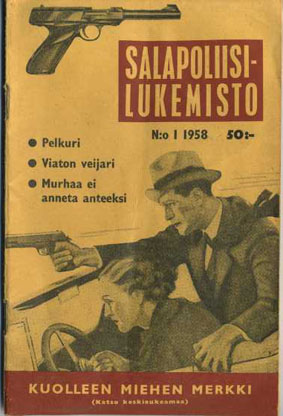
I do have sketchy entries for some writers from whom I found only short stories. One of them is Michael AKA Mike Hervey. Not many have heard of him during the past 30 or 40 years. He had lots of stories and serials translated in Finnish pulp and other fictionmags in the fifties. The magazine called Salapoliisilukemisto (The Detective Digest or some such) had issues that had only stories by Hervey in them!

Now, who was Mike Hervey? He seems a pretty enigmatic character in his own right. He wrote lots of cheap paperbacks for mushroom publishers like Forsyte and Mitre in the 1940s and 1950s. Many of his books are one-act plays or skimpy short story collections. The books have hardboiled titles like Dumb Witness or No Excuse for Murder. (The book in the picture is from 1946, hardback from Alliance, yet another publisher I've never heard of.) This guy wrote a lot.

But not for a great many years. Seems like his first book (Save Your Pity) came out in 1943 and his last one Crime a la Carte in 1953. His career lasted only ten years, yet he's said to have written 3,500 short stories.

There's something fishy about Mike Hervey. The Science Fiction and Fantasy Encyclopedia tells us more. He was born in 1915, but he told everyone he was born in 1920. His birth name was apparently Mark Hockman, but he used the name Mark Hoffman. Then he changed it into Michael Hervey. And then, in the early fifties, he moved to Australia. Therein he edited a magazine called The Mike Hervey Detective Monthly Magazine that a publisher called Transport put out. The magazine seems to have contained only stories by Hervey himself. (The Finnish digest I mentioned earlier probably picked its stories from this magazine, and only hell knows how the stories found their way into Finland.) And then it stopped in 1953. (The years are uncertain.) The SFF encyclopedia tells us Hervey died in 1979. What did he do for the last 26 years of his life?

And what was with the name changes and all? Was Hervey a swindler? Changed names to deceive those whom he owed money to? Or was he just a guy down on his luck who couldn't find any reasonable way to make his living? Anyone know anything about Mike Hervey? Did he change names again living in Australia and write something entirely else?

How are his stories then? I'll get back to them in a later post, now I'm slightly drunk and getting soon to get to bed.

Monday, May 12, 2014

Philip Chambers and Sexton Blake

Philip Chambers is a writer almost next nothing is known of. He was born in 1936, is possibly dead by now, wrote six Sexton Blake stories in the early sixties and nothing else. I've skimmed through his Blake story Bullets to Bagdad (1960) in which a secret organization is planning to take over the government in Iraq and take their oil supplies. In the story Blake's boss is and old man called Craille. He's the leader of the British counter-intelligence organization, as secret as the criminal organization in the book.

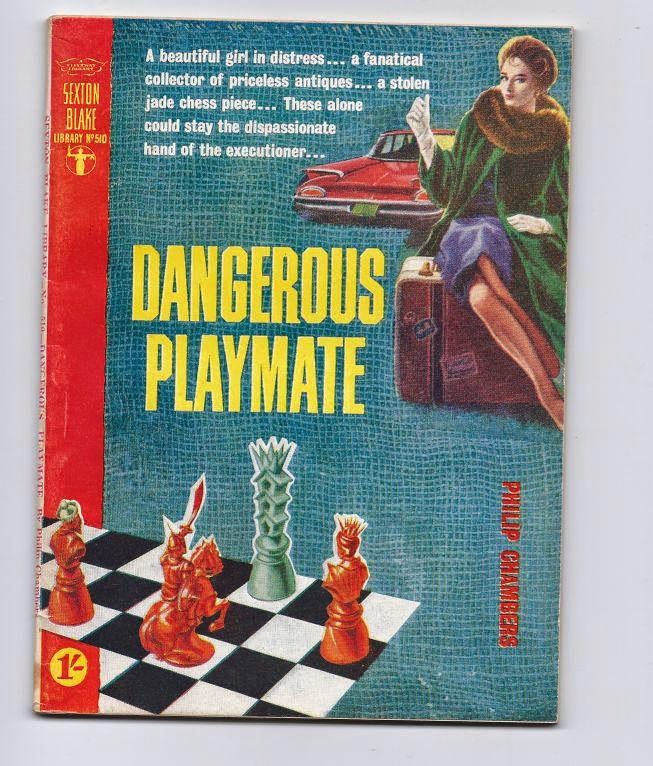
Here are some of Chambers's Sexton Blake covers. Pretty good ones, too, but I don't know the illustrator. There's a signature in Keep It Secret!, it seems it says "S. Barany".


Tuesday, May 06, 2014

Sean Gregory's serial hero Mack Regan

I'm sure not many of you have heard of Sean Gregory, not even by his real name, Harry Hossent. He started out in the early 1950s writing cheap crime hardbacks for Hamilton under the house name Jeff Bogar. He went on to write more thrillers in the sixties under his real name. He seems to have dropped out of the publishing business in the early seventies.

As by Sean Gregory he wrote some short paperbacks for the Tit-Bits Books paperback series in the early 1950s. (At least I think they were paperbacks, but I'm not 100 % certain. Hope someone can confirm this. I believe the books accompanied the issues of the Tit-Bits magazine.) His stories in that series were for some reason or another translated in Finnish in a paperback series called Max Strong (who was an Australian series character, but that's another story altogether). I've browsed through the three stories, here's a lowdown.

All the stories came out originally in 1954. The hero, appearing in all three stories, is one Mack (short for Mackenzie) Regan. He's a Hollywood PR agent, but in what I believe was the first story in the series, Murder Bangs a Big Drum, he's still trying make his living in Ohio. He gets a phone call from a Hollywood producer, who asks Regan to come down to Hollywood to prevent a young actor's name appearing in headlines. Reason: he's disappeared. It all ties down to a hazy union job. In Murder Makes the Corpse Regan is asked to write a book on an undertaker firm. He agrees, but finds out soon there's something fishy about the outfit. Murder Is Too Permanent finds Regan working for a gangster called Ricky Vescino. He wants Regan to make way for his beautiful wife and escort her into high society, but at the same time his own life is being threatened as someone wants to blow up his car.

The stories are old-fashioned private eye fun, nothing more, but nothing less, though. As I didn't really read the stories, I can't say how well they hold up, but if you come across them, I'll advise to take a look. Seems, though, that the Tit-Bits Books are hard to come by.

One more thing: Harry Hossent-Sean Gregory came up with some strange names for his stories. This seems a staple in this kind of private eye stuff. There are Bats Moloney, Lex Hupner, Alvar Domonici, Rafe Engels, Bull Gregow and Jed Yurfy, and there's also a heavy called Griff, which is a nod to a house name of British mushroom jungle publishers.

Photos accompanying the post are the covers of the Finnish editions of Sean Gregory's stories.

Monday, May 05, 2014

Frank Struan's other stories from Tit-Bits Books

Remember I wrote about Frank Struan's private eye booklet Murder's So Unpleasant? It was published in the Tit-Bits Books paperback series in 1954 and translated in Finnish some ten years later. The story features one Johnny July, and I got to thinking he might warrant an entry in the Thrilling Detective site, but I've now browsed through (note: not read!) Frank Struan's other translated titles and none have Johnny July in the lead. Of course there's a possibility that Struan has more stories that were not translated in Finnish.

Struan has another series character, though. His stories Tunnel of Nightmare, Ruthless Enemy and Fall Guy, all from Tit-Bits Books and from 1954, are spy stories about a British counter-spy called Fabian and his bosses called Delmer and Johnstone. The best of the bunch is probably Tunnel of Nightmare (Painajaistunneli, see the photo) in the beginning of which Fabian wakes up from the seedy side streets of the London port and seems to have lost his memory. Ruthless Enemy is about an East-European communist leader whom other commies want to kill. Fabian is set to protect him. I didn't really make any notes on Fall Guy, so I can't say anything about that.

There was still another piece by Struan in Finnish. The story The Girl from the Sea (yet another from 1954)
is about, well, a girl from the sea. A guy is swimming by the sea and notices a young woman is trying to escape from a ship that's anchored some hundred meters from the shore. It all has to do with the English nuclear weapons.

I'm a private eye man myself, so these spy stories didn't interest me as much. The stories seem competent enough, but they are no hidden gems.

I'm finally getting my Pulpografia Britannica - book on British crime pulpsters and paperbackers - together. It should be out in June. Don't know for sure yet, still got tons to do. I'll post some stuff on the writers therein in the blog for some days now.

Thursday, April 17, 2014

John Wainwright: four crime novels

As I mentioned earlier, I read four novels by British writer John Wainwright to be mentioned in my forth-coming book on British crime paperbackers. I've been at it for over ten years and I thought it would finally come out next Summer, but we'll have to see about that, as I still have loads of work to do. But now John Wainwright has finally been done with.

Wainwright is best known - if known at all today - for his police procedurals. He wrote some dozens of them saying he got his inspiration from Ed McBain and his 87th Precinct series and that clearly shows. The settings are realistic and Wainwright shows some critical insight into the society he writes about. There are lots of characters, all colourful. The police are a mixed bunch, some of them are almost crooks themselves, taking law into their own hands, some of them just look on from the side and realize there's no use getting mixed with their colleagues' doings. The actual crooks are very much crooks: sleazy low-life scum. This is one of the weakest things in Wainwright's police novels. He shows real contempt when he writes about the lower class people and their inhabitats. In Wainwright's novels there's also lots of dialogue. One can imagine being in a police station amidst all the nervous talk and shouting.

I read The Big Tickle (1969; Kurja päivä kuolla in Finnish) and Talent for Murder (1967; Huhtikuun murhat in Finnish) and liked the latter more, even though the former is more clearly set in the reality of the streets. The novel suffers from bad Finnish translation though.

Wainwright also wrote some middle-class tragedies. I read two of them, The Distaff Factor (1982; Tuomion jälkeen in Finnish) and Cul-de-sac (1984; Umpikuja in Finnish). Georges Simenon spoke highly of the latter, and it is indeed the better of the two in its depiction of a sad marriage that ends in the death of the wife. It's already declared an accident, when an eye-witness comes forward saying it was a murder, done by the woman's husband. Cul-de-sac is a dense book with a pleasing climax. I hope I'm not giving anything away saying Wainwright uses the same technique that made Gillian Flynn famous with her Gone Girl.

The Distaff Factor starts with a promising idea: the husband of a middle-class woman is declared guilty of maiming and killing three prostitutes. This one also has a twist in the middle and yet another in the end, but I wasn't entirely satisfied. The book drags somewhat in the middle and the end climax is both misogynistic and somewhat implausible. Yet it also shows Wainwright could really write tragedy.

Wainwright wasn't a paperbacker in his native land, but his books came out in paperback here in Finland, that's why I'm including him in my book.

Tuesday, April 15, 2014

Finnish film noir: some worthy specimens

The Warsaw Song, Chris Paischeff in the middle
Some weeks (or months?) ago I wrote a review of John Grant's A Comprehensive Encyclopedia of Film Noir and listed some Finnish specimens of film noir. I mentioned I'd be seeing some of them on big screen, since there was a festival of Finnish cinema here in Turku where I live and one of the themes of the festival was - ta-ta! - Finnish film noir. Here's a lowdown of the films I managed to see.

Varsovan laulu (The Warsaw Song, 1953, director: Matti Kassila): hardboiled and cynical tale of two booze smugglers, who struggle with love and lust. Very noirish with a downbeat ending and some quite seedy love triangle in the middle of the film. Chris Paischeff makes a very nice femme fatale in the lead. Suffers from the director's indecisiveness: there are two plotlines that don't mix easily. Suffers also from laughably props in the scenes set overseas.

Pikajuna pohjoiseen (Express to North, 1947, director: Roland af Hällström): I'm not sure whether this really qualifies as a film noir, but it has a very downbeat ending. The film seams almost effortlessly into a tragedy after being a thriller with comic overtones. Possibly one of the best Finnish feature films ever, reminiscent of English thrillers of the thirties and especially French films of the thirties and fourties. Set almost entirely on a train. Suffers from overacting at various points.

Silmät hämärässä (Eyes in the Mist, 1952, director: Veikko Itkonen): a very peculiar film about a writer who's down on his luck and drifts into a hotel room seeing four desperate-looking men in a room across the street. The writer imagines what has brought the men together. Their fictional story is told in a flashback (that has some flashbacks seamed in it), and in the end it's revealed the men's story forms the writer's new short story. Quite intricate with some good scenes throughout, but a bit contrived and not very plausible, but still possibly the most noir of the Finnish film noirs.

Joel Rinne gets mad in The Price for One Night
Yhden yön hinta (The Price for One Night, 1952, director: Edvin Laine): an attempt to bring the neorealistic formula of the films such as The Naked City to Finland. Succeeds at times, but is also unintentionally funny, especially in the scenes with criminals. On the other hand, Joel Rinne as the criminal mastermind gets into a Dennis Hopper craze as he twists his lady friend's head violently back and shouts: "Kiss Me! Kiss Me!" The film is fast-moving, though, and never really boring.

Olemme kaikki syyllisiä (We Are All Guilty, 1954, director: Aarne Tarkas): director-writer Aarne Tarkas was very interested in American film and film noir (and in American popular culture altogether, he picked his last name from ERB's Mars books!) and that shows in his comedies and crime films. This is a serious attempt to depict a doomed love story between a young man who suffers from mania and fits of rage and an innocent young woman who loves him first, but betrays him in the end. Quite believable and suspenseful to the end. I believe Tarkas himself suffered from ADHD that was left unattended, and I got to thinking this film might be something of a self portrait.

Tulio's The Criminal Woman
The film noirs I didn't manage to see:

Kultainen kynttilänjalka (The Golden Candelabra, 1946, director: Edvin Laine): crime film with gothic and comedy overtones. Never seen it, so can't comment. From what I've heard veers into camp.

Rikollinen nainen (The Criminal Woman, 1952, director: Teuvo Tulio): I've seen this earlier, a story of a woman who's driven mad by a jealous and abusive husband. I've written about Tulio earlier here.

These are of course not all the film noirs made in the Finnish studio system, I'm sure there's at least a dozen more. And of course there are some fringe examples, crime films that have lots of comic element in them, spy films made in the appropriate era, psychological thrillers that are devoid of the noir feel, pessimistic domestic dramas with downbeat endings etc.

I'm sure some of the films I mentioned above could be shown at a noir festival like, say, Noir City that has had British and Spanish film noirs during the past years. Paging Eddie Muller!

See also my posts on Finnish western films, part one here and part two here. And since this probably qualifies as an Overlooked Film post, go to Todd Mason's blog here to check the other overlooked films out!

Wednesday, April 02, 2014

Rapture, The Sniper, John Wainwright et al.

In the midst of life I find my hands full with work. So, here's only a quick update:

Michael Tolkin: Rapture: challenging film about religious hystery, seems quite underrated and somewhat ahead of its time ****
Edward Dmytryk: The Sniper: also ahead of its time in its depiction of a sexually frustrated serial killer, who kills young women with his rifle, but slightly muddled by some naïvety and too many policemen on screen! ***½
Robert Altman: McCabe and Mrs. Miller: has yet to be seen properly on big screen, but still convincing in its depiction of a frontier town, probably one of the very few really realistic westerns there are ****

I've also been reading - amidst the Finnish war stuff and some Tolkien (work-related both) - police and other crime novels by British John Wainwright, whose books are quite good, despite Wainwright's tendency to overwrite his rants about the slums and the people therein. Will get back to them later on.

Tuesday, March 25, 2014

Tuesday's Overlooked Film: Private Hell 36

Don Siegel was once one of the Hollywood's best paid directors, but his star seems to be fading. Does anyone anymore remember any other film by him than Dirty Harry? Yet he directed some thirty films, some very good (Charley Varrick, Hell Is for Heroes, The Killers, Flaming Star, The Beguiled, The Shootist and others), some quite good, all quite capable. 


Private Hell 36 (1954) is one of his lesser-known films, yet it's a very capable, at times a very good film noir with cynical characters and a downbeat ending. It was produced by Ida Lupino's and Collier Young's indie outfit called Filmakers (no Filmmakers!) and Siegel was brought in at a late date. Collier Young scripted the film originally for his wife, Lupino, but Lupino had already divorced Young and married Howard Duff, who plays the other lead in the film. The other lead is Steve Cochran, who's very good at playing a sleazy cop who wants to get some extra money and start all over with Lupino with whom he's fallen in love. 

Some of the scenes last too long (something that mars also Siegel's The Killers), but all in all this is a pretty effective low-key drama. I'd hope there was more action, as Siegel really knows how to edit fight and chase scenes. I'm not complaining, though. There's also some naivety in the outcome, especially Howard Duff gets out a bit too nicely. 

Comes highly recommended by me, even though this is no means perfect. 

I saw the film at the Finnish Film Archive's screening. Before the film, the film critic Tapani Maskula offered a half-hour lecture on how he met Siegel in Finland in the late seventies (you know, Telefon was filmed partly in Finland) and discussed Siegel's fifties' films. Siegel told for example that while filming Private Hell 36 the lead actors were often suffering from hangover. There's a scene with Ida Lupino in which she's sitting on a bumper of a truck. Lupino had said to Siegel that he'd better shoot the scene quick, since she's about to throw up. And you can see it in the scene. It works miracles. Lupino has never looked so vulnerable, tired, bored and broken. 

More Overlooked Films here.

Wednesday, March 19, 2014

Bibliographic puzzle: Ronald Wills/Hans Vogel: What Comes Next?

I've dealt in my research with some bibliographic problems before, but this one is a real puzzle. I don't even know where to start.

Okay, there's a paperback published in Finnish in 1955 called Hän ei tullut kotiin. It translates back as "He Never Came Home" or some such. It's a private eye novel about kidnapping of rich kids. Now, there's no book under this title (or actually there almost is, but it's not this one). The Finnish translation is credited as by Ronald Wills. There really was a writer called Ronald Wills. His real name was Ronald Wills Thomas. He lived from 1910 to 1969 (or possibly 1955) and wrote crime novels starting from 1950, ending in the early sixties. He used pseudonyms, such as Jeff Bogar (a house name) and James Cadell.

As Ronald Wills he published four crime novels in the early fifties, but they all seem to have something to do with fishes and fishing, and this here novel doesn't, so it's not any of them. What is it then?

The Finnish translation - at least my copy doesn't - doesn't give away the original title, but the bibliography of crime fiction published in Finnish and the Finnish National Library database both say it's What Comes Next? Now, that is a real novel, published in 1953 by the paperback house Scion. It was published under the house pseudonym Hans Vogel. And sure enough, the Finnish book has Hans Vogel as the hero. (Can you think of a more un-American name for a private eye?) But this isn't over yet. The British pulp and paperback scholar Steve Holland says in his blog that What Comes Next? features one Scud Keddell as the hero. And "He Never Came Home" doesn't have anyone called Scud Keddell. (And furthermore What Comes Next? isn't supposed to be written by Ronald Wills. Actually Ronald Wills doesn't seem to have written anything under the Hans Vogel house name.)

So, what gives here? Is this written by someone else entirely than Ronald Wills? Is this something entirely else written under a pseudonym by Ronald Wills, but published in Finland for some reason under his real name? Anything written as by Jeff Bogar doesn't even remotely sound like the book at hand. Or is this something that's been published only in Finland? As you might remember, while doing my first book, Pulpografia (on American crime paperbackers), I found out there were some dozen American books that were never published in the US, but published in Finland and/or Scandinavia.

different book published as by Hans Vogel
What's the book about? Oh, that's a different issue altogether. The book is a sorry mess, but somehow intriguing. Hans Vogel is a private eye working for the FBI (which, by the way, is spelled as FIB in the Finnish book), he handles very special cases. Now, there's a gang kidnapping small children of rich families and Vogel is hired to investigate the matter. He uses some strange methods that don't seem very professional. We never believe that this is a real private eye. Also we never believe this really takes place in the US, which is quite common for the early British crime paperbacks.

There are some truly odd moments throughout the book. Hans Vogel is for example tortured by boiling his feet in hot water. His skin peels off, but somehow he manages to still walk and drive a car. Okay, he admits he feels pain. There's also an odd perversion for talking about Nathaniel Hawthorne all the time - or actually "Nat", as Hans Vogel calls him. In the end Hans Vogel gets the kidnappers with the help of some 13-year old kids who are out playing Wild West with real-looking guns. The book is filled with erotic scenes, but nothing happens in them, they are just Vogel's descriptions of good-looking ladies in erotic costumes, such as silky night gowns. And this is what drove writers and publishers to jail?!

This is in no way a good crime novel, let alone a good novel, but there's something fascinating about the badness and weirdness of it. But the main thing here is the bibliographic puzzle. Can anyone help? I'd really love to solve this, but I don't know where else to look.

Tuesday, March 18, 2014

Basil Copper's Mike Faraday

In my on-going research into British pulp and paperback crime writing, I read the two novels by Basil Copper translated in Finnish. Both have Copper's private eye Mike Faraday as the hero, and both are pretty basic old-fashioned hardboiled private eye stuff.

Flip Side (1980, translated as Kuoleman kääntöpuoli/"The Flip-Side of Death") puts Faraday delve into the international jewel trade. Snow Job (1986, Älä huoli huomisesta/"Don't Worry About Tomorrow", meaningless title if there ever was one) has Faraday look into the drug trade, even though he doesn't know that from the start. Copper knows his business: in the end Faraday is investigating another case than he's originally hired to investigate. He runs into corpses and beautiful, but deceitful ladies, heavies with guns in their hands, all that stuff that's been known since Black Mask and Dime Detective made the cliches popular. The books were entertaining enough and Copper keeps the story moving, but there's still one problem: I've almost forgotten what happened in them.

Basil Copper also wrote some high-regarded horror stuff which I haven't read. He also wrote the Solar Pons stories after August Derleth died. I think I've read some of Derleth's Solar Pons stories, but none of the Copper ones.

The books in the picture above. The right one has the cover illo by Kari T. Leppänen, who's best known for his work in the Phantom magazine for the Swedish publisher. It's quite nicely done, but it's also pretty static for a hardboiled private eye novel.

Thursday, March 13, 2014

Väinö Linna: The Unknown Soldier (1954)

Due to a book project I've been working on, I started to read Väinö Linna's classic war novel Tuntematon sotilas/The Unknown Soldier for the first time in my life. I'd earlier avoided the novel, mainly because I've always been a bit irritated at the notion of books one has to read for reasons larger than life (i.e. patriotism or the Fatherland or some such nonsense), but I was very glad to note I liked the book, was even thrilled by it.

The Unknown Soldier tells about the so called Continuation War in which Finland and the Soviet Union fought against each other. The war started in 1941 and ended in 1944. One of the biggest questions in Finnish history is whether Finland fought alongside Nazi Germany or whether it had its own war with the Soviets. The book is one of those realistic war novels, with the eye sight fixed on the everyday of the battling soldiers, their camaraderie, their fears, frustrations, hopes and anger. There are no heroes in this novel. The war is ugly, chaotic and violent. No one knows why they're fighting - only the higher officers have some idea and even that is filled with stupid notions of Greater Finland.

The Unknown Soldier has dated somewhat and we've had more realistic war novels since, but what keeps the book fresh is that it's polyphonic. There's not a single truth in the novel, there are only multiple narrators (or, actually, narratees) that present their variations of the situation. Linna writes warmly and empathetically of each and everyone of them, even the most obnoxious officers. And his battle scenes are quite good. He really captures the chaotic essence of war - well, as well he should, since he was himself at the war.

The book is available in English. The English translation came out from Putnam in the US and Collins in the UK in 1957, and I believe it was the same translation. For some reason or another, the translator's name isn't mentioned anywhere in the book. The translation is abridged (the reports on how heavily differ), and it's also clumsy with the Finnish idioms (which the book is full of). It's a miracle the translation should be so bad, since it's reported to be the work of one Alex Matson, a Finnish literary essayist, who spent many years in the 1920s living abroad and travelling the world seas. (Thanks for this tip to Ossi Kokko!)

However, it's the only English translation, and it's been used repeatedly even by Väinö Linna's Finnish publisher, WSOY (see the photo above for their edition). They've published several editions of the English translation - still with no translator's name attached. Seems like you could manage to buy the book via Amazon.

There's also the Ace edition from 1958, which is seemingly scarce (see above). The cover illustration is made by someone famous, but I forget who. The illustration was used in Finland in some entirely other paperback, but I forget even that one!

Edit: there's a small news item from 2012 saying that Penguin has bought the rights for Linna's novel and they are putting the new translation out in the near future. Liesl Yamaguchi is the translator.

Tuesday, March 11, 2014

Tuesday's Overlooked Movie: Ravenous

I remember Ravenous being shown in Finland at some film festival in 1999 or 2000, but it was deemed X-rated and the distributor backed down. The film was never shown commercially in Finnish theaters, it was only released in VHS with five minutes of gore cut away, and then in 2005 in television. I don't know whether the TV version was intact. I watched the old VHS I'd bought at some point, but failed to watch until now. It was released as Erämaa syö miestä ("The Desert Eats Up the Man" or some such nonsense).

Ravenous follows the story of Alferd Packer (I believe it's supposed to be written that way) and the pack he was leading into the wild that gets lost and has to resort to cannibalism. Ravenous takes the storyline a step further developing it into a serial killer story, with lots of satiric overtones and black humour.

And at times it works very well. The first half of the story is intriguing, but then it gets bogged down by some implausible plot twists. They keep the story moving, however. The ending is a bit over-the-top, but there's still some funny stuff in there. The feel for human flesh never goes away.

I realize I haven't seen the film in its full gory, but it still comes recommended by me. There's one interesting point still: the film was directed by Antonia Bird. There aren't that many female directors out there making westerns, let alone gory horror westerns. Bird was however only appointed director of Ravenous after the original director took off. Her earlier film Priest was excellent, however. I see she died last year. Did Ravenous destroy her career? She never made another feature film. (Then again she did films for TV, and I was told she herself said she preferred working for television.)

Also of merit is also the soundtrack by Michael Nyman and Damon Albarn (of the Blur fame). It's often contradictory to the image we see on the screen, but that makes an interesting effect.

And oh, here's my review (amongst others) of an earlier film based on the same Alferd Packer incident. Ravenous is 1,000,000 times better.

More Overlooked Movies here (whenever Todd gets the chance).

Sunday, March 09, 2014

Malcolm MacKay: The Necessary Death of Lewis Winter

It's always very welcome when a new noir author gets translated in Finnish. Malcolm MacKay's short novel The Necessary Death of Lewis Winter came pretty quickly out in here: it was published originally in 2013 and the translation came out just in the beginning of this year (under the title Lewis Winterin on kuoltava).


MacKay's book is about a hired killer, Calum McLean, who's almost autistically meticulous in his methods. The book is also about his target, a small-time drug dealer whose name is given out in the title. He leads a boring life with a younger woman who still wants to party and drink all night. There's lots of intriguing melancholy here. 

The first half of the book is quite good. MacKay writes short, somewhat repetitive sentences, and their rhythm grabs you. But then after the target's been hit, the novel bogs down for some reason or another, even though there's a surprise twist and an open ending that comes as a bit of a shock. I can recommend the book, though it wasn't totally satisfactory. 

Wednesday, February 26, 2014

Tuesday's Overlooked Film: The Reflecting Skin


I remember being very impressed by Philip Ridley's first feature film The Reflecting Skin back in the early nineties. And I wasn't the only one. The film was being shown at cinema clubs all over again and everyone loved it.

But then it vanished. There has been no proper DVD publication, and at least the Finnish VHS publication is pretty scarce. In Finnish television it's been shown twice, last in 1998. So it was no wonder there was quite a lot of people at the Film Archive screening of the film last Monday.

The film is still hauntingly beautiful, terrifyingly funny, tragically sad, absurdly real, full of grief, fear and laughter. It's a morbid film, but it's still full of warmth towards the people in it. Lots of these weird genre hybrids are devoid of feelings, but The Reflecting Skin is about real people and their real feelings, even though they are all pretty sick and weird. There was one young dude in the audience saying the film seems more like a curiosity, something no one's ever heard of, but then again he was two when the film came out. I'd like to ask him what he thought of the film after he'd seen it.

More Overlooked Films at Todd Mason's blog.

Sunday, February 23, 2014

Nicolas Winding Refn: Valhalla Rising

I never blogged about Only God Forgives, even though I liked it to a certain extent. It was very exciting and interesting and extremely well done and beautiful in all its gore, though I never knew what Nicolas Winding Refn was talking about in his film.

Same goes for his viking epic Valhalla Rising (if you can call a film that has only some dozen people in it an epic). It's not as well made as Only God Forgives - he was clearly given a bigger budget for his OGF after the popular Drive. Valhalla Rising is just as baffling as OGF. It's something Jim Jarmusch might make out of an unproduced Robert Bresson script collaborating with Antonin Artaud. Very strange and impenetrable, but still somehow fascinating. But not as fascinating as I'd hoped it to be. Three stars out of five - or maybe three and a half.

Wednesday, February 19, 2014

Akiva Goldsman: Winter's Tale

Akiva Goldsman: The Winter's Tale: uneasy mix of whimsical fantasy, some scary and not-so-scary devil horror and sentimental coffee table book "wisdom". I haven't read Mark Helprin's 1,000-page novel, but seems like lots has been cut down in the film, which makes the bad parts show up.

Monday, February 17, 2014

Stephen Graham Jones: The Last Final Girl

Here's a book I really wanted to like, but didn't for some reason or another get in. I understood Jones's idea of a metafictional book that takes place inside a film or a TV show, but this just didn't grab my interest the way I thought it would. I'll give it another try later, and I'm definitely interested in Jones's output which seems to mix noiry edginess with ultra-violent horror. Sounds definitely my kind of stuff.

Thursday, February 13, 2014

Michael Koryta: The Ridge

Recently read: Michael Koryta's horror novel The Ridge. I'd read earlier one of Koryta's PI novels featuring Lincoln Perry and liked it a great deal (read the review here) and I grabbed this from the book store's sale. The Ridge is an entertaining horror novel with an interesting and an original premise - at least I haven't seen it used much. And there are some interesting locations, such as a shelter for big felines and a lighthouse nowhere near the sea. As in Koryta's PI novels, the mystery is rooted in the old times, where things were crueler than they are now. There's some truly fascinating stuff behind the lighthouse an old man has built for himself.


Koryta also writes in a clear and easy prose that's not overtly sentimental. There's an edge of noiriness in his words sentencens. The Ridge comes off as a quiet novel about the futile efforts of man. His people and the ending of the book are sad, as befits the horror genre.  

Tuesday, February 11, 2014

Tuesday's Overlooked Film: Stanley Kubrick's Fear and Desire (1953) and an assortement of other strange films

Fear and Desire
We had another film festival at the cabin with some friends of mine. (Here and here are posts on the earlier festivals.)

One of the most interesting films we watched was the first feature film by Stanley Kubrick, Fear and Desire (1953) that Kubrick himself had put a ban on, so it hasn't been legally been available for decades. It's recently been released on DVD and is easily available. None of my friends had seen it, so it was all new to all of us.

It's a war film set somewhere in an unknown war, so it's heavily symbolic and abstract to the edge of being almost meaningless. Fear and Desire was written by a playwright, Howard Sackler (who also wrote Kubrick's second film, Killer's Kiss), so it's no wonder it resembles an absurdist play a lot. At times it gets bogged down by hilariously "deep" dialogue and monologue, but the first half-hour is actually quite good. Kubrick - who himself shot and edited the film - edits quirkily, against the rules, using quick flashes of people's faces and pieces of action. Kubrick was at least in the beginning of his career a noir director and there's a strong noir feel also in this little war film. It's an intriguing film, well worth a watch.

Other films with snappy mini-reviews and starrings:

The ass of the Machine Gun Woman
Ernesto Díaz Espinoza: Bring Me the Head of the Machine Gun Woman (Chile 2012): sounded great, but proved amateurish and boring.

Lucio Fulci: Beyond (Italy 1981): confusing and dead-serious zombie flick. **

Willard Huyck: Howard the Duck (USA 1986): absolute bore-fest, with people (and the duck) just shouting, running and jumping all the time. *

Kaarlo Kortelainen: Makkarakalakeittoa, sano Tympee Huttunen/Sausage fish soup, said the Grumpy Huttunen (Finland 1988): one of the worst films ever, only video-released calamity shot somewhere at a deserted cabin and in near-by woods. Very hilarious. * or *****

Veikko Itkonen: Mullin mallin/Topsy-turvy (Finland 1961): nonsensical and incoherent musical comedy made near the end of the Finnish studio system. Probably one of these: * or ****

Adam McKay: Anchorman (USA 2004): I'd never seen anything by Will Ferrell, but even though this was mildly funny, I don't feel an urgent need to watch more of his films. **

Robert Culp: Hickey & Boggs (USA 1972): pretty hard to follow without subtitles, but still great early seventies' crime flick, without any of the genre trappings. ****

Lucien Castaing-Taylor, Verena Paravel: Leviathan (USA 2012): experimental documentary of a fishing ship somewhere in the Atlantic, quite hypnotic at times, but don't go looking for a content. ***½

Tobe Hooper: Lifeforce (USA 1985): interesting movie about space vampires, but even though the main monster is one of the most beautiful women in the history of cinema, suffers from too much length and uninteresting lead actors. **½

Andrzej Zulawski: The Third Part of the Night (Poland 1971): very interesting allegory on Communist Poland, with lots of grotesque and surrealistic imagery thrown in. ***½

Fred Cavaye: Point Blank (France 2010): capable and snappy thriller. ***

Kinji Fukasaku: Message from Space (Japan 1978): a hapless Star Wars clone should've been more hilarious than it really was. **

Albert Band: Zoltan, Hound of Dracula (USA 1978): I didn't watch this myself, but from what I gathered is either * or *****

Ismo Sajakorpi: Merkitty/Branded (Finland 1984): early Finnish horror TV movie, not bad, but somewhat dated. ***

Steve Carver: Lone Wolf McQuade (USA 1983): hilariously serious Chuck Norris vehicle, quite entertaining if you're willing to forget it's very stupid and clichéd. **½

More Overlooked Movies coming in at a blog near you!


Monday, February 10, 2014

The 2000th blog post of Pulpetti


I've been thinking a lot lately of what I should be writing here now that I have reached the 2,000th post line. I've been unaware of whether I should just do a regular blog post (I have several things coming up) or whether I should do a long special post – and if that, what should it be? One subject I thought of was the history of this blog – but is anyone interested? My 1000th post was a long article on H. A. DeRosso. (For some reason many people have read this minuscule write-up on my 1900th post.)

There hasn't been much going on here at Pulpetti. I've been lazy for the past two or three years. At first I used to write one or even two posts per day! I can't grasp where I found all that time, still working my ass off writing books and newspaper articles and reviews of books and films and what not. I don't seem to be able to find that time even now when I seem to have less work at my hands than, say, five years ago. And some three years ago I decided I should concentrate more on my Finnish blog (here at Julkaisemattomia, meaning The Unpublished, the name I've been trying to get rid of). Hey, I'm a Finnish writer after all! My readers are Finnish, so why promote in English?

But then again I've made some friends with Pulpetti: Kevin Wignall, Todd Mason (acquaintance also from several Yahoo groups - and yet another thing I don't have time for anymore!), Bruce Grossman, James Reasoner, Bill Crider... Pulpetti was also elemental when I started editing the crime paperback series for the Arktinen Banaani publisher some years ago. The series didn't last long, but the books are still out there, here's hoping someone will find them and become a writer and write the goddamnedest book in the annals of the Finnish literature. And there's also this point: I really want to write about this pulpy and sleazy hardboiled stuff, I'm not sure if there's enough interest with Finnish readers to warrant a whole blog in Finnish. (I sometimes get the feeling that even though there's much love for, say, James Ellroy or Charles Willeford in Finland, there's not much interest for new writers in this genre we so affectedly call noir. Maybe that's the case everywhere.)

I've been working on a book that will be called "Pulpografia Britannica", focusing on the British crime fiction published in Finnish in cheap paperbacks or pamphlets. I haven't written about those books as much as one would hope, and I have a hard time explaining why that is. (One explanation is that I haven't really read all the books I'm covering, some I've just sampled or browsed through.) There are some writers I'd really like to cover (Angus Ross, for example), but at the same time I've been reading lots of other books, for example the new Finnish translation of James Fenimore Cooper's The Deerslayer which I painstakingly tackled through for a review. (I don't think I'll be reading the other books in the Leatherstocking series, though there will be new translations for all of them.) At the time I'm tackling through the collection of Bruno Schulz's weird surrealistic stories, again for a review. I should be writing about them as well in here. Why don't I? It is at times pretty hard to write something substantial about a book or a film in a language that's not your own. Try it someday! I don't know how people like Nabokov or Conrad did it. (Well, they were idiosyncratic and not easy writers, Conrad being even clumsy.)

I didn't mean this to get so wordy and, well, pathetic? Suffice to say that even though I've been thinking about quitting Pulpetti, I'm sure I'll keep on posting stuff about books and films and stuff.

When I posted the above-mentioned 1900th post, Jerry House (whose blog I should be reading more) said I should send a cake to every reader of Pulpetti, when I reach the 2000 limit. So here's cake to everyone out there!

Friday, January 31, 2014

John Grant's massive encyclopedia of film noir

One of my Christmas presents was this huge film noir encyclopedia by film historian John Grant. I asked for it on purpose, because I had a hunch I'd enjoy the book.

And I most certainly did. Grant's book commands respect. He covers 3,500 films, both classic films noirs of the Golden Age of Hollywood and later neo-noirs of the 1970's, 1980's and 1990's. He also includes lots of forgotten gems no one's ever heard of and has a feel for the Asian films as well. Grant knows his stuff and writes well. He has also nice things to say about some underrated films.

There are some problems with the book, though. The main thing for any reader is that it doesn't have a proper index. Some actors and directors are indexed, but it's a frustrating collection of only the most famous names. The point of this kind of book is the info on less-known films and directors, although Grant gives nice mini-essays also on well-known films, such as Citizen Kane. The info on the films is at times a bit thin, sometimes Grant provides only a short synopsis. And I happen to have a habit of skipping synopses and going straight to the review or the analysis part.

Grant also includes films I have a hard time to accept as noirs, mainly from the eighties and nineties, such as Ridley Scott's Black Rain, Gregory Hoblit's Primal Fear and Alan J. Pakula's Presumed Innocent. Are these noirs?

It's of course possible to say that it's better to give too much information than too little of it. Grant also includes films that are only fringe noirs, such as British suspense fillers from the fourties. It's unlikely they are full of sound and fury and despair that describes some of their Hollywood counterparts. But it seems Grant allows for many kind of definitions of film noir, even contradictory. He discusses these definitions in the foreword, giving out examples and thematic similarities, but still seems like his definition is too wide. I'm not really complaining, mind you, it's interesting to read also about those films.

I could find some films that Grant hasn't mentioned. What about Stark Fear from 1963? Radio On from 1979? I also checked - rather painstakingly because of the absent index - all the films based on the books and screenplays by Jean-Patrick Manchette. There's only one mentioned!

There are also some glaring omissions of foreign films noirs. It's understandable of course, when there's only scarce or no information on them easily available. Then again there are lots of non-Hollywood films Grant mentions I've never heard of (and likely will never see) from, say, Spain or Greece. Grant mentions some Finnish films as well, but he has only some three films by Aki Kaurismäki and one (half-Estonian) by Ilkka Järvi-Laturi. All of them are neonoirs from the eighties and nineties, while there were lots of studio-era films noirs made in Finland. Here are some of the classic Finnish films noirs for you:

Teuvo Tulio: Rikollinen nainen (The Criminal Woman); Sellaisena kuin sinä minut halusit (The Way You Wanted Me); Rakkauden risti (The Cross of Love) (all sleazy melodramas)
T. J. Särkkä: Kuu on vaarallinen (The Moon is Dangerous,  pure James M. Cainish stuff about a wild woman charming an older guy)
Roland af Hällström: Pohjoisen pikajuna (The Express Train to North, suspense in a train)
Edvin Laine: Musta rakkaus (Black Love - hey, even the title is purest noir!)
Matti Kassila: Varsovan laulu (The Warszaw Song; about smuggling); Tulipunainen kyyhkynen (The Crimson Dove, psychological suspense)
Veikko Itkonen: Silmät hämärässä (The Eyes in the Mist, one of the purest films noirs in Finnish cinema)
Aarne Tarkas: Olemme kaikki syyllisiä (We're All Guilty, what could be more noir than that?); Hän varasti elämän (He Stole a Life, marvelous Psycho pastiche, made already in the early sixties, absurd and darkly funny)

There are lots of others, but these came off top of my head. There are also many humorous crime films that because of the time they were done and the black-and-white photography are mentioned as films noirs, but I'm not sure whether they qualify. Some of the films mentioned above will be screened at the Festival of Finnish Cinema later in the coming spring, I'll write more about them then (as I did last year about Finnish westerns, see here and here).

As Grant also has lots of neonoirs in the book, here's also a list of Finnish neonoirs:

Pauli Pentti: Pimeys odottaa (The Darkness Waits); Macbeth (b&w rendering of the Shakespeare play)
Pekka Hyytiäinen: MP - minä pelkään (IA – I'm Afraid, uneasy but very hypnotic mixture of experimental dystopian film and some very personal horror; Hyytiäinen's other indie-produced films might also qualify, but they are very hard to come by)
Veikko Aaltonen: Tuhlaajapoika (A Prodigal Son, sleazy scumbag noir with S&M undertones); Rakkaudella, Maire (With Love, Maire, very stylish piece of Hitchcockian noir)
Petri Kotwica: Musta jää (Black Ice, family noir)
Ville Mäkelä: Lain ulkopuolella (Outside the Law, a vigilante film)
Taavi Kassila: Petos (Betrayal, a nice piece of epoque noir)
Mika Kaurismäki: Condition Red (Aki's brother's film filmed somewhere in Texas)
Visa Mäkinen: Yön saalistajat (The Predators of the Night,
sleazy hardboiled crime film from the only proper exploitation director-producer of the Finnish film history)

(Too many links to provide here, sorry - Google them or check them at IMDb!)

All in all, John Grant's book comes highly, highly recommended by me.

Thursday, January 30, 2014

What did I say about noir in Hollywood in the 2010s?

Remember what I said about new noir films in Hollywood? See my post on Denis Villeneuve's Prisoners here.

I stumbled on a post at Hardboiled Wonderland listing the best crime films of the last year. Seems there are more noir or at least noirish crime films out there than I first realized. I hated The Counselor, but Jedidiah Ayres writes interestingly on other films he mentions. (Of course not all the films are Hollywood, but nevertheless.)

Tuesday, January 21, 2014

Tuesday's Overlooked Film: Heathers (1988)

I finally saw this cult classic from the late eighties. Watched it from an old VHS, and over at Facebook a friend said that it's a film that just has to be watched from VHS.

There is indeed certain charm that only low-budget 80's flicks have. But that aside, this is a neat quirky little film that has lots going for it: young Winona Ryder and Christian Slater with their snarling accents, taut script by Daniel Waters (I believe he won the Edgar for the script) and funny late eighties' costumes. The story about two high school lovers who start killing their school mates is twisted and funny. Slater's behaviour is never really explained, which is a good thing, since it might've been awkward. There are also some implausibilities as comes to the behaviour of Winona Ryder's character and her behaviour. The ending with Ryder starting to befriend the high school fatso didn't feel right, even though I can see why they did it that way.

Nevertheless, this is a fun film that hasn't dated badly. (More Overlooked Films here.)

Thursday, January 16, 2014

Denis Villeneuve: Prisoners

I just saw this in a movie theater (a press screening) and I was totally overwhelmed! What a movie!

The story about two missing kids and their families going through a heart-breaking and violent tragedy might play out sentimental and simplistic, but Denis Villeneuve, in his first Hollywood outing, keeps things both fragile and rough at the same time. You can feel the tension in the pictures, in the actors' movements, in the saddening Pennsylvania milieu the film takes place in... Although there are some things that were done less or more slackly, I'll give this five stars out of five.

It must've started out with Winter's Bone. There have been lots of recent interesting and touching films that have crimes in them, but are not crime films per se: Place Beyond the Pines, Paperboy, Mud, Take Shelter, End of Watch... There are also Andrew Dominik's admirable Killing Them Softly and William Friedkin's sick but funny Killer Joe, not to mention Nicolas Winding Refn's Drive and Only God Forgives and Harmony Korine's Spring Breakers.

Noir thrives in Hollywood.

Tuesday, January 14, 2014

Tuesday's Overlooked Movie: Year of the Dragon

I watched Michael Cimino's 1985 film from an old VHS cassette, afterwards I threw the cassette away. Why? Because I want to get rid of my old cassettes - of course only those that can be replaced. But seems like everything is replaceable nowadays. I'm not sure whether that's a good thing or not.

I'd seen Cimino's film earlier - some 20 years ago, or even longer ago - and it hadn't made much of an impact on me. The same thing happened also at this time. One might blame the fact that I watched the movie from a worn cassette with possibly a wrong picture ratio. But still I find I wasn't very intrigued with Cimino's script and his characters. I'm not sure if I ever want to try to see this on big screen.

Even though there might be much to like in the film for someone who likes his crime fiction heroes despicable. Mickey Rourke is not bad in Year of the Dragon, but he's overdone with his fedora and long overcoat. His motivations are not very satisfactorily explained and he almost comes off as the hero, even though he's shown to be a bully and racist. This is a very contradictory film at its heart.

There are many great scenes in the film (such as Chinese drug lord John Lone's visit to Thailand, also the shootout near the end is expertly done), but there's also the stacked-on ending, which is really unfitting. And then there's the scene in which Rourke almost attacks a woman after which the said woman starts kissing Rourke... You'd think they wouldn't have done these things in this way in 1985, but hey, what do you know?

More Overlooked Films here. (Seems like only later on.)

Thursday, January 09, 2014

Unused Finnish cover for Jason Starr's Fake ID

Can't believe I haven't posted this earlier.

Remember when I used to edit the noir paperback series for a Finnish publisher, with books by Duane Swierczynski, Christa Faust, Scott Phillips and others? Well, the story didn't end well, since the line was canceled after six books. The format was changed into hardcover, but that didn't help.

I'd already translated Jason Starr's excellent Fake ID over years ago and it was scheduled to come up next in the series, in hardcover. Ossi Hiekkala made this very nice cover illustration to go with it, but the book never came out, due to many reasons. I can't really tell you how sorry I'm for this.

Tuesday, January 07, 2014

Joe Gores: Interface

After reading for years praises for Joe Gores' 1974 novel Interface I decided finally to read it during the holidays. The book is a private eye classic, but not anything Chandler or Macdonald might've written. It's a tense novel in which the private eye is no hero. He works with the crooks, for the crooks, against the crooks. He's no tarnished knight.

The "he" of the novel is Neil Fargo, but he's not the main protagonist of the book. There's also one Docker, half-crazy and violent Vietnam veteran, who in the beginning kills two guys and steals an attache case full of drug money. This takes place already in the midst of events, as Gores doesn't give anything away for the reader. He also writes in a terse, behaviorist style that stays away from depicting what the characters are thinking at any given moment or what they are driving at with their actions. This made - at least for me - pretty difficult to get into the book. The rhythm started to feel easier in the middle of the book. There's a mesmerizing twist in the end, but even that's not very easily narrated.

I'd really like to read this in a good translation - it's never been translated in Finnish, I don't know why (some other books by Gores have been) -, but somehow I don't think that's gonna happen. Still, a very good book that comes highly recommended.

Saturday, December 28, 2013

Friday's (or actually Saturday's) Forgotten Book: Victor Gischler: Go-Go Girls of the Apocalypse

Back in the days when I was planning and editing the short-lived paperback series of the Arktinen Banaani publishers one of the manuscripts I was sent was Victor Gischler's Go-Go Girls of the Apocalypse. I didn't read it at the time, because it seemed obvious from the start that the series wouldn't continue for long. I'd read Gischler's Vampire A-Go-Go and enjoyed it, but thought it wouldn't fit the paperback line easily; here's my blog post on the book. The manuscript of Go-Go Girls of the Apocalypse I'd printed out came up when I was cleaning my desk before the holidays and I decided I'd finally read it, but instead of reading the book from the printed sheets, I ordered a copy from a web store.

I'm glad to tell you that Go-Go Girls of the Apocalypse (GGGOTA) is a very good book. It's funny, exciting and violent, but there's also some warm humanity in the depiction of the protagonists. The set-up is good: one man has lived in a cage for nine years after the apocalypse (which is explained away in a short sentence, which is a good thing) kills three mysterious men he encounters in the woods and starts to think he should try to find out what's happened to the mankind. He also misses his wife he hasn't seen in nine years. Not all about their marriage is explained in the beginning and Gischler keeps important things away from sight till the second half of the book. The collapsed society of the near future is plausibly done, even though it's a mix-up of westerns and Mad Max. Gischler takes things over the top, but does that very well. GGGOTA is a grand adventure in the style of Huckleberry Finn. I would've gladly taken the book in with the Finnish paperback series, but alas the series didn't see the light of day after five books (and four that came out in hardcover - the format change didn't change a thing, even though we added two Finnish books in the bunch).


GGGOTA may not be to everyone's taste, but I liked the heck out of it. One point, though: I didn't like the scene with the crazy man-hating transsexual.

It seems Gischler managed to fund writing the sequel, but the book doesn't seem to be out as yet.

Didn't mean to do this as a part of the Forgotten Books meme, but here's a link to Todd's blog with the other links.


Monday, December 23, 2013

Saturday, December 21, 2013

Christa Faust: Choke Hold

Some of you may remember that I had a hand in getting Christa Faust's admirable paperback original Money Shot in Finnish in the all-too-short-lived paperback series of the Arktinen Banaani publishers. The book is very good and got some good reviews (some bad as well), but it sold zilch. So the sequel, called Choke Hold, never came out in Finnish.

Which is a pity, since Choke Hold is a very good book as well. Truth be told, I didn't read it until now. I can't explain how this came to be, but now it's finally read - and as I said, it's a great book. It has the same virtues as Money Shot: non-stop action, solid characterizations of fallible human beings, no-nonsense narration and witty banter both in dialogue and the voice of the protagonist, ex-porn actress Angel Dare. She's in witness protection program, but her past - told in Money Shot - gets back to her and she has to flee.

Choke Hold is a short novel, read almost in a jiffy, but in this kind of book that's a virtue of its own. Faust shows respectable professionalism in that she creates memorable characters in just a few lines and scenes of action. You'll remember some of her characters for a long time. The ending tells that Angel Dare's story is not over, which is a good thing, even though I'm not sure if I like the idea of series characters. There's enough grimness in Faust's climax that the next book is bound to start from scratch.

Friday, December 13, 2013

Friday's Forgotten Book: H. L. Lawrence: The Sparta Medallion

H. L. Lawrence wrote only two books. The other one, called both The Children of Light (1960), is the better-known of the two, since Joseph Losey based his Hammer-thriller The Damned on it - and it's a pretty good film, too, almost completely without the usual clumsiness of many Hammer thrillers. Lawrence's other book is called The Sparta Medallion and it was published one year after The Children of Light.

It's a pretty solid thriller, with a decidedly British bent on it. It stars a British geologist on his way to South America. He meets a strange German in the plane. The plane crashes however and only three people are left to survive: the geologist, the German and an air hostess. The German is killed in the jungle in mysterious circumstances, the air hostess is captured by the Indians and the geologist is left to survive in the jungle with the German's stuff, so when he's found he's thought to be the German. The man finds out soon there was something mysterious about the German and his belongings, and as he reaches Lima, several people are trying to kill him and take the suitcase that belonged to the German. The geologist however makes nothing out of the stuff therein.

It all comes down to a large, world-wide conspiracy that harks back to the Nazis, but Lawrence deals with it nicely in just 160 pages (I checked: the British first hardcover edition has 160 pages, the Finnish paperback has 139 pages). Nothing larger than life, just a nice solid thriller. It's a wonder Lawrence wrote nothing more. If someone has an explanation, I'd like to hear. Seems like he worked in advertising, maybe he ran out of time to do extra work.

More Forgotten Books here.

Monday, December 09, 2013

Charlie Williams: Graven Image

Wanted to read something short and catchy and reverted to my Kindle that I've used all too rarely for these past months. Charlie Williams's novella Graven Image had landed free on my Kindle just some time ago and I decided to read it.

And it's very good stuff, smooth but edgy, funny but smart, violent, brutish and noirish. It's the story of a fallen man who tries to make it good, but never succeeds. You want him to, even though he's not a good man, but you know from the start it doesn't end well for him.

I just kind of lost in the end. I really have no idea what went down. Maybe someone could explain it to me? I'm sure the fault is all mine, not Charlie Williams's.

Wednesday, December 04, 2013

Paul Denver: The Deadly Chance (1973)

Okay, I'm cheating here a bit. This is one of the books I'm including in my forth-coming book on British paperback crime fiction. I only browsed through the book while cycling at the gym. I think that's enough for this book, which isn't exactly quality stuff.

Paul Denver was one of the pseudonyms used by the British writer Douglas Enefer. He has no Wikipedia entry, but there's always Goodreads. I've read some of his books starring private eye Michael Power, they are mildly ok, mediocre but still entertaining enough. (Actually I first thought, over ten years ago when I was writing my first book, Pulpografia, that Denver was American.) Enefer also wrote some Cannon novelizations as by Paul Denver, and the titular The Deadly Chance is one of them. I believe the story went like this: when the bona fide American Cannon novelizations (written by Richard Gallagher) ran out, the British publisher World Distributors asked Denver to write more of them. And that's just what he did. I don't know whether Denver wrote on an outline or a screenplay of an episode or whether he just made it all up. I'll have to check that out.

The first problem is that Denver/Enefer can't write like an American. There's always a feeling someone's cheating. Denver/Enefer is clever enough though to keep descriptions at minimum. The dialogue also gives the Britishness of the author away, but that doesn't happen all that often in the Finnish translation (though it at times adds layers of its own). The story is a bit silly with its depiction of a small town drug scene, but there's a twist that might keep the reader interested. I say "might", because I skipped lots that went on interim. There's something tired about the book.

There are good British paperback crime novels out there, but this doesn't seem to be one of them. Included is the Finnish edition from 1976, published in a series that consisted only of TV novelizations.

Edit: I changed the publisher from Consul to World Distributors. They put out the Cannon novelizations written by Paul Denver. Consul published earlier paperbacks by Denver.