Wednesday, February 25, 2015

Luis Buñuel: Él

I've always loved Luis Buñuel's films, they are very fluent and his direction is almost invisible, yet they are full of surrealistic imagery and atmosphere, even though the events in the films aren't necessarily surrealistic or even weird themselves.

One of Buñuel's best films, to my mind, is this weird little melodrama Él, made in Mexico in 1952. Buñuel's Mexican period clearly was one of his most creative periods, even though there were no dull phases in his career (saying this must mean he's one of the best directors in the history of cinema, almost everyone else had their dull phases). Él is a noir melodrama that's more noir that any American film noir made in 1952 - or any other year from 1933 to 1958 (I'm thinking Touch of Evil here). Él is a hard-hitting drama about a man so jealous he's willing to kill his newly-wed wife for no reason at all, he's just imagining all the things he says his wife is doing behind his back. Yet this is a very funny film, though there's nothing funny about the way the man acts. Buñuel wouldn't be Buñuel, if the film didn't also mock the society and the Catholic church that protect and almost encourage this mad behaviour. Él is a perfect analysis of the narcissistic mind, made almost 50 years before talk about narcissism became commonplace.

Tuesday, February 17, 2015

Tuesday's Overlooked Film: The Glass House

I bought this movie not knowing what to expect, but it was cheap (probably 20 cents) and it had the name of Truman Capote on its cover. It was on VHS, but being an old TV movie that didn't matter much. The cast also was pretty strong, spelled wrong though some of the names were on the Finnish cassette cover ("Vice Morrow"!). The Finnish title means "The Law of the Strongest" (or "The Strong Rules"), and the description of the movie is as wrong as can be, making the film some kind of a vigilance fest.

The story behind The Glass House is interesting. Seems like Truman Capote wrote the original screenplay, but it was so bad another writer was called in, mainly award-winning Tracy Keenan Wynn, who'd later written stuff like The Longest Yard and The Drowning Pool. He tossed Capote's script out of the window and started from scratch. Because of the contract with Capote his name had to be kept on the credits (the Finnish cassette cover says it's from Capote's novel). The film was shot in a jail, with inmates working as extras and in bit parts. There's a really gritty feel to the story and atmosphere, and the ending is really bleak. No one would be able to make this on American TV anymore - or maybe, then again, a channel like HBO might. This is a very realistic movie about the jails and the struggle for power in them, and there are not many clichés in it, though there have been lots of realistic jail movies for decades. This is not action-oriented, mind you, it's more a drama with lots of violent tension in the air.

The actors are superb. Vic Morrow as the homosexual gang leader is brilliant, Alan Alda is his usual good self. Clu Culager is for once the good guy, but there are no easy solutions for him in the film. The directing is not very visual, but it's physical and effective. Tom Gries is not known for his insightful films, but his filmography might warrant a second look.

Seems like the film is easily available on DVD, but based on what I've read about other TV movies of this era (the golden era of American TV movies?), that's not always the case.

I don't know who collects nowadays the Tuesday's Overlooked Films posts, can someone shed some light on this? Todd Mason hasn't done a blog post in over a month.

EDIT: corrected Tracy Keenan Wynn's script credits.

Thursday, February 12, 2015

Dan Gilroy: Nightcrawler

I've been saying this a lot lately: Hollywood handles neonoir pretty well these days. Just look at this list: Prisoners, Mud, The Place Beyond the Pines, Killing Them Softly, Out of the Furnace... Also End of Watch and A Walk Among the Tombstones prove my point. Even True Detective (a show I still have to write about) comes from under Ellroy's shadow.

One of these very good neonoirs from Hollywood is Dan Gilroy's Nightcrawler that I finally saw the other night. I liked it a great deal - I knew going in I'd like it a great deal. It's a perfect case of noir: you know from the first minute everything is going terribly wrong, but you just can't turn your eyes away. (But saying this doesn't give away the film's superbly ironic ending.) Jake Gyllenhaal is masterful as a narcissistic sociopath who believes the neo-capitalist bullshit about how one can achieve anything if he just takes everything passionately.

Highly recommended. No easy solutions in this film, nor any genre trappings.

Tuesday, February 10, 2015

The Killing of America

The Killing of America by Leonard Schrader and Sheldon Renan from 1982 is a controversial film that has - as far as I understand - never been seen in the US, save for some occasional screenings when it was just released. The American producers backed out on it, thinking it was too extreme and radical. In Finland the film was known mainly through the VHS cassettes that recycled from hand to hand with everyone whispering about the scenes in which real people kill real people.

The Finnish Film Archive has a beautiful 35 mm copy of the film and I just saw it last night. I was a bit surprised and disappointed at the same time. I went in thinking the film consists mainly of the serial killers being interviewed, but there's surprisingly little of this material, though there are some scenes. The Killing of America is a straightforward documentary about the gun culture in the USA, and possibly the anti-gun sentiment in it has made it a forbidden film in America.

But it's also a very grim film, full of shocking imagery and arbitrary violence, make no mistake. There are some scenes I wouldn't want to watch again, though this wasn't made for cheap thrills, like films of the Faces of Death ilk. The directors, Leonard Schrader and Sheldon Renan, approached the theme seriously, Schrader being a known screenwriter (and Paul Schrader's brother) and Renan being an expert on American underground cinema (he's written a book about it). The use of archive material - live TV, surveillance camera shots etc. - makes The Killing of America look at times like an experimental film.

There are, however, some serious problems with the film. The anti-gun sentiment is clear: why are there so few killing in countries like Japan and Germany? Because it's not easy to buy guns there, and families don't pack weapons at home. The Killing of America can't analyze this further, it just points it out. The killings depicted in the film should've been more tightly related to the gun culture of the US. So should've been the argument about the murders of JFK and Robert Kennedy causing a killing spree in the US. What Schrader and Renan are forgetting is the fact that the large media coverage of violence causes more violence, just like there are more suicides if there are more stories about suicides in the media. The Killing of America doesn't question its own role in this process, though one could ask: how should this thing be approached then?

These gripes considered, The Killing of America is still a fascinating film and remits a watch, if one can find a copy. The most fascinating part is the interview of Ed Kemper who talks about his killing spree in a jail. He's self-ironic and almost funny, yet deeply weird. With his new glasses he looks almost hipsterish... I was hoping the film would have more of this stuff.

As an interesting side note, some funny folks from the little town of Pori, Finland, where I grew up made this parody of The Killing of America - called Killing of Pori. Pori is a town of some 77,000 inhabitants, yet the statistics in the beginning of the film claim there are million people killed every year. (You can see the second part here.)


Edit: Oops, I totally ignored the fact that The Killing of America is available for viewing in YouTube. Check it out here. Some stupid commentary under the clip.

Wednesday, February 04, 2015

Rare Australian pulp on sale

Life is hectic, so this short post has to suffice. The famous Australian collector Graeme Flanagan has put up some items from his collection on sale, check the books out here.

Sunday, January 25, 2015

A star is born

This was born early today, at 6 a.m. this morning. It's a girl. Mom and baby are doing fine.


Tuesday, January 20, 2015

Tuesday's Overlooked Film: The Last Starfighter

A teenage guy is so good at an arcade game about shooting spaceships that he gets shanghaied into space and fights enemy spaceships. I believe this film was sold to producers on that line, but for some reason it works pretty well, even though it's still silly.

I remember seeing posters and ads for The Last Starfighter (called Viimeinen suuri seikkailija / "The Last Great Adventurer" in Finland, maybe they thought referring to "space" would scare the audience) and feeling sorry for not seeing the film. We didn't have a VCR at our house, so I wasn't able to see even it on video at the time. Not long ago I bought the film on VHS cassette for 20 cents and was able finally to watch it.

The Last Starfighter was directed by Nick Castle whose other films are not much of interest to me, with a possible exception of his first feature, T.A.G.: The Assassination Game. Castle of course was the guy behind Michael Myers's mask in Halloween. The Last Starfighter was an early example of incorporating computer graphics into a feature film alongside with Tron. I believe this one was more successful commercially*, but it's nowhere near the innovative graphic look of Tron, although The Last Starfighter is more entertaining than Steven Lisberger's stiff movie. The Last Starfighter benefits from two good veteran actors, Dan O'Herlihy and Robert Preston. Lance Guest as "the last starfighter" isn't bad either. He should've had a better career. The main plot about the battle in space is silly and clichéd, but the aliens look delightfully goofy.

I would've loved this as a kid, and there's still enough charm for me to like it even that I'm now a cynical adult. More Overlooked Films here (when the time comes).

* In IMDb's biography for Lance Guest it is said: "He was told that Starfighter reportedly made no money on it's initial release, so he returned to the theatre", but Wikipedia states thus: "The Last Starfighter was a financial success, earning over $28 million on an estimated budget of $15 million."

Saturday, January 17, 2015

Paul D. Brazill: Guns of Brixton

Guns of Brixton was the last book I read during the Christmas holidays that had nothing to do with work. It was perfect for that: a mix between Guy Ritchie's hyperkinetic crime movies and Irvine Welsh's lowlife scum novels. I don't need to recap the plot, here's a good outline from Out of the Gutter.


That said, I must note that I lost my way amidst all the lowlife in the book. There are quite many characters, maybe one or two many, and perhaps too many scenes are about new characters making their way into the story. Guns of Brixton gets too convoluted in the end, and I read the last pages having lost some of my interest. There are also more typos near the end, so perhaps Paul D. Brazill himself got lost in his own text! Available as an e-book, for example here.

Here's also Paul's blog, full of interesting news items and interviews with new noir authors!

Tuesday, January 06, 2015

Michael Marshall: The Straw Men

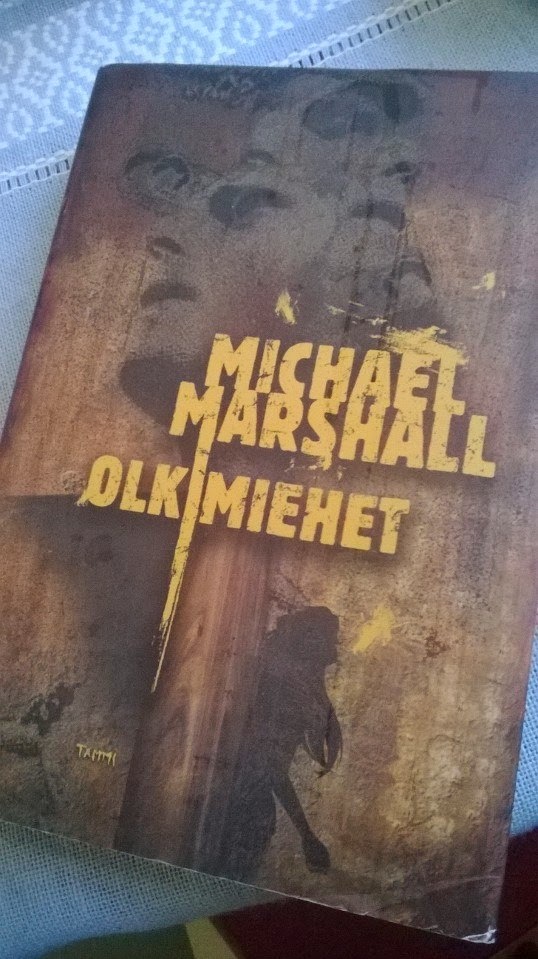
the Finnish translation
I'd been looking for the Finnish translation of Michael Marshall's The Straw Men (translated literally as Olkimiehet) for some years. It seems to be rare (though there are several copies for sale online), but I located a copy a month ago and read it last week. True enough, the book passed by in Finland without making much impact here and no one ever talks about it, even though it's a very good book, rising above many Scandinavian thrillers everyone seems to be reading now.

The Straw Men is a very clever and frightening take on the serial killer genre - genre that I'm not very interested in. Michael Marshall gives the phenomenon a nice historical and even mythical explanation and creates a conspiracy thriller that one won't easily forget. There's not much a reader will guess beforehand, and the climax is very exciting.

The only bad thing about the book is that it was written in the early 2000's and there's just too much talk about the internet, ADSL cables, IP addresses and such. It's dated already - probably was dated even five years ago. Marshall should've seen it coming, though the plot points about the internet must've been quite original in 2001 when the book came out.


Wednesday, December 31, 2014

Frank Castle: Lovely and Lethal

After Brian Evenson's weird and effective The Open Curtain I thought I'd be in the mood for something lighter, maybe something old, maybe something pulpy (or paperbacky). I have tons of old paperbacks in my shelves, but not enough to time for them. So I thought I'd read one.

I read two or three westerns by Frank Castle when I was doing my book on American westerns paperbackers called Kuudestilaukeavat ("Six Guns" in English) and liked them well enough to try one of his crime novels. I picked up Lovely and Lethal, a Gold Medal paperback from 1957, and started it - and pretty soon dropped it and moved on to something else.

Lovely and Lethal is a bit like a private eye novel, but the hero of the book, one Jeff Normand, is actually a lawyer moving to a small town and getting acquainted with both the high society and the low-life of the place pretty quickly. He meets a beautiful dame, whose sister had possibly killed herself, but in odd circumstances. Normand starts to unravel the mystery behind the sister's death.

Castle's prose style is flat and not very interesting, not even very hardboiled, though I remember his westerns were pretty tough. The characters in Lovely and Lethal are pretty much stock. There's too much talk, not enough action. So Lovely and Lethal proved a bit boring and thought I'd read something else instead. And the book has a boring cover. Where's Robert McGinnis when you need him? There are enough sultry babies in the book to warrant a nice GGA cover!

Here's my earlier post on Frank Castle and his later crime novel "Sowers of the Doom" that seems to have been published only in Finland, and here's Castle on Steve Lewis's MysteryFile blog. I'm beginning to think that the book published in Finland only was the last one on Castle's career, unless he moved on to markets where he used only pseudonyms, writing porn or some such, and the pseudonyms have never come to light.

I'm now reading Michael Marshall's The Straw Men and enjoying it more.

Monday, December 29, 2014

Brian Evenson: The Open Curtain

I'd ordered Brian Evenson's The Open Curtain on a whim when I noticed someone post about it on Facebook. It looked intriguing, and based on a short description of the plot it reminded me of the manuscript I've been working on. Now that I read The Open Curtain, I can tell it really doesn't resemble much what I've written so far, but let me tell you that I'd really like to be able to write as well as Evenson - and just as daringly and as unpredictably as Evenson! The Open Curtain really grabbed and scared me, even though there are virtually no hallmarks of the horror genre.

Yet The Open Curtain is clearly a horror novel. It's terrifying and very distracting. The main character is a teenage guy Rudd, who seems a bit autistic and lives with his Mormon mother. His father has been dead for some time now, and Rudd finds some letters in a garage that seem to reveal he has a half-brother, called Lael, living somewhere else with his own mother. At the same time Rudd has to make an essay on history for school, and he stumbles on an article on an old murder case in which there was a possibility of an old Mormon ritual of a blood atonement. There were lots of bizarre elements in the murder, such as an accomplice the existence of whom was never proved. All these elements start to show in Rudd's life and toy with his identity that seems to fall apart. The twist in the middle made me almost pee in my pants.

This is something David Lynch might have written, but all the elements are actually very down-to-earth and realistic. Even the 100-year-old murder was a true case. Evenson describes it with a chilling minuteness, and the whole novel is written with minimalist preciseness that's quite scary. To know that blood atonement was a true doctrine in the Mormon faith makes The Open Curtain really effective as a horror novel. Yet Evenson never really gives any sure answers. The end might be a bit of a letdown, but it's the only alternative imaginable.

Someone said (I don't remember anymore where I saw the comparison) that if Jim Thompson were alive today, he'd write like Brian Evenson. Based on The Open Curtain, Evenson is a more literary writer, but there are same elements, for example the use of the unreliable narrator and the disintegration of the identity. (And taking a look at Evenson's Facebook page, I notice there's a discussion on Thompson in which Evenson says: "Have read almost all of Thompson, who I really love.")

I'll definitely be reading more Evenson. There are no Finnish translations, but if I have anything to say about the state of affairs, there will be.

Saturday, December 27, 2014

New publisher in the works

A new Finnish publisher announced its first three books just before the holidays. I had something to do with all of them, so I'm a bit obliged to say something about them, even though the books are in Finnish. The new publisher is called Putki Kustannus (never mind the translation, it doesn't make much sense) and it works only via Lulu. The books are print-on-demand, which is still a novelty in the Finnish book industry, but it's a bit cumbersome to make the books in Lulu, since they don't offer Finnish ISBN codes (or any ISBN codes for that matter), so they are a bit invisible and won't automatically be catalogued in the Finnish National Library system.

But on to the books! Remember my 12-hour novel I wrote some years ago? I thought initially I wouldn't publish the book, but when Jukka-Pekka Kervinen e-mailed me about his idea to publish pulp-styled literature in print-on-demand and asked for help, I thought immediately about my manusript. It fits here perfectly, and the story was actually better than I remembered. The book is called Älä soita sinivuokoille, Joe Novak, which translates roughly as "Don't Call the Coppers, Joe Novak" (Novak being the private eye hero of my one previous novella and various short stories).

I also put together a small anthology of crime and horror stories, some of which were previously published, mostly in my fanzines Isku and others. Some of the stories were previously unpublished, though, for example Harri István Mäki's wonderful story about Edgar Allan Poe's relationship with Annabel Lee. The book is called The Last Shot according to Tuomas Saloranta's sleazy story of a revenge falling over a porn dealer. The first line: "Start jerking off."

The third book is Petri Hirvonen's short story collection Kuolevan jumalan yö ("The Night of the Dying God" in English) that I put together from the stories I've published in various mags through years. There are some western stories, a pirate story with horror overtones, some eighties-style action, some revenge stories, all told with energy and a good eye for violent action. Petri is a little-known pulp writer who's done some Finnish Jerry Cotton stories and the FinnWest western series. Putki Kustannus is also putting out his novella Kalmankylväjä ("Deathsower" or some such) that takes place somewhere in the Central America. The body count is massive in just 100 pages. Both Petri's and my book have forewords or afterwords that explain what's going on.

There are other books coming out from Putki Kustannus: a criminous short story collection by Teemu Paarlahti, a collection of my Mikko Jarmo short stories that mix private eye genre with silly alternative history themes, a collection of flash fiction crime stories I ran in my mag, Ässä, and a collection of my reviews and articles on American hardboiled fiction. I've been also working on a small collection of obscure Finnish pulp short stories from the thirties and fourties, but there are some copyright problems I'll have to resolve. There's possibly also a western short story collection coming from Sami Myllymäki.

Here's more in Finnish on my other blog.

Tuesday, December 23, 2014

William F. Nolan: The Black Mask Murders

To commemmorate the holidays I started to read William F. Nolan's The Black Mask Murders that Tapani Bagge loaned me already some years ago. The book features Dashiell Hammett as the first-person narrator, Raymond Chandler and Erle Stanley Gardner feature as sidekicks. All of them wrote for Black Mask, one of the best known and the most influential pulp magazines of the pre-WWII era. Some other writers also get mentioned, just as F. Scott Fitzgerald.

The book is an amiable pulp pastiche, if nothing more. Nolan writes well and the era is created pretty convincingly, but somehow I never really believe these guys really are Hammett, Chandler and Gardner. Perhaps Hammett, narrating his own story, comes closest. It comes off clear though that Nolan knows his stuff and knows how to keep the story moving. The plot sure moves along fast.

I'm now reading Brian Evenson's horror novel The Open Curtain. Seems pretty intriguing so far.

I've been a bad blogger for some time now (and I do know that it's bad blogging to blog about how bad you're at blogging), but I'll try to remedy that in the near future. I've had too little time on my hands, which shows here at Pulpetti. I'm not sure, though, whether I'll be able to squeeze in more hours or even minutes, since we'll be having our second child in the end of January (my third, I feel a bit old). There's not knowing how much the baby will keep me busy. (I can't believe this is the first time I've said this at Pulpetti, but that shows how much I've been able to think about blogging.)

Merry Christmas to all!

Tuesday, December 09, 2014

Tuesday's Overlooked Film: Fear Over the City

A grinning serial killer is hunting the women of Paris, inspector Le Terrier is hot on his trail. This is the basic and simple premise behind Henri Verneuil's Fear Over the City (Peur sur la ville) that came out in 1975. I just saw it last night on a 35 mm print, though it was somewhat faded and full of scratches.

There's much of Italian giallos in this film, and indeed it was partially financed by Italian producers. The Italian feel was heightened by English dubbing, which, while it wasn't badly made in itself, also added to the feel of unintentional humour. The film is at times an uneasy mix between serious thrill-seeking suspense film and a comical, almost self-parodist slapstick. Jean-Paul Belmondo in the lead as Le Terrier made his own stunts and one never really knows whether the scenes are thought to be funny or not, even though Belmondo was clearly at risk here.

In the end, it's only a middling film, with some nice touches here and there, but also with some ludicrous stuff here and there and everywhere. Some of the latter parts are very funny, some aren't. There are some beautiful women to be killed later on, which always makes me squirm a bit. The character of the serial killer is quite intriguing, though, his grin is scary. (I was told that the actor doing the killer's part was Italian, which also may have something to do with the giallo atmosphere.)

The best thing about the film is Ennio Morricone's eerie music. Check out the trailer below. Might've been better in the original French.

More Overlooked Films here at Todd Mason's blog. [Though seems like no post is up yet.]

Thursday, December 04, 2014

Overlooked Film weekend at the cabin: Stake Land, Leonard Part 6, Angst, Samurai Cop etc.

Stake Land
We spent a movie weekend at a cabin, me and six friends of mine, watching 14 feature-length films and an assortement of short subjects in a row. Fun was had by all, but I didn't get much sleep and am only now recovering. The films were a really mixed bunch, with some true oddities thrown in. Here's the lowdown.

Jim Mickle: Stake Land: pretty good gritty vampire apocalypse film from the director of Cold in July. ***½

Steven Knight: Hummingbird: tedious noirish film about an Afghanistan veteran (Jason Statham) trying to make wrongs right. Statham can't act serious stuff, but that's not the only problem here. Knight has done better stuff before (writing Dirty Pretty Things and Eastern Promises) and since (directing Locke), but this is just boring. **

Paul Weiland: Leonard Part 6: truly absurd Bill Cosby vehicle that Cosby has tried to keep off the air,.The film has some great moments, but is simply too long, some scenes seem to go on forever. * or ****

Ben Kamras: Life on the Line: shitty home video released in 1995 on VHS and later on DVD, with Finnish people speaking (bad) English. Everything is horribly wrong in this film by the son of a Finnish film mogul and theater owner. The film has some very, very bad fight scenes, the hits miss by a mile. I laughed so hard I thought I was going to die. * or *****

Aurora Productions: S.O.S.: some truly weird moments were had with this: catchy pop songs about Christians being harassed by a mob of soldiers and bar codes being tattooed on people's foreheads in praise of Satan, anti-evolutionist praises and what not. I'd found this on VHS not knowing what to expect, but this was truly something. Possibly shot in Australia. I understand the Family cult behind this has been accused of child abuse and other sex crimes. Some truly disturbing shit on them in the web. Can't really give stars to this.


Michael Bay: Pain & Gain: too long, but still up there with Spring Breakers as one of the essential neo-neonoirs of the 2010s: slick and shallow, full of spectacle, with a heart of pure satire. ***½

Jan Svankmajer: Surviving Life: I've liked Svankmajer's wild and surreal animations, but this didn't satisfy me much, seems like he's not very good with feature films. **

David Ayer: Sabotage: it's no wonder Schwarzenegger's comeback movie didn't make much impact with the audience: all the characters are unpleasant and the story line is botched (possibly because of the producer's interference), but there are still some of Ayer's trademarks: fast and meaningless dialogue and the tension between the bad cops and the worse cops. **½

Gerard Kargl: Angst: intimate and disturbing depiction of a serial killer released from prison and going on a killing spree in an isolated house. Banned in many European countries and possibly in the US as well, but still very intricately shot by Zbigniew Rybczynski and well acted. ****½

Anthony Mann: Strange Impersonation: strong noirish melodrama with an identity switch, suffers from a slack ending. ***

Arim Shervan: Samurai Cop: laughably and entertainingly ridiculous straight-to-video cop flick from the early nineties, shot possibly with a VHS camera. Lots of very bad acting and editing. Still a bit too long. A sequel is being made as I write. * or ****

Efren Pinon: The Killing of Satan: incomprehensible Philippine horror/fantasy film. Might've been a contender, but wasn't, save for some scenes here and there. * (After this we watched a Finnish VHS video from the early eighties in which a Finnish escape artist talks about his faith. I don't know why we bothered.)

Franck Khalfoun: Maniac: intelligent reworking of the dubious slasher classic by William Lustig. The POV technique works well: we almost never see Elijah Wood's face. ***½

Joseph Zito: Invasion USA: inept and stupid Chuck Norris vehicle with a wildly implausible plot to overthrow the US government. Yeah, right. Other guys seemed to love this. *½


Saturday, November 22, 2014

Joe R. Lansdale: The Thicket

Joe R. Lansdale's The Thicket (2013) is a bit like Cormac McCarthy wrote a novel from a treatment by Robert E. Howard: it's a weird, brutal and merciless story that moves on with the speed of a bullet, set in the desolate wasteland of the early 20th century Texas.

The Thicket is a western that pulls no punches. Everything is dirty and violent, but Lansdale makes the people he writes about come alive. The reader cares for them and really wishes no harm would come to them - and then Lansdale makes the worst happen. The bad guys are really scary. The Thicket is truly a gripping read.

The book loses some of its momentum after the first half, and some of the characters lose their spark a bit (especially prostitute Jimmie Sue, who seems very vibrant at first), but the first half and the climax just before the end is some of the best stuff I've read all year. Can't wait for the movie to come out.

Sunday, November 16, 2014

100 American Crime Writers out - already in 2012!

I hadn't earlier noticed that 100 American Crime Writers, edited by Steven Powell, is out - has been actually already from 2012! The book looks good based on the Google Books page and some blog reviews I came across (here and here, for example). I was mentioned, and still I didn't notice!

I haven't received my contributor's copies, I'll have to get in touch with someone! Wonder if this is still doable. Now if only I'd remember if I wrote something for 100 British Crime Writers - I have a nagging feeling such a book was in the making at the same time...

Here's Steven Powell's interesting crime-oriented blog Venetian Vase.

Thursday, November 13, 2014

Everybody Lies out

My newest book, the short story anthology Everybody Lies, is finally out. It's available here - and of course it's in Finnish and the actual title is Kaikki valehtelevat, which is the literal translation of James Reasoner's story in the book.

The book consists of some 20 criminous short stories from writers like Reasoner, Jason Starr, Kevin Wignall, Duane Swierczynski, Vicki Hendricks and Patricia Abbott. All of the stories came previously out in my mags Isku, Ässä and Seikkailukertomuksia (= Adventure Stories), that were self-published pastiches of old-time crime rags. All the translations have been edited and proofread carefully. It's a nice and varied collection of new hardboiled and noir writing, especially since almost none of these writers are available in Finnish at the moment. Most of the stories were translated by me, but some of them were translated by some of my talented friends, namely Antti Autio, Tapani Bagge, Sonja Lahdenranta and Lotta Sonninen. Thanks for them for the big help! 

The beautiful cover was envisioned by a friend of mine, Jenni Jokiniemi, who works as a designer. This was her first book cover, if I understood correctly. I hope to collaborate with her more in the future. 

Here's the table of contents. 

I'm actually doing another collection in the same vein, of the flash fiction stories I published in Ässä. I've been asking for permissions from writers, but not all have responded. If you read this and remember having received an e-mail or a Facebook message from, please do respond! 

Wednesday, November 12, 2014

Some sword and sorcery stories: Robert E. Howard, C. L. Moore, Manly Wade Wellman

A week ago I had a feeling I'd like to read something that wasn't work-related in any way. As usual, I had some trouble finding something suitable to read even though I have some 5,000 books in my shelves.

However, I picked up a Finnish anthology of old sword and sorcery stories, mainly from Weird Tales, but also from some other pulp mags. The book is called Mustan jumalan suudelma AKA Black God's Kiss after the story by C. L. Moore in the book. Of the stories I read, Moore's was the best. It's full of surreal images and still it moves with a breakneck pace. Very beautiful and thrilling. The story came out first in Weird Tales in 1934.

The other stories I read were Robert E. Howard's novella-length "The Black Stranger" (1934-1935, unpublished in Howard's life-time, published in 1953 in abridged form and in 1987 in original form) and Manly Wade Wellman's "Thunder in the Dawn" (Amazing Stories 1939). Wellman's story was a bit slow and dated, I didn't feel the thrill of adventure in this, even though the premise is pretty good: a stone age warrior is really the Hercules of the Greek lore and is the cause of Atlantis sinking in the ocean. Howard's story pits Conan against some pirates and settlers, in the story everyone deceives one and another. It's a great read, though I still preferred C. L. Moore.

The striking cover in the book was drawn by Jukka Murtosaari, a friend of mine, who's studied classical American illustration art for decades now - and it clearly shows. The editor of the book is one Markku Sadelehto, who's done a good day's work bringing American pulp fiction to Finnish readers, as he's edited tons of anthologies for different publishers for over 20 years now. His magnum opus is the edition of the collected stories of H. P. Lovecraft. The sixth and final volume came out just two months ago.

Alas, I didn't have time to read more of the stories from the book. I've read this when it came out some 20 years ago, but don't remember much of it.

Thursday, November 06, 2014

Laura Lippman: The Innocents

I was looking for something easy to read between some work-related books and grabbed Laura Lippman's The Innocents I'd bought from a thrift store earlier. I'd read one or two of Lippman's Tess Monaghan novels and thought they were pretty good. I knew this wasn't part of the series, but I knew it was a stand-alone book, and thinking I'd read it in a jiffy started to read it. (Tess Monaghan makes a short appearance, though, giving the story an extra boost.)

Instead it turned out to be a serious mainstream novel, with an episodic and a bit labyrinthine structure, with people's lives mingling with each other's lives, criss-crossing in time and place. Lippman gives hints there's something bad in the past of people she writes about, but she reveals it a bit by bit, very slowly, but enticingly. I didn't read this in a jiffy, but I still enjoyed it quite a bit. It could've been shorter, but that's just me.

Seems like this was published in the US as The Most Dangerous Thing. I found a British edition that has an alternate title. (Explains why this can't be found from Lippman's site with that title.)

Tuesday, November 04, 2014

Tuesday's Overlooked Film: Godzilla vs. Mechagodzilla


It's been months since I last wrote an entry to this blog meme.

I don't know if anybody noticed, but yesterday marked the sixtieth birthday of Godzilla AKA Gojira. The first Godzilla film premiered on third of November in 1954 in Japan, and I helped organize the showing of one of the later Godzilla films, Godzilla vs. Mechagodzilla, at the Finnish Film Archive screening here in Turku, Finland. It was shown on 35 mm film, in a Cinemascope picture.

The film is a hoot. It's very, very hilarious. It's fast-paced, it never slows down, which is a normal handicap for bad and campy pictures: they are slow. There's always something going on in Godzilla vs. Mechagodzilla even though none of it makes sense. Cigar-smoking space invaders in silver suits? Check. A huge cyborg pretending to be Godzilla? Check. An ancient Japanese god living inside a cave? Check. A woman singing praise to the said god on a beach with a nice orchestrated background? Check. A mysterious Interpol agent masquerading as a freelance journalist in a long coat trying very hard not to look suspicious? Check. Mysterious gangsters turning into monkeys when they die or even get hit? Check. Name it, and you probably have it in the film.

Highly recommended, lots of laughs guaranteed. More Overlooked Films coming up at Todd Mason's blog here.

Monday, October 27, 2014

Gillian Flynn's Gone Girl and Dark Places

Some of you might remember I had some gripes about Gillian Flynn's bestselling chick noir novel Gone Girl (here's my short review, I wrote a more detailed review in Finnish). I liked Flynn's earlier novel, Dark Places, more, and it's out in Finnish in a good translation. It's darker and more believable and the seedy and unpleasant atmosphere is very well realized. The plot unravels slowly, Flynn knows how to make the reader turn pages without reverting to easy gimmicks. 

I ran into a good review of Gone Girl at the Rara-Avis e-mail list, written by Mark Nevins. I asked for Mark's permission to publish the review here and he complied. I think he is pretty spot on on some of the weaknesses of the novel. So, here goes. 

Gillian Flynn, GONE GIRL (2012) 

While I'm probably the last person in American to have finally gotten around to reading GONE GIRL, I'll still try to avoid spoilers in this review--which will be hard to do, so consider stopping reading now if you're planning to pick up this novel any time soon.

Gillian Flynn has written an incredibly clever novel in GONE GIRL, and it's worth reading the book just to see how she creates a complicated and layered narrative puzzle, somewhat along the lines of THE USUAL SUSPECTS or THE SIXTH SENSE. Nothing is what it seems in the "perfect" marriage of Nick and Amy Dunne, and the reader is forced to try to make sense of how the pieces of the story fit together via Nick and Amy's alternating first-person chapters, made more difficult by the fact that each of them has multiple "personas" as well.

Most readers seem to think GONE GIRL gets better after the "reveal" in the middle. While I saw the reveal coming, I nevertheless felt the second part of the novel was weaker than I would have hoped, given the fantastic set-up. When Flynn has to shift from narrative cleverness (and her construction of the narrative and all of its many moving parts is very very clever indeed) to real psychological depth, she comes up a bit short. While the first half of the novel promises something truly new, the resolution feels a little too much like the standard mass market thriller, including stock characters such as the creepy doting rich lover and the powerhouse slick attorney.

One of my biggest problems with the book is that I found neither of the two main characters in any way sympathetic: other writers working in the "doomed noir" space (e.g., the obvious candidate, James M. Cain) somehow make us root for bad people to succeed. My other big problem is that the overall tone of the book's prose is a bit too "chick lit" for me. GONE GIRL flirts with postmodern structure and unreliable narrators in ways reminiscent of Italo Calvino or Vladimir Nabokov, and it dances with dirty, twisted characters similar to those you might find in books by Charles Willeford or Jim Thompson, and yet the result is a book that falls somewhere in the comfortable middle, also known as the top of the NEW YORK TIMES bestseller list for fiction. (Which may have been the author's objective after all, and who am I to quibble with that?)

I would in the end genuinely recommend GONE GIRL--if only because it's such a phenomenon, and a clever construction--but I think readers well-versed in the classics of noir are likely to find it a little "lite." (On another note, I will be intrigued to see how the book will be adapted to film, since what makes the book so interesting can really only be achieved on the printed page.)

Monday, October 13, 2014

Richard Moore and Barry Malzberg on Donald Westlake's The Getaway Car

I spotted this nice mini-review of Donald Westlake's non-fiction collection, The Getaway Car, by Richard Moore on the Rara-Avis e-mail list and asked for his permission to republish it here. Richard, ever the gentleman, gave his permission. It was originally posted to the PulpMags e-mail list.

The Getaway Car by Donald E. Westlake and edited by Levi Stahl (University of Chicago 2014) is a fascinating collection of Westlake’s non-fiction. It is a must for Westlake fans but anyone interested in writing will find it worthwhile.

It includes Westlake’s “The Hardboiled Dicks” first delivered in a May 1982 lecture at the Smithsonian Institute in Washington, DC and later published in The Third Degree. I was at that lecture and it is hard to believe it was over 30 years ago. I remember thinking the lecture was toned down in a couple of spots prior to publication but I will need to find what I wrote for a fan publication at the time for any specifics. It remains a great analysis of the work of the private eye.

One short piece that fascinates me is “Light” an unpublished manuscript found in Westlake’s files and apparently written in 1997 or 1998. His 40th novel “The Ax” was a departure that got great reviews, sold surprisingly well, and caught his publisher’s attention. His return to the world of Parker after a hiatus of more than 20 years in “Comeback” also created a stir.

Suddenly, expectations were raised. He had another novel finished but it was no longer deemed suitable as a follow-up to “The Ax.” He told his agent “It’s a little late for me to have second novel problems, but that is what this is.”

I noticed that the Wall Street Journal has just published an appreciation of Westlake and a nice review of Stahl’s fine collection by William Kristol, editor of the National Review. I rarely agree with Mr. Kristol on anything but I share his enthusiasm for Westlake. I would not go quite as far as Krystol, who said Westlake was “the greatest modern American novelist.”

Here's also writer Barry Malzberg's comment to Richard Moore, published here with Mr. Malzberg's permission: 

As I wrote Lawrence Block off-list a week or two ago, "I am being escorted however reluctantly to belief in Donald E. Westlake as the greatest 20th Century USA writer." A refugee for half a century now from the precincts of quality lit and its bias, I am perhaps unthrilled but also embraced by this inference. No writer alive or dead has given me more pleasure per capita than Donald Westlake. I wish he had not been such a nasty son of a bitch (at least to me) but as Murch's mother would point out, the best route does not usually parallel the most scenic route.

GET REAL shows a 75 year old writer going out at the top, his gifts not only undiminished but soaring. The two posth, the last novel, and the last published in Westlake's lifetime shows his gift not only intact but still growing. The posthumously published novels are sensational, in fact THE COMEDY IS FINISHED, dealing with the same essential national dilemma as AMERICAN PASTORAL outdoes Roth's great novel as social and literary document.


Wednesday, October 08, 2014

Errors circulating about Gil Brewer's career

I just spotted this blog post via the Facebook group for Gil Brewer fans. It's a review of The Vengeful Virgin, Brewer's novel that was reprinted by Hard Case Crime some years ago. (Mind you, I've never read it, maybe it's about time!) There are some glaring errors I want to point out.

First of all, Gil Brewer didn't start writing at the age of seven. He was born in 1922, so he couldn't have started out in pulp magazines in 1929! It was his father. I know where this originates from: the St. James to The 20th Century Crime and Mystery Writers, but I believe it's been corrected in later editions. Anyone should see it's plain wrong, but apparently not.

Second, Gil Brewer didn't hit the pages of Black Mask, but then again, his first novel was published in 1950, and Black Mask ceased publication in 1951! And as for someone not publishing in Black Mask, let me point out that Fredric Brown - whom we all consider a genius, right? - published only one story in Black Mask. And Manhunt that has been one of the most influential crime short story magazines in history was Brewer's mainstay for years.


Tuesday, October 07, 2014

Tuesday's Overlooked Film: The Shining


Well, most certainly Stanley Kubrick's The Shining, based on one of Stephen King's best-known books, is not an overlooked movie. It is to me, though, since I have never seen it on big screen, and it's been years since I saw it on TV. The screening of the Finnish Film Archive last night remedied this, and I can say the film blew my mind. I've had some problems with Kubrick's films - maybe even all of them -, but they are very cinematic to the edge of maniacal perfection.

Almost everything in The Shining is honed to perfection: the camera drives (remember that Francois Truffaut said Kubrick started out copying Aldrich's camera drives!), weird shooting angles, Jack Nicholson's acting (I wouldn't blame him on overacting on this, as many have done, he's masterly at timing his bursts), the use of music... There are some problems in the film, though: the use of Scatman Crothers's character is mechanic and doesn't bring much to the thematics of the film, and the ending is a bit abrupt.

However, the biggest problem is this: who cares what happens to these people? As the French critic Jacques Rivette once said, Kubrick makes films about machines to other machines. Shelley Duvall's wife is irritating, always almost bursting out in tears, Danny Lloyd's little boy is fascinating, but I think Kubrick could understand his kind of autistic kids. And you never really know what makes Nicholson's Jack Torrance tick. It's of course the basic idea in the film: you never really know... but one would hope for some clues. The film and its story and people exist in a fictional maze that's closed from the other society. It fascinates only as a game, even though it's a really suspenseful game.

This is my first foray into this theme in months. Here's a link to Todd Mason's blog where all the things happen, and here's a link to the previous gathering.

Tuesday, September 23, 2014

King Vidor, the pulp writer?

Checking something else from the Fictionmags Index, I noticed this entry:

VIDOR, KING (chron.)
Southern Storm, (ss) Esquire May 1935
The Texas Rangers, (ms) Texas Rangers Dec 1936

Now, can this be the famous film director of Fountainhead, Ruby Gentry, War and Peace and other films?

Monday, September 22, 2014

Charles Beckman's short story "The Dancing Death"?

As many of you probably know, pulp writer Charles Beckman who specialized in hardboiled and noir crime stories and wrote also for the western market has been seeing a revival of his work getting into print. (Here and here Amazon links for the new collections of his old stories.) Beckman is still alive and I was able to ask him via James Reasoner if I could a small collection of his work that's been translated in Finnish.

The collection would be with two stories. There's an old story in an old Finnish pulp magazine called Seikkailujen Maailma (The World of Adventures), and then there's a called story "Class Reunion" that was translated by my friend, Tapani Bagge, that appeared in a late crime fiction magazine called RikosPalat (Crime Bits or some such in English). Beckman gave me his permission. (There are also some three or four stories in the old issues of the Finnish edition of Alfred Hitchcock's Mystery Magazine, but I don't have an easy access as to who translated them and where I could find them for a permission.)

After I'd typed "Class Reunion" I started typing the other story from the 1955 pulp mag. The Finnish title is "Tanssiva kuolema", which translates back as "The Dancing Death". The anti-hero of the story is one "Kippy Nikkeli" (I believe the name's been changed), who's on the run from some organized crime thugs, one of whom is called Pope (probably so, since his name is translated as "Paavi", which is the literal translation of "Pope"). In the beginning of the story Kippy finds himself in a junky joint trying to have a hamburger. It seems he hears voices in his head, and he also reminiscences another joint where he used to dance. He's also involving with Pope's mistress falling in love with another man. It's a moody noir-type piece where there no winners, only losers.

Now, there are several problems. Beckman himself didn't remember the story, nor did he find it in the pulp magazines he still has from his writing days. The story is not "Run, Cat, Run" that was reprinted in Beckman's Suspense, Suspicion & Shockers, nor is it "Should a Tear be Shed" in the same book, even though they share some similarities.

Googling the story's name with "Charles Beckman" doesn't give any clues. I don't have access to the crime fiction short story indices and I could check only the Fictionmags Index. There are some stories with the title "The Dancing Death", but none that match. Some of the stories listed therein did appear in a pulp magazine, but they seem to be a bit old or too long, i.e. serials. The story that I have at hand is more like a filler, even though it's a good story.

But there's a story called "Die Dancing, Kid" from Detective Tales, January 1947, and by Charles Beckman. Now, the publisher of Seikkailujen Maailma used lots of stories from the Popular Publications' magazines, such as Dime Detective and Detective Tales (and also Dime Mystery). I asked Beckman again if this could be our story. He said he doesn't remember writing that story and doesn't have a copy.

Now, does anyone have the issue of Detective Tales, January 1947, and can check the story out for me?

The photo accompanying this post is the illustration for the Finnish publication. For all I know, it could be the original illustration for Beckman's story.

Monday, September 08, 2014

Nic Pizzolatto: Galveston

This is a very good book: original, well-written and unpredictable, even though at times there are some elements that might be a bit too familiar.

That happens in almost any noir novel, though. I can't see how you could get away without adding any tough gangsters or any other clichéd material. At least Pizzolatto does a pretty good job with them.

The antihero of the book, Roy Cady is a man without a future. He's doubly that: he's got cancer in his lungs, and he works as a hired hand for a local crime boss who loves Cady's ladyfriend. Cady is a man without qualities, he's empty inside, were it not for the cancer.

Yet he speaks in a beautiful voice. Galveston is full of poetic touches, marvellous lines, quotable stuff on the seedy side of life. And still I don't feel Pizzolatto is over-doing this. Galveston remains believable and plausible almost throughout. (There's one thing plot-wise that didn't wholly convince me, but I won't go into that.)

By the way, I haven't seen any episode of True Detective. I'm pretty eager to see it, yet I'm too lazy to try look it up. (I know there's a chance of seeing it on HBO Nordic, but I'm still waiting for it come on proper TV channels.)

Monday, September 01, 2014

Quick update after the holidays

I've been trying get back to work on a regular basis after the long summer holiday. We did quite a bit of travelling, mainly in Finland, but we also paid a visit to Denmark (Copenhagen and Legoland), where we'd never been. We also bought a summer cottage, so we spent lots of time there. (It's not actually a cottage, but the long explanation might be too difficult.)

Even though July and August were supposed to be a vacation, I had to read work-related stuff: I've started doing a book on the history of Finnish western literature. I also reread lots of Tolkien, since I did a non-fiction book on Tolkien with a friend of mine. I finished it up late last week and sent it off. Now I'm finishing some other lesser books, such as a small anthology of western-themed horror stories by Finnish writers. Then I'm rushing off to finish a book on Finnish war-time photography. Then I'll be able to concentrate on my book on Finnish westerns.

Sounds like I'll be busy, eh? I'll try to get back to regular blogging, but don't expect much, since I'll be loaded with work. Our son went to a fourth grade and comes back home at two p.m., so the working hours are a bit short. Maybe some Overlooked Movies and Forgotten Books every now then.

Oh, I started Nic "True Detective" Pizzolatto's novel Galveston and it seems really, really good. I also read Gillian Flynn's Dark Places (came out in Finnish as Paha paikka) and I liked it a great deal. It's almost like a private eye novel in which the protagonist is herself in the middle of the mystery. Every move, every inquiry she makes affects her own life. Highly recommended, even more so than her celebrated Gone Girl.

Friday, August 15, 2014

James Reasoner's collection in Finnish

I just picked up my copies of a new book I was making. I compiled a small collection of James Reasoner's stories that had previously been published in my fiction magazines Isku and Seikkailukertomuksia and such, and a micropublisher a friend of mine runs published it. Here's more info on the book - it's in Finnish, but you can still read the original titles of the stories. "Red Reef" wasn't previously published in Finnish, it came out only in this book. It's a nice little book full of good old-fashioned pulp fun!

The striking cover is by Pertti Jarla, known for his humorous Fingergpori strip, but alas his name got dropped out at the last minute.

Thursday, July 31, 2014

Charlie Huston: Already Dead

I'm still alive and kickin', though you wouldn't realize it by looking at this blog. I've been on holiday which has also meant not blogging. We've travelled quite a bit and been doing some renovations at our new summer cottage (I'll probably post about that something soon).

But here's something that's more in the vein of Pulpetti. Someone might remember I wasn't thrilled about Charlie Huston's vampire private eye novel Already Dead back in 2007, but I've now read the book in Finnish translation and I'm happy to say I liked it more this time. It's a fast-moving, cynical and very violent book about Joe Pitt, a guy who went vampire when being given a blow-job in a New York punk club in the late seventies and who now works as a private eye between the world of vampires and the real human beings. Highly recommended. And this also proves that translations are sometimes a good thing, even though books are usually best read in their original language. Not this time, for some reason or another.

Sunday, June 22, 2014

Some e-books I read during the trip: Allan Guthrie, Peter Brandvold, Paul Levine, Gerard Brennan, J. David Osborne

That's a long subject line, isn't it?

We were on a smallish trip earlier this week: we went to Denmark, where we've never been. We visited Legoland, the Louisiana Museum of Modern Art (highly, highly recommendable) and the vintage Tivoli entertainment park in the centre of Copenhagen. It was a fun trip, for most part, but I'm not going to write about it. Instead, in the spirit of this blog, I'll say something about the books I read during the trip. I had nothing with me but my Kindle. I download only free e-books, since I don't have a credit card with which I could buy e-books, so I'm dependent on what comes free. Even with this approach, I've managed to accumulate a pretty good selection of new noir and hardboiled writing, with some westerns and horror thrown in. Mentioned should also be some classic noir stuff that's coming from publishers like Prologue Books.

Okay, to the books. Peter Brandvold's better known as a western writer, but I've never read any of his books in that genre, but they seem quite good. I read his short novel Paradox Falls that I think is mislabelled as horror. It's more like a suspense thriller, with a possible serial killer hunting some hikers in the Colorado mountains. The book reads pretty fast, but the ending is a bit abrupt. There was also some interesting stuff on being a writer that seemed a bit autobiographic, as the main character, a sympathetic young man yearning for his early love affair, makes his living writing sex westerns. Paradox Falls could've been published as a cheap paperback in the early eighties, and I mean this as a good thing.

Allan Guthrie's Kill Clock was even a shorter book, a novella-length tale of Guthrie's occurring character, Pearce. Guthrie tells his brutal tale with short sentences, but also manages to make Pearce a sympathetic character in all his bruteness and tendency to sudden bursts of violence. Kill Clock also has a good plot for a novella. Recommended quite highly.

Paul Levine's Last Chance Lassiter is the first Jake Lassiter story I've ever read, as I'm not very keen on courtroom thrillers. But this one was so funny and entertaining I'd be willing to try more of Levine's work. Very fluent writing, very smooth plotting, some quite funny wisecracking.

J. David Osborne runs Broken River Books that's a very interesting crime and horror fiction outfit specializing in edgy and bizarre neo-noir. Osborne's own short story collection Our Blood In Its Own Circuit is full with, well, edgy and bizarre stuff that's not easily labelled. I read the first three stories on our flight back, and two of them were very strong: the titular story is about Mexican cops who bathe in the blood of chickens, and the western story "Amends Due, West of Glorieta" is full of shocking violence and characters straight out of a Cormac McCarthy novel. Check out this free Broken River Books sampler!

I also started Gerard Brennan's novella The Point, a brutally realistic story about two brothers whose life goes to hell when they move to a small town on the seaside and the other one starts dealing stolen cars. The plot could be more original, but Brennan's clipped style makes it interesting. I'm only halfway in the middle, so there might be some surprises coming.

Thursday, June 12, 2014

Me and my new book

Pulpografia Britannica just came from the printers! Here's me with a happy smile and my first book, Pulpografia that came out in 2000 and deals primarily with American crime pulpsters and paperbackers. You can see it's a worn copy. Hopefully this new book comes just as handy.

Tuesday, June 10, 2014

Patricia Abbott's short story collection – in Finnish!

Just when I finished my book on British crime paperbackers, I was notified that another book was ready to be picked from the printers. It's Patricia Abbott's Merenneidot (meaning "Mermaids") short story collection I edited and published with a small print run. The book collects six of Abbott's insightful, clever, cruel and empathetic crime stories, most of them are in the flash fiction length, but the longest story in the book is about ten pages long.

The stories are: "Mermaids", "My Hero", "How to Launder a Shirt", "Johnny Jinx", "Hole in the Wall" and "Initiation". Most of these were originally published in the web, but some were print publications. Most of the stories came out in Finnish in my magazines Isku and Ässä, but "Mermaids" and "How to Launder a Shirt" were translated for this book and were never before published in Finnish. "Johnny Jinx" and "Hole in the Wall" were translated by my friend Lotta Sonninen and I'm sure their translations are better than my attempts!

The cover is by Aapo Kukko as are my usual mini books. See the Ray Banks book here and the Ed Gorman book here. (Seems like I haven't blogged about the Gorman book, but it's a translation of his "Scream Queen".)

Most of the copies I'm selling are going to the libraries here in Finland, but this is also available through me for a measly three euros!

Thursday, June 05, 2014

Pulpografia Britannica to the printers

Just sent my Pulpografia Britannica to the printers. Here's the cover by Ville Manninen who did spectacular job.

It was a 15-year work. This at least should prove I'm no ADHD person, even though the idea crosses my mind every once in awhile.

Here's the list of authors tackled in the book:

Ray Alan
Eric Ambler
W. Howard Baker
John Boland
David Brierley
Jonathan Burke
Peter Cave
Johnny Cello
Peter Chambers
Philip Chambers
Leslie Charteris
James Hadley Chase
Peter Cheyney
Hugh Clevely
Basil Copper
John Creasey
Paul Denver
Adam Diment
Rex Dolphin
John Drummond
F. Dubrez Fawcett
P. A. Foxall
Stephen Frances
Pete Garroway
Tudor Gates
John S. Glasby
Berkeley Gray
Sean Gregory
Leonard Gribble
Angus Hall
Roger Hamilton
Rex Hardinge
Edwin Harrison
Jack Higgins
Harry Hobson
Hartley Howard
John Hunter
Warwick Jardine
Hank Janson (the pseudonymous efforts of the unknown authors)
George Joseph
Harold Kelly
Arthur Kent
Bill Knox
H. L. Lawrence
Brian McDermott
Arthur MacLean
Wilfred McNeilly
James Moffatt
Stanley Morgan
James Munro
Victor Norwood
Flann O'Brien
Peter O'Donnell
D. J. Olivy
Anthony Parsons
Bryan Peters
John T. Phillifent
Hugh C. Rae
Desmond Reid
Colin Robertson
Angus Ross
Kenneth Royce
Jimmy Sangster
Julian Savarin
Frederick E. Smith
Gordon Sowman
James Stagg
Jack Trevor Story
Rosamond Mary Story
Frank Struan
Martin Thomas
E. C. Tubb
Walter Tyrer
Gerald Verner
John Wainwright
Vernon Warren
Ronald Wills

Sunday, June 01, 2014

Some problematic Sexton Blakes

I've been posting some bibliographic puzzles here on Pulpetti for some time now. I'm finally getting my book on British crime paperbackers to print (hopefully at the end of the next week), but there are still some things I'd like to be more sure of. I have several Sexton Blakes translated in Finnish in the early sixties for which I haven't been able to find the original publishing info, as I don't have an access to original English stories.

Here's a lowdown, with the Finnish titles translated literally back to English (but do note that the English titles don't match any known Sexton Blake stories):

Edwin Harrison: "The Green Spider" (published in 1963): someone is coming to meet Sexton Blake at his office, but is hit by a car just in front of Blake's building and gets killed.
Edwin Harrison: "Spanish Blood" (1963): a matador is poisoned by syanide.
Anonymous (only Sexton Blake published in Finnish without the author's name): "The Disappeared Author" (1963): the promising writer of a great book gets lost.
Desmond Reid (a house name): "The Avenger from Dartmoor" (1962): the authorities let a a prisoner escape so that he can revenge and take out his former allies who let him down
Desmond Reid: "The Woman Is Dangerous" (1962): takes place in fictional state of Costa Barria, features also Huxton Rymer, but is still clearly from the post-WWII era
Desmond Reid: "The Trumper Killer": a jazz player makes extra money killing people
Desmond Reid: "The Angel of Death": an early story on animal rights movement, some young people are fleeing the circus animals
Jack Trevor Story: "Gold Means Death": Splash Kirby looks into the world of Italian immigrants and is kidnapped and taken to Italy
Jack Trevor Story: "Death Before One's Eyes": now, this is interesting: Blake is a first person narrator (the only time in the history of Sexton Blake?) and is approached by a former lover who asks Blake look into a mystery
Jack Trevor Story: "Love Under the Gallows": Sexton Blake vs. the teenage gangs

And also, is Jack Trevor Story's Invitation to Murder about someone killing models?


Wednesday, May 21, 2014

Kenneth Royce

Of all the British pulpsters and paperbackers I've been covering in my forth-coming book, there have been only a few writers whose work I've really been fond of. I don't know why this is, but it's something I've been noticing for the past dozen years: I like American stuff more than British, and this is the case even with films and music. Give me The Sonics anytime over The Rolling Stones or The Dead Kennedys over The Sex Pistols!

But there are indeed some British crime writers whose work I really like. Kenneth Royce is one of them. He writes in clear prose that keeps the story moving, he creates interesting characters with just a few lines, they are likable even though they are not heroes, his plots are unpredictable and original. Too bad he's not very well known these days. I'm not sure if he's known at all. He does have a Wikipedia page, though. He's had three Finnish translations, all in pulpy paperbacks and with not interesting covers (see below).

Of the two translations, the first two have Royce's serial character, Spider Scott, as the hero. He's a former master burglar, who's gained his nick name with his skills in climbing. He climbs any wall. In the beginning of the first Spider Scott book, The XYY Man (1970; Ansa ilman muuta in Finnish; the original name comes from the "fact" that most of the male criminals have an extra chromosome). Scott is lured by some secret organization to break and entry the Chinese embassy or his brother's career in the police force is threatened. Spider Scott doesn't want that, so he complies - and has to kill the Chinese ambassador in order to stay alive. And now he has to flee everyone. This is a very intriguing thriller, to the last page.

In the second Spider book, The Miniatures Frame (1972; Tie murhaan in Finnish), the plot is even more original. Spider is taken into a committee that's supposed to make the prisons better places for the prisoners. The head of the committee is a rich asshole who collects art and antique. Spider is lured by the man's teenage daughter into a secret chamber the man has in his house and Spider spots two extremely valuable miniature paintings he's stolen ten years ago! The man threatens Spider with the jail, but Spider fights back. Spider Scott was developed into a TV series, but I've never seen it.

The third translation, The Stalin Account (1983; Tappavat varjot in Finnish), is an interesting spy novel the plot of which starts in the 1920s and the attempt of the Soviet bolsheviks to turn Brits into communists and then spies for the Soviet Union. What follows is a tragic love story between a Soviet spy and a young British girl. The thing comes again alive in the early eighties when the woman of the love story dies almost entirely alone, nurtured only by her nephew. When the elderly woman dies, her diary also goes missing. It all ties around the story of Stalin's son, Jacob. It's a very interesting spy novel with believable characters and believable history.

I haven't read any other books by Royce, but I come across them, I'll be sure to take a look. George Kelley says in his entry for Royce in The St. James Twentieth Century Crime and Mystery Writers that some of Royce's best books are The President Is Dead (1988), Fall-Out (1989) and 10,000 Days (1981). The last one should prove interesting as it's about the ending of oil.

Everybody Lies and other crime stories

Apart from finishing my book on British pulpsters and paperbackers, I've also been compiling and editing the book that will hopefully come out later this year. It's a collection of the new crime stories that came out mainly in Isku, but also in Ässä and Seikkailukertomuksia (Adventure Stories), all mags I published in 2003-2011. Here's the lowdown:

Ed Gorman: Tauko (Layover)
Allan Guthrie: Rakkain terveisin Rex (Love, Rex)
Patrick Shawn Bagley: Vielä yksi sotku (One More Mess)
Bill Crider: Ilta Carlin kanssa (Evening Out with Carl)
Lawrence Schimel: Pudotus (Falling)
David Terrenoire: Tulipalo (The Fire)
Harry Shannon: Langanpätkiä (Loose Ends)
James Reasoner: Kaikki valehtelevat (Everybody Lies)
J. A. Konrath: Ihmisen paras ystävä (Whelp Wanted)
Duane Swierczynski: Munakello (Eggtimer)
Kevin Wignall: Kuolema (A Death)
Anthony Neil Smith: Clive tunnustaa (Clive Confesses)
Vicki Hendricks: West End (West End)
Keith Rawson: Veri, sirpaleet ja kaikki muu (The Blood, the Shattered Glass and All the Rest)
Pat Lambe: Lemurian portto (The Whore of Lemuria)
J. D. Rhoades: Satanen (The Hundred)
Jason Starr: Viimeiseksi valittu (The Last Pick)
Pearce Hansen: Halvaantunut tappajasimpanssi (Paraplegic Killer Chimp)
Sandra Ruttan: Ihana tapa kuolla (To Die For)
Ed Lynskey: Isoveli (Think Pink)
Michael Wiecek: Lahja veljeltä (A Brother's Gift)
Molly Brown: Tähti (Star)
Sandra Scoppettone: Lihamureke (Meatloaf)
Patricia Abbott: Aukko seinässä (Hole in the Wall)
Christa Faust: Anna tulla (Hit Me)

The book will be titled according to James Reasoner's story. It will also have a short preface by Tapani Bagge and a longer preface by me. There's no cover yet. I think that's a mighty good table of contents, don't you?

Monday, May 19, 2014

Michael AKA Mike Hervey, pt. 2

I promised to say something about short story writer Mike Hervey's short stories. I covered what I know of his life in this post. It's not much and lots is mere speculation.

Same goes for his short stories. I can't say I read them carefully, many I only eyed lazily. Lots were translated in Finnish and published in mags in the late fourties and the fifties. As you remember, he had a magazine to his own name in Australia, called The Mike Hervey Detective Monthly Magazine. The Finnish magazine called Salapoliisilukemisto (Detective Digest; see photo) seems to have taken its stories from that magazine, since it had issues that contained only stories by Hervey! And many were straight from the Australian magazine.

Hervey was as prolific as hell, writing over 3000 short stories in a span of ten years. That must show in the quality of his stories. Many are pretty simple, focusing on the twist at the end, as in the story "Death of a Widow" (1953). There's not much description of the scenery, nor is there much character development. Most of the characters are what's usually called stock characters: detective, police officer, career criminal, deceitful babe, disappointed wife, etc. In "Nick to the Rescue" (1953) that's almost of a flash fiction length we get both the career criminal and the deceitful babe. There are some variations, though. "Death on Wheels" (1953) is about a race driver who's forced to win in a race. If he loses, he'll be killed.

Some of the stories are science fictional, for example in the story called "In the Year 2500" (I don't know the original title, and I don't even know what really takes place in the story). "You Can't Deceit Faith" (the original title missing, probably from 1953) is about foreseeing the future and clairvoyance.

I realize this isn't much, but it's a start! There's not much info on Mike Hervey in the web.