Showing posts with label war paperbacks. Show all posts

Thursday, December 02, 2021

Robert Crane: Born of Battle


Robert Crane was really Con Sellers, a steady writer of low-grade paperbacks working through the sixties and seventies for the small publishers, and finally finding some mainstream success in the eighties and early nineties. It seems his breakthrough novel was the novelization of the Dallas TV series he did in 1980. He died in 1992. Here's a link to the Finnish translation of the Dallas book - it came out here in hardcover, with a very non-pulp cover! 

I read now one of Sellers's war paperbacks as by Robert Crane. Most of the Robert Crane books are about one Sgt. Ben Corbin fighting in Korea, but this one, called Born of Battle, tells about an Army old hand Ernie Kovacs and a war reporter called Saxon, who must be Sellers's self-portrait, since he started writing for the war papers (I don't know the actual term here) in Korea. The book came out in Finland under the title Sankarit ovat kuolleet ("The Heroes Are Dead"), which doesn't make any sense. The cover is also misleading.  

Born of Battle doesn't contain many action or battle scenes, it's more like a love novel, since Saxon's romance with a South Korean woman takes so much place in the narration, and the book is pretty episodic. But I didn't mind, since Crane/Sellers writes convincingly and effortlessly about his characters and their endeavors. The book came out from Pyramid in 1962, but there's not much pulpiness that was so prevalent in the books Pyramid usually published. 

Thursday, March 13, 2014

Väinö Linna: The Unknown Soldier (1954)

Due to a book project I've been working on, I started to read Väinö Linna's classic war novel Tuntematon sotilas/The Unknown Soldier for the first time in my life. I'd earlier avoided the novel, mainly because I've always been a bit irritated at the notion of books one has to read for reasons larger than life (i.e. patriotism or the Fatherland or some such nonsense), but I was very glad to note I liked the book, was even thrilled by it.

The Unknown Soldier tells about the so called Continuation War in which Finland and the Soviet Union fought against each other. The war started in 1941 and ended in 1944. One of the biggest questions in Finnish history is whether Finland fought alongside Nazi Germany or whether it had its own war with the Soviets. The book is one of those realistic war novels, with the eye sight fixed on the everyday of the battling soldiers, their camaraderie, their fears, frustrations, hopes and anger. There are no heroes in this novel. The war is ugly, chaotic and violent. No one knows why they're fighting - only the higher officers have some idea and even that is filled with stupid notions of Greater Finland.

The Unknown Soldier has dated somewhat and we've had more realistic war novels since, but what keeps the book fresh is that it's polyphonic. There's not a single truth in the novel, there are only multiple narrators (or, actually, narratees) that present their variations of the situation. Linna writes warmly and empathetically of each and everyone of them, even the most obnoxious officers. And his battle scenes are quite good. He really captures the chaotic essence of war - well, as well he should, since he was himself at the war.

The book is available in English. The English translation came out from Putnam in the US and Collins in the UK in 1957, and I believe it was the same translation. For some reason or another, the translator's name isn't mentioned anywhere in the book. The translation is abridged (the reports on how heavily differ), and it's also clumsy with the Finnish idioms (which the book is full of). It's a miracle the translation should be so bad, since it's reported to be the work of one Alex Matson, a Finnish literary essayist, who spent many years in the 1920s living abroad and travelling the world seas. (Thanks for this tip to Ossi Kokko!)

However, it's the only English translation, and it's been used repeatedly even by Väinö Linna's Finnish publisher, WSOY (see the photo above for their edition). They've published several editions of the English translation - still with no translator's name attached. Seems like you could manage to buy the book via Amazon.

There's also the Ace edition from 1958, which is seemingly scarce (see above). The cover illustration is made by someone famous, but I forget who. The illustration was used in Finland in some entirely other paperback, but I forget even that one!

Edit: there's a small news item from 2012 saying that Penguin has bought the rights for Linna's novel and they are putting the new translation out in the near future. Liesl Yamaguchi is the translator.

Thursday, November 25, 2010

Gordon Davis's AKA Leonard Levinson's Death Train

It's not Friday, but I think this could be linked to Patti Abbott's Friday's Forgotten Books series of blog posts.

I wrote earlier about a war paperback by Gordon Davis that was for some reason published in Finnish as by "Steve Jenkins". The real name behind the pseudonym was Leonard Levinson, a prolific paperback writer from the seventies and eighties. Late last night I finished the other Gordon Davis novel published in Finnish, called Kuoleman juna. It's the literal translation of Death Train, and it's the first book in Davis's Sergeant series.

Just like the earlier "Steve Jenkins" novel, this was also fluently written and quite fastly and crisply paced, without much padding. Some of the scenes with historical figures, like Eisenhower, could've been left out, but then again they are not very long. The battle scenes are short enough and there's enough action to keep the reader's interest going. The main character, Mahoney, is delightfully cynical - I think it's him on the cover. There are some sex scenes, but Davis/Levinson has just enough style to make them plot points, not just loose scenes with sex. I'm not sure, though, whether the scene with a young nun, Mahoney bursting with lust to break her virginity, was done with good taste. Well, then again Mahoney decides to pull out.

I'd like to read more of Levinson's work, as he seems a writer who knows how to spin a yarn and keep it tight, but there are no more translations (I think) and ordering these from abroad seems a bit silly. I was thinking I'd try to compile a Levinson bibliography with the help of Hubin's biblio, Abebooks and Pat Hawk's pseudonyms catalogue, but I won't do it now. Later on I'll write a more thorough article in Finnish about these two books and post it on the Pulp magazine blog here. Here's Bill Crider on one book by Levinson, the non-genre The Last Buffoon.

Friday, September 24, 2010

Friday's Forgotten Book: Gordon Davis: Hell Harbor: Battle for Cherbourg


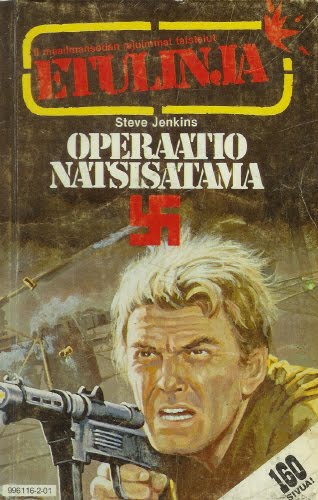
I bought some old paperbacks from an old used book store in Forssa that was closing down and selling everything out with half a cover price. One of the books was a war paperback that I've never taken a closer look at. It was by "Steve Jenkins", called Operaatio natsisatama (Operation Nazi Harbour; stupid title if there ever was one). It was published by Viihdeviikarit, one of the last cheapo paperback publishers in Finland, in their Etulinja/Frontline series in the early eighties. The book was left lying on the floor with some other books, but then one night, pretty tired of the historical novels I've been reading for a reference book project I picked the book up and started to read it. It was fluent and fast reading, with lots of dialogue and pretty good action scenes and one or two sex scenes: good old-fashioned disposable trash. I got more interested in the book and started Googling.

No "Steve Jenkins". No war paperback was ever published under that by-line. Googling more I found out that this might've been published originally under some other name - and then I found out that the Etulinja series this was published in held also another book with the main character called Mahoney. That book, called Kuoleman juna/Death Train, was written by one Gordon Davis. And bingo! Gordon Davis is a pseudonym used exclusively by Leonard AKA Len Levinson, a paperback hack working mainly in the seventies and eighties, and the book called Operaatio natsisatama was also written by him and erroneously published in Finland under the "Steve Jenkins" by-line. (Why this? We can only guess.) The original title is Hell Harbor.

The books were a part in Levinson's Sergeant series, which conveniently happens to have a Wikipedia article, even though Levinson doesn't merit one. There's not a lot of information on him anywhere in the web. If anyone knows more, I'd be interested to hear. Has there been an interview with him in Gary Lovisi's Paperback Parade or some such? Levinson was born in 1935, that much Lee Server says in his encyclopedia of pulp fiction writers. Server raises Levinson's non-genre paperback, The Last Buffoon (1980) as "Leonard Jordan", from the pile and says it's an interesting account of the life of a paperback hack. Anyone read that?