Showing posts with label Friday's Forgotten Books. Show all posts

Friday, December 15, 2017

Friday's Forgotten Book: Bill Crider: Outrage at Blanco

The Brash Books reprint.
Don't think 
they have sunglasses in the book...
I've known Texan author Bill Crider for twenty years. I joined the Rara-Avis e-mail list I think in 1997 (not 100% certain about this, it could be 1998 as well) and found Bill's postings to be knowledgeable, funny and not besserwisserish. (Is that a word?) We have swapped e-mails on and off about all things hardboiled and noir, and we've commented each other's blogs for years now. I think Bill is one of my most permanent readers.

So I was actually quite sorrow-struck to learn that Bill is in hospice care. I'd known that he has cancer (he writes about it openly), but still this made me sad. I'm glad to be able to participate in this Friday's Bill Crider commemoration.

With the help of Evan Lewis, I got my hands on Bill's 1999 western novel Outrage at Blanco. It suited me just fine, since I'd been thinking I'd like to read me a good solid western story, and I knew Bill would deliver it. And yes, he does. Outrage at Blanco is a fast-moving tale with multiple point-of-view characters, and each and every one seems like a whole human being, though some of them are merciless bastards with no meaning in life. There are two bank robbers and rapists, there is an old patriarch on the brink of his own death and his cowardly son who's after his father's money, there is a frontier woman whom the bank robbers rape in the beginning of the novel (Bill handles the scene with compassion, I don't anyone could accuse him of using rape as a titillation), there is the woman's husband, an ordinary man who suddenly feels a burst of rage when he hears about what happened to his wife. Some of the folks in the book die suddenly, which keeps the reader guessing who will come out alive.

This was the first Bill Crider's westerns I've read, but I certainly would like to read more. He writes very fluently and effortlessly, like the best of them, and the story keeps moving without a pause, yet there's enough room for building a tension or characters or their backstories. Nothing ever gets in the way of the story. Here's Bill talking about the book.

I've read some of Bill's crime and horror novels earlier, here's my review of Blood Marks, and here's Goodnight Moom. In my book Pulpografia (in Finnish only) I have a reviews of Bill's Nick Carter novel (his first book!) and another horror novel as by Jack MacLane. (There's a side character called Jack MacLane in Outrage at Blanco.) Mind you, I've also published a short story by Bill, namely "Evening Out with Carl", in the anthology Kaikki valehtelevat/Everybody Lies.

By the way, here's a little something most people have probably forgotten: Bill's short story in the form of a blog.

More posts about Bill Crider and his books coming your way on Patti Abbott's blog here.

Friday, June 03, 2016

Friday's Forgotten Book: It Rhymes with Lust

Possibly a first edition,
based on the defects on the cover.
One of the stablemates in any genre is to discuss what was the first artifact produced in the particular genre. Hence there are many first graphic novels. I don't know what the first graphic novel really is, but I do know that there were many before It Rhymes with Lust was published in 1950 by a small outfit called Picture Novels, a subsidiary of St. John Publications.

It Rhymes with Lust was written by Leslie Waller and Arnold Drake and illustrated by Matt Baker. Drake and Baker had been doing regular comics for some time, mainly for DC, Waller had published a crime novel or two. Later on he did lots of movie novelizations. There have been two reprints, one in Comics Journal ten years ago and one by Dark Horse in 2007. It's been sold out for some time now, but I managed to pick up a copy.

It Rhymes with Lust (a great title, by the way!) is a slightly noirish exposé story of a cynical journalist who's called to a town called Copper City to run a newspaper published by the big man of Copper City, Buck Masson. Masson has passed away just before the story starts, but our man doesn't know it entering Copper City. It's soon revealed to him that Copper City is a corrupt place and eventually he has to stop the corruption. He has to face some thugs run by the deceased Buck Masson's lusty widow, Rust ("it rhymes with lust"), but he also falls in love with Buck Masson's daughter.

It Rhymes with Lust wouldn't be great literature if if were a prose novel, but now it's interesting, at least as a curiosity. It might work also as a movie, but even then it would be cliched. The active woman, Rust, is a bad femme fatale, and the passive one, Buck Masson's daughter, is a good girl. You've seen this a thousand times. Matt Baker draws well (beautiful women especially), his line is fluid, and the continuity is pretty good - this stuff reads fluently -, but as a story this would require some extra twists.

Picture Novels published another graphic novel, The Case of the Winking Buddha, by pulp novelist Manning Lee Stokes and illustrator Charles Raab -, but that's never been reprinted, so I'm not very likely to be able to read it. It has a great cover, though. Stokes wrote some crime novels from the thirties on and later he did a dozen Nick Carter paperbacks.

I noticed while reading this that a new small publisher Automat.Press has just launched a new Kindle edition of another early graphic novel, also in paperback format, i.e. Joseph Millard's Mansion of Evil. It was originally published by no less than Fawcett Gold Medal! Millard was an interesting character in his own right, making comics in the 1940's and 1950's and then moving to paperback originals. He wrote as Joe Millard some The Man With No Name westerns in the early seventies (though everyone knows Clint Eastwood has a name in all the Sergio Leone movies he's in). There are some free pages of Mansion of Evil in Amazon, and from those it seems that Mansion of Evil is purer noir, with its doppelgangers and all that stuff. Graphicwise, it doesn't seem as solid as It Rhymes with Lust.


Friday, October 16, 2015

Friday's Forgotten Book: Jack MacLane: Goodnight, Moom

I was lucky to find this almost ancient paperback from a junkyard sale at a comics book store here in Turku. Goodnight, Moom, published originally in 1989, is a cult item, cherished by few aficionados. And it deserves to be.

It's a sort of Frankenstein tale, set amongst the white trash of Texas. Victor Frankenstein of the book is Ed Leach, a car mechanic who abuses his wife and does nothing else but work at his garage and drink beer with his loser buddies. The monster of the book is his son, Harry, whom Ed throws against the wall when the kid is very small. Something happens to the baby and he grows up weird, not saying anything to anyone. He goes to school, but learns nothing. At one point, Harry tortures a kitten. Then he kills another child, a girl who's taken to liking him, since he's so quiet all the time. Ed decides to lock Harry up in the cellar. His mother, Harriette, takes care of the boy, but is afraid of him. And she should be... Harry breaks free and goes on a killing spree, repeating "moom" everytime full moon is up. Ed goes
after him, just like Victor Frankenstein does in Shelley's novel. It develops into a nasty mess, with Ed wanting to keep his son's misdeeds hidden.

Goodnight, Moom is a well-paced horror novel with a ghastly plot and ghastly details, but what's more important is that Jack MacLane can make Harry an interesting character, even though Harry can't speak and doesn't know any words for his strange emotions. You care for the sick, silent bastard. And you care for Harriette, his mother, and you even might care for Ed - you almost surely care for his loser buddies whom he takes with him to catch Harry.

Jack MacLane is really Bill Crider, the Texan writer, paperback collector and blogger. He used the pseudonym Jack MacLane in a string of horror books written for the now-defunct Zebra. The Texas landscape comes alive with many telling details about the wasted life of the small-town Texans. At times Crider goes into a tall-tale territory, like his friend Joe Lansdale also often does.

Goodnight, Moom is available as an e-book alongside the other Jack MacLanes Crider wrote.

One of the Jack MacLanes, Keepers of the Beast, was translated in Finnish in 1989 as Paholaisen opetuslapset in the short-lived horror series by the Viihdeviikarit publishers. There's a sheriff called Jay Reasoner in the book, but that's about all I remember from the book. Might be the time to reread it.

More Forgotten Books at Patti Abbott's blog here or at Todd Mason's blog here.

Saturday, December 28, 2013

Friday's (or actually Saturday's) Forgotten Book: Victor Gischler: Go-Go Girls of the Apocalypse

Back in the days when I was planning and editing the short-lived paperback series of the Arktinen Banaani publishers one of the manuscripts I was sent was Victor Gischler's Go-Go Girls of the Apocalypse. I didn't read it at the time, because it seemed obvious from the start that the series wouldn't continue for long. I'd read Gischler's Vampire A-Go-Go and enjoyed it, but thought it wouldn't fit the paperback line easily; here's my blog post on the book. The manuscript of Go-Go Girls of the Apocalypse I'd printed out came up when I was cleaning my desk before the holidays and I decided I'd finally read it, but instead of reading the book from the printed sheets, I ordered a copy from a web store.

I'm glad to tell you that Go-Go Girls of the Apocalypse (GGGOTA) is a very good book. It's funny, exciting and violent, but there's also some warm humanity in the depiction of the protagonists. The set-up is good: one man has lived in a cage for nine years after the apocalypse (which is explained away in a short sentence, which is a good thing) kills three mysterious men he encounters in the woods and starts to think he should try to find out what's happened to the mankind. He also misses his wife he hasn't seen in nine years. Not all about their marriage is explained in the beginning and Gischler keeps important things away from sight till the second half of the book. The collapsed society of the near future is plausibly done, even though it's a mix-up of westerns and Mad Max. Gischler takes things over the top, but does that very well. GGGOTA is a grand adventure in the style of Huckleberry Finn. I would've gladly taken the book in with the Finnish paperback series, but alas the series didn't see the light of day after five books (and four that came out in hardcover - the format change didn't change a thing, even though we added two Finnish books in the bunch).


GGGOTA may not be to everyone's taste, but I liked the heck out of it. One point, though: I didn't like the scene with the crazy man-hating transsexual.

It seems Gischler managed to fund writing the sequel, but the book doesn't seem to be out as yet.

Didn't mean to do this as a part of the Forgotten Books meme, but here's a link to Todd's blog with the other links.


Friday, August 16, 2013

Friday's Forgotten Book: Livia Reasoner: The Vampire Affair

I won this book from Livia Reasoner, James Reasoner's wife, some years ago in a blog or a Facebook contest. I got around to reading it only now, but luckily it still seems to be available as an e-book, though I believe these Silhouette books have a short shelf life.

This is the only paranormal Silhouette book Livia has written, but I don't know why this is, since The Vampire Affair is a solid book, fast-paced thriller with enough vampires, romance and erotic love. It's a clearly work of a professional. The main characters are a young and eager female journalist and a mysterious millionaire who turns out to be a vampire hunter and a bit of a vampire himself. This may sound cliched (and indeed many parts of the book are), but Reasoner writes deftly and keeps the story running. The book is quite short, so the cliches don't get in the way. In the end Livia throws some American Indian mystique in the mix, and it works, too!

The Vampire Affair could've also easily started a series, since both major characters could well play leading parts in coming books as well. Here's hoping it will happen!

More Forgotten Books here on Patti Abbott's blog.

Friday, July 26, 2013

Friday's Forgotten Book: Sébastien Japrisot: The Lady in the Car With Glasses and a Gun

Still suffering from a bad back, I finished lying on a sofa the French writer Sébastien Japrisot's thriller La Dame dans l'auto avec des lunettes et un fusil (1966). I had a beat-up copy I'd found somewhere cheap, and upon noticing I already have a better copy I decided to throw this away - most certainly something I wouldn't normally do.

This is a very good crime novel. I once read somewhere that if you're a male writer, don't try a woman's point of view (unless you're Cornell Woolrich). Japrisot does it and does it very well. Of course some of the stuff in the book depicting a young woman's sexual and social disorientation is dated, but they didn't overrun the reading experience. The book reminded me a bit of Gillian Flynn's Gone Girl, which I liked to a certain point, but I also got weary of its longevity. Not so with Japrisot's novel, as it clocks at about 250 pages. The book starts in the middle of the woman's noir nightmare of which the characters and the reader can't possibly fathom what's going on. Japrisot likes to toy with the reader's expectations and this is far more exciting and surprising than Gone Girl. Japrisot also writes in a very French style that's both hypnotic and diffuse at the same time. This is a very engaging book and although the prose isn't the most straight-forward one, you can't help but read the book in one sitting.

The book was made into a British movie in 1970 with Samantha Eggar and Oliver Reed. Haven't seen it, though. Seems like there's no decent DVD on it. Here's a good blog post on the film.

More Forgotten Books coming up here.

Edit: I forgot to mention it, but I read the Finnish translation from 1967. The title means "The Woman in the Car". Guess this was clear to anyone. Crime Club (with the nice logo) was a quality paperback series from the large Finnish publishing house Otava back in the late sixties. 

Friday, July 12, 2013

Friday's Forgotten Book: Dean Koontz: Shattered (1973)

I've never read much Dean Koontz and my impression of his later and longer work (see here) has not been very good, but Shattered proved out to be short, gripping and brisk. It's one of Koontz's early books, published initially under his K. W. Dwyer pseudonym (and later on published as Dean Koontz), and still it tells a full-bloodied tale of full-bloodied people.

The premise is not very different from Richard Matheson's and Steven Spielberg's Duel which is two years senior, so Koontz may have had it in mind. Shattered also differs from Matheson's work in that the chase is personal in tone. A dark, mysterious van is behind two drivers, a young boy and the boyfriend of his older sister, who's a father figure to the kid. They don't know who drives the van, but Koontz shows he's a menace in the chapters narrated through the mysterious driver.

The ending is a bit too abrupt and there are some characters of which I didn't know whether they really were necessary. But Shattered is still a
suspenseful book that feels for its doomed characters.

This came out in Finnish in 1994 from Book Studio under the title Varjostaja. See the Finnish cover here.

More Forgotten Books here.

Friday, June 28, 2013

Friday's Forgotten Book: Jack Williamson: Darker Than You Think

I'm writing this before I've finished the book, so I don't know the outcome and how it will play out, but here goes nevertheless.

Jack Williamson's Darker Than You Think (published first in 1940 in Unknown, then in book form in 1948) is a werewolf classic and as such it seems dated now, though it must've been pretty ground-breaking at the time, for all its realism and psychological acuteness. Williamson even strives for a plausible explanation of lycanthropy, but the explanation of course seems dated now.

The title of the book is a lot like many film noirs with its emphasis on dark, and sure enough one could see this as a film noir, especially with the red-haired femme fatale of the book, April Bell. The hero of the book, Will Barbee, is an ordinary sap, hacking newspaper stories and drinking whiskey and waking up to a nightmare of his life.

More Forgotten Books here at Patti Abbott's blog. There's an Elmore Leonard week, but I wasn't able to participate in that.

Friday, February 15, 2013

Friday's Forgotten Book: Adam Diment: The Dolly Dolly Spy

Adam Diment's The Dolly Dolly Spy (translated in Finnish with a misleading title Nukkevakooja) was an enormously popular spy novel published in 1968 that's largely forgotten these days. It does seem to have some sort of a cult following, though, which I can understand, but not easily relate to.

I did enjoy the book mildly. The book has lost some of its shock value - I mean, we have seen quite a lot of free sex and the use of mild drugs since 1968, there's not much to it anymore. But it's still entertaining, even though in the case The Dolly Dolly Spy there's also lots of old-fashioned sexism to it. A blogger wrote that Adam Diment's Philip McAlpine makes Ian Fleming's James Bond books feel like they were written by Andrea Dworkin!

The main problem for me in The Dolly Dolly Spy was that the book was too episodic. There's not much coherence to it. I'm the first to admit this was probably something Diment was aiming at, but it doesn't work very well (though it does work in some books). The first part of the book is pretty good, and so is the end, but the middle part drags - and none of them have much to do with each other! It does, however, add to the overall parodic quality of the book. The parody goes well with Philip McAlpine's character, since he couldn't be less interested in the Cold War affairs and he gets rather pissed off by the fact that his employers want him to help an old Nazi officer escape.

Adam Diment's story has been interesting, read for more here and here.

More Forgotten Books here.

Friday, December 21, 2012

Friday's Forgotten Book(s): The Eighth Circle, Don't Ask, Chip Off the Bloc

Here are three books all of which I've read or tried to read recently.

Stanley Ellin's The Eighth Circle (1958) has come with high praise from many crime fiction aficionados as one of the more original private eye novels. Ellin has written some very good short stories, some of which are classics, and some good films have come out of his novels, but I couldn't get past page 100 or so of The Eighth Circle. Maybe I'm the one to blame, but nothing much seemed to happen. I also couldn't get into Ellin's style. The situation might be different if there were a good Finnish translation of the book, but unluckily this is not the case here. I'm sure many of Pulpetti's readers might like Ellin's book. (The Penguin cover is so great I wanted to use that, even though it's not very American in style.)

Donald Westlake's Don't Ask (1992) is one of his Dortmunder novels. I haven't been a fan of Dortmunders (lately I've found I don't really find jokes funny, especially in a book), but I've liked to read one now and then. This wasn't very entertaining, I must admit. I struggled the book through, as I hoped the book would turn funnier. Beside some mild amusement and some satire on United Nations and some quirky characterization the book seemed a bit forced. I'm actually sorry to say this, since I've liked other books by Westlake very much.

Gar Wilson's Chip Off the Bloc (1986) is something completely different: it's a book in the men's adventure series Phoenix Force that's a spin-off of the Mack Bolan series. I don't really care for this kind of stuff, but I have, shall we say, an academic interest for it. I left most of these books out of my first book, Pulpografia, and I've been thinking about a sequel in which I'd talk about these later men's adventure series. (Seems though I'll never make it. I might settle for a longer article.) This one was written by a guy called Paul Glen Neuman who has a website of his own (he lists at least thirty screenplays he's written, but none of them seems to have been filmed). Neuman has done also other men's adventure series, so I guess you could call him a pro. Chip Off the Bloc is written in a pretty dull way, I must admit: there's no actual development, the scenes just follow each other and something just happens in them. I understand this is supposed to be simple stuff, to be read shallowly and leisurely (which is actually what I did), but I think you could do these books with more imagination and better characterization. Now there's not much life to these people. The book has also some funny outdated stuff on early modems and computers. (I recall reading somewhere that Dan J. Marlowe penned one or two of these books, is this confirmed in the new Marlowe biography? The Finnish edition of this book, by the way, is credited with the original title as "Chip Off the Bloch"!)

More Friday's Forgotten Books here.

Friday, December 07, 2012

Friday's Forgotten Book: Clark Howard: Dirt Rich

I mention this book in my Pulpografia in the entry for Clark Howard, but I've actually never read it - until now. Dirt Rich (1986) is a long, sweeping epic on Texas, oil, fatherless sons, tyrant fathers, absent sisters, treacherous wives and hard-working men. The story starts from 1918 and ends just after World War II, and there are also some backflashes to the days of Wild West. Lots of things happen in the 800 pages of the book.

Clark Howard is an excellent short story writer and he also seems to be a good novelist. There's lots to admire in Dirt Rich, for example how Howard never really tells what a person looks like, but you still get the feel of how he/she acts, moves, reacts, dresses. The real history of a nation is somewhere in the background, but still effecting the acts of individuals.

I know the Friday's Forgotten Book meme is about Ray Bradbury this week, but I just happened to finish this late last night.

Friday, October 19, 2012

Friday's Forgotten Book: Robert Colby: The Captain Must Die

Thanks to Kindle and Prologue Books, I was finally able to read this magnificent crime paperback by Robert Colby that has been getting praise from the likes of Ed Gorman for some years now. I've earlier read some very good short stories by Colby and his paperback novel Beautiful but Bad (Monarch 1962), but this one has eluded me. Not anymore, of which I'm very glad.

The Captain Must Die (Gold Medal 1959) is one of those late fifties to early sixties noir paperbacks that tell about paranoia, broken dreams and people's hatred towards each other. This is firmly set in the world of well-being suburbs and tells about what's going behind the happy facade. This is also about the effects of war and the frustration that it breeds. Colby weaves his plot smoothly, albeit he has also fragmented it in a way that seems way ahead of its time - at least for a 50-year old crime paperback! Some scenes are very exciting and suspenseful. The ending may a be a bit too happy, though. (The cover lets us suppose it's a war novel. It's not - the war is in the background all the time.)

Here's Cullen Callagher on Colby's novel, and here's Ed Gorman, calling it a masterpiece. Here's Peter Enfantino's essay on Colby. Load the novel here. (And congrats to Prologue Books for doing this. There were some formatting and scanning errors in the Kindle version, but not so many that I'd actually complain.)

More Forgotten Books here.

Saturday, September 22, 2012

Friday's Forgotten Book: The Mark of Zorro

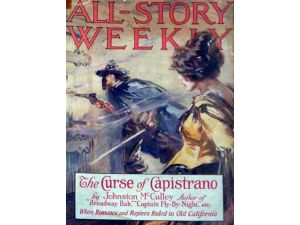
I've been compiling the new issue of Ruudinsavu (= Gunsmoke), the official magazine of the Finnish Western Society. I've been dreaming about the issue dedicated to the Zorro phenomenon, to the movies and comics and other stuff that's been made about him. It seems like it's now coming true, with me writing the article on Johnston McCulley who originally invented the character and wrote the first stories about him.

McCulley wrote four novel-lenght stories about Zorro, but weirdly enough only the first seems to have been published in book from. Can this be true? And the first one, originally "The Curse of Capistrano", later published as The Mark of Zorro, the title of the Douglas Fairbanks film of 1920, is now available only in the POD edition from Wildside Press. (It's okay, but it has an ugly cover, with McCulley's name written wrong ("McCully") and the book has some formatting and scanning errors.) How can this be? McCulley died in 1958, so his work is technically still under copyright - except seemingly for The Mark of Zorro, since I don't think Wildside Press is paying anyone anything for the rights of book. Is there a problem with McCulley's heirs? I notice Googling around that there's been talk about the collected Zorro short stories coming from Black Dog Books, but so far nothing.

Back to the actual book. "The Curse of Capistrano" was published in All-Story Weekly in 1919, making Zorro one of those long-living heroes originated in the pages of a pulp or other fiction magazine, just like Tarzan or Sherlock Holmes. The story was fast made into a movie and hence the book was getting to be known as The Mark of Zorro.

The book is entertaining, and though it's dated in many ways (Zorro never kills anyone, except one guy in a duel and that's perfectly alright for everyone concerned), it's still a quick read. McCulley uses a highly sophisticated style, one he probably thought suits the early 19th century Spaniards, and at times it's a bit too funny - unintentionally. The book's also staged like a play, with far too few scenes for action and too many of them take place indoors. There are some good battle scenes to make up for the staginess. The basic gimmick - that Zorro and Diego Vega are one and the same guy - is basic knowledge to everyone now, so the book loses one of its advantages at first sight.

I'd really like to read the other McCulley Zorros, but it seems it's almost impossible, unless I pay some real money for the old pulps they were published in. (Make sure to note these Zorro tie-ins from Sandra Curtis that to my knowledge have never been published in English.)

The weird things don't end here, by the way: McCulley's Zorro was never published in Finnish. We've had only the movies and the Disney TV show and Steve Frazee's novelization of it.

Other Forgotten Books at Patti Abbott's blog here.

Friday, August 31, 2012

Friday's Forgotten Book: Tales of Suspense audio book

I bought this for one euro from the local recycling center. It had once belonged to a small town library in the Eastern Finland - and I really don't know why it was purchased there in the first place! I'd guess no one had ever loaned it.

There are two C-cassettes (and yes, I still have a C-cassette player) and a leaflet containing the four stories read aloud in the cassettes: Rob Kantner: "The Last Day", Nancy C. Swoboda: "Roomer Has It", Chet Williamson: "The Undertaker's Wedding" and Pauline C. Smith: "The Dog". The readers are William Hootkins and Barbara Rosenblat. The year is 1986.

There's just one problem: I don't usually have time to listen any audio books, so I guess I'll just read the stories.

More Forgotten Books here.

Friday, August 17, 2012

Friday's Forgotten Book: Peter Cheyney's Dangerous Curves

I have never read much Peter Cheyney, largely because his reputation has been so bad. I started to read an old paperback edition of his Slim Callaghan novels, Dangerous Curves from 1939. I'm not sure whether I'll read more by Cheyney, but seems like I have to, since I want to do my book on British crime writers one of these days... Give me a Hank Janson by Stephen Frances any day instead!

Cheyney's dialogue is terrible pseudo-tough wisecracking and I've rarely seen such stupid chauvinism in a book. There's some toughness to Callaghan, a London PI, but I must admit he's not a very interesting character. The plotline is confusing to follow - and it's also not very interesting! There's no life to Cheyney's characters.

I was very pleased to receive a Joe Pike novel The First Rule by Robert Crais in the mail today. I'll start reading it tonight and toss Cheyney gladly aside.

But do take a look at the Cheyney cover gallery at Steve Holland's Bear Alley blog here. Dangerous Curves was published in Finnish as Kuoleman huvipursi (The Yacht of Death or some such) in 1957. See photo. I don't know the illustrator.

More Forgotten Books here.

Friday, August 10, 2012

Friday's Forgotten Book: John Creasey: Gideon's Risk

I haven't had time to finish this book, but here goes nevertheless.

John Creasey has been one of the most prolific writers in the world, but there are only few of his books translated in Finnish - his series on the Superintendent Gideon made its way in Finnish only twice. I believe it has something to do with the fact that the books came out of nowhere and the publisher didn't allow the readers enough time to get acquainted with the series and all the characters. It's interesting to note however that many aspects of the police procedural genre we usually associate with TV series like Hill Street Blues and The Wire and writers like Joseph Wambaugh were already fully used by a Briton like Creasey. There is the sympathetic and determined main character Gideon, there are lots of his colleagues and employees (what's the right word here?), there are intertwined plotlines, there are many subplots, there is the sociological perspective to all this. There's also the British class society very visibly in sight, many of Creasey's - or Gideon's - sociological notions lean on patronizing.

I would tend to say this is a bit outdated, but interesting nevertheless. Gideon ottaa riskin (Gideon's Risk, 1960) came out in Finnish in 1965. More Forgotten Books at Todd Mason's blog here.


Friday, July 27, 2012

Friday's Forgotten Book: Hartley Howard Double Bill

Okay, let's be honest about this: I haven't finished these two novels I'm about to introduce. I've been away and travelling and one of the books was forgotten behind and when I was able to get back to it, I couldn't anymore remember what had been going on. The other one then didn't simply feel rewarding enough.

Then why am I writing about these books? Because I'd really like to get my book on British crime paperbackers done. Hartley Howard's books were originally published in hardcover in England, but all of them were paperback in Finnish translation. They also have something of a paperbackish feel to them: Hartley Howard's private eye hero Glenn Bowman feels a mix between Mike Hammer and Lew Archer. The earlier of the two books, A Hearse for Cinderella (1956, translated as Kaikki menetettävänä/Everything to Lose; see the photo, illustrated by Bertil Hegland), starts like Kiss Me Deadly: Glenn Bowman is driving in his car late at night and almost runs over a young woman dressed only in an overcoat. Bowman takes the girl to the doctor to find out the girl escapes the minute he's taking the doctor to see her. Escapes - or is kidnapped. The plot is a bit too convoluted to be fluently followed, but there is big stuff at stake here.

Epitaph for Joanna, published much later (1972), reminds me more of Ross Macdonald's Lew Archer books and is more serious in tone. Bowman comes across as a really sad type, being all the time all alone without any friends - which was typical to the private eyes of the bygone days. Did Archer or Philip Marlowe ever have any friends? The same goes for Bowman as well. The plot also reminds me of Ross Macdonald, with the stuff from the past affecting the present-day lives of the book's characters. In this book, the stuff from the past is the accidental death of a young woman called Joanna a decade earlier.

The biggest problem with Howard's books is that his scenes are a bit too long and stilted. The melancholy of Glenn Bowman is too meticulously told, the reader - at least I am - is too easily bored with Bowman's whinings. Less would do. The plots are over-complicated to be at times so thin. The books might read better in the original English, I read these in Finnish translation and the old Finnish paperback translations are not usually very good. But nevertheless I'm going to give Hartley Howard another shot or two.


More Forgotten Books at Patti Abbott's blog here

Friday, June 29, 2012

Friday's Forgotten Book: Bill Crider: Blood Marks

Bill Crider, as you probably very well know, is a long-time crime, western and horror novelist who also maintains a popular blog. It's been years since I read something by him, but now I decided to read his Blood Marks, a serial killer thriller from 1991, that's been getting high praise from the likes of Ed Gorman.

It's a good novel, with a horrifying central character and Crider does a pretty good job keeping the reader guessing who the serial killer might be. The book is divided in three chapters, and while it veers towards implausibility, the second chapter with the emphasis on the heavily abused three-year boy is the most horrifying. 

There are some downsides to the novel as well. One of the characters leads a double life, but I didn't really buy that. The main female character doesn't feel like she's been studying English literature and is looking for a job to teach it. (I've known quite a few literature students, mind you.) One of the lead characters is too pointedly unpleasant. The revelation in the end doesn't feel so much a reveleation as it should feel.

But this is a fluent and suspenseful read, I recommend it wholeheartedly.

More Forgotten Books at Patti Abbott's blog here.

Friday, June 15, 2012

Friday's Forgotten Book: Patricia Highsmith: Ripley Under Water

I'm not sure if a Tom Ripley novel by Patricia Highsmith is forgotten, but they don't really seem to get the merit they deserve. The books are strangely appealing, even though there's a nihilistic streak to them. It seems to make the books more enticing, though.

In Ripley Under Water Ripley is suddenly threatened by a strange American couple, who seem to know something about Ripley's shady past and some killings he's done. Ripley of course wants to get rid of them, but there's also another reason: he thinks they are irritating, behave badly, disturbing the peace of the French countryside. It's entertaining that Ripley can consider murdering people only for behaving badly in public, not playing by the rules. Ripley only wants to spend time with his beautiful wife, play some music, do some amateur paintings of his own, eat the good food his maid prepares. In Highsmith's world, this can be sometimes achieved only through murder.

Ripley Under Water suffers somewhat from being too slow, especially in the middle when nothing much happens, but the ending is strong.

More Forgotten Books at Patti Abbott's blog here.

Edit: of course I meant "appealing", but this went as "strangely appalling" for many days. I noticed it, but couldn't do anything about it as I was travelling!

Friday, June 01, 2012

Friday's Forgotten Book: Margaret Millar

Patti Abbott is hosting a Margaret Millar week at his blog here, and all I have time or patience to do is to link to this earlier posting of mine. I've done some other posts on Millar, here's another.