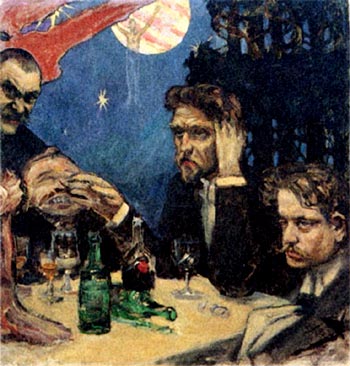
Thursday, July 29, 2010

Jason Pinter's The Mark and John Rector's The Cold Kiss

As this is a literary blog and not really about my personal life and what I've been doing lately (it used to be, but as I've grown older and wiser [hah!], I've decided to go for an alternative), it has to suffice that I write about the books that I read during our 1½-week trip through Finland. Well, let me say this: we went first to Mänttä to visit my relatives, swam in the lake nearly all the time and visited the Mänttä Kuvataideviikot art thing, and then we went to Nokia to visit my dad and went to the Särkänniemi amusement park and Ottilia made me go to the new Motogee thing and I have to say I almost started to cry when it finally - after 28 seconds - ended. And then we went to Pori to visit my mother and just tried to chill out - which is near impossible in this temperature. (Over 25 Celsius all the time and no rain.)

Okay, the books. Jason Pinter is one of the newer thriller writers who hark back to the older traditions of the genre and don't write high tech thrillers à la Tom Clancy or don't go for the huge historical conspiracies like Dan Brown and his followers. The Mark, his first novel from 2007, is very reminiscent of the wrong man thrillers of the 1930's and 1940's. In fact, the novel could be labelled "noir", unless one wants grimness and an unhappy ending from one's noir. In The Mark Pinter creates his series character, journalist Henry Parker, who's involved accidentally in killing a police officer and becomes a most wanted criminal. Parker decides to solve the case before the police catch him, just like many heroes of the films from the thirties and fourties.

There's much to like in the book: the narrative is catchy, the pace is good, the description about journalism and journalists is good (Pinter is a journalist himself) and there's not much padding. I thought however that there were some implausibilities that nagged me from the halfway on, and the romance felt a bit forced and clichéd. I notice now - after having finished the book over a week ago - that I don't remember much about the book. But I guess that's one of the criteria of entertainment: you don't want to think too much about it. Me, I could've wished for more.

John Rector's debut novel, The Cold Kiss (out now from Forge in hardcover), was more to my taste: a noir novel that has the grimness that's required in noir. Rector's minimalistic style and the plot reminded me very much of the classic noir paperbacks of the fifties and writers like Day Keene, Gil Brewer and Richard Deming. Of course Rector, writing in the 2000's, is more open about sex, drugs and violence than his predecessors, but the picture he paints about human evil is no less chilling than with Keene or the other writers. The Cold Kiss is essentially a thriller set in a snowbound roadside motel where there are only a few people, one of them seemingly dead.

One of the best things about The Cold Kiss is how Rector reveals facts about his characters little by little. You get to know them and feel for them and even when they are not the best of people, you have to sympathize for them and hope the best for them. Even though they seem pretty stupid and do unnecessarily nasty things.

I can't much say about the plot, since there are lots of twists early on. I can say, though, that mentioning Scott Smith in the back cover copy gives too much about what will happen in the book. These things said, I must admit that the book is just a bit too long, maybe by 20 or 30 pages. I also guessed who the bad guy in the book is - there are too few characters in the novel. And the ending could've also been just a bit grimmer. There's a hint of ambivalence in the end, but I could've wished for more. Let's make it clear, though: an excellent debut.

Monday, July 26, 2010

Review of the Isku webzine

Paula Arvas reviews the first issue of the electronic Isku here. (In Finnish, of course.) She writes:

Iskuun tutustuminen [kannattaa] aloittaa vaikkapa ottamalla käteen kuppi kahvia ja lukemalla Kevin Wignallin hieno novelli "Kuolema", joka on alunperin ilmestynytEllery Queen's Mystery Magazinessa.

In English:

You get acquainted with Isku best with having a cup of coffee and reading Kevin Wignall's fine short story "A Death" that was originally published in the Ellery Queen Mystery Magazine.

Sunday, July 25, 2010

Safe back from the trip

Just wanted to let you know that we came back from our trip that eventually lasted more than a week. I'll be posting something about it - perhaps some photos and reports about the books I read during the trip, including a thorough essay on John Rector's debut novel The Cold Kiss.

Wednesday, July 14, 2010

John Quinn's Terminator novel


I finished Justin Cronin's massive vampire novel The Passage (Ensimmäinen siirtokunta in Finnish) yesterday and wrote a review of it for the local newspaper. I enjoyed the novel quite a bit and can recommend it; now, suffice to say that any friend of long, epic western novel should try The Passage.

After finishing the 850-page The Passage I wanted to read something quick. I had recently found a free copy of an eighties' men's adventure paperback, John Quinn's The Kill Squad (1983) - or actually the Finnish translation of it, called Nitistäjä ja salamurhaajat (1985). Since Quinn's hero Rod Gavin is called Terminator after the "best" men's adventure fashion, calling him Nitistäjä in Finnish doesn't really work, since it sounds like he's hiding in the bushes and shoots in the back. The other two Quinn translations, Silicon Valley Laughter/Kamikazemurhaaja and Mercenary Kill/Viimeinen isku, don't carry the Nitistäjä label. The author behind the John Quinn pseudonym is presumably Dennis Rodriguez, who's probably written lots of these kind of books.

Okay, back to the book. I read the book in one hour or so, which is a virtue in itself. As for the other virtues in the book...

The book's kinda episodic and there's not much plot, basically just scenes put together. The premise is kinda interesting: a group of terrorists hides behind the survivalist group working somewhere in Arkansas, seemingly scheming to kill president Reagan (why in Arkansas of all places is never clear) and seemingly getting instructions from someone in the US federal state organization. The book's also kinda erotic or even pornographic, as almost every baddie in the book seems to get sexual satisfaction from beating up and killing women. In the end, the book's kinda clichéd. Kinda?

I started to think about Rod Gavin, the Terminator of the title. What right does he have to use the Terminator label? He doesn't do anything in the book. If he really were the Terminator, he'd be able to prevent at least some of the killings and slayings in the book, don't you think? Instead he's hit in the head and while he's unconscious, two thugs torture and kill a nice young lady. (Okay, he does kill them later, but that doesn't much help the young lady.) Similar thing happens also later in the book. Only in the end, he gets to shoot some of the baddies, but it comes all too late after several innocents have been maimed. To my surprise, I began to hope Mike Hammer would step in and start hitting some teeth with his gun. Rod Gavin is a wimp, if you ask me!

Here's another review of the book at Johnny LaRue's Crane Shot. He seems to basically agree with me.

The Finnish cover of the paperback seems to be an exact copy of the original one, which is kinda rare in the history of the Finnish paperback publishing.

Wednesday, July 07, 2010

Summertime Blues

I know, I know, it is pretty boring to post just to say is busy and will be busy and will be having a vacation, but that's what I'm gonna do right now. My daughter came to Finland to spend the summer with us and we are doing a bit of travelling, so there won't be much to write.

But, ah man, there's been a lot to write about. I just don't know where I'm spending my time (on Facebook, maybe?), but some things I've been meaning to write about but haven't:

1) the Red Riding trilogy: superb rendering of David Peace's book quartet: serial killing put in the social context (I really was meaning to write a long essay about this, but suffice to say that T. Jefferson Parker did this thing better in his California Joe; brilliant nevertheless)

2) Robert Harris's Rome novels: utter bores, don't waste your time on them

3) a Mexican wrestling movie from the early seventies I watched with some friends of mine: forgot the title, but the movie was hilarious, just like the sixties Batman TV show

4) Arturo Perez-Reverte's novels on Captain Alatriste: just can't get hooked on them, even though they are said to be popular and hark back to the golden days of the adventure novels, give me a Thomas B. Costain any day over Perez-Reverte!

I know I'm forgetting something. I just know it.

I'm reading Justin Cronin's celebrated vampire novel The Passage (Ensimmäisten siirtokunta in Finnish) and liking it a great deal, but

Monday, June 28, 2010

A foreword to a new book

I just posted a foreword to my new (still forth-coming) book. It's a book with the famous illustrator Kari Suomalainen's collected fiction, three crime short stories from the late thirties and a YA crime novel from 1948 put together. You can read it here. (In Finnish, understandably.) I liked doing the book, but it seems there are some complications with the publisher about the foreword, so we'll have to see what the outcome is.

I have a longer version of the foreword, but I'm saving it for some other time.

Wednesday, June 23, 2010

My new webzine: first issue out


I've been pretty quiet around here for a week or so, as I've been concentrating on another blog project: the web version of my crime fiction magazine, Isku. And it's out now! You can see the first issue here. It is of course in Finnish, but I'm sure you'll recognize some of the writers: Keith Rawson, Kevin Wignall and Anthony Neil Smith. There are also two new Finnish short stories and a vintage story by Matti Kid Hytönen. It's from 1988 and was originally published in the short-lived crime fiction mag called RikosPalat (Crime Pieces, or something along those lines, in English).

My idea is to put out two issues each year, so the next one will be out somewhere around Christmas. Probably on Christmas Eve, if I know me well enough...

There's one thing missing from this issue of Isku: there's no Joe Novak. I used to have a new Novak story in each issue, but I think I got pretty bored with him. Or then I just didn't have enough time. I have some unpublished Novak stories sitting in my computer, but I think they are a bit too long for this kind of webzine. I'll have to see what to do with them. (Ahem... seems like the Thrilling Detective link above is a bit dated. Will have to fix that. Not even a mention of the novel It's a Weird Buzz, Joe Novak! APB! APB!)

Monday, June 21, 2010

Tapani Bagge's Kasvot tuulilasissa


My friend Tapani Bagge's newest book is a little paperback called Kasvot tuulilasissa/The Face in the Windshield. It came out from Turbator (the same publishing outfit that did my Sherlock Holmes book) and carries a brilliant cover illustration by Anssi Rauhala - who also did the Holmes cover.

Kasvot tuulilasissa is about Onni Syrjänen, who's a lawyer down on his luck and willing to take almost any job. Hence he gets to search for a missing daughter of a known crime boss. Syrjänen finds her pretty easily, as corpses don't much walk... The book speeds on like a bullet and Syrjänen visits almost every city in Finland, in search for a missing cocaine loot. There's lots of violence and black humour and also a feel for common man, like in all the books by Tapani Bagge. I recommend this highly, if you want to spend an entertaining hour. Reading the 15,000 words (thereabout) doesn't take much longer. This is what paperbacks are supposed to be like!
As a reminder: Onni Syrjänen can be read also in English, as Thrilling Detective has two stories of his escapades in translation. Check out here and here!

Wednesday, June 09, 2010

My Sherlock Holmes book


I promised to say something about the collection of Finnish Sherlock Holmes stories I edited. The book will be out next Tuesday, with this great cover by Anssi Rauhala. I posted my short foreword and the table of contents here, on one of my other blogs, and here is also the afterword Petri Salin wrote for the book - it's about the world of Holmes pastiches.

This is the first time this kind of book has been done in Finland. I don't know why, since Holmes pastiches are pretty popular in the UK and the USA. Holmes has been loved by the Finns for almost 100 years now, you'd think someone would've come up with this idea before. I got the idea when I noticed that Petri Salin, a writer of great skill and flair for old school adventure and crime, had a Holmes story in one of the issues of the Usva magazine. Then I noticed he had one even earlier in the nineties, in the science fiction magazine, Portti. And then I found two Finnish Holmes parodies in a Finnish pulp mag from the fourties, the other story being an anonymous "Sherlock Holmes in Finland" (Holmes gets lost in Finland and a Finn helps him out using his common sense) and the other being a parody by pulp writer Tuuri Heporauta (under the pseudonym of Ilkka Pilkka), with the hero's name altered into Herlock Sholmes. Then I knew I had to do this book. And I knew it would be a mix of old and new.

It wasn't very hard to get people to write for this book. Almost everyone I asked was enthusiastic, and that shows. The stories I got are very good and I'm sure not many would recognize them being not written by Doyle. Some of the stories are of course parodies, especially the one written by Jari Tammi, in which Holmes seemingly gets spanked with a whip by two young ladies.... There's also one SF/horror story set in an alternate history, written by Anne Leinonen.

Thanks to Risto Raitio I got some great old stories thrown in. And I really like the play that concludes the book: Sherlock Mopsi, written by one Arvo Salmivaara, a totally forgotten writer of plays and radio plays from the thirties and fourties. Sherlock Mopsi is very funny, and I sure hope someone will pick it up from this!

I sure hope this book will find its audience. It was fun to do and I'm sure it shows! Holmes, mainly due to the Downey film, has been regaining his stature lately, and two other Finnish publishers are bringing out new Holmes books this Summer: from Teos we will have the collection of Doyle's all Holmes stories and from Bookkari will come a new edition of the Holmes stories written by Adrian Doyle and John Dickson Carr.

Tuesday, June 08, 2010

Margaret Millar's Tom Aragon novels


As I mentioned earlier, I was writing an article on Margaret Millar for a forth-coming book 100 American Crime Writers (or something along those lines, I'm forgetting the exact title - or then it is just that!). I was going to do a Forgotten Friday post last Friday on two of Millar's later novels, but I never got around to doing it, so I'll post it now.

Or actually I'm just copy-pasting what I wrote on the Tom Aragon books in my article.
Tom Aragon was one of the few series characters Millar wrote about, and actually the only in her late career. There were couple short-lived series characters in her early books, but her mature phase (from around 1950 to the mid-sixties) hasn't any.

Millar's late phase is also worthy of note, even though her books from the seventies and eighties don't rise to the level of her classics. A good example is Ask For Me Tomorrow (1976) that is also one of her most traditional crime novels. The hero of the book is a young lawyer called Tom Aragon, who's called for help to search for a missing first husband. The book takes the reader on tour to Mexico, especially the poor wasteland of Baja California. Millar draws memorable characters of people living in destitude and their struggle to survive which often turns into quest for the impossible. Millar is very good at depicting Americans trying to find the American Dream, to rise from rags to riches, and their dishonesty towards themselves.

Ask For Me Tomorrow is not one of Millar's best, and neither is The Murder of Miranda (1979), which also stars Tom Aragon. Both books are a bit uneasy mixtures of social satire and the private eye genre. Millar is not very good writing humorous scenes (which is paradoxical, since her earlier books were full of satire), and the books change the point of view rather clumsily. The best parts are those with Aragon, but in these scenes Millar shows the influence of her husband - they could've well been written by Ross Macdonald (which of course is a compliment). The last of the three Tom Aragon novels, Mermaid (1982), is about Aragon searching for a mildly retarted runaway girl.

Do you think I'm right saying that Kenneth Millar had an influence on his wife, Margaret? I think I sensed the Ross Macdonald vibe in Ask For Me Tomorrow even when I read it in the mid-eighties, when I was 15 or 16. There are similar themes and plotlines, with the private eye figure (sure, Aragon is not a private eye, but still close and he acts like one) travelling from place to place and unravelling the mysteries of the past. Of course Ross Macdonald had died by the time Ask For Me Tomorrow was published, but one could possibly imagine that it was based on an outline Macdonald had made.

And, oh, the editor of the book
100 American Crime Writers, Steven Powell, maintains a crime-related blog here at the Venetian Vase. Take a look.

Wednesday, June 02, 2010

Sherlock Holmes in Finland


Here's the cover for my newest book, an anthology I edited called Sherlock Holmes in Finland. There are fourteen short stories and one play (!) in it, a mix of new and old. The play is from 1936, called Sherlock Mopsi, from a forgotten writer called Arvo Salmivaara. It's hilarious.

But I'll post more details later; the book will be out on Friday, 11st. The cover (which is simply great) is by Anssi Rauhala and you can see by taking a look at this how it refers to the famous painting by the Finnish artist Axel Gallén-Kallela.

Tuesday, June 01, 2010

Two Finnish pulp magazine covers


I took two (well, pretty lousy) snapshots of two Finnish fiction mag covers earlier today at the university library, where I was researching stuff for a book. (Have to say I got ideas for half a dozen books.) Here they are, both are from the Lukemista Kaikille/Reading For Everyone magazine that was published by Ilmarinen from the twenties to 1960.

The first one is by Martti Masala, who was really versatile and talented. He did lots of illustrations for the Ilmarinen publishers, week by week, and I'm sure he burned out, since he vanished from sight in the late fourties. Not much is known about him, but his illustrations are knock-outs.

The second one is by Poika Vesanto, about whom Timo Kokkila and Ville Hänninen made a good book a year ago.

Monday, May 31, 2010

Greek film noir pastiche Singapore Sling


Well, to call Singapore Sling a pastiche is a weird way to put it. Certainly, there's a lot of pastiche and parody of film noir in Singapore Sling, but it's a very far cry from your usual neo-noir. Singapore Sling is a disturbing stageplay of great perversity.

Directed by Nikos Nikolaidis, Singapore Sling starts with two women dressep up in sexy lingerie digging a grave and burying a man in there. It rains heavily down on this grim scene. It actually rains almost all the time through the film - one of the film noir touches in the film, an obvious allusion to The Big Sleep. These two women are a mother and a daughter living alone in a big mansion, talking about the killing of someone called Laura, a mysterious young woman who showed up in their house one stormy night. They restage the scene of killing her from time to time, as a foreplay to sex between them. From this point on, you know this film is not for everybody.

There's also a private eye (or a cop, it's never fully explained) who's looking for the same young woman, Laura (another illusion, this time to Vera Caspary's novel and Otto Preminger's film). The film uses a flashback technique to explain what has happened to the private eye, but everything is not fully out in the open. It's possible that Laura was a false identity to the young woman and she used it to escape the law - she seems to have killed someone. The private eye comes to the women's house, wounded from a gun shot, and is instantly taken into the weird sex roleplays the mother and daughter engage themselves in. There's a lot of bondage, whipping, vomiting, peeing and such in the film, and it's not very pleasant to watch, even though it's done with style, with a great detail in the costumes and such. The film is often quite funny, though, so it's not only disturbing. There's also less gore than one might imagine. Weird thing is that the private eye's private parts are never shown, even though the director doesn't shy away from showing a mother whipping her own daughter or the mummified father having sex with the same daughter.

There's just that the film seems a bit empty in retrospect. What's it about? What is the director trying to tell us? There are quite a lot of metanarrational techniques in the screenplay, and it's clear not everything we are shown really happens, but in the end the film seems just another postmodern pastiche ripe with empty irony.

Singapore Sling came out in 1990 and won some awards at film festivals, mainly for its direction and photography, which are very stylish. Then the film became more obscure and it vanished from sight, to be released on DVD in 2009.

Saturday, May 29, 2010

Salted coffee à la Lew Archer

For years I've been thinking that there's a scene in one of Ross Macdonald's Lew Archer novels, where Archer asks someone - a chef or some such - to put salt in coffee that's been forgotten on a coffee machine and reheat it. The salt is supposed to take away the bitter taste that's stuck on the coffee. I've mentioned this scene on one or two forums before - such as the Rara-Avis e-mail list -, but so far no one has verified there really is such a scene in one of Macdonald's novels.

But just the other day I was reading Ask For Me Tomorrow by Margaret Millar (you know, Ross Macdonald's wife) and there the scene was. Well, it wasn't actually what I had had in mind, but still close enough. Lawyer Tom Aragon has a cup of coffee with a woman who's related to the case he's working on and he thinks that a cinch of salt would take the stale aroma out of the coffee. Ask For Me Tomorrow is a book where Ross Macdonald's effect on Margaret Millar is very visible - in fact, some of the scenes could've well been written by Macdonald, especially the ones with Aragon. (The book changes the point of views pretty clumsily, and the ones without Aragon are not as worthy as the ones with him.) So, it's entirely possible that I've been thinking about this book - which I remember reading already in my teens, in the Finnish SAPO series in which Millar's novel came out in 1980 - and just getting it confused with a Macdonald.

Or then there is a similar scene in one of the Lew Archers. Maybe the writing couple did it on purpose. "You put this scene in this book, I put it here in one of mine."

As for putting salt in your coffee, just read this conversation thread.

And by the way, here's a recent post by Steve Lewis about Millar. There's some interesting discussion in the comment section.

Wednesday, May 26, 2010

True Men's Ads?

The well-known British ad agency Ogilvy and the Finnish ad agency Taivas got an award for this advertisement used in Finland. A friend of mine thought first that this was just a rip-off from some old men's adventure magazine, but it seems that the ads are original. See this link.

Wednesday, May 19, 2010

An obscure René Goscinny cartoon


This is more of interest to the Finnish readers, but I'm sure some othesr will find it interesting as well. I bought some old children's magazines from a thrift store dealer yesterday, one mainly because there was an old cartoon written by the French René Goscinny in it. The strip, drawn by Berck (known for his humorous Sammy Day gangster graphic novels), was called T.A.X. Suhari and Gorilla (the "TAX Suhari" is a bad pun meaning a taxi driver). It's called Strapontin in French, and I'm sure it was never published anywhere else in Finnish. The magazine I found this in was called Nasta - it was a magazine for the young, published from 1957 to 1965.

Here's a sample of the cartoon. It's about a gorilla that's been captured and given some treatment to become more human-like. The bad guy (in the right frame) tries to set up a trap for the gorilla, who's now too intelligent to be captured again. (Here's another link to Goscinny. I seriously everyone knows Goscinny's masterworks, Lucky Luke, Asterix and especially Iznogoud.)

Tuesday, May 18, 2010

The last issue of Pulp


I mentioned before that the last issue of my crime fiction fanzine, Isku, just came out. Now the last issue of my other fanzine, Pulp, has come out and is ready to be sent to the subscribers (of which there are not many). Pulp is not a fictionmag, it's about the different aspects of pulp and other popular fiction.

I started publishing Pulp shortly after the Finnish Western Society's magazine, Ruudinsavu (Gunsmoke), was started. The first issue of Pulp came out in 2003. It had articles on Paul Auster's first novel, Squeeze Play, William Johnston's Maxwell Smart novelizations and the Finnish translations of Peggy Gaddis's romantic paperbacks. The magazine was published four times a year. The circulation never rose above 80, and for the last issues the print run was only 40. It covered also the few libraries that have been subscribers.

There have been issues that I've been very fond of: the two issues consisting fully of Edgar Rice Burroughs-related material (the works of ERB's relatives, ERB pastiches, ERB copies and so forth), the issue that was solely about sex and sleaze in pulps and paperbacks, the issue that was solely about the Finnish pulp fiction... At times I was even able to use some of the material in Pulp in my other, more commercial work, such as my book on the forgotten works of Mika Waltari, the famous Finnish novelist and fictioneer. I also liked the logo very much. It was done with an old typewriter of my friend - thanks, Lotta!

Jukka Murtosaari was a great supporter of Pulp from early on and he provided the magazine with many interesting and meticulously (sometimes too meticulously...) researched pieces on obscure paperbacks and pulp and paperback illustrators. One could do a book solely on Jukka's articles for the magazine. It was just too bad Pulp was always a black-and-white magazine - the photos of the pulp and other covers just don't look right in b&w.

But the process really wore me out: editing the mag, writing the articles, asking others to do articles, getting the mag into print, sending out copies... I was losing money with this, so I decided to pull the plug. So it's bye-bye, Pulp, we'll miss ya. There's lots of stuff that was meant to be done (such as the theme issue on TV and movie novelizations, the kiddies' pulp, the religious pulp, the article on the Flash Gordon novels, etc.) and I really wanted to get deeper into the Finnish pulpy fiction, so this is a missed opportunity. We'll have to see if I get something published in a blog format. We'll definitely have to see...

There's also a possibility that I'll publish a collection of my own articles that came out in Pulp. That should have an interest for 50-100 buyers. At least.

On top of the post is the cover of the last issue. The issue features two articles by Jukka Murtosaari, the other one being about the Finnish reprint series of the Fawcett Gold Medal books, called Kultamitalikirjat, and the other one about the illustrator R. G. Harris. (Sorry for the bad photo: it was taken with my cell phone.)
PS. Don't bother to ask me for a copy, since they are all gone already.

Saturday, May 15, 2010

Margaret Millar


I've been writing an entry for a forth-coming book 100 American Crime Writers on Margaret Millar. I promised to do a 2,500-word article on her, but it's proven quite difficult, for some reason or another. (One of the reasons is that I'm writing in another language other than Finnish.) It started getting better when I decided I'll have to reread some of Millar's books. And it seems I read Beast in View (1955) for the first time in my life, since I didn't remember anything about it! And I'm sure glad I did, since it's an excellent psychological thriller, with lots of noirish overtones and a very convincing twist in the end. It didn't win the Edgar for nothing. The only bad thing about the book is the way Millar depicts homosexuals, as weak perverts with cold hands. But hey, it's 1955!

I also read The Listening Walls from 1959, and while not equally good as Beast in View, still a very worthwhile book about two young women in Mexico and the other one getting killed in what seems like a suicide. There's also a private eye called Elmer Dodd, short and somewhat overweight. Beast in View stars a similar character, a family friend and solicitor, who's asked to care of some awkward things, but he ends up acting like a private eye, even solving the case - this shows that Millar was interested in private eyes, but just didn't want to use one hero regularly. (Or then it was her husband's idea: "Why don't you use one of these private eyes, they can be quite handy?")

I started thinking about Mexico in Millar's work. It shows quite often, many times almost as the unconscious of the depressed and lonely Americans she writes about. It's a place where everyone wants to go, to forget, to start anew - it's also a place wherein you can set lies easily, as happens in Beast in View (which otherwise takes place only in Los Angeles). Mexico is important in Ask For Me Tomorrow, one of Millar's later Tom Aragon novels. Private eye Steve Piñata in Stranger In My Grave is half-Mexican. And then there's of course The Listening Walls. I'm not sure, but I've got a feeling Mexico plays an important part also in The Air That Kills - I've read that years ago (twice, I think), but I'm not sure anymore and I can't find my copy of the book. Anyone can confirm my suspicion?

Tuesday, May 11, 2010

Frank Miller's and Zack Snyder's 300


Last Friday night we were out having fun with my friends from our victorious movie pub quiz team. Between hopping from one bar to another, we were at one of my team mate's place and watched the Blu-Ray edition of the movie 300. Someone might think that I'd go for a movie about sword-yielding Spartans, but I thought - and all of my friends - the movie sucked big time. There were several points in the movie that I really disliked.

First. There's no plot. The movie is basically one long battle scene. There is some intrigue behind the lines, but not enough to merit a mention. I think the same marred Ridley Scott's Gladiator for me: the plot wasn't just interesting enough.

Second. The movie is full of empty posturing. The dialogue is silly and full of meaningless one-liners. The movie is directed with a bent toward empty posturing. Some of the battle scenes are not very exciting, since Snyder likes to stop the action by showing blood flow in slow motion or some such nonsense. Everything looks nice on a photo, but the drama just doesn't move along.

Third. The movie is politically so appalling that you feel like John Milius is a Commie pinko. It's not very hard to understand that Sparta is the USA, the ugly, hideous and back-stabbing witches are the UN and the Persians are - well, Persians (or Iraqis). Miller and Snyder like to show everyone else but Spartans are ugly or weak (the other Greeks that come to help the Spartans; they are presumably the British). Or a homosexual and a pervert - when Xerxes, the King of the Persians, came on the scene I burst out laughing and started to sing Sylvester's disco classic "You Make Me Feel Mighty Real". The movie also shows that the conflict between Persia and Sparta is one-sided, that the Persians just move in on Sparta - oh poor, poor Sparta!

Aside from the political overtones (they really not undertones) of 300, it's possible to see the plotlessness and the slow-motion being good examples of the new Hollywood cinema that's more based on videogames and their aesthetique, and not on old-fashioned drama, like Spartacus or Ben-Hur. It's more about the cinema of attraction rather than drama. It's also possible to see that these new historical films take the genre back to the its older roots, the ancient myths, Greek myths, Beowulf, etc., where the plot is not the crucial matter. However, I can't stop thinking that both Gladiator and 300 are just utter bores.

Monday, May 03, 2010

A pair of Morgan Kane jeans


I spotted this pair of vintage Morgan Kane jeans at the UFF thrift store earlier today. I believe they are from the seventies. The size was a kiddies' (or a small lady's) size, so no point for me to buy them. Unless as a trophy. Must think about this further.