Friday, January 28, 2011

Cormac McCarthy: No Country For Old Men

It is rather dubious to write something about you've read a month ago, right? But I'm still doing it. I read Cormac McCarthy's great novel No Country For Old Men during the Christmas holidays, but the book still lingers in my mind, so I thought I'd try to get away with it. (And I know, I know, this is a very bad and not very intriguing way to start a blog post...)

As everyone reading this blog knows, the Coen brothers' equally great movie was made from McCarthy's novel. I can't think of many other examples where the mastery of cinema is as evident as in this film. Every scene, every cut, every camera move is necessary. Nothing is wasted, nothing is there for vain.

Same goes for McCarthy's narration and prose style. It's very clipped, without the quotation marks and parentheses. It works miraculously well, even though it's very elliptical at times. (There's one scene in which I think I caught McCarthy for using unnecessary words and commenting what the person in the scene was doing as an omniscient narrator.) This is what "hardboiled" was invented to mean.

Yet, McCarthy is one the of the US Nobel prize candidates. He writes dirty, mean and lean books about criminals and what havoc they bring on the world. Why doesn't Elmore Leonard can't be the candidate for the Nobel as well?

I'm not saying that there are no hidden depths in Leonard's books, but in McCarthy there sure are. I remember talking with my dad about the Coens' film and he said he couldn't find anything to say about it, even though he thought the film was very well made. It's very easy to say that the film - and the book - are about the disappearing world in which people still respected each other. This is brought out by the sheriff's monologues throughout the book and the film. It's also easy to believe this is the view McCarthy himself has. But I don't believe this is correct. McCarthy asks us to look into our easy nostalgia and ask ourselves if things really were better in the past. There are not many hints into this theme, but - as a liberal European, of course - one of those things was that the sheriff talks against abortion. He thinks it's degrading, but to my mind it's a sign of useless clinging to the past.

You might want to compare what the sheriff is saying to the charismatic killer's speeches he keeps just before he kills his victims. He's eloquent and says beautiful things about how people waste their life. In fact he's not saying anything. It's just bubbles, something a salesman or a consult might say to a customer he's never met before. He lures us to think he's got something meaningful to say. The killer is just one of those self-help demagogues that fill the bookshops with an endless row of books about - nothing. In this way, he's a prophet of the coming times and as such even scarier than he is as a killer. (Even though Chigurh is one of the scariest motherfuckers in the pages of any book.)

In the end of the book, the sheriff sees a dream about his father, himself also a sheriff. In the dream, the father rides on a horse to shine a light to a distant darkness. It's not easy to see what McCarthy has in mind in this scene, but it probably has to do with this notion: whatever we do, we must not lose hope. Someone has to cast a light in the darkness that's also called life. It's just that we have to put our hope also in the hands of those whose values we don't share. The life is scary and we can't do anything about that.

PS. It's said that the Coens' film is very faithful to the book. Yet I couldn't find the scene from the film in which  Josh Brolin shoots a dog chasing him in the book. Can anyone confirm it's not in the book? 


PPS. I'm posting this on Friday, but this is not a part of the Friday's Forgotten Book series, hosted this week on this blog.

Monday, January 24, 2011

Where's my Michael Koryta?

I ordered some books recently from the web. One of them was A Welcome Grave by Michael Koryta about whom I've read good things. The book is one of his Lincoln Perry PI novels. I thought it was good - at least the first hundred pages. The premise was very interesting: Perry is asked by her former girlfriend to locate the lost son of her husband, who's recently been brutally slaughtered. Perry finds the guy, but then something weird happens.

Then I lost the book. I don't know where it is. I can't find it anywhere at our place. I've asked all the libraries and shops if they've seen it.

I guess I'll have to order a new copy.

Tuesday, January 18, 2011

Tuesday's Overlooked Film: The Murder Maze

Todd Mason will start hosting a series of blog posts from around the world profiling forgotten and overlooked films. I was going to say something about a movie I found recently cheap on VHS anyway, so I thought I'd take part.

City of Angels was a short-lived private eye show in 1976, which I'd never seen, but the moment I noticed the VHS cassette in a thrift store titled Murhasokkelo/The Murder Maze I knew it was bound to be interesting. I guess this movie, made from two episodes of the TV series, was never aired in the US, as it's not mentioned anywhere in IMDb nor in the Thrilling Detective listing for the series (see the link above). I notice from the Finnish Elonet database that this was released as late as 1988 (and also in 1991).

The original TV series, with Wayne Rogers as private eye Jake Axminster in the 1930's Los Angeles, was created by Roy Huggins and Stephen J. Cannell, who usually knew what they were doing, but for some reason or another the series never caught on. I believe this movie was made to cash in on some money from foreign rental markets. Kevin Burton Smith says in his Thrilling Detective entry for City of Angels that Wayne Rogers never felt like a real PI, as he was better known as one of the M*A*S*H* jokers. He also says Rogers never liked the show himself.

The VHS compiles together the episodes "A Lonely Way to Die", written and directed by veteran Douglas Heyes, and "The Losers", written by Roy Huggins himself and directed by Across 110th Street alumni Barry Shear. The joints are very well hidden, the plots are made to intersect and interweave, they just don't follow each other, like they usually in these kind of films do. The story gets close to the complexity of Chinatown, which was obviously the model for City of Angels. The setting is the same - obnoxious private eye, bullying cops, family secrets - and the mood is the same - the perverse 1930's, glamorous Los Angeles and Hollywood. The dialogue is good, getting close to the snappy remarks of a Chandler, even using "Be missing" that Chandler wrote in one of his letters he prefers to "Get out".

There's just the fact that the plots don't really click - as the story unfolds, we are disappointed that the two storylines don't connect with each other. And Heyes and Shear have two different directorial styles, I believe it's Shear who goes for more early seventies' type of stuff, with some New Wavish ideas, scenes getting on top of each other, dialogue overlapping and all. Heyes goes for more traditional narration. Some of the characters are also not very well introduced, as they are recurring characters from the show - it took me some time to realize the purpose of Jake Axminster's secretary. I should believe, though, that these two are some of the better episodes in the original series.

Friday, January 14, 2011

Friday's Forgotten Book: Zane Grey Western Magazine, August 1970

When I was sick last week, I read a couple of stories from an old mag a friend of mine had sent me. It was an August, 1970 issue of Zane Grey Western Magazine, a magazine I'd never seen (mainly because these don't often travel to Finland) and I was curious about it. I thought maybe reading a Western short story or two might be manageable even on my sick bed.

The lead story of the issue was by "Romer Zane Grey", who was supposed to be Zane Grey's son, but was actually Tom Curry. At least according to the Fictionmags Index; I'd earlier thought that Bill Pronzini and Jeffrey Wallmann used the pseudonym, at least in the two or three paperbacks that came out of the pages of Zane Grey Western Magazine. The Romer Zane Grey story in the issue is called "Last Stand at Indigo Flats" and it's basically a standard Western yarn, full of six-gun action. The lead character is Zane Grey's Laramie Nelson, but he could be any Western hero, just give him a different name and you have a different story. On its own, "Last Stand" can stand comparison to any pulp story: it is full of action and full of tension, with quite many intersecting plots and twists going on at the same time. Whoever wrote this, Tom Curry, Bill Pronzini or Jeffrey Wallmann, he knew how to do his stuff. Not all of the plots are handled with equal depth - one of them is actually resolved pretty badly - but I can live with that.

The other story I read from the issue was a sequel to Bret Harte's classic story, "Luck of Roaring Camp". The new story, "Reunion at Roaring Camp" was said to have been written by "Robert Hart Davis", which was of course a house name. The sequel is said to start a new series, called "Bret Harte Country", i.e. stories about mining life. I don't know how many stories appeared in this series. "Reunion at Roaring Camp" is an amusing little tale, nothing more, but nothing less; I think this should be reprinted in some massive Western anthology, collecting various and ephemeral pieces of literary history.

The other writers in the issue are James Hines (a reprint from a 1955 Action-Packed Western), Gladwell Richardson, Glenn Shirley, Doris Curda (her only story according to the FM Index), William Heuman and R. Brennin Ward (his only story). Heuman is the only name I recognize.

More forgotten books at Patti Abbott's blog.

Wednesday, January 12, 2011

Devil Thumbs a Ride (1947)

As the last treat of their great film noir series, the Finnish Broadcasting Association showed a Felix E. Feist double bill: first his best-known film, Devil Thumbs a Ride (1947) and then his lesser-seen atomic bomb thriller, The Threat (1949). I'd never seen both (and realized only afterwards that Donovan's Brain I've seen over a decade ago was directed by the same Feist) and I was very intrigued especially about the aforementioned film.

It's a very solid B-thriller about Lawrence Tierney, a ruthless killer who hitchhikes his way away from the cops and ends up in the car of an amiable young guy, who's driving back to see his fiancée. Two women down on their luck and life ride along with them. That's basically the plot - more tension comes out of whether anyone else realizes that Tierney is a sociopath and a killer. Seemingly not, and here lies the main problem with the film: you'd think Tierney would rather kill anyone than watch those jerks ruin his getaway trip. Well, maybe it's the neo-noir buff in me that's talking, but I thought the film lacked plausibility in this matter. Otherwise Tierney makes a great villain and the film moved along in a breakneck pace. This is based on a novel by Bob Du Soe - how come the novel's not in print? (The cover of the late fourties paperback reprint from Avon seen above.)

The Threat wasn't as good as Devil Thumbs a Ride, but interesting nevertheless in its story about a criminals waiting for the getaway plane at the atomic bomb test site. Charles McGraw is good as the head criminal wanting revenge on those who put him in jail.

Tuesday, January 11, 2011

Donald Westlake's The Hook

A series of short posts starts from here, just in order to catch up with what's happened and what's going on. I promised to write something about Donald Westlake's crime novel The Hook which I read already during the early days of Christmas (why does that feel like it was already a long ago?). It's a very good novel, in the black humour mold of Westlake, even though not anywhere near the hilarity or the slapstick of the Dortmunders.

The Hook is almost a serious meditation on the state of writing and publishing in the early 2000's America. The famous and best-selling writer meets a midlist writer who was once famous, but has never risen to his ranks. They talk shop and wonder what's become of them: the bestselling one has a writer's block, the midselling one is still an able writer, but can't sell aggressively enough. Westlakes pokes bitter fun at how the bookstores decide what to sell and what not. I guess this is him talking here, though he's never been as low as these guys: the bestselling writer asks the other guy to give his novel to him, to be published under his name, and kill his wife. If he does that, he'll get 50% of the advance and the royalties of the coming novel.

Westlake actually shows how these two men start to resemble each other. It becomes a sort of an identity play, a bit like Orhan Pamuk's The White Castle (a historical novel by a Turkish Nobel winner, you should read it, if you haven't). Westlake sure can keep the reader glued to his seat, even though there's not much happening here. The outcome is bitterly ironic. Strongly recommended.

Monday, January 10, 2011

The best crime novels of 2010

In lieu of a better post (I've been sick and now gotta catch up my work) here's the link to the Spinetingler Magazine's lists of the best crime novels of 2010. Damn, where can I get more time to read all this fascinating stuff?

Tuesday, January 04, 2011

My 2010

I can't compete with James Reasoner when it comes to profilicity: he wrote over 6000 pages of fiction last year. That amounts to over 16 books.

I published three books last year. One of them was a self-publication, one of them was only compiled by me and I didn't even get the credit for it, and the third one was an anthology edited by me. But I've got four books coming out next Spring: a collection of articles on the discussion over copyright, a reference book on historical novelists, collections of old outdoor stories and vampire stories. That's not bad, huh?

I'm also rapidly working on a new sleaze novel, since the first one, Lausteen himokämppä/The Lust Cabin of Lauste was so popular. It has actually been one of the most talked about books I've ever done, which might put some of my more serious work to shame. The next one will be called Mynämäen motellin munamällit, which is pretty hard to translate to English. (If you're a native speaker of English, don't try to pronounce the title. You might get hurt.)

My three books last year:

Lausteen himokämppä.

Kari Suomalainen: Tarkastaja Wilson ja muita dekkareita.

Sherlock Holmes Suomessa.

That's not bad for one year, but I'm not really sure why some of my books were so much delayed. I'll have to get a grip and start really working. (Especially as I should get the architectural guide to the city of Turku finished by March. What am I thinking?) (I'm not sure if I've mentioned the project here earlier, but it's actually bogging me down a bit and I'm having terrible dreams relating to it. Last night I had to replace the solo guitarist of Mötley Crüe.)

Monday, January 03, 2011

And now for something completely different...

Here's a link to the very stylish latex underwear and lingerie show by the Atsuko Kudo label held recently. I think this stuff is very sexy and pretty and so much reminiscent of the fourties and early fifties style that I thought it might merit posting here - these babes could perform in a classic noir film!

Sunday, January 02, 2011

Jason Starr's Tough Luck

As I said in an earlier post, I was going to write about Jason Starr's Tough Luck. As you probably know by now, I'm a stout admirer of Starr's work. He writes in deceptively simple sentences, but creates the looming atmosphere or paranoia, loneliness and utter despair in just a few lines. The greatest examples of his work are, I think, still two of his earlier novels, Fake I.D. (coming in Finnish under the title Väärä rooli, with a great cover by Ossi Hiekkala) and Nothing Personal. I hadn't read Tough Luck for some reason, but it's almost as good as those two books. Well, it could easily be just as good as them.

Tough Luck is not about a sociopath, like Fake I.D. or Nothing Personal are; the main characther, Michael, is a basically normal young guy (barely in his twenties), who's just had a bad luck all his life: his mother has died, his father is suffering from Altzheimer and was an asshole to begin with, his few friends are losers and bullies, his future is totally unclear, he's working at a fish store and he smells like fish all the time. His demise starts with a Mob guy coming in to the fish store and asking Michael to place some sports bets for him. The Mob guy loses every time, but he just won't pay and Michael has to dig out the money himself. So go his savings and probably his studentship at the college. And then comes Rhonda, the woman of Michael's dreams.

Starr doesn't write your basic noir thrillers. Rhonda is no utter babe with big boobs and a vicious attitude, and there are almost no guns in sight, except in two crucial, but pretty short scenes. There's actually very little violence in Tough Luck and the relieving humour is largely absent. Starr also makes no knowing winces to the noir aficionados. Yet there's always the feeling for the underdog, the depressed, those hungry for love and acceptance, which they, in Starr's world, will never get. The last lines in Tough Luck, after everything's seemingly alright again, are a tour de force of ambiguity. We just know Michael didn't lear anything from his troubles, but we sympathize and empathize with him just because of that.

Saturday, January 01, 2011

Happy New Year!

I'm being a bit of a bore here, but this is just a post to tell you that I'll be writing about these things later on: Donald Westlake's The Hook, Jason Starr's Tough Luck (a Starr I hadn't read before; I'm only halfway through, but seems excellent so far) and Felix Feist's B-film Devil Thumbs a Ride. 

Friday, December 24, 2010

Wishes for Merry Christmas...

...with this nice pulp-styled boxer shorts package I discovered while I was shopping for Christmas gifts. I thought for a minute I'd buy them for Kauto, my son, but I wasn't sure whether he likes boxer shorts, as he doesn't wear them, so instead I just took a photo. I think this is very well done.

So: Merry Christmas and all that!

Thursday, December 23, 2010

Cuban film The First Charge of Machete

Before my Christmas wishes I wanted to say something short about a stupendous film I recently saw: it's a Cuban agit prop/art film The First Charge of Machete from 1969, directed by Manuel Octavio Gómez. It's a retelling of the Cuban rebellion against the Spanish in the 1860's, but the point in the film is how it's made: it's as if the style of the sixties' cinéma vérité style had been invented already in the mid-19th century and the movie was made as if the rebels, the Spanish officers and several people on the street were interviewed by the film crew, and there are lots of hand-held camera shots. The main point in the film, though, is that the film has been artificially rendered almost totally black-and-white, there are scenes in which the pictures have no grey areas anywhere. You could almost say: "Sin City, eat your heart out! These guys did it already!"

Especially the battle scenes that have been shot with hand-held cameras are very, very striking. You could say: "Steven Spielberg, eat your heart out!" I mean, these guys did already 40 years ago what Spielberg tried to do with his Saving Private Ryan. There's also no sentimentality that jars the Spielberg film. The First Charge of Machete is also clearly a political film: there's no doubt it's about the Cuban revolution and also the Vietnam war, with the Spanish playing the role of the US, telling that they only want to bring peace and comfort to the Cuban people who've asked for their presence during these troubled times. The machete of the title refers to the only weapon the poor Cubans have. It's the fist of the proletariat, the film seems to be saying. (I wonder if Robert Rodriguez has seen this. I mean, doesn't his Machete have the same theme?)

The Cuban film meets of course quite a few problems, especially the question why the film has deteriorated so badly if the film as a medium existed already in the 1860s? If they have come to the same narrative conclusions as the original cinéma vérité directors of the 1950s and 1960s (Jean Roach, the Maysles brothers, D. A. Pennebaker etc.), why does the film look it's over hundred years old? It would mean that they  made the first films already in the late 18th century, not late 19th century, as the case is now.

But this doesn't really marr the film's impact. The battle scenes are very, very exciting, one of the most exciting ever put on celluloid.

Here's a longish quote from the book The Film as Subversive Art (thanks to Mies Mikkonen for the quote):

"Possibly the most "aesthetic" and "experimental" of revolutionary Cuba's films, this outstanding work utilizes high contrast photography, overexposure, and solarization to create the faded chiaroscuro and poetic authenticity of the period it depicts. The film deals with an 1870 uprising against the Spanish occupation troops in Cubam in which the machete originally used to cut sugar cane, becomes a weapon of people's warfare. The portrayals of decadent upper classes and heroic peasants are sharp and incisive, and distancing devices - such as the characters addressing the camera - are used the induce attitudes of analysis instead of involvement. The emergence of such a strongly poetic work within the Cuban film industry testifies to the divergent aesthetic tendencies permitted expression within the revolution."

eBay has a DVD on sale.

Tuesday, December 21, 2010

The new issue of Isku out now!

Here's a link to the latest issue of Isku, my crime fiction webzine. Check it out: stories by Harry Shannon, Morris Hershman, Rob Kantner, Tuomas Saloranta, S. J. Hintsala and the Nova winner Tomi Jänkälä! It's a treat, even though I say it myself. And here's also the cover.

Thursday, December 16, 2010

Dave White: When One Man Dies & The Evil That Men Do

I've said earlier that I really don't care about the recent private eye characters whose problems are worse than their clients. The major exception here is Reed Farrel Coleman, but on the whole I'd rather the private eyes would disappear if they turned sideways.

This didn't stop me enjoying Dave White's two novels, When One Man Dies (2007) and The Evil That Men Do (2009). In them, the private eye hero Jackson Donne suffers from many problems: he's only 28 and yet he's an alcoholic, his former colleagues at the police hate him, he's done nothing much to educate himself, he's alienated from his family and his girlfriend left him and died later from something Jackson Donne did.

In When One Man Dies Jackson Donne is having a drink and consoling himself for his ex's death, when an old, a bit weird but harmless man is run over by a car outsider the bar. Donne feels he has to look into the old man's death - he used to share drinks with the guy, after all -, but he runs into trouble when his old nemesis at the police force starts to investigate the same accident, only to do harm to Donne. Dave White spins an interesting story with many interlocking incidents, and even though the twists in the story sometimes feel a bit forced, it remains intriguing to the end. Jackson Donne's past mistakes in the police force are drawn into the center of the story, and it seems like he can never escape them.

The Evil That Men Do is the more powerful novel of the two and Jackson Donne is really deep in the story of his sister who asks Donne to check into what their old and ill mother has been talking about their granddad. Donne's PI license was taken out in the aforementioned book, but he decides nevertheless he can do this last favour to his family and to his dying mother. He finds out soon that there's a maniac on the loose to avenge something ancient to his family - but just what it is is clear only in the end, if even then. White tramples the ground between the plausible and the implausible, but manages to stay on the clean side with this.

There's one thing I didn't get accustomed easily: When One Man Dies is narrated both in Donne's first person narration and the third person narration in the other sections. In The Evil That Men Do Donne is being narrated through a third person narrative, which makes more sense. There are also scenes set in the late thirties, when White tells just what tragic happened in the past.

In the end feels like there can be no future for Jackson Donne. I asked Dave White if there are plans for other Jackson Donne novels, but he said he doesn't have a publication date for his next novel. I'm hoping there will be a new Donne book, if only to see what White does to make Donne rise from the ashes. (He writes in his blog, though, about a new manuscript. [Link above.])

Dave White is, by the way, a good example of how one can rise from the on-line ghetto of crime literature. The bunch of Jackson Donne short stories were first published in different venues in the web before White published his first book. And here's hoping he'll publish many more!

Friday, December 10, 2010

Hard Case Western

I've said it as a comment to a blog post here and there, but let's make it official: besides their great Hard Case Crime line, Charles Ardai should've set up also a line called Hard Case Western. Many of the Western novels of the late fourties, fifties and early sixties could also be catered to the audience of the hardboiled and noir literature, and many of the books from bygone decades would very well be worth reprinting.

This idea came to me many years ago, but I was reminded of it, when Cullen Callagher started posting reviews of hardboiled westerns on his delightful blog, Pulp Serenade. You can see some of the reviews here (Harry Whittington: Desert Stake-Out), here (A.S. Fleischmann's Yellowleg, basis for an early Peckinpah film), here (Frank Castle's Dakota Boomtown) and here (Gil Brewer's rare entry into the genre, Some Must Die), but do read all of his blog, I guarantee it's worth your while.

All of those novels could well be published under the Hard Case Western by-line. I have some other recommendations:

Marvin Albert: Posse at High Pass, Fawcett 1964 (Albert wrote also excellent crime novels as Al Conroy and different other nyms; this is a great Western thriller)
Jack April: Feud at Five Rivers, Dodd Mead 1955 (Broadway script writer's only Western novel, great noirish atmosphere in a story of revenge)
Frank Castle: Brand of Hate, Tower 1966 (Cullen said nice things about Dakota Boomtown, this is a very good tale about guy who sells guns to Indians, but winds up being double- and triple-crossed)
Merle Constiner: Short-Trigger Man, Ace 1964 (if there's a blueprint of a hardboiled Western, this is it)
William R. Cox: Comanche Moon, McGraw Hill 1959 (unbearably suspenseful thriller of the people trapped by Indians, noir in its tones of despair and disappointment)
H.A. DeRosso: .44 (need I say anything more about this?)
Steve Frazee: Desert Guns, Dell 1957 (became a bad film with Roger Moore, but the book is gripping, full of action)
Philip Ketchum: Harsh Reckoning, Ballantine 1962 (is there a more noir title than that?)
James B. Chaffin (Giles Lutz): The Wolfer, Belmont 1962 (weird story about wolf-hunters, living in caves, full of action)
Richard Meade (also known as Ben Haas): Big Bend, Doubleday 1962 (man has to go to Mexico to avenge wrongs)
D.B. Newton: The Wolf Pack, Bantam 1953 (great thriller about a gang terrorizing a whole city, compares to The Violent Saturday and preceded it by two years)
Dudley Dean (also wrote as Dean Owen): Six-Gun Vengeance, Fawcett 1953 (great claustrophobic and hysterical noir)
Gordon Shirreffs: Too Tough to Die, Avon 1964 (just gotta love that title! Boetticher-like minimalism and hardboiledness)
Luke Short: Blood on the Moon, 1948 (I haven't read this one, but the film that was based on this, with Mitchum, would be just too great to pass)

Any early Western by Brian Garfield would also fit the bill, and so would anything by Donald Hamilton, whom Hard Case Crime has already reprinted. A later addition could be Jack Ehrlich's The Fastest Gun in the Pulpit from 1973: funny and violent. I'm also sure many new writers would like to try their hands at a Western, and I'm sure someone like James Reasoner has a noir Western in him, and so do Joe Lansdale, Tom Piccirilli and others.

Having said all of the above, I do know that the market for Western paperbacks is limited and that the market for paperbacks is diminishing, but who says one can't have a dream?

Monday, December 06, 2010

My essential noir

The Psycho Noir blog has posted fascinating lists of essential noir novels by some writers and other noir aficionados. You can see the lists here. I posted my list on Facebook and thought I'd post it here as well. It's merely a scratch and I did it in a hurry and I'm sure it's missing many important titles. Hardboiled is not included, hence no Chandler, Hammett or Ross Macdonald. One late addition, not mentioned in Facebook, would be Reed Farrel Coleman's The James Deans - in it the ordinary PI stuff forms into a great and depressing noir read.

James M. Cain: The Postman Always Rings Twice/Postimies soittaa aina kahdesti
Jason Starr: Fake ID (ilmestyy ensi vuonna suomeksi nimellä Väärä rooli)
Kevin Wignall: Who Is Conrad Hirst?/Kuka on Conrad Hirst?
Charles Willeford: The Director/The Woman Chaser
Dan J. Marlowe: One Endless Hour
Jim Thompson: possibly Killer Inside Me, but I've always liked The Getaway more (Tappaja sisälläni, Pakotie)
James Ellroy: The Big Nowhere/Suuri tyhjyys
Scott Phillips: The Ice Harvest/Jäätävää satoa
James Sallis: Drive/Kylmä kyyti
Vicki Hendricks: Miami Purity
Dave Zeltserman: Killer
Peter Raben The Anatomy of a Killer/Tappajan anatomia
Camus: The Outsider/Sivullinen
Jean-Pierre Jonquet: The Gold-Diggers/Kullankaivajat
Jean-Patrick Manchette
Jacques Tardi and Leo Malet: 120, Rue de la Gare (and I mean the graphic novel, since the original novel doesn't actually rise much above mediocrity)
Gil Brewer: Little Tramp/Tyttö hurjana
Harry Whittington: The Murder Web/Murhaverkko
James McKimmey: The Squeeze Play
Tedd Thomey: Killer in White/Valkotakkinen tappaja
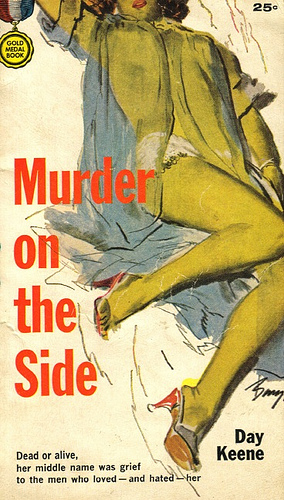
Day Keene: Murder on the Side/Ansa
H.A. DeRosso: .44.

Saturday, December 04, 2010

The new issue of my fanzine, Pulp

I just finished editing and publishing the newest issue of my fanzine, Pulp, that's been an on-line publication only for the past few months. Here's the link to the issue's editorial - it has links to all the articles. Following them is the best way to read the articles in order. For some reason or another, I messed up the order that I'd carefully planned ahead.

The articles are about the "Gordon Davis" war paperbacks by Leonard Levinson and the war-themed science fiction written in Finland plus there are three book reviews, one of them being about the book I compiled, Kari Suomalainen's crime stories.

Wednesday, December 01, 2010

The Narrow Margin and some other film noirs

I've watched all the film noirs the Finnish Broadcasting Association has been showing in the theme series for the past few months, but for some reason I've neglected to write about them. I'll try to remedy that, but a short post will have to suffice for two films.

Richard Fleischer's The Narrow Margin, although excellent at times, is not really a film noir. It's more of a thriller, with a hardboiled hero. But noir? No way. Charles McGraw is one of the most hardboiled guys ever (he would've made a great Mike Hammer) and his action throughout the film carries some noir overtones, but all in all the film's just a thriller. 

At that it's great at times. Fleischer knows how to edit a fight scene and build up suspense. There's just one thing I don't get: there's this well-known gangster and his wife, and no one knows what the wife looks like! Was the guy ashamed of his wife and never went anywhere with her? (I remember liking Peter Hyams's new version of this in the early nineties, but I notice it's received quite a lot of negative reviews.)

Nicholas Ray's On Dangerous Ground on the other hand is truly noir, even though the ending is upbeat and optimistic. Well, it should be, since everything before it is gloomy and dark and pessimistic. Robert Ryan is great as the hard-hitting cop who's lost all his hope and just keeps on beating the baddies and snitches. Bernard Herrmann's music and the opening scenes reminded me strongly of Taxi Driver - and the both films share lots of issues about alienation and loneliness. Travis Bickle was in Vietnam, Ryan's character must've been in the WWII. (I liked Herrmann's music during the other parts as well.) 

Yet the film is of great beauty. Some of the scenes carry the solemn grace of a silent film, of a Dreyer or a Sjostrom. I got into a debate with a friend of mine whether the ending was believable, but I said it doesn't matter when you're doing something this beautiful and touching. I found myself crying in the end. 

Thursday, November 25, 2010

Gordon Davis's AKA Leonard Levinson's Death Train

It's not Friday, but I think this could be linked to Patti Abbott's Friday's Forgotten Books series of blog posts.

I wrote earlier about a war paperback by Gordon Davis that was for some reason published in Finnish as by "Steve Jenkins". The real name behind the pseudonym was Leonard Levinson, a prolific paperback writer from the seventies and eighties. Late last night I finished the other Gordon Davis novel published in Finnish, called Kuoleman juna. It's the literal translation of Death Train, and it's the first book in Davis's Sergeant series.

Just like the earlier "Steve Jenkins" novel, this was also fluently written and quite fastly and crisply paced, without much padding. Some of the scenes with historical figures, like Eisenhower, could've been left out, but then again they are not very long. The battle scenes are short enough and there's enough action to keep the reader's interest going. The main character, Mahoney, is delightfully cynical - I think it's him on the cover. There are some sex scenes, but Davis/Levinson has just enough style to make them plot points, not just loose scenes with sex. I'm not sure, though, whether the scene with a young nun, Mahoney bursting with lust to break her virginity, was done with good taste. Well, then again Mahoney decides to pull out.

I'd like to read more of Levinson's work, as he seems a writer who knows how to spin a yarn and keep it tight, but there are no more translations (I think) and ordering these from abroad seems a bit silly. I was thinking I'd try to compile a Levinson bibliography with the help of Hubin's biblio, Abebooks and Pat Hawk's pseudonyms catalogue, but I won't do it now. Later on I'll write a more thorough article in Finnish about these two books and post it on the Pulp magazine blog here. Here's Bill Crider on one book by Levinson, the non-genre The Last Buffoon.