I've never been a fan of Shaft, but this longish essay or article on the origin of the character was fascinating. Check it out!
Check out also the Friday's Forgotten Books on Patti Abbott's blog here!
Friday, February 25, 2011

Tuesday, February 22, 2011
Tuesday's Overlooked Film: Anima Persa
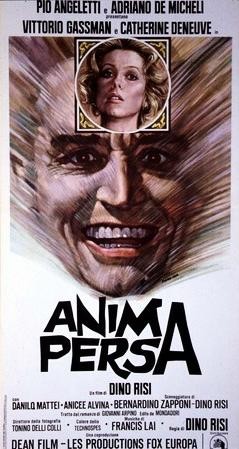 The Finnish Film Archive showed last night a very interesting Italian film that's not very well known: Dino Risi's Anima Persa (1977) that seems like it's not been shown in the English-speaking countries (there's a title for it in the IMDB, but with the caption "undefined", whatever that means). The film falls somewhere between an artsy film and a giallo film with some shock moments, but it's no Mario Bava or Dario Argento. It's no Fellini, either. Dino Risi was a skillful comedy director from the late fourties on and this shows with many funny and humorous moments, even though the pervasive feel in the film is the feel of the thread, the fear and the absurd. The dirty town of Venice is one of the main players in the movie, as is the decayed Renaissance palace these people live in. Vittorio Gassman, the former leading man of the Italian romantic comedies, is simply marvellous as the engineer who keeps his wife - the beautiful Catherine Deneuve - in tight leash. Highly recommended.
Two other films seen recently, from the small screen:
Antoine Fuqua: Training Day: a very interesting, but at times highly implausible take on what cops do when no one sees them. Seems to be the peak of Fuqua's career, though.
Ron Shelton: Dark Blue: an interesting take on the same theme, with a historic view, as can be expected from James Ellroy whose screen story this is based on. (Did Ellroy write a non-fiction piece on Rodney King or was he planning a novel on the subject? Then he must've sold the treatment to the producers.) Suffers greatly from Shelton's slack direction and Terence Blanchard's cliché-ridden film noir soundtrack with howling saxophones.
More Overlooked Films at Todd Mason's blog here.
Thursday, February 17, 2011
Winterbottom's Killer Inside Me
 Michael Winterbottom's controversial rendering of Jim Thompson's famous paperback original, The Killer Inside Me, didn't seem to make much impact in Finland. Maybe we're so used to looking at helpless women getting beaten and kicked to death we don't care. Many commentators here said the film is lame.
I watched the film recently on DVD and have to wonder: lame? what the fuck? I didn't see anything lame about this - it was a very powerful and unsettling experience, even though I'm pretty accustomed to read about rapes and beatings.
Winterbottom's film is very close to Thompson, but stays away from going into killer Lou Ford's head. He's seen from the outside, his own comments in the voice-over narration don't do much to deepen what we already see. I think this might be what makes the film lame to others. They want to see some crazy stuff happening, the guy going really insane and saying "boo!" and thinking perverse thoughts all the time. This stuff doesn't happen here - it would be just too easy and public-pleasing - and I really think this is the best way to film Jim Thompson.
I realized watching this that's it's been almost 20 years, since I read Thompson's novel. About time to revisit it, especially when the film made some things clearer that I hadn't understood the first time around. But I do remember that I wrote a review of the then new Finnish translation and compared it to Ellis's American Psycho and Donna Tartt's The Secret History, under the headline "The American Nihilism", and came to the conclusion that Thompson outwins both Ellis and Tartt in the harshness of his vision.
Friday, February 11, 2011
Friday's Forgotten Book: Max Brand: Jim Silver, hjälten från Arizona
 Don't have time to do a proper Forgotten Book entry, so a photo of a Max Brand translated in Finland, but published in Swedish will have to do.
The book was published by Schildts (still in business, after all these years, but doing mainly books in Finnish) in 1949. It was a part of their Pocket-serie series that had 23 books in it. It was one of the first real paperback series published in Finland. They had also one other Jim Silver book in the line. I don't know who the cover illustrator is, but the art is pretty nice.
The title of the book means "Jim Silver, the hero from Arizona" and the book belongs to the Silvertip series. I have no way of knowing if the Swedish translation is abridged or done from a condensed version of the original magazine version, as I don't really read Swedish. Actually I'm going to throw the book away (if no one comes to rescue), since, well, we are moving and something needs to be thrown away. I already started from a book club edition of a Tess Gerritsen novel.
More Forgotten Books here, at George Kelley's blog!
Thursday, February 10, 2011
My working bibliography: Nummeliniana
 I celebrated my 10-year career as a writer two weeks ago.* Beside the big party I threw, I also published a small leaflet containing my working bibliography. (Working in the sense not complete, something that others can build upon.) The book is called Nummeliniana. I collected all my published books, all my self-published novels and leaflets and all the stuff I've published in my own fictionmags, such as Isku and Seikkailukertomuksia**. I dug out some pretty obscure stuff, which I'd completely forgotten myself. I also included all the small leaflets and booklets I've done through my own publishing outfit called Abraxas. Many of these are without the ISBN code, which makes them rather unvisible to other bibliographers. There are items that have had a print run of 10 or 20 or even 5. Even if someone would start collecting my stuff, he/she wouldn't find some of the Abraxas books/leaflets very easily (especially as I suspect some of the stuff I've given away have been thrown away).
 There's a bit of self-irony in this, but I'm not sure if it's readily visible. I'm being pompous here on purpose. If there's someone out there interested in obtaining this, let me know. I'm selling these for two euros each.
* With "writer" I mean author, the writer of published books. As a freelance writer and a contributor to various magazines I've been almost 25 years.
** Isku = Punch; Seikkailukertomuksia = Adventure Stories.
Wednesday, February 09, 2011
Roger Smith's Mixed Blood
 I stayed up late last night finishing Roger Smith's South African thriller Mixed Blood. Only thing I can say is "vow!" What a mix of relentless, suddenly outbursting violence, harsh language and terse narration, high-octane suspense and heart-throbbing sentiment, with the added of bonus of a Dickensian cast of obscene and absurd characters! Highly, highly recommended. Not a wasted scene in sight - and what a noir ending! Will be interesting to see if they can use the scene in the forth-coming film (starring Samuel Jackson - well, actually his character is a minor one in Smith's book).
Can't recommend this highly enough and I immediately started working towards getting the book translated in Finnish. (I'm sure there's a big publisher who's already started bidding on the book. Which would be nice.)
Tuesday, February 08, 2011
Tuesday's Overlooked Film: A Force of One
 The idea of me commenting on a Chuck Norris film is something mind-boggling, but when I found a vintage Norris film A Force of One on VHS for 10 cents, I just couldn't resist buying it. But the fact remains: every time I've tried to watch a Norris film, I've found them to be boring as hell. But I noticed this was scripted by Ernest Tidyman, who wrote the original novel and the script for Shaft. Well, that may not be a recommendation to all - it's not necessarily to me, since I've never much cared for Shaft. (And the other films scripted by Tidyman - The French Connection and High Plains Drifter - have always been a bit overrated to me.)
Okay, beginning to sound like I shouldn't be writing this entry, but A Force of One actually is a somewhat interesting film, with themes of betrayal and parenthood (Norris is a father to a black kid!). It's more interesting during the first thirty minutes, when it resembles a realistic cop film, with the drug stake-outs, tough cop dialogue, relationships between cops and such, but then it gets only weird and pretty stupid, when the cops are being taught karate - to fight the bad guy, who kills cops with kung fu (or some such). I lost interest and started to leaf through some old magazines I'd gotten hold of and the film rolled on. I don't actually know what happened in the end. Someone died and Chuck Norris had a love affair with another cop.
I started to watch another old VHS cassette, Mel Brooks's 12 Chairs. I'm not sure if even that's an overlooked film being largely unfunny. (But probably the only US film made from a Soviet novel. Any other contenders? The original Twelve Chairs was written by Ilya Ilf and Yevgeni Petrov.)
More overlooked films over here.
Friday, February 04, 2011
Friday's Forgotten Books: Operation Sex by Kimberly Kemp and an unknown sleaze book by Gerald Kramer
 For just the fun of it, I picked up recently two old sex paperbacks (in Finnish translation) and read them. The first one of them I actually said to my wife was research, since I'm writing a sex novel set in a roadside motel, and the Finnish title of the book I read was Seksimotelli/Sex Motel (the original title is said to be Swap Motel, though). If I could pick up an obscure reference to use, I'd be more than happy!
The other book I read was Operation: Sex by "Kimberly Kemp" (Operaatio seksi in Finnish), who was really Gilbert Fox. He used this pseudonym in other novels as well. I find this information on him at the Lesbian Pulp Fiction Collective site: "Gilbert Fox (b. 1917) was a friend of Harry Shorten, the founder of Midwood Books, and the author of over 100 titles for the line using the pseudonyms Kimberley Kemp and Dallas Mayo for his lesbian novels and Paul Russo for his heterosexual novels." The book was published originally by Midwood in 1962 and features actually quite a nice cover. The prices for the book seem to be quite high! The Finnish translation should go for less than five euros.
Operation: Sex is a fast read. It's a spy novel, in which a beautiful dancer Colleen Mead is asked to act as an undercover agent and take part in a mysterious flight. There's a mystery man in the plane as well, and also a very beautiful woman who starts to flirt with Colleen, but also takes something out of the mystery man's pockets when the plane crashes down in the sea. The women are rescued by a famous playboy cruising around in his orgy-filled yacht. There's a bit of everything in this: some spy action, some lesbian scenes, some mild domination, a near-rape scene in the end... As I said, it's a quick read, but there's really nothing much to think about.
 For some reason I found Gerald Kramer's Seksimotelli more interesting. It's bibliographically challenging, since I can't find any publishing info for it. Gerald Kramer, whoever he was, did write porn and sleaze for publishers like Midwood, as this blog proves. I took a look at Abebooks and was able to come up with this short bibliography. Anyone know more about Kramer?
Seksimotelli/Swap Motel is a loosely narrated tale of a young man who owns a small roadside motel. He gets into weird escapades: in the beginning of the book, there's a young couple coming into the hotel, with the man being obnoxious and abrasive while flirting and the girl resisting. The young man peeks into their room and witnesses bad sex after which the couple falls into sleep. As the motel owner has the gift of hypnotism, he goes in and hypnotizes the woman and starts to caress her tits. The young guy is then lured into a strange plot: the husband comes in several days later and says that if he won't come to a party with him to hypnotize more people to have sex, he goes public with the hypnotism stuff. Some even more weird escapades follow. This is a picaresque novel for the free-wheelin' sixties. There's not much sense in it, but it's fun in a sort of depraved way. The motel owner is a heel, but he's a sympathetic heel, who feels sorry for the cruel jokes his victims are inflicted upon. One of the weird details in the book is the code word the guy uses trying to get the girl of his dreams: Kropotkin, the name of the famous Russian anarchist. This goes on to prove that there's more than meets the eye in the American sleaze literature of the sixties.
One detail for my Finnish readers: as an euphemism for "penis/dick/kyrpä/kikkeli" the Finnish translator (the pseudonymous Kaino V.T. Sievänen) uses quite often the humorous and not so exciting word "kikuli".
The Finnish books were published in the sleazy Cocktail paperback series in the early seventies. The publisher came from Turku where I live and they also published the porn magazine with the same name.
Other Forgotten Book entries collected in Todd Mason's blog here.
Thursday, February 03, 2011
Coleman's and Bruen's Tower
 Reed Farrel Coleman is one of my favourite new private eye writers - he has a great sense of tragedy, place and noir. I've read less of Ken Bruen's work, but what I've read has been good, especially London Boulevard (that's coming out in Finnish in a few months; see to it that you read this book). So their joint effort, Tower (out in 2009 from Busted Flush Press) was bound to be good - and my God, it is very good! It's both tragically and hilariously violent, very elliptic in style and narration (and actually pretty hard to follow at times) and there's also a nice twist or two in the middle. It's clear both writers had a good time writing this. See Cullen Callagher's review at Pulp Serenade.
Granted, I had some trouble getting into the flow of the narrative and I thought the ending could've been stronger, but I don't mind, since the other stuff is so good. No wonder this has been popular and victorious: it won Macavity for best novel and was nominated thus: Anthony: best original paperback, Spinetingler Magazine Best Novel: Legends, Book of the Year: Foreward Reviews, Crimespree Magazine: Best Novel of 2009.
Tuesday, February 01, 2011
Tuesday's Overlooked Film: Dreams That Money Can Buy
 I've had this film on DVD for years on loan from a friend of mine, but I had some time to watch only now. I'd read about the film quite a lot and I'd been interested in it for a long time, but the film proved to be somewhat disappointing.
This is spelled out in the excellent brochure that comes with the British Film Institute DVD: the film is "neither intellectual enough for an art film, nor entertaining enough to be popular". But the story behind the film is more interesting than what we see on screen. Dreams That Money Can Buy was supervised by Hans Richter, German avantgarde filmmaker whose abstract animations are part of the canon of the experimental cinema. The film was made in the US as an indie production and the point was to make an experimental film that could be played in more conventional forums, not only in art galleries and places like that. Richter got other European Surrealists and other artists to go along in the project - the list is breath-taking: Marcel Duchamp, Man Ray, Fernard Léger, Alexander Calder and Max Ernst. This is not only abstract animation, the episodes are made all in different styles and techiques. (I won't provide links to all the artists, I'm sure you know who they are. At least you should!)
The problems are visible almost the minute the film starts: the actors are clumsy, the voice-over narration (used also in dialogue) is clumsy. Not all of the episodes are interesting either. I recognized Max Ernst himself in his own episode, "Desire", that followed the Surrealist dogma of resembling a dream, but his episode left me cold. This was a far cry from any Luis Buñuel film. (Buñuel always did things in a very realist way, shooting at eye-sight and not using weird editing techniques - this keeps even his most Surrealist films very watchable.) Fernand Léger's episode, "The Girl with the Prefabricated Heart", was a love story told with shop-window dummies - must've been a fresh idea at the time, but it's been done so many times since that Léger's film seemed dated. The song to go with it, sung by Libby Holman and Josh White, was quite funny, with its Surrealist lyrics, but all too long.
Man Ray's spoofy and jokey "Ruth, Roses and Revolvers" was about the film media making people act against their own will, but again, not very interesting. Marcel Duchamp's "Discs" was one of weirdest episodes, but also one of the best: it has different discs rotating, facing the viewer, and shots of a nude descending the stairs (Duchamp's best-known Cubist painting). The film also refers to Duchamp's earlier film, Anemic Cinema. The music was by John Cage (more on that later). Alexander Calder, famous for his beautiful mobiles, had two episodes. The first one was just about his mobiles moving around, and it was not even very well photographed. The other episode, "Circus", was done with some of his moving toy-like figures. Charming, but not very interesting as a movie - not enough story.
The film ends with Hans Richter's film noir parody, "Narcissus". A guy notices his face turns blue during a poker game. A nightmare starts, he runs away from other people and other things, everything seems scary. This episode also suffers from stilted acting and voice-over, but it's still one of the most interesting things in the film. David Lynch is said to like the film and it's easy to see that he's taken things especially out of Richter's episode.
As for the music in Dreams, it's done by modernist composers, like Darius Milhaud and Louis Applebaum. Their music has suffered in the hands of time, though: it just doesn't like modern anymore. John Cage is an exception here, his short composition for Duchamp's hypnotic film supports the images and sounds fresh even today. Interesting to note, though, that Paul Bowles, the writer of The Sheltering Sky, wrote the compositions for two films, Ernst's and Calder's.
The BFI disc has also three short films by Hans Richter, from the 1920's. They are interesting, but suffer from the lack of music on the soundtrack. There's a hypnotic quality to these, though. The middle one, Ghosts Before Breakfast (1928), shows the love the Surrealists had for the crime and adventure fiction, and the last one, Everyday (1929), has some contribution from Sergei Eisenstein - there are some shots in the film that might be outtakes from an Eisenstein film.
Here's the link to other contributions to the Tuesday meme.
Here's Duchamp's and Cage's "Discs" from the film:
Friday, January 28, 2011
Cormac McCarthy: No Country For Old Men
 It is rather dubious to write something about you've read a month ago, right? But I'm still doing it. I read Cormac McCarthy's great novel No Country For Old Men during the Christmas holidays, but the book still lingers in my mind, so I thought I'd try to get away with it. (And I know, I know, this is a very bad and not very intriguing way to start a blog post...)
As everyone reading this blog knows, the Coen brothers' equally great movie was made from McCarthy's novel. I can't think of many other examples where the mastery of cinema is as evident as in this film. Every scene, every cut, every camera move is necessary. Nothing is wasted, nothing is there for vain.
Same goes for McCarthy's narration and prose style. It's very clipped, without the quotation marks and parentheses. It works miraculously well, even though it's very elliptical at times. (There's one scene in which I think I caught McCarthy for using unnecessary words and commenting what the person in the scene was doing as an omniscient narrator.) This is what "hardboiled" was invented to mean.
Yet, McCarthy is one the of the US Nobel prize candidates. He writes dirty, mean and lean books about criminals and what havoc they bring on the world. Why doesn't Elmore Leonard can't be the candidate for the Nobel as well?
I'm not saying that there are no hidden depths in Leonard's books, but in McCarthy there sure are. I remember talking with my dad about the Coens' film and he said he couldn't find anything to say about it, even though he thought the film was very well made. It's very easy to say that the film - and the book - are about the disappearing world in which people still respected each other. This is brought out by the sheriff's monologues throughout the book and the film. It's also easy to believe this is the view McCarthy himself has. But I don't believe this is correct. McCarthy asks us to look into our easy nostalgia and ask ourselves if things really were better in the past. There are not many hints into this theme, but - as a liberal European, of course - one of those things was that the sheriff talks against abortion. He thinks it's degrading, but to my mind it's a sign of useless clinging to the past.
You might want to compare what the sheriff is saying to the charismatic killer's speeches he keeps just before he kills his victims. He's eloquent and says beautiful things about how people waste their life. In fact he's not saying anything. It's just bubbles, something a salesman or a consult might say to a customer he's never met before. He lures us to think he's got something meaningful to say. The killer is just one of those self-help demagogues that fill the bookshops with an endless row of books about - nothing. In this way, he's a prophet of the coming times and as such even scarier than he is as a killer. (Even though Chigurh is one of the scariest motherfuckers in the pages of any book.)
In the end of the book, the sheriff sees a dream about his father, himself also a sheriff. In the dream, the father rides on a horse to shine a light to a distant darkness. It's not easy to see what McCarthy has in mind in this scene, but it probably has to do with this notion: whatever we do, we must not lose hope. Someone has to cast a light in the darkness that's also called life. It's just that we have to put our hope also in the hands of those whose values we don't share. The life is scary and we can't do anything about that.
PS. It's said that the Coens' film is very faithful to the book. Yet I couldn't find the scene from the film in which Josh Brolin shoots a dog chasing him in the book. Can anyone confirm it's not in the book?
PPS. I'm posting this on Friday, but this is not a part of the Friday's Forgotten Book series, hosted this week on this blog.
Monday, January 24, 2011
Where's my Michael Koryta?
 I ordered some books recently from the web. One of them was A Welcome Grave by Michael Koryta about whom I've read good things. The book is one of his Lincoln Perry PI novels. I thought it was good - at least the first hundred pages. The premise was very interesting: Perry is asked by her former girlfriend to locate the lost son of her husband, who's recently been brutally slaughtered. Perry finds the guy, but then something weird happens.
Then I lost the book. I don't know where it is. I can't find it anywhere at our place. I've asked all the libraries and shops if they've seen it.
I guess I'll have to order a new copy.
Tuesday, January 18, 2011
Tuesday's Overlooked Film: The Murder Maze
 Todd Mason will start hosting a series of blog posts from around the world profiling forgotten and overlooked films. I was going to say something about a movie I found recently cheap on VHS anyway, so I thought I'd take part.
City of Angels was a short-lived private eye show in 1976, which I'd never seen, but the moment I noticed the VHS cassette in a thrift store titled Murhasokkelo/The Murder Maze I knew it was bound to be interesting. I guess this movie, made from two episodes of the TV series, was never aired in the US, as it's not mentioned anywhere in IMDb nor in the Thrilling Detective listing for the series (see the link above). I notice from the Finnish Elonet database that this was released as late as 1988 (and also in 1991).
The original TV series, with Wayne Rogers as private eye Jake Axminster in the 1930's Los Angeles, was created by Roy Huggins and Stephen J. Cannell, who usually knew what they were doing, but for some reason or another the series never caught on. I believe this movie was made to cash in on some money from foreign rental markets. Kevin Burton Smith says in his Thrilling Detective entry for City of Angels that Wayne Rogers never felt like a real PI, as he was better known as one of the M*A*S*H* jokers. He also says Rogers never liked the show himself.
The VHS compiles together the episodes "A Lonely Way to Die", written and directed by veteran Douglas Heyes, and "The Losers", written by Roy Huggins himself and directed by Across 110th Street alumni Barry Shear. The joints are very well hidden, the plots are made to intersect and interweave, they just don't follow each other, like they usually in these kind of films do. The story gets close to the complexity of Chinatown, which was obviously the model for City of Angels. The setting is the same - obnoxious private eye, bullying cops, family secrets - and the mood is the same - the perverse 1930's, glamorous Los Angeles and Hollywood. The dialogue is good, getting close to the snappy remarks of a Chandler, even using "Be missing" that Chandler wrote in one of his letters he prefers to "Get out".
There's just the fact that the plots don't really click - as the story unfolds, we are disappointed that the two storylines don't connect with each other. And Heyes and Shear have two different directorial styles, I believe it's Shear who goes for more early seventies' type of stuff, with some New Wavish ideas, scenes getting on top of each other, dialogue overlapping and all. Heyes goes for more traditional narration. Some of the characters are also not very well introduced, as they are recurring characters from the show - it took me some time to realize the purpose of Jake Axminster's secretary. I should believe, though, that these two are some of the better episodes in the original series.
Friday, January 14, 2011
Friday's Forgotten Book: Zane Grey Western Magazine, August 1970
 When I was sick last week, I read a couple of stories from an old mag a friend of mine had sent me. It was an August, 1970 issue of Zane Grey Western Magazine, a magazine I'd never seen (mainly because these don't often travel to Finland) and I was curious about it. I thought maybe reading a Western short story or two might be manageable even on my sick bed.
The lead story of the issue was by "Romer Zane Grey", who was supposed to be Zane Grey's son, but was actually Tom Curry. At least according to the Fictionmags Index; I'd earlier thought that Bill Pronzini and Jeffrey Wallmann used the pseudonym, at least in the two or three paperbacks that came out of the pages of Zane Grey Western Magazine. The Romer Zane Grey story in the issue is called "Last Stand at Indigo Flats" and it's basically a standard Western yarn, full of six-gun action. The lead character is Zane Grey's Laramie Nelson, but he could be any Western hero, just give him a different name and you have a different story. On its own, "Last Stand" can stand comparison to any pulp story: it is full of action and full of tension, with quite many intersecting plots and twists going on at the same time. Whoever wrote this, Tom Curry, Bill Pronzini or Jeffrey Wallmann, he knew how to do his stuff. Not all of the plots are handled with equal depth - one of them is actually resolved pretty badly - but I can live with that.
The other story I read from the issue was a sequel to Bret Harte's classic story, "Luck of Roaring Camp". The new story, "Reunion at Roaring Camp" was said to have been written by "Robert Hart Davis", which was of course a house name. The sequel is said to start a new series, called "Bret Harte Country", i.e. stories about mining life. I don't know how many stories appeared in this series. "Reunion at Roaring Camp" is an amusing little tale, nothing more, but nothing less; I think this should be reprinted in some massive Western anthology, collecting various and ephemeral pieces of literary history.
The other writers in the issue are James Hines (a reprint from a 1955 Action-Packed Western), Gladwell Richardson, Glenn Shirley, Doris Curda (her only story according to the FM Index), William Heuman and R. Brennin Ward (his only story). Heuman is the only name I recognize.
More forgotten books at Patti Abbott's blog.
Wednesday, January 12, 2011
Devil Thumbs a Ride (1947)
 As the last treat of their great film noir series, the Finnish Broadcasting Association showed a Felix E. Feist double bill: first his best-known film, Devil Thumbs a Ride (1947) and then his lesser-seen atomic bomb thriller, The Threat (1949). I'd never seen both (and realized only afterwards that Donovan's Brain I've seen over a decade ago was directed by the same Feist) and I was very intrigued especially about the aforementioned film.
It's a very solid B-thriller about Lawrence Tierney, a ruthless killer who hitchhikes his way away from the cops and ends up in the car of an amiable young guy, who's driving back to see his fiancée. Two women down on their luck and life ride along with them. That's basically the plot - more tension comes out of whether anyone else realizes that Tierney is a sociopath and a killer. Seemingly not, and here lies the main problem with the film: you'd think Tierney would rather kill anyone than watch those jerks ruin his getaway trip. Well, maybe it's the neo-noir buff in me that's talking, but I thought the film lacked plausibility in this matter. Otherwise Tierney makes a great villain and the film moved along in a breakneck pace. This is based on a novel by Bob Du Soe - how come the novel's not in print? (The cover of the late fourties paperback reprint from Avon seen above.)
The Threat wasn't as good as Devil Thumbs a Ride, but interesting nevertheless in its story about a criminals waiting for the getaway plane at the atomic bomb test site. Charles McGraw is good as the head criminal wanting revenge on those who put him in jail.
Tuesday, January 11, 2011
Donald Westlake's The Hook
 A series of short posts starts from here, just in order to catch up with what's happened and what's going on. I promised to write something about Donald Westlake's crime novel The Hook which I read already during the early days of Christmas (why does that feel like it was already a long ago?). It's a very good novel, in the black humour mold of Westlake, even though not anywhere near the hilarity or the slapstick of the Dortmunders.
The Hook is almost a serious meditation on the state of writing and publishing in the early 2000's America. The famous and best-selling writer meets a midlist writer who was once famous, but has never risen to his ranks. They talk shop and wonder what's become of them: the bestselling one has a writer's block, the midselling one is still an able writer, but can't sell aggressively enough. Westlakes pokes bitter fun at how the bookstores decide what to sell and what not. I guess this is him talking here, though he's never been as low as these guys: the bestselling writer asks the other guy to give his novel to him, to be published under his name, and kill his wife. If he does that, he'll get 50% of the advance and the royalties of the coming novel.
Westlake actually shows how these two men start to resemble each other. It becomes a sort of an identity play, a bit like Orhan Pamuk's The White Castle (a historical novel by a Turkish Nobel winner, you should read it, if you haven't). Westlake sure can keep the reader glued to his seat, even though there's not much happening here. The outcome is bitterly ironic. Strongly recommended.
Monday, January 10, 2011
The best crime novels of 2010
In lieu of a better post (I've been sick and now gotta catch up my work) here's the link to the Spinetingler Magazine's lists of the best crime novels of 2010. Damn, where can I get more time to read all this fascinating stuff?
Tuesday, January 04, 2011
My 2010

I published three books last year. One of them was a self-publication, one of them was only compiled by me and I didn't even get the credit for it, and the third one was an anthology edited by me. But I've got four books coming out next Spring: a collection of articles on the discussion over copyright, a reference book on historical novelists, collections of old outdoor stories and vampire stories. That's not bad, huh?
I'm also rapidly working on a new sleaze novel, since the first one, Lausteen himokämppä/The Lust Cabin of Lauste was so popular. It has actually been one of the most talked about books I've ever done, which might put some of my more serious work to shame. The next one will be called Mynämäen motellin munamällit, which is pretty hard to translate to English. (If you're a native speaker of English, don't try to pronounce the title. You might get hurt.)
My three books last year:
Lausteen himokämppä.
Kari Suomalainen: Tarkastaja Wilson ja muita dekkareita.
Sherlock Holmes Suomessa.
That's not bad for one year, but I'm not really sure why some of my books were so much delayed. I'll have to get a grip and start really working. (Especially as I should get the architectural guide to the city of Turku finished by March. What am I thinking?) (I'm not sure if I've mentioned the project here earlier, but it's actually bogging me down a bit and I'm having terrible dreams relating to it. Last night I had to replace the solo guitarist of Mötley Crüe.)
Monday, January 03, 2011
And now for something completely different...
Here's a link to the very stylish latex underwear and lingerie show by the Atsuko Kudo label held recently. I think this stuff is very sexy and pretty and so much reminiscent of the fourties and early fifties style that I thought it might merit posting here - these babes could perform in a classic noir film!
Subscribe to:
Posts (Atom)