Wednesday, May 21, 2014

Kenneth Royce

Of all the British pulpsters and paperbackers I've been covering in my forth-coming book, there have been only a few writers whose work I've really been fond of. I don't know why this is, but it's something I've been noticing for the past dozen years: I like American stuff more than British, and this is the case even with films and music. Give me The Sonics anytime over The Rolling Stones or The Dead Kennedys over The Sex Pistols!

But there are indeed some British crime writers whose work I really like. Kenneth Royce is one of them. He writes in clear prose that keeps the story moving, he creates interesting characters with just a few lines, they are likable even though they are not heroes, his plots are unpredictable and original. Too bad he's not very well known these days. I'm not sure if he's known at all. He does have a Wikipedia page, though. He's had three Finnish translations, all in pulpy paperbacks and with not interesting covers (see below).

Of the two translations, the first two have Royce's serial character, Spider Scott, as the hero. He's a former master burglar, who's gained his nick name with his skills in climbing. He climbs any wall. In the beginning of the first Spider Scott book, The XYY Man (1970; Ansa ilman muuta in Finnish; the original name comes from the "fact" that most of the male criminals have an extra chromosome). Scott is lured by some secret organization to break and entry the Chinese embassy or his brother's career in the police force is threatened. Spider Scott doesn't want that, so he complies - and has to kill the Chinese ambassador in order to stay alive. And now he has to flee everyone. This is a very intriguing thriller, to the last page.

In the second Spider book, The Miniatures Frame (1972; Tie murhaan in Finnish), the plot is even more original. Spider is taken into a committee that's supposed to make the prisons better places for the prisoners. The head of the committee is a rich asshole who collects art and antique. Spider is lured by the man's teenage daughter into a secret chamber the man has in his house and Spider spots two extremely valuable miniature paintings he's stolen ten years ago! The man threatens Spider with the jail, but Spider fights back. Spider Scott was developed into a TV series, but I've never seen it.

The third translation, The Stalin Account (1983; Tappavat varjot in Finnish), is an interesting spy novel the plot of which starts in the 1920s and the attempt of the Soviet bolsheviks to turn Brits into communists and then spies for the Soviet Union. What follows is a tragic love story between a Soviet spy and a young British girl. The thing comes again alive in the early eighties when the woman of the love story dies almost entirely alone, nurtured only by her nephew. When the elderly woman dies, her diary also goes missing. It all ties around the story of Stalin's son, Jacob. It's a very interesting spy novel with believable characters and believable history.

I haven't read any other books by Royce, but I come across them, I'll be sure to take a look. George Kelley says in his entry for Royce in The St. James Twentieth Century Crime and Mystery Writers that some of Royce's best books are The President Is Dead (1988), Fall-Out (1989) and 10,000 Days (1981). The last one should prove interesting as it's about the ending of oil.

Everybody Lies and other crime stories

Apart from finishing my book on British pulpsters and paperbackers, I've also been compiling and editing the book that will hopefully come out later this year. It's a collection of the new crime stories that came out mainly in Isku, but also in Ässä and Seikkailukertomuksia (Adventure Stories), all mags I published in 2003-2011. Here's the lowdown:

Ed Gorman: Tauko (Layover)
Allan Guthrie: Rakkain terveisin Rex (Love, Rex)
Patrick Shawn Bagley: Vielä yksi sotku (One More Mess)
Bill Crider: Ilta Carlin kanssa (Evening Out with Carl)
Lawrence Schimel: Pudotus (Falling)
David Terrenoire: Tulipalo (The Fire)
Harry Shannon: Langanpätkiä (Loose Ends)
James Reasoner: Kaikki valehtelevat (Everybody Lies)
J. A. Konrath: Ihmisen paras ystävä (Whelp Wanted)
Duane Swierczynski: Munakello (Eggtimer)
Kevin Wignall: Kuolema (A Death)
Anthony Neil Smith: Clive tunnustaa (Clive Confesses)
Vicki Hendricks: West End (West End)
Keith Rawson: Veri, sirpaleet ja kaikki muu (The Blood, the Shattered Glass and All the Rest)
Pat Lambe: Lemurian portto (The Whore of Lemuria)
J. D. Rhoades: Satanen (The Hundred)
Jason Starr: Viimeiseksi valittu (The Last Pick)
Pearce Hansen: Halvaantunut tappajasimpanssi (Paraplegic Killer Chimp)
Sandra Ruttan: Ihana tapa kuolla (To Die For)
Ed Lynskey: Isoveli (Think Pink)
Michael Wiecek: Lahja veljeltä (A Brother's Gift)
Molly Brown: Tähti (Star)
Sandra Scoppettone: Lihamureke (Meatloaf)
Patricia Abbott: Aukko seinässä (Hole in the Wall)
Christa Faust: Anna tulla (Hit Me)

The book will be titled according to James Reasoner's story. It will also have a short preface by Tapani Bagge and a longer preface by me. There's no cover yet. I think that's a mighty good table of contents, don't you?

Monday, May 19, 2014

Michael AKA Mike Hervey, pt. 2

I promised to say something about short story writer Mike Hervey's short stories. I covered what I know of his life in this post. It's not much and lots is mere speculation.

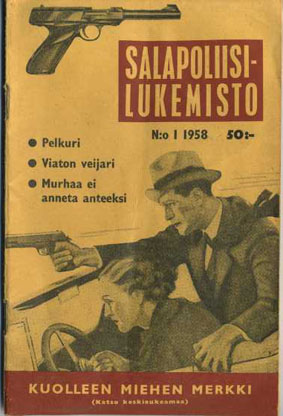
Same goes for his short stories. I can't say I read them carefully, many I only eyed lazily. Lots were translated in Finnish and published in mags in the late fourties and the fifties. As you remember, he had a magazine to his own name in Australia, called The Mike Hervey Detective Monthly Magazine. The Finnish magazine called Salapoliisilukemisto (Detective Digest; see photo) seems to have taken its stories from that magazine, since it had issues that contained only stories by Hervey! And many were straight from the Australian magazine.

Hervey was as prolific as hell, writing over 3000 short stories in a span of ten years. That must show in the quality of his stories. Many are pretty simple, focusing on the twist at the end, as in the story "Death of a Widow" (1953). There's not much description of the scenery, nor is there much character development. Most of the characters are what's usually called stock characters: detective, police officer, career criminal, deceitful babe, disappointed wife, etc. In "Nick to the Rescue" (1953) that's almost of a flash fiction length we get both the career criminal and the deceitful babe. There are some variations, though. "Death on Wheels" (1953) is about a race driver who's forced to win in a race. If he loses, he'll be killed.

Some of the stories are science fictional, for example in the story called "In the Year 2500" (I don't know the original title, and I don't even know what really takes place in the story). "You Can't Deceit Faith" (the original title missing, probably from 1953) is about foreseeing the future and clairvoyance.

I realize this isn't much, but it's a start! There's not much info on Mike Hervey in the web.

Wednesday, May 14, 2014

Michael AKA Mike Hervey, pt. I

My forth-coming book on British paperbackers doesn't really cover the writers who specialized in short stories. There are two reasons for this: there were only few translations from those who wrote only short stories, and then again I haven't had enough resources to check the magazines that could've carried British writers' stories. The American pulpsters were covered in great length by mainly a one magazine, the Lahti-based Seikkailujen Maailma (The World of Adventures; see this post in English by me), but none were specialized in British pulps.

I do have sketchy entries for some writers from whom I found only short stories. One of them is Michael AKA Mike Hervey. Not many have heard of him during the past 30 or 40 years. He had lots of stories and serials translated in Finnish pulp and other fictionmags in the fifties. The magazine called Salapoliisilukemisto (The Detective Digest or some such) had issues that had only stories by Hervey in them!

Now, who was Mike Hervey? He seems a pretty enigmatic character in his own right. He wrote lots of cheap paperbacks for mushroom publishers like Forsyte and Mitre in the 1940s and 1950s. Many of his books are one-act plays or skimpy short story collections. The books have hardboiled titles like Dumb Witness or No Excuse for Murder. (The book in the picture is from 1946, hardback from Alliance, yet another publisher I've never heard of.) This guy wrote a lot.

But not for a great many years. Seems like his first book (Save Your Pity) came out in 1943 and his last one Crime a la Carte in 1953. His career lasted only ten years, yet he's said to have written 3,500 short stories.

There's something fishy about Mike Hervey. The Science Fiction and Fantasy Encyclopedia tells us more. He was born in 1915, but he told everyone he was born in 1920. His birth name was apparently Mark Hockman, but he used the name Mark Hoffman. Then he changed it into Michael Hervey. And then, in the early fifties, he moved to Australia. Therein he edited a magazine called The Mike Hervey Detective Monthly Magazine that a publisher called Transport put out. The magazine seems to have contained only stories by Hervey himself. (The Finnish digest I mentioned earlier probably picked its stories from this magazine, and only hell knows how the stories found their way into Finland.) And then it stopped in 1953. (The years are uncertain.) The SFF encyclopedia tells us Hervey died in 1979. What did he do for the last 26 years of his life?

And what was with the name changes and all? Was Hervey a swindler? Changed names to deceive those whom he owed money to? Or was he just a guy down on his luck who couldn't find any reasonable way to make his living? Anyone know anything about Mike Hervey? Did he change names again living in Australia and write something entirely else?

How are his stories then? I'll get back to them in a later post, now I'm slightly drunk and getting soon to get to bed.

Monday, May 12, 2014

Philip Chambers and Sexton Blake

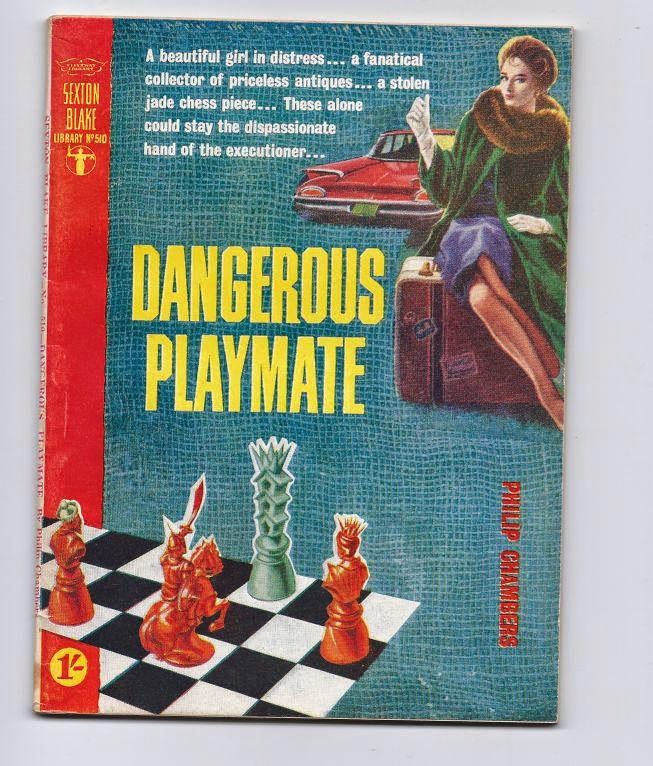
Philip Chambers is a writer almost next nothing is known of. He was born in 1936, is possibly dead by now, wrote six Sexton Blake stories in the early sixties and nothing else. I've skimmed through his Blake story Bullets to Bagdad (1960) in which a secret organization is planning to take over the government in Iraq and take their oil supplies. In the story Blake's boss is and old man called Craille. He's the leader of the British counter-intelligence organization, as secret as the criminal organization in the book.

Here are some of Chambers's Sexton Blake covers. Pretty good ones, too, but I don't know the illustrator. There's a signature in Keep It Secret!, it seems it says "S. Barany".


Tuesday, May 06, 2014

Sean Gregory's serial hero Mack Regan

I'm sure not many of you have heard of Sean Gregory, not even by his real name, Harry Hossent. He started out in the early 1950s writing cheap crime hardbacks for Hamilton under the house name Jeff Bogar. He went on to write more thrillers in the sixties under his real name. He seems to have dropped out of the publishing business in the early seventies.

As by Sean Gregory he wrote some short paperbacks for the Tit-Bits Books paperback series in the early 1950s. (At least I think they were paperbacks, but I'm not 100 % certain. Hope someone can confirm this. I believe the books accompanied the issues of the Tit-Bits magazine.) His stories in that series were for some reason or another translated in Finnish in a paperback series called Max Strong (who was an Australian series character, but that's another story altogether). I've browsed through the three stories, here's a lowdown.

All the stories came out originally in 1954. The hero, appearing in all three stories, is one Mack (short for Mackenzie) Regan. He's a Hollywood PR agent, but in what I believe was the first story in the series, Murder Bangs a Big Drum, he's still trying make his living in Ohio. He gets a phone call from a Hollywood producer, who asks Regan to come down to Hollywood to prevent a young actor's name appearing in headlines. Reason: he's disappeared. It all ties down to a hazy union job. In Murder Makes the Corpse Regan is asked to write a book on an undertaker firm. He agrees, but finds out soon there's something fishy about the outfit. Murder Is Too Permanent finds Regan working for a gangster called Ricky Vescino. He wants Regan to make way for his beautiful wife and escort her into high society, but at the same time his own life is being threatened as someone wants to blow up his car.

The stories are old-fashioned private eye fun, nothing more, but nothing less, though. As I didn't really read the stories, I can't say how well they hold up, but if you come across them, I'll advise to take a look. Seems, though, that the Tit-Bits Books are hard to come by.

One more thing: Harry Hossent-Sean Gregory came up with some strange names for his stories. This seems a staple in this kind of private eye stuff. There are Bats Moloney, Lex Hupner, Alvar Domonici, Rafe Engels, Bull Gregow and Jed Yurfy, and there's also a heavy called Griff, which is a nod to a house name of British mushroom jungle publishers.

Photos accompanying the post are the covers of the Finnish editions of Sean Gregory's stories.

Monday, May 05, 2014

Frank Struan's other stories from Tit-Bits Books

Remember I wrote about Frank Struan's private eye booklet Murder's So Unpleasant? It was published in the Tit-Bits Books paperback series in 1954 and translated in Finnish some ten years later. The story features one Johnny July, and I got to thinking he might warrant an entry in the Thrilling Detective site, but I've now browsed through (note: not read!) Frank Struan's other translated titles and none have Johnny July in the lead. Of course there's a possibility that Struan has more stories that were not translated in Finnish.

Struan has another series character, though. His stories Tunnel of Nightmare, Ruthless Enemy and Fall Guy, all from Tit-Bits Books and from 1954, are spy stories about a British counter-spy called Fabian and his bosses called Delmer and Johnstone. The best of the bunch is probably Tunnel of Nightmare (Painajaistunneli, see the photo) in the beginning of which Fabian wakes up from the seedy side streets of the London port and seems to have lost his memory. Ruthless Enemy is about an East-European communist leader whom other commies want to kill. Fabian is set to protect him. I didn't really make any notes on Fall Guy, so I can't say anything about that.

There was still another piece by Struan in Finnish. The story The Girl from the Sea (yet another from 1954)
is about, well, a girl from the sea. A guy is swimming by the sea and notices a young woman is trying to escape from a ship that's anchored some hundred meters from the shore. It all has to do with the English nuclear weapons.

I'm a private eye man myself, so these spy stories didn't interest me as much. The stories seem competent enough, but they are no hidden gems.

I'm finally getting my Pulpografia Britannica - book on British crime pulpsters and paperbackers - together. It should be out in June. Don't know for sure yet, still got tons to do. I'll post some stuff on the writers therein in the blog for some days now.

Thursday, April 17, 2014

John Wainwright: four crime novels

As I mentioned earlier, I read four novels by British writer John Wainwright to be mentioned in my forth-coming book on British crime paperbackers. I've been at it for over ten years and I thought it would finally come out next Summer, but we'll have to see about that, as I still have loads of work to do. But now John Wainwright has finally been done with.

Wainwright is best known - if known at all today - for his police procedurals. He wrote some dozens of them saying he got his inspiration from Ed McBain and his 87th Precinct series and that clearly shows. The settings are realistic and Wainwright shows some critical insight into the society he writes about. There are lots of characters, all colourful. The police are a mixed bunch, some of them are almost crooks themselves, taking law into their own hands, some of them just look on from the side and realize there's no use getting mixed with their colleagues' doings. The actual crooks are very much crooks: sleazy low-life scum. This is one of the weakest things in Wainwright's police novels. He shows real contempt when he writes about the lower class people and their inhabitats. In Wainwright's novels there's also lots of dialogue. One can imagine being in a police station amidst all the nervous talk and shouting.

I read The Big Tickle (1969; Kurja päivä kuolla in Finnish) and Talent for Murder (1967; Huhtikuun murhat in Finnish) and liked the latter more, even though the former is more clearly set in the reality of the streets. The novel suffers from bad Finnish translation though.

Wainwright also wrote some middle-class tragedies. I read two of them, The Distaff Factor (1982; Tuomion jälkeen in Finnish) and Cul-de-sac (1984; Umpikuja in Finnish). Georges Simenon spoke highly of the latter, and it is indeed the better of the two in its depiction of a sad marriage that ends in the death of the wife. It's already declared an accident, when an eye-witness comes forward saying it was a murder, done by the woman's husband. Cul-de-sac is a dense book with a pleasing climax. I hope I'm not giving anything away saying Wainwright uses the same technique that made Gillian Flynn famous with her Gone Girl.

The Distaff Factor starts with a promising idea: the husband of a middle-class woman is declared guilty of maiming and killing three prostitutes. This one also has a twist in the middle and yet another in the end, but I wasn't entirely satisfied. The book drags somewhat in the middle and the end climax is both misogynistic and somewhat implausible. Yet it also shows Wainwright could really write tragedy.

Wainwright wasn't a paperbacker in his native land, but his books came out in paperback here in Finland, that's why I'm including him in my book.

Tuesday, April 15, 2014

Finnish film noir: some worthy specimens

The Warsaw Song, Chris Paischeff in the middle
Some weeks (or months?) ago I wrote a review of John Grant's A Comprehensive Encyclopedia of Film Noir and listed some Finnish specimens of film noir. I mentioned I'd be seeing some of them on big screen, since there was a festival of Finnish cinema here in Turku where I live and one of the themes of the festival was - ta-ta! - Finnish film noir. Here's a lowdown of the films I managed to see.

Varsovan laulu (The Warsaw Song, 1953, director: Matti Kassila): hardboiled and cynical tale of two booze smugglers, who struggle with love and lust. Very noirish with a downbeat ending and some quite seedy love triangle in the middle of the film. Chris Paischeff makes a very nice femme fatale in the lead. Suffers from the director's indecisiveness: there are two plotlines that don't mix easily. Suffers also from laughably props in the scenes set overseas.

Pikajuna pohjoiseen (Express to North, 1947, director: Roland af Hällström): I'm not sure whether this really qualifies as a film noir, but it has a very downbeat ending. The film seams almost effortlessly into a tragedy after being a thriller with comic overtones. Possibly one of the best Finnish feature films ever, reminiscent of English thrillers of the thirties and especially French films of the thirties and fourties. Set almost entirely on a train. Suffers from overacting at various points.

Silmät hämärässä (Eyes in the Mist, 1952, director: Veikko Itkonen): a very peculiar film about a writer who's down on his luck and drifts into a hotel room seeing four desperate-looking men in a room across the street. The writer imagines what has brought the men together. Their fictional story is told in a flashback (that has some flashbacks seamed in it), and in the end it's revealed the men's story forms the writer's new short story. Quite intricate with some good scenes throughout, but a bit contrived and not very plausible, but still possibly the most noir of the Finnish film noirs.

Joel Rinne gets mad in The Price for One Night
Yhden yön hinta (The Price for One Night, 1952, director: Edvin Laine): an attempt to bring the neorealistic formula of the films such as The Naked City to Finland. Succeeds at times, but is also unintentionally funny, especially in the scenes with criminals. On the other hand, Joel Rinne as the criminal mastermind gets into a Dennis Hopper craze as he twists his lady friend's head violently back and shouts: "Kiss Me! Kiss Me!" The film is fast-moving, though, and never really boring.

Olemme kaikki syyllisiä (We Are All Guilty, 1954, director: Aarne Tarkas): director-writer Aarne Tarkas was very interested in American film and film noir (and in American popular culture altogether, he picked his last name from ERB's Mars books!) and that shows in his comedies and crime films. This is a serious attempt to depict a doomed love story between a young man who suffers from mania and fits of rage and an innocent young woman who loves him first, but betrays him in the end. Quite believable and suspenseful to the end. I believe Tarkas himself suffered from ADHD that was left unattended, and I got to thinking this film might be something of a self portrait.

Tulio's The Criminal Woman
The film noirs I didn't manage to see:

Kultainen kynttilänjalka (The Golden Candelabra, 1946, director: Edvin Laine): crime film with gothic and comedy overtones. Never seen it, so can't comment. From what I've heard veers into camp.

Rikollinen nainen (The Criminal Woman, 1952, director: Teuvo Tulio): I've seen this earlier, a story of a woman who's driven mad by a jealous and abusive husband. I've written about Tulio earlier here.

These are of course not all the film noirs made in the Finnish studio system, I'm sure there's at least a dozen more. And of course there are some fringe examples, crime films that have lots of comic element in them, spy films made in the appropriate era, psychological thrillers that are devoid of the noir feel, pessimistic domestic dramas with downbeat endings etc.

I'm sure some of the films I mentioned above could be shown at a noir festival like, say, Noir City that has had British and Spanish film noirs during the past years. Paging Eddie Muller!

See also my posts on Finnish western films, part one here and part two here. And since this probably qualifies as an Overlooked Film post, go to Todd Mason's blog here to check the other overlooked films out!

Wednesday, April 02, 2014

Rapture, The Sniper, John Wainwright et al.

In the midst of life I find my hands full with work. So, here's only a quick update:

Michael Tolkin: Rapture: challenging film about religious hystery, seems quite underrated and somewhat ahead of its time ****
Edward Dmytryk: The Sniper: also ahead of its time in its depiction of a sexually frustrated serial killer, who kills young women with his rifle, but slightly muddled by some naïvety and too many policemen on screen! ***½
Robert Altman: McCabe and Mrs. Miller: has yet to be seen properly on big screen, but still convincing in its depiction of a frontier town, probably one of the very few really realistic westerns there are ****

I've also been reading - amidst the Finnish war stuff and some Tolkien (work-related both) - police and other crime novels by British John Wainwright, whose books are quite good, despite Wainwright's tendency to overwrite his rants about the slums and the people therein. Will get back to them later on.

Tuesday, March 25, 2014

Tuesday's Overlooked Film: Private Hell 36

Don Siegel was once one of the Hollywood's best paid directors, but his star seems to be fading. Does anyone anymore remember any other film by him than Dirty Harry? Yet he directed some thirty films, some very good (Charley Varrick, Hell Is for Heroes, The Killers, Flaming Star, The Beguiled, The Shootist and others), some quite good, all quite capable. 


Private Hell 36 (1954) is one of his lesser-known films, yet it's a very capable, at times a very good film noir with cynical characters and a downbeat ending. It was produced by Ida Lupino's and Collier Young's indie outfit called Filmakers (no Filmmakers!) and Siegel was brought in at a late date. Collier Young scripted the film originally for his wife, Lupino, but Lupino had already divorced Young and married Howard Duff, who plays the other lead in the film. The other lead is Steve Cochran, who's very good at playing a sleazy cop who wants to get some extra money and start all over with Lupino with whom he's fallen in love. 

Some of the scenes last too long (something that mars also Siegel's The Killers), but all in all this is a pretty effective low-key drama. I'd hope there was more action, as Siegel really knows how to edit fight and chase scenes. I'm not complaining, though. There's also some naivety in the outcome, especially Howard Duff gets out a bit too nicely. 

Comes highly recommended by me, even though this is no means perfect. 

I saw the film at the Finnish Film Archive's screening. Before the film, the film critic Tapani Maskula offered a half-hour lecture on how he met Siegel in Finland in the late seventies (you know, Telefon was filmed partly in Finland) and discussed Siegel's fifties' films. Siegel told for example that while filming Private Hell 36 the lead actors were often suffering from hangover. There's a scene with Ida Lupino in which she's sitting on a bumper of a truck. Lupino had said to Siegel that he'd better shoot the scene quick, since she's about to throw up. And you can see it in the scene. It works miracles. Lupino has never looked so vulnerable, tired, bored and broken. 

More Overlooked Films here.

Wednesday, March 19, 2014

Bibliographic puzzle: Ronald Wills/Hans Vogel: What Comes Next?

I've dealt in my research with some bibliographic problems before, but this one is a real puzzle. I don't even know where to start.

Okay, there's a paperback published in Finnish in 1955 called Hän ei tullut kotiin. It translates back as "He Never Came Home" or some such. It's a private eye novel about kidnapping of rich kids. Now, there's no book under this title (or actually there almost is, but it's not this one). The Finnish translation is credited as by Ronald Wills. There really was a writer called Ronald Wills. His real name was Ronald Wills Thomas. He lived from 1910 to 1969 (or possibly 1955) and wrote crime novels starting from 1950, ending in the early sixties. He used pseudonyms, such as Jeff Bogar (a house name) and James Cadell.

As Ronald Wills he published four crime novels in the early fifties, but they all seem to have something to do with fishes and fishing, and this here novel doesn't, so it's not any of them. What is it then?

The Finnish translation - at least my copy doesn't - doesn't give away the original title, but the bibliography of crime fiction published in Finnish and the Finnish National Library database both say it's What Comes Next? Now, that is a real novel, published in 1953 by the paperback house Scion. It was published under the house pseudonym Hans Vogel. And sure enough, the Finnish book has Hans Vogel as the hero. (Can you think of a more un-American name for a private eye?) But this isn't over yet. The British pulp and paperback scholar Steve Holland says in his blog that What Comes Next? features one Scud Keddell as the hero. And "He Never Came Home" doesn't have anyone called Scud Keddell. (And furthermore What Comes Next? isn't supposed to be written by Ronald Wills. Actually Ronald Wills doesn't seem to have written anything under the Hans Vogel house name.)

So, what gives here? Is this written by someone else entirely than Ronald Wills? Is this something entirely else written under a pseudonym by Ronald Wills, but published in Finland for some reason under his real name? Anything written as by Jeff Bogar doesn't even remotely sound like the book at hand. Or is this something that's been published only in Finland? As you might remember, while doing my first book, Pulpografia (on American crime paperbackers), I found out there were some dozen American books that were never published in the US, but published in Finland and/or Scandinavia.

different book published as by Hans Vogel
What's the book about? Oh, that's a different issue altogether. The book is a sorry mess, but somehow intriguing. Hans Vogel is a private eye working for the FBI (which, by the way, is spelled as FIB in the Finnish book), he handles very special cases. Now, there's a gang kidnapping small children of rich families and Vogel is hired to investigate the matter. He uses some strange methods that don't seem very professional. We never believe that this is a real private eye. Also we never believe this really takes place in the US, which is quite common for the early British crime paperbacks.

There are some truly odd moments throughout the book. Hans Vogel is for example tortured by boiling his feet in hot water. His skin peels off, but somehow he manages to still walk and drive a car. Okay, he admits he feels pain. There's also an odd perversion for talking about Nathaniel Hawthorne all the time - or actually "Nat", as Hans Vogel calls him. In the end Hans Vogel gets the kidnappers with the help of some 13-year old kids who are out playing Wild West with real-looking guns. The book is filled with erotic scenes, but nothing happens in them, they are just Vogel's descriptions of good-looking ladies in erotic costumes, such as silky night gowns. And this is what drove writers and publishers to jail?!

This is in no way a good crime novel, let alone a good novel, but there's something fascinating about the badness and weirdness of it. But the main thing here is the bibliographic puzzle. Can anyone help? I'd really love to solve this, but I don't know where else to look.

Tuesday, March 18, 2014

Basil Copper's Mike Faraday

In my on-going research into British pulp and paperback crime writing, I read the two novels by Basil Copper translated in Finnish. Both have Copper's private eye Mike Faraday as the hero, and both are pretty basic old-fashioned hardboiled private eye stuff.

Flip Side (1980, translated as Kuoleman kääntöpuoli/"The Flip-Side of Death") puts Faraday delve into the international jewel trade. Snow Job (1986, Älä huoli huomisesta/"Don't Worry About Tomorrow", meaningless title if there ever was one) has Faraday look into the drug trade, even though he doesn't know that from the start. Copper knows his business: in the end Faraday is investigating another case than he's originally hired to investigate. He runs into corpses and beautiful, but deceitful ladies, heavies with guns in their hands, all that stuff that's been known since Black Mask and Dime Detective made the cliches popular. The books were entertaining enough and Copper keeps the story moving, but there's still one problem: I've almost forgotten what happened in them.

Basil Copper also wrote some high-regarded horror stuff which I haven't read. He also wrote the Solar Pons stories after August Derleth died. I think I've read some of Derleth's Solar Pons stories, but none of the Copper ones.

The books in the picture above. The right one has the cover illo by Kari T. Leppänen, who's best known for his work in the Phantom magazine for the Swedish publisher. It's quite nicely done, but it's also pretty static for a hardboiled private eye novel.

Thursday, March 13, 2014

Väinö Linna: The Unknown Soldier (1954)

Due to a book project I've been working on, I started to read Väinö Linna's classic war novel Tuntematon sotilas/The Unknown Soldier for the first time in my life. I'd earlier avoided the novel, mainly because I've always been a bit irritated at the notion of books one has to read for reasons larger than life (i.e. patriotism or the Fatherland or some such nonsense), but I was very glad to note I liked the book, was even thrilled by it.

The Unknown Soldier tells about the so called Continuation War in which Finland and the Soviet Union fought against each other. The war started in 1941 and ended in 1944. One of the biggest questions in Finnish history is whether Finland fought alongside Nazi Germany or whether it had its own war with the Soviets. The book is one of those realistic war novels, with the eye sight fixed on the everyday of the battling soldiers, their camaraderie, their fears, frustrations, hopes and anger. There are no heroes in this novel. The war is ugly, chaotic and violent. No one knows why they're fighting - only the higher officers have some idea and even that is filled with stupid notions of Greater Finland.

The Unknown Soldier has dated somewhat and we've had more realistic war novels since, but what keeps the book fresh is that it's polyphonic. There's not a single truth in the novel, there are only multiple narrators (or, actually, narratees) that present their variations of the situation. Linna writes warmly and empathetically of each and everyone of them, even the most obnoxious officers. And his battle scenes are quite good. He really captures the chaotic essence of war - well, as well he should, since he was himself at the war.

The book is available in English. The English translation came out from Putnam in the US and Collins in the UK in 1957, and I believe it was the same translation. For some reason or another, the translator's name isn't mentioned anywhere in the book. The translation is abridged (the reports on how heavily differ), and it's also clumsy with the Finnish idioms (which the book is full of). It's a miracle the translation should be so bad, since it's reported to be the work of one Alex Matson, a Finnish literary essayist, who spent many years in the 1920s living abroad and travelling the world seas. (Thanks for this tip to Ossi Kokko!)

However, it's the only English translation, and it's been used repeatedly even by Väinö Linna's Finnish publisher, WSOY (see the photo above for their edition). They've published several editions of the English translation - still with no translator's name attached. Seems like you could manage to buy the book via Amazon.

There's also the Ace edition from 1958, which is seemingly scarce (see above). The cover illustration is made by someone famous, but I forget who. The illustration was used in Finland in some entirely other paperback, but I forget even that one!

Edit: there's a small news item from 2012 saying that Penguin has bought the rights for Linna's novel and they are putting the new translation out in the near future. Liesl Yamaguchi is the translator.

Tuesday, March 11, 2014

Tuesday's Overlooked Movie: Ravenous

I remember Ravenous being shown in Finland at some film festival in 1999 or 2000, but it was deemed X-rated and the distributor backed down. The film was never shown commercially in Finnish theaters, it was only released in VHS with five minutes of gore cut away, and then in 2005 in television. I don't know whether the TV version was intact. I watched the old VHS I'd bought at some point, but failed to watch until now. It was released as Erämaa syö miestä ("The Desert Eats Up the Man" or some such nonsense).

Ravenous follows the story of Alferd Packer (I believe it's supposed to be written that way) and the pack he was leading into the wild that gets lost and has to resort to cannibalism. Ravenous takes the storyline a step further developing it into a serial killer story, with lots of satiric overtones and black humour.

And at times it works very well. The first half of the story is intriguing, but then it gets bogged down by some implausible plot twists. They keep the story moving, however. The ending is a bit over-the-top, but there's still some funny stuff in there. The feel for human flesh never goes away.

I realize I haven't seen the film in its full gory, but it still comes recommended by me. There's one interesting point still: the film was directed by Antonia Bird. There aren't that many female directors out there making westerns, let alone gory horror westerns. Bird was however only appointed director of Ravenous after the original director took off. Her earlier film Priest was excellent, however. I see she died last year. Did Ravenous destroy her career? She never made another feature film. (Then again she did films for TV, and I was told she herself said she preferred working for television.)

Also of merit is also the soundtrack by Michael Nyman and Damon Albarn (of the Blur fame). It's often contradictory to the image we see on the screen, but that makes an interesting effect.

And oh, here's my review (amongst others) of an earlier film based on the same Alferd Packer incident. Ravenous is 1,000,000 times better.

More Overlooked Movies here (whenever Todd gets the chance).

Sunday, March 09, 2014

Malcolm MacKay: The Necessary Death of Lewis Winter

It's always very welcome when a new noir author gets translated in Finnish. Malcolm MacKay's short novel The Necessary Death of Lewis Winter came pretty quickly out in here: it was published originally in 2013 and the translation came out just in the beginning of this year (under the title Lewis Winterin on kuoltava).


MacKay's book is about a hired killer, Calum McLean, who's almost autistically meticulous in his methods. The book is also about his target, a small-time drug dealer whose name is given out in the title. He leads a boring life with a younger woman who still wants to party and drink all night. There's lots of intriguing melancholy here. 

The first half of the book is quite good. MacKay writes short, somewhat repetitive sentences, and their rhythm grabs you. But then after the target's been hit, the novel bogs down for some reason or another, even though there's a surprise twist and an open ending that comes as a bit of a shock. I can recommend the book, though it wasn't totally satisfactory. 

Wednesday, February 26, 2014

Tuesday's Overlooked Film: The Reflecting Skin


I remember being very impressed by Philip Ridley's first feature film The Reflecting Skin back in the early nineties. And I wasn't the only one. The film was being shown at cinema clubs all over again and everyone loved it.

But then it vanished. There has been no proper DVD publication, and at least the Finnish VHS publication is pretty scarce. In Finnish television it's been shown twice, last in 1998. So it was no wonder there was quite a lot of people at the Film Archive screening of the film last Monday.

The film is still hauntingly beautiful, terrifyingly funny, tragically sad, absurdly real, full of grief, fear and laughter. It's a morbid film, but it's still full of warmth towards the people in it. Lots of these weird genre hybrids are devoid of feelings, but The Reflecting Skin is about real people and their real feelings, even though they are all pretty sick and weird. There was one young dude in the audience saying the film seems more like a curiosity, something no one's ever heard of, but then again he was two when the film came out. I'd like to ask him what he thought of the film after he'd seen it.

More Overlooked Films at Todd Mason's blog.

Sunday, February 23, 2014

Nicolas Winding Refn: Valhalla Rising

I never blogged about Only God Forgives, even though I liked it to a certain extent. It was very exciting and interesting and extremely well done and beautiful in all its gore, though I never knew what Nicolas Winding Refn was talking about in his film.

Same goes for his viking epic Valhalla Rising (if you can call a film that has only some dozen people in it an epic). It's not as well made as Only God Forgives - he was clearly given a bigger budget for his OGF after the popular Drive. Valhalla Rising is just as baffling as OGF. It's something Jim Jarmusch might make out of an unproduced Robert Bresson script collaborating with Antonin Artaud. Very strange and impenetrable, but still somehow fascinating. But not as fascinating as I'd hoped it to be. Three stars out of five - or maybe three and a half.

Wednesday, February 19, 2014

Akiva Goldsman: Winter's Tale

Akiva Goldsman: The Winter's Tale: uneasy mix of whimsical fantasy, some scary and not-so-scary devil horror and sentimental coffee table book "wisdom". I haven't read Mark Helprin's 1,000-page novel, but seems like lots has been cut down in the film, which makes the bad parts show up.

Monday, February 17, 2014

Stephen Graham Jones: The Last Final Girl

Here's a book I really wanted to like, but didn't for some reason or another get in. I understood Jones's idea of a metafictional book that takes place inside a film or a TV show, but this just didn't grab my interest the way I thought it would. I'll give it another try later, and I'm definitely interested in Jones's output which seems to mix noiry edginess with ultra-violent horror. Sounds definitely my kind of stuff.