Friday, June 26, 2015
Ten best noir novels of the 21st century
Eric Beetner has a pretty good list. I've read five (Starr, Phillips, Zeltserman, Rector, Max Phillips), and also two of the ones bubbling under (Megan Abbott and James Sallis).

Tuesday, June 23, 2015
Megan Abbott interviewing Patti Abbott
I really loved this small item: Megan Abbott interviewing her mother, Patricia Abbott, on their family reading habits, her (Megan's) tuition into crime fiction and lots of other matters. I still have Patricia's first novel, Concrete Angel, to read, but I will in the near future.
Monday, June 22, 2015
True Detective's opening credits
I know this is starting today in the US and also in different streaming sites around the world, but I'll be lagging behind, I know. Just watched these credits today and all I can say is "vow!" Leonard Cohen's song is also very nice, atmospheric and gripping.
True Detective Season 2 Main Titles from Patrick Clair on Vimeo.
True Detective Season 2 Main Titles from Patrick Clair on Vimeo.
Sunday, June 14, 2015
Three flash stories by David Terrenoire
 Been working my ass off lately, since I was commissioned to a write a non-fiction book in a month. The Spring of 2015 was otherwise a lazy Spring, I got only three books out, one of these being a self-published pamphlety thing. The other two were a reprint of an old erotic old short story by a Finnish writer called Larin-Kyösti and a collection of Reino Helismaa's adventure stories. There's also a recent collection of my stories written as by Jaakko Ensio, with private eye Mikko Jarmo as the hero, but it's only POD and the stories are light-weight fun at best. I have some two books coming still during the Summer, the other being a collection of jokes I edited and the collected works of Mikael X. Messi, my pornographic alter ego. More on this later.
Didn't mean to brag about my work, instead I was going to say a word about this: I just sent a book by David Terrenoire to the printers. It's a small, 16-page collection of his flash stories, called Hyvä naapurusto, after his story "A Family Neighborhood". Two of the stories, "Sacrifice and the ACC" and "The Fire", were earlier published in my crime fiction mag, Isku, but "A Family Neighborhood" hasn't been available in Finnish prior to this. "The Fire" was also published in Kaikki valehtelevat, the collection of the translated short stories that came out in Isku, and "Sacrifice and the ACC" is still coming out in a small book I put together from the stories I ran in Ässä, my flash fiction magazine. (More on that later.)
David Terrenoire is a very good writer whom I'd like to see getting more praise. His only novel Beneath a Panamanian Moon is a nice thriller, but we'd love to see more. He's very good at short lengths also, as these stories prove. Mind you, these stories were first published in the web in now-defunct on-line fiction mags, and I don't think you can find any of them anywhere. I was very happy to send two of the stories to David himself, as he'd lost his files they were contained in. (One of the stories I had only in Finnish translation, which was too bad.)
The cover is by me. I snatched the photograph from an old Finnish arms and ammunition mag I found in the trash bin.
I've got some other weird stuff cooking also. I've got a collection of Finnish aviation stories coming out, with four stories by one Maunu Jorva, about whom I know nothing, except that he wrote four expertly done aviation pulp stories in 1941.
Tuesday, May 12, 2015
Tuesday's Overlooked Movie: a few Finnish neo-noirs
Some weeks ago The Festival of Finnish Cinema showed some Finnish films that can be labeled as neo-noir. This was continuation from the last year's theme of Finnish film noir. Last year only films from the studio era were shown, now the films were mainly from the eighties and nineties, with one film from 1978 and one from 2011.
 Pekka Hyytiäinen was an indie director, who made only three feature-length films two of which were shown at the festival. His first, Kirje (The Letter, 1978), was his most successful, as it was seen by 600 people when it opened! There are interesting elements in this psychological thriller, but the film is so slow there's actually no tension at all. Only glimpses of what was to come are seen on screen. Hyytiäinen's next, strangely titled 50-minute i + i (1981), is much more interesting. It's almost a collage of experiences in the life of a young man who's morbidly interested in suicide and dying. There's no coherent story line and it's difficult to tell what's going on in the film, as some of the film stock was almost destroyed by the laboratory, but the scenes were used nevertheless. i + i was seen by some 400 people in the premiere week after which it vanished almost completely.

 |
| Kaurismäki: Crime and Punishment |
The first one shown was Aki Kaurismäki's debut feature based on Dostoyevsky's Crime and Punishment. The film was made in 1983 and already shows the sureness of Kaurismäki. His style has changed somewhat after this, but it's still clearly his film. The spare narration, tight frames and the matter-of-factness of the dialogue are pure Kaurismäki. The film, taking place in Helsinki in the 1980s, is a bit like B-movie shot in only a few days, but it still packs quite a punch and remains one of Kaurismäki's best up to this day. Kaurismäki has some other films that could be labeled as neo-noir, such as Ariel, Hamlet Goes Business (even though it's pure comedy from the start) and I Hired a Contract Killer, in which a quiet man (Jean-Pierre Leaud) asks a hired killer to finish him off. There's also the TV movie Dirty Hands made from Sartre's play, which might also qualify, but I haven't seen it.
Pauli Pentti produced and co-scripted and worked as assistant director in many of Kaurismäki's films, and he directed two neo-noirs in the eighties. Both were shown at the festival. Pimeys odottaa (Darkness Awaits, 1985) is perhaps the most quintessential Finnish neo-noir, strange drama of a young man who gets caught up in scheming and betrayal. The story unfolds a bit uneasily, but there's still lots of interest in the urbane film. Macbeth, made almost hand in hand with Kaurismäki Hamlet Goes Business in 1987, takes Shakespeare's nasty little tale into the late eighties' Helsinki. Macbeth in the film is the leader of the gang of criminals who rob empty houses and gas stations at the sea-side. The film is nicely photographed, but it's unfortunately marred by unclear narration of events. If you don't know the story beforehand, it's possible you don't really understand what goes on in Pentti's Macbeth.
Pekka Hyytiäinen was an indie director, who made only three feature-length films two of which were shown at the festival. His first, Kirje (The Letter, 1978), was his most successful, as it was seen by 600 people when it opened! There are interesting elements in this psychological thriller, but the film is so slow there's actually no tension at all. Only glimpses of what was to come are seen on screen. Hyytiäinen's next, strangely titled 50-minute i + i (1981), is much more interesting. It's almost a collage of experiences in the life of a young man who's morbidly interested in suicide and dying. There's no coherent story line and it's difficult to tell what's going on in the film, as some of the film stock was almost destroyed by the laboratory, but the scenes were used nevertheless. i + i was seen by some 400 people in the premiere week after which it vanished almost completely.
Hyytiäinen's best film, MP - minä pelkään (I Am Scared, 1983) was shown afterwards in the Finnish Film Archive's series, and it's ten or even hundred times more powerful than i + i. It's a dystopian horror tale set in a near future. There's possibly a war going on somewhere of which there are some really strange news on TV. A small family is trying to have a vacation at their summer cabin, and the reality and the dreams and nightmares of the family mingle with each other. MP is a very experimental film with some haunting imagery. It's an uneven piece of work (especially the actors are not up to their tasks), yet unlike any other film made in Finland, still it was seen only by some 300 people in 1983. After it was dug out from the archives some five years ago, it's been seen by more people than during its few weeks in the 1980s.
Tallinnan pimeys (The Darkness in Tallinn, 1993) by Ilkka Järvi-Laturi is more a suspense film than a proper neo-noir, but it was shown nevertheless, as it is not often seen and it's not out on DVD. I didn't watch the film at this time, but I saw when it came out. It's a well done caper movie set in Tallinn just after Estonia declared independence from Russia. Ilkka Järvi-Laturi's debut movie Kotia päin (Homeward, 1989) is also worth a look if you're interested in Finnish neo-noir, as is his History Is Made at Night (1999), but it's also so bad it practically ruined his career and he hasn't directed since.
All the previous films were over 20 years old, but there was still one neo-noir more from 2011: Martón Jelinko's indie film Pystyssä (Indebted) that wasn't shown in Turku during its premiere week, so this was its proper premiere in this city. Jelinko, a Hungarian-born film-maker working in Finland, was at the screening and told how this movie was made with only 8,000 euros and how it was distributed without any funding from the Finnish Film Foundation (that's almost the only way to get your film properly distributed here). Jelinko also told his biggest influence in making Indebted was Nicholas Winding Refn's Pusher trilogy, which to my mind is a recommendation. Indebted tells the story of two young women, the other working for a crime gang, the other working as a prostitute to pay her bills. It's hard-hitting movie with a recklessly moving camera and some tough violence. The ending is bleak, as befits a neo-noir movie. Indebted is not going to be released on DVD or Blu-Ray, but you can watch it at Indieflix. Comes highly recommended by me.
There could've been more neo-noirs to be shown in the festival, but there were time and schedule restrictions. Some films, such as Veikko Aaltonen's two or three stylish and hard-hitting crime films, were shown during earlier festivals. I mention some other films in the post on studio-era film noirs; link at the top of this post.
More Overlooked Movies here.
More Overlooked Movies here.
Saturday, May 09, 2015
The new English translation of Linna's Unknown Soldiers
 Remember I wrote about Väinö Linna's war novel Tuntematon sotilas AKA The Unknown Soldier a while back? Check it out here. I mentioned at the end of my blog post that the new English translation by Liesl Yamaguchi is on its way. It's been out some weeks now, and the first reviews have come out. Here's the first one, from Independent. It's not overtly positive, but there's not much contextualizing in the review. The critic writes like it's a new book. And I had no problem with the multitude of characters, maybe it's because the critic is too accustomed to the habit of new novels introducing the characters a tad too carefully?
There's also the issue of the slang being translated in another language. It's never easy. The Adventures of Huckleberry Finn was translated in the seventies so that the African-Americans spoke the Turku region dialect (which to many sounds funny), the same with cockney in Stoker's Dracula. It's annoying and distracting and only mildly funny. So one can understand the difficulties the translator of Linna's war novel had to come over, since there are so many dialects in the book.
But do note that the new translation is called Unknown Soldiers, not "The Soldier", as the previous, reportedly bad piece of work. I was told, by the way, that the earlier translation should've been better. Alex Matson, whom I mention in my earlier post, wanted his name left out from the book after the publishers botched his work and cut several pieces from the text.
Monday, May 04, 2015
A Most Violent Year
.jpg) I'd be a rich man, if I was given a nickel every time I hear someone say that they don't make movies for adults anymore. How about trying some of these new crime films, like Prisoners or Mud or A Most Violent Year?
I'd be a rich man, if I was given a nickel every time I hear someone say that they don't make movies for adults anymore. How about trying some of these new crime films, like Prisoners or Mud or A Most Violent Year?The last one, directed by J.C. Chandor, is a very serious film taking place in 1981, with Oscar Isaac playing a business man trying to make it big and keeping it honest, even though he's married to a mob princess. The police are interested in what he's doing, and someone is hijacking his gas trucks. There's only little violence, only one car chase, but plenty of tension and threat hovering over our hero - who's not a hero in the least, but he's no scumbag either. There's lots of interesting ambivalence in the people of the film, and in the end we are not wiser. There's a clever twist in the end, which you may or may not notice.
Chandor writes and directs with ease and sureness, which makes me want to check out his earlier films, All Is Lost (with no other actors than Robert Redford) and Margin Call.
Tuesday, April 28, 2015
Stacks of crime books found in a trash bin
 Been busy as hell. But I found some extra time when a friend of mine alerted me that her father, writer and critic, had to throw out his English-language crime novels. My friend said I might be interested, the books are in the trash bin of their house and easily available. I jumped on my bike and rode over to the other side of the town.
Lo and behold! There were some 200 books, mostly hardcover, in the trash bin, lots of American and British authors, with some very interesting writers included. I climbed in the bin and started unloading the books. There were so many I phoned a friend of mine who's a taxi driver. He said he's close by and can come to pick the books and take them to our house. When I got back home, I started going through the books. I picked up all the hardboiled and noir books, alongside with the thrillers, and let my friend have all the cozy ones. I didn't know all the books or the writers, but here are my stacks. What say you? Any stinkers in there I should get rid of?
 There is a story behind the books. The writer (whom I actually also konw) has worked as a reader for a publisher in Finland and these (or at least most of them) were books that the foreign publishers and authors' agents had sent to Finland for a translation. I think almost none of these books ended up in being published, with the exception of Robert B. Parker's Poodle Springs (and that's the first edition). You note there's a small stack of Black Lizards in one of the photos. In one of them was a note from the Finnish publisher: "Could you read these and comment if they make any sense? They feel like pulp paperbacks."
Some of the books are ARCs, but I don't mind. I notice there are some rarities, like a book by Tom Kakonis, and William DeAndrea's The Werewolf Murders. I believe the Black Lizards aren't very common. Haven't checked these particular titles, though. Even the cozies included lots of uncommon titles, for example lots of first editions of British crime novels published in hardcover by Hale.
I hurt my left leg climbing out of the trash bin, so these didn't come free.


Tuesday, March 31, 2015
Tuesday's Overlooked Film: Tales of Ordinary Madness
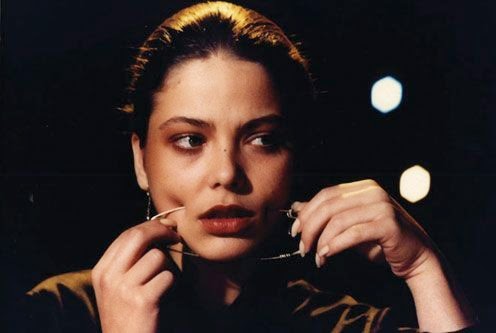
Charles Bukowski hasn't been a favourite of mine for over 20 years. I liked his books when I was 15 or so, but then they wore me out with their machismo. And then came Pulp, a very bad pastiche of hardboiled crime novel, which wasn't funny in the least. I might reread some of his novels in the near future, but we'll see if I really can make it. I remember, though, that Bukowski is a very easy and quick read.
All this leads me to the first film version of Bukowski's work. I saw Marco Ferreri's Tales of Ordinary Madness, based on a short story collection from the early seventies, already in 1986 or 1987, but just last night I saw it again. I didn't remember anything from it, save from the scene in which Ornella Muti pierces her cheek with a huge needle.
Tales of Ordinary Madness proved to be a pretty good film. Ben Gazzara is wonderful (if you can call him that) as Charles Serking (meaning Henry Chinaski, but they couldn't use the character's real name, due to the fact that Taylor Hackford owned it at that time). Serking is a sleazebag of a man, stalker, rapist, drunk, loudmouth, cynical asshole with nothing good to say about anyone. Yet we feel something for him, when he meets Cass, played by gorgeous Ornella Muti, a wreck of a human being working as a prostitute. Serking falls in love with Cass, and problems ensue. The film ends in a tragedy after Serking is lured to New York by a big publishing house, but he doesn't want to work for them.
Bukowski started where David Goodis left off. There's indeed something noirish in Tales of Ordinary Madness, its view of people of the streets, with no hope, with only their lust and booze. This is enhanced by Serking's hardboiled monologue with sentences out of a neo-noir novel. Gazzara's voice is low and brutal and he works well on those consonants.
Tales of Ordinary Madness, filmed in the US, but made with European money, is no B-grade flick. The decorations of Dante Ferretti and the photography of Tonino Delli Colli make sure it looks good even in the lowest depths of mankind.
More Overlooked Films here.
Friday, March 20, 2015
The left-wing and the right-wing definitions of noir
Here's Dave Zeltserman's (wonderful author) interesting essay on the definition of noir at the Artery site. Zeltserman emphasises what an individual, possibly or preferably sick or at least doomed, does to his or her own life. He argues against Dennis Lehane's social class theory of noir, where the failure of man is explained by the circumstances of life, which one cannot influence easily or not at all. Zeltserman is backed up by Otto Penzler, who says: "Noir is about losers. The characters in these existential, nihilistic tales are doomed."
Zeltserman's is what I should call a right-wing theory of noir. There's been a lively discussion over Zeltserman's essay at this Facebook site, and people like Vicki Hendricks (wonderful author) and Woody Haut (wonderful noir and pulp essayist) have been saying most interesting things. The Facebook discussion is public, so I thought I could link it here and quote it. Here's Woody Haut's comment (after which he says: "Does that make sense?") which, to my mind, illustrates what could be the left-wing definition of noir: "Taking into account society as a whole and the forces at work that produce a noir sensibility. To put it bluntly, social issues inevitably become individual issues. Penzler’s definition is as comprehensive as they come, and easier to digest, but only so far as the individual. On the other hand, that's what noir is invariably about. But, in the end, even though he expresses it in simplistic terms, Lehane’s statement ends up being a deeper concept, if only because the social and the individual can’t be separated."
Further on, Woody Haut says that the psychological struggle (that Zeltserman emphasises) and the social issues can't be separated, both affect each other. The background of many noir stories is minimal and sparse, like in Double Indemnity Zeltserman mentions in the discussion, but I don't think this is not not being about social or class issues. I think Woody Haut nails it when he says: social issues become individual issues. The anxiety of one's place in the society, the urge to move upward, even with the help of violence, the frustration or the anger of what one has become when not wanting to on in the society, these are both social and individual issues. In the right-wing theory of noir, these losers are losers because that's all they can do, in the left-wing theory, the same losers are losers because there's no other possilibity for them in the society, be they rich or poor.
Zeltserman's is what I should call a right-wing theory of noir. There's been a lively discussion over Zeltserman's essay at this Facebook site, and people like Vicki Hendricks (wonderful author) and Woody Haut (wonderful noir and pulp essayist) have been saying most interesting things. The Facebook discussion is public, so I thought I could link it here and quote it. Here's Woody Haut's comment (after which he says: "Does that make sense?") which, to my mind, illustrates what could be the left-wing definition of noir: "Taking into account society as a whole and the forces at work that produce a noir sensibility. To put it bluntly, social issues inevitably become individual issues. Penzler’s definition is as comprehensive as they come, and easier to digest, but only so far as the individual. On the other hand, that's what noir is invariably about. But, in the end, even though he expresses it in simplistic terms, Lehane’s statement ends up being a deeper concept, if only because the social and the individual can’t be separated."
Further on, Woody Haut says that the psychological struggle (that Zeltserman emphasises) and the social issues can't be separated, both affect each other. The background of many noir stories is minimal and sparse, like in Double Indemnity Zeltserman mentions in the discussion, but I don't think this is not not being about social or class issues. I think Woody Haut nails it when he says: social issues become individual issues. The anxiety of one's place in the society, the urge to move upward, even with the help of violence, the frustration or the anger of what one has become when not wanting to on in the society, these are both social and individual issues. In the right-wing theory of noir, these losers are losers because that's all they can do, in the left-wing theory, the same losers are losers because there's no other possilibity for them in the society, be they rich or poor.
Wednesday, March 11, 2015
Mark Coggins on The Long Goodbye
I was just writing on Chandler's The Long Goodbye for a forth-coming book I've started working on, and Googling for some references I found this interesting article by Mark Coggins on Chandler writing the novel. Well worth checking out!
(Sorry for not blogging. I'll try to get something done in the near future.)
(Sorry for not blogging. I'll try to get something done in the near future.)
Wednesday, February 25, 2015
Luis Buñuel: Él

One of Buñuel's best films, to my mind, is this weird little melodrama Él, made in Mexico in 1952. Buñuel's Mexican period clearly was one of his most creative periods, even though there were no dull phases in his career (saying this must mean he's one of the best directors in the history of cinema, almost everyone else had their dull phases). Él is a noir melodrama that's more noir that any American film noir made in 1952 - or any other year from 1933 to 1958 (I'm thinking Touch of Evil here). Él is a hard-hitting drama about a man so jealous he's willing to kill his newly-wed wife for no reason at all, he's just imagining all the things he says his wife is doing behind his back. Yet this is a very funny film, though there's nothing funny about the way the man acts. Buñuel wouldn't be Buñuel, if the film didn't also mock the society and the Catholic church that protect and almost encourage this mad behaviour. Él is a perfect analysis of the narcissistic mind, made almost 50 years before talk about narcissism became commonplace.
Tuesday, February 17, 2015
Tuesday's Overlooked Film: The Glass House
 I bought this movie not knowing what to expect, but it was cheap (probably 20 cents) and it had the name of Truman Capote on its cover. It was on VHS, but being an old TV movie that didn't matter much. The cast also was pretty strong, spelled wrong though some of the names were on the Finnish cassette cover ("Vice Morrow"!). The Finnish title means "The Law of the Strongest" (or "The Strong Rules"), and the description of the movie is as wrong as can be, making the film some kind of a vigilance fest.
The story behind The Glass House is interesting. Seems like Truman Capote wrote the original screenplay, but it was so bad another writer was called in, mainly award-winning Tracy Keenan Wynn, who'd later written stuff like The Longest Yard and The Drowning Pool. He tossed Capote's script out of the window and started from scratch. Because of the contract with Capote his name had to be kept on the credits (the Finnish cassette cover says it's from Capote's novel). The film was shot in a jail, with inmates working as extras and in bit parts. There's a really gritty feel to the story and atmosphere, and the ending is really bleak. No one would be able to make this on American TV anymore - or maybe, then again, a channel like HBO might. This is a very realistic movie about the jails and the struggle for power in them, and there are not many clichés in it, though there have been lots of realistic jail movies for decades. This is not action-oriented, mind you, it's more a drama with lots of violent tension in the air.
The actors are superb. Vic Morrow as the homosexual gang leader is brilliant, Alan Alda is his usual good self. Clu Culager is for once the good guy, but there are no easy solutions for him in the film. The directing is not very visual, but it's physical and effective. Tom Gries is not known for his insightful films, but his filmography might warrant a second look.
Seems like the film is easily available on DVD, but based on what I've read about other TV movies of this era (the golden era of American TV movies?), that's not always the case.
I don't know who collects nowadays the Tuesday's Overlooked Films posts, can someone shed some light on this? Todd Mason hasn't done a blog post in over a month.
EDIT: corrected Tracy Keenan Wynn's script credits.
Thursday, February 12, 2015
Dan Gilroy: Nightcrawler

One of these very good neonoirs from Hollywood is Dan Gilroy's Nightcrawler that I finally saw the other night. I liked it a great deal - I knew going in I'd like it a great deal. It's a perfect case of noir: you know from the first minute everything is going terribly wrong, but you just can't turn your eyes away. (But saying this doesn't give away the film's superbly ironic ending.) Jake Gyllenhaal is masterful as a narcissistic sociopath who believes the neo-capitalist bullshit about how one can achieve anything if he just takes everything passionately.
Highly recommended. No easy solutions in this film, nor any genre trappings.
Tuesday, February 10, 2015
The Killing of America
 The Killing of America by Leonard Schrader and Sheldon Renan from 1982 is a controversial film that has - as far as I understand - never been seen in the US, save for some occasional screenings when it was just released. The American producers backed out on it, thinking it was too extreme and radical. In Finland the film was known mainly through the VHS cassettes that recycled from hand to hand with everyone whispering about the scenes in which real people kill real people.
The Finnish Film Archive has a beautiful 35 mm copy of the film and I just saw it last night. I was a bit surprised and disappointed at the same time. I went in thinking the film consists mainly of the serial killers being interviewed, but there's surprisingly little of this material, though there are some scenes. The Killing of America is a straightforward documentary about the gun culture in the USA, and possibly the anti-gun sentiment in it has made it a forbidden film in America.
But it's also a very grim film, full of shocking imagery and arbitrary violence, make no mistake. There are some scenes I wouldn't want to watch again, though this wasn't made for cheap thrills, like films of the Faces of Death ilk. The directors, Leonard Schrader and Sheldon Renan, approached the theme seriously, Schrader being a known screenwriter (and Paul Schrader's brother) and Renan being an expert on American underground cinema (he's written a book about it). The use of archive material - live TV, surveillance camera shots etc. - makes The Killing of America look at times like an experimental film.
There are, however, some serious problems with the film. The anti-gun sentiment is clear: why are there so few killing in countries like Japan and Germany? Because it's not easy to buy guns there, and families don't pack weapons at home. The Killing of America can't analyze this further, it just points it out. The killings depicted in the film should've been more tightly related to the gun culture of the US. So should've been the argument about the murders of JFK and Robert Kennedy causing a killing spree in the US. What Schrader and Renan are forgetting is the fact that the large media coverage of violence causes more violence, just like there are more suicides if there are more stories about suicides in the media. The Killing of America doesn't question its own role in this process, though one could ask: how should this thing be approached then?
These gripes considered, The Killing of America is still a fascinating film and remits a watch, if one can find a copy. The most fascinating part is the interview of Ed Kemper who talks about his killing spree in a jail. He's self-ironic and almost funny, yet deeply weird. With his new glasses he looks almost hipsterish... I was hoping the film would have more of this stuff.
As an interesting side note, some funny folks from the little town of Pori, Finland, where I grew up made this parody of The Killing of America - called Killing of Pori. Pori is a town of some 77,000 inhabitants, yet the statistics in the beginning of the film claim there are million people killed every year. (You can see the second part here.)
Edit: Oops, I totally ignored the fact that The Killing of America is available for viewing in YouTube. Check it out here. Some stupid commentary under the clip.
Wednesday, February 04, 2015
Rare Australian pulp on sale
Life is hectic, so this short post has to suffice. The famous Australian collector Graeme Flanagan has put up some items from his collection on sale, check the books out here.
Sunday, January 25, 2015
A star is born
This was born early today, at 6 a.m. this morning. It's a girl. Mom and baby are doing fine.

Tuesday, January 20, 2015
Tuesday's Overlooked Film: The Last Starfighter
 A teenage guy is so good at an arcade game about shooting spaceships that he gets shanghaied into space and fights enemy spaceships. I believe this film was sold to producers on that line, but for some reason it works pretty well, even though it's still silly.
I remember seeing posters and ads for The Last Starfighter (called Viimeinen suuri seikkailija / "The Last Great Adventurer" in Finland, maybe they thought referring to "space" would scare the audience) and feeling sorry for not seeing the film. We didn't have a VCR at our house, so I wasn't able to see even it on video at the time. Not long ago I bought the film on VHS cassette for 20 cents and was able finally to watch it.
The Last Starfighter was directed by Nick Castle whose other films are not much of interest to me, with a possible exception of his first feature, T.A.G.: The Assassination Game. Castle of course was the guy behind Michael Myers's mask in Halloween. The Last Starfighter was an early example of incorporating computer graphics into a feature film alongside with Tron. I believe this one was more successful commercially*, but it's nowhere near the innovative graphic look of Tron, although The Last Starfighter is more entertaining than Steven Lisberger's stiff movie. The Last Starfighter benefits from two good veteran actors, Dan O'Herlihy and Robert Preston. Lance Guest as "the last starfighter" isn't bad either. He should've had a better career. The main plot about the battle in space is silly and clichéd, but the aliens look delightfully goofy.
I would've loved this as a kid, and there's still enough charm for me to like it even that I'm now a cynical adult. More Overlooked Films here (when the time comes).
* In IMDb's biography for Lance Guest it is said: "He was told that Starfighter reportedly made no money on it's initial release, so he returned to the theatre", but Wikipedia states thus: "The Last Starfighter was a financial success, earning over $28 million on an estimated budget of $15 million."
Saturday, January 17, 2015
Paul D. Brazill: Guns of Brixton
Guns of Brixton was the last book I read during the Christmas holidays that had nothing to do with work. It was perfect for that: a mix between Guy Ritchie's hyperkinetic crime movies and Irvine Welsh's lowlife scum novels. I don't need to recap the plot, here's a good outline from Out of the Gutter.

That said, I must note that I lost my way amidst all the lowlife in the book. There are quite many characters, maybe one or two many, and perhaps too many scenes are about new characters making their way into the story. Guns of Brixton gets too convoluted in the end, and I read the last pages having lost some of my interest. There are also more typos near the end, so perhaps Paul D. Brazill himself got lost in his own text! Available as an e-book, for example here.
Here's also Paul's blog, full of interesting news items and interviews with new noir authors!
Tuesday, January 06, 2015
Michael Marshall: The Straw Men
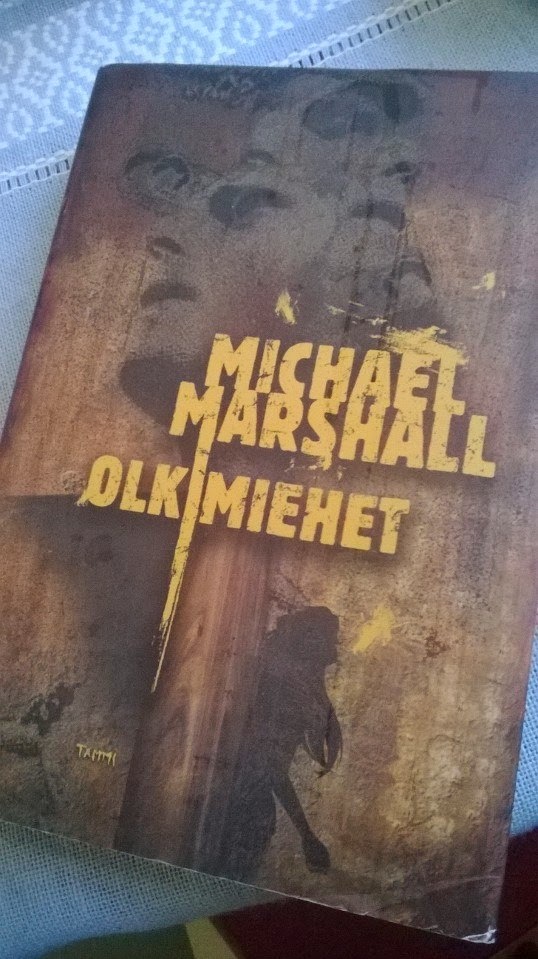 |
| the Finnish translation |
The Straw Men is a very clever and frightening take on the serial killer genre - genre that I'm not very interested in. Michael Marshall gives the phenomenon a nice historical and even mythical explanation and creates a conspiracy thriller that one won't easily forget. There's not much a reader will guess beforehand, and the climax is very exciting.
The only bad thing about the book is that it was written in the early 2000's and there's just too much talk about the internet, ADSL cables, IP addresses and such. It's dated already - probably was dated even five years ago. Marshall should've seen it coming, though the plot points about the internet must've been quite original in 2001 when the book came out.
Subscribe to:
Posts (Atom)