Showing posts with label noir. Show all posts

Wednesday, October 22, 2025

The preface for my book Dark Places and Little Tramps


Here's the preface I wrote for my book Dark Places and Little Tramps, which is a collection of writings about crime and other genres, taken from this very same blog. The sales have been lacking - I don't know what I expected, but I couldn't foresee that they would stop sending parcels across the Atlantic. There was also a bit of a delay getting the book in Amazon, and I think some of the possible momentum was lost while waiting for the book to appear there. It's now available, but as I already implied, I'm not sure whether it moves across the pond at the moment. (Damn you, Trump, and your tariffs!). But alas, seems like there's no Kindle version, even though I had an electronic version of the book made. Luckily my income isn't dependent on this! I'm not sure if it works, but the e-book version can also be bought here. Here, on another blog, is the table of contents for the book - it's too long to post here!


This book is a collection of book reviews from my blog called Pulpetti (Finnish for pulpit). I set the blog up in 2005 and updated it irregularly into 2022, when I finally stopped. Pulpetti, as the title probably tells you, was mainly about pulp or pulpish fiction, stuff that was published in pulp magazines, paperback novels and other low-end literary venues. I also wrote a lot about obscure films and some classics, and there was also a lot about my family issues and other odds and ends (I even published some poems there!), but sometime around 2010 I decided to concentrate on the reviews of pulp fiction and films and stop talking about my personal life, other than some work-related stuff, i.e. translating crime fiction, writing about it and what have you. I also started other blogs where I could direct my seemingly endless energy. 

Blogs around the world were mainly in English when I started Pulpetti, so it was natural to me that Pulpetti was also in English. I'm not a native speaker, as I live in Finland, but I've always thought my English is pretty fluent. At times I also published in Finnish, and I remember writer J. D. Rhoades saying that those parts in Pulpetti sounded like Elvish to him. 

Pulpetti brought many connections. From 2004 to 2011 I published a crime fiction fanzine called Isku in Finnish, and I got lots of new hardboiled and noir writing in them, stories by Patti Abbott, Bill Crider, Christa Faust, Ed Gorman, Jason Starr and Kevin Wignall, to name just a few. I couldn't have had the same supply of good stories without the blogging. Thanks go also to the Rara-Avis e-mail list which was still going strong during those years. 

Great cover by Ossi Hiekkala.

Largely thanks to Pulpetti, I had also connections to sample new crime novels for a paperback line I was editing for a Finnish publisher, namely Arktinen Banaani. I hand-picked books for the line in 2008–2010. The line went bust after only six books, but what classics they were: Duane Swierczynski's The Wheelman, Kevin Wignall's Who Is Conrad Hirst?, Allan Guthrie's Kiss Her Goodbye, Scott Phillips's The Ice Harvest, Christa Faust's Money Shot and James Sallis's Drive. How could you not love those books? But it seems the Finnish audience was able to resist their call, and the publisher really didn't know what to do with the books, so the paperback line ceased. After the paperbacks, there came a few books in hardcover (Kevin Wignall's The Dark Flag, which unfortunately still hasn't been published in English and probably never will, Duane Swierczynski's The Blonde, and Ken Bruen's London Boulevard, plus two crime novels by Finnish authors), but they vanished without a trace. A writer friend of mine, Antti Tuomainen, said to me that one day someone's gonna pick up one of these books, decides to become a writer and writes a book that changes the course of history. Here's hoping...

Why then did I stop blogging? I simply couldn't find the time anymore: I was already writing or doing some other writing-related work six, seven or even eight hours every day, so I thought it would be too tiresome to try to come up with something worthwhile to be published in a blog. And then there was social media, namely Facebook, where I could also publish stuff about my writing and pulpish fiction. Sometime around 2020 Facebook stopped showing links to Google-owned Blogger in its newsfeed, so it became quite frustrating to publish something on Blogspot and then find out no one has read it. There are other problems with Facebook that I wholeheartedly recognize, and as I'm writing this introduction, I've been on a Facebook break. I also wanted to have these reviews at hand and in print, just in case of Google deciding to cease all defunct or dormant blogs. 

As I said, Pulpetti was mainly about pulpish fiction, mostly hardboiled and noir writing, but also some westerns, some horror, some fantasy, some sleaze and other erotica and other genres. Many of the reviews in Pulpetti were born out of making a sequel to my original Pulpografia (2000, in Finnish only), a reference book on American crime and mystery writers published mainly in the pulp and paperback format. I also did a book on American western writers, so it was natural to post about that genre as well. 


In the early 2020's I started finishing up the sequel to Pulpografia, and I had to read some men's adventure books, a genre I'm not very much interested in, but which seems quite popular nowadays. When I was writing my first book over 20 years ago, I concentrated on genres that I really cared about, the noir and hardboiled stuff, but the wind has changed, at least according to the sites like Paperback Warrior and Facebook groups like Men's Adventure Paperbacks of the 20th Century, where men's adventure books, like the Mack Bolans by Don Pendleton, are very much a fad.  (As I'm writing this introduction, the sequel is not finished yet, but I'm hoping it will see the light of day in 2025! EDIT: Here's hoping...) 

In this book, there's also a large section on neo-noir, since I was reading (and still am!) new American, British and Irish crime fiction, mainly in the noir or neo-noir subgenre. I think there hasn't been any kind of history of neo-noir fiction, so this could be a start, or at least someone can use this as a source or a reference work. A word of warning: neo-noir is a famously slippery genre, so someone might think that not all the books mentioned here are neo-noir or even noir.

We have also a section on sleaze or sex paperbacks of the 1960's and 1970's (and later ones as well). Many people know that lots of sleaze paperbacks are also crime fiction. Just to name a few: Lawrence Block, Donald Westlake, Robert Silverberg, Orrie Hitt, Barry Malzberg... I did a book on sleaze paperbacks in 2020, called Pulpografia Erotica. It concentrates on American books that were published also in Finnish, so the scope is pretty limited and haphazard. There were lots of crime-related books that have never before been called to attention of crime fiction aficionados, though, so I think this section should prove interesting to many paperback fans. 

There are also sections on westerns and some other genres as well, with a short segment of non-fiction books and magazines. One of the most important segments in this book focuses on older British crime fiction. There are reviews and articles on British spy books, but also stuff about British private eye books, some of which are very light pastiches of the genuine American stuff. James Hadley Chase has many of his books reviewed, though I really don't find him that appealing. In the end, we have some reviews on crime/noir graphic novels and also some stuff on Finnish literature, mainly Aino Kallas and Mika Waltari, but also a survey of Finnish private eye fiction. "Reviews in brief" is just what it is: very short reviews on hardboiled, noir and other novels. 

The book doesn't contain the blog posts as they were, since I've edited them and taken out stuff that's not relevant anymore, i.e. things about where I was reading the book or some such. I've also combined some of the shorter reviews into longer ones, for example in the case of James Hadley Chase. 

The texts are arranged alphabetically according to the writer's surname. I've also added the publishing info, and you can find the publisher and the year of the first edition in the headers. (In this time of e-books, it's becoming more and more difficult to find the publishing year and the name of the original publisher!) 

I hope you find this mixed-up collection of reviews and essays interesting and entertaining. 

(And I indeed hope you can order the book and get it into your hands, tariffs or not!)

Tuesday, June 10, 2025

My book Dark Places and Little Tramps out


I decided to break the silence here, because I have a new book out and it's in English! One day, over a year ago, I got an idea: I'd take all the blog posts here in Pulpetti that are about literature, crime or otherwise, and edit them into a collection of reviews and articles. It took me over a year, but the book finally came out last month. I edited the texts, took out some blogginess (is that a word? I mean stuff like where I was reading the book etc.), organized them in different genres and wrote a foreword. My friend and colleague JT Lindroos, the mastermind behind the now defunct PointBlank, also did the cover and helped with the back cover copy. The book came out under the moniker Pulpetti Books. 

I thought at first I'd publish the book via Amazon, but then I thought I should do it via Books on Demand (BoD), which is situated in Germany. I use it regularly with my own publishing house, Helmivyö, and I thought it would be the best way to make the book available to public, since through them I could also have  the international distribution. Here the book is on Amazon, though not as an eBook. The book is available on many other sites as well, for example in The Australian Booktopia. The book should be out also as an eBook, but I'll have to find out about that. Do check out also this, this and this. (EDIT: I thought at first that Dark Places isn't available in Amazon, but Tony Baer over at Rara-Avis list found it. There must've been a delay, and I didn't check the availability when writing this blog post.) 

Mind you, the title of the book isn't supposed to refer to Charles Chaplin (this didn't occur to me at all, and neither to JT!), it's a reference to Gil Brewer's novel which I mention in the book's list of essential noir. (Dark Places is the title of Gillian Flynn's novel, which I also write about.) (EDIT: In an earlier version of this post, I mentioned I write about Brewer's Little Tramp in the book, but that is not the case after all. But there are two reviews of other novels by Brewer.) 

Here's the back cover copy: 

Dark Places and Little Tramps collects Juri Nummelin's writings on noir, hardboiled, sleaze and other literary genres of yesteryear. The author has written extensively about genre fiction and popular culture for more than four decades, but this new volume is the first publication of his writings in English. Among many other subjects, it features a lengthy section on neo-noir and writers like Gillian Flynn, Allan Guthrie, Jason Starr and Duane Swierczynski. He also investigates British spy and crime fiction, and includes chapters on western and horror. Nummelin shines new light to many of these areas, such as the largely forgotten topic of sleaze paperbacks.

And also little something about me as well: 

Juri Nummelin is a Finnish writer and publisher, who has had a life-long crush on hardboiled and noir. His blog, Pulpetti, was for many years a steady source of news and opinions about pulp and paperback fiction and edgy new crime writing. The texts in this volume are culled from the blog, but they have been newly edited and organized by genre. In the book, Nummelin also reminisces about his experiences in attempting get new neo-noir writers published in the Finnish language.

You can find the whole table of contents here

Wednesday, June 23, 2021

Sleaze novels that are also crime


Many people know that lots of sleaze paperbacks are also crime fiction. Just to name a few: Lawrence Block, Donald Westlake, Robert Silverberg, Orrie Hitt, Barry Malzberg... And as many people reading my blog know, I just published a book on sleaze paperbacks. It concentrates on American books that were published also in Finnish, so the scope is pretty limited and haphazard. There were lots of crime-related books that have never before been called to attention of crime fiction aficionados, though. At least not to my knowledge. (The book, called Pulpografia Erotica, is available here. But mind you, it's in Finnish and there's no international sales possibility.) 

So, I think the following books should be included in the next edition (or at least the appendix) of Allen Hubin's crime fiction bibliography (if they already are, I didn't notice and apologize): 

Norman Bligh: The Sisters. Softcover Library 1966. (Includes a killing of a mob boss, though not exactly a crime novel.)

Beth Brown: Man and Wife. Claude Kendall 1933. (Includes a private eye who shakes down clients of a famous prostitute. Not exactly a crime novel.) 

Richard E. Geis: Girlsville. France Books 1963. (Private eye called Vic Kunzer is hired to find a film producer's daughter.) 

Alexander Keith: The Love Gun. Bee-Line Books, the late sixties. (Murder takes place in a hunting cabin where there are some half dozen people. Set in Canada, there's also a French-speaking lieutenant! Can't find the exact year for this.) 

Kimberly Kemp (Paul Russo): Operation Sex. Midwood 1962. (International intrigue and sex.)

Peter Keyes (most possibly Andrew J. Collins): The Love Odds. Brandon House 1967. (Hardboiled crime novel about a private eye like character Steve Wayne who tackles the mobsters running a casino.) 

Lester Lake: So Wild, So Wanton. All Star Books 1962. (Cab driver fights the shakedown ring working in an elite high school.) 

Lester Morris: Savage Lust. Private Editions 1962. (Narcissistic womanizer kills accidentally his ex-mistress and tries to keep it hidden. Great noir novel with a very downbeat ending.) 

Max Nortic: Code Name: The Gypsy Virgin. Midwood 1971. (International intrigue and sadism as two female spies fight each other.) 

Max Nortic: The Real Thing. Midwood 1970. (A classic heist novel taking place in a casino.) 

Eric Sand: The Seduction. Beacon 1965. (Noirish novel about a young woman who comes back to her home town to revenge her father's death.) 

Floyd Smith: Action Girls. Midwood 1977 (there must be an earlier edition, since this was published in Finland in 1974). (An archaeologist tries to find his wife's ring in the desert so he can't be punished for killing her.) 

Gary Tubbs: The Case of the Missing Rubber. Published in 1969, can't find the publisher. (Private eye Charlie Romp gets mixed up in the smuggling of a sex drug.) 

David Warren: Tunnel of Love. Criterion Classics, no date. (Man is in prison for killing his wife's lover, then he finds out the man didn't die after all, and hunts him down. Lots of description of prison life. Maybe Warren was an inmate himself? This is the only book he wrote, at least under this moniker.) 

Then there are also these two books that are heavily crime-related, but I can't find any info on them: 
Jason Brown: Little Girl Lost and Bob Grand: Between All of Us. If anyone has anything on them, I'll be glad to hear it. I've written about these books (and the two published as by "Ralph Hayes") earlier here in Pulpetti. 

Tuesday, April 27, 2021

Lester Morris: Savage Lust (1962)

Here's another noir novel masquerading as a sleaze paperback! No one has ever heard of Lester Morris, let alone his sole novel Savage Lust that came out from a small paperback house called Private Editions. I thought this was pretty good and solid and could've been written by some better known paperbacker. The ending is devilishly cruel and ironic. 

Savage Lust's anti-hero is Si, a heel and a gigolo who uses and cheats women all the time. He's living in Florida and skimming money from every broad he can get his hands on. One of his lady friends, the wife of a hotel owner, wants to get Si all to herself and kills her husband and tells Si they can get the husband's money. Si doesn't want to get involved in a murder, but manages, almost accidentally, to kill the lady friend. Si buries the bodies and tries to act as the caretaker of the hotel while the owners are on a vacation. You can see this is not going to end well, right? And it sure doesn't! The ending is a punishment you just don't see coming. 

Not altogether plausible, but entertaining nevertheless, and the more noir aspects of the story are worth your while. I seem to enjoy the American sleaze paperbacks where the main guy is a no-good heel, who's getting beaten. No idea who really wrote this, but there were other Lesters writing sleaze at the same time, for example Lester Lake and Lester Arthur. They might be the same guy or,
then again, might not. 

Tuesday, August 22, 2017

Stark House Western Classics

There's been some talk about the idea of reprinting classic hardboiled and noirish westerns of the fifties and sixties. I compiled such a list earlier on my blog here (I called the list, jokingly, Hard Case Western) and the Spinetingler Mag maven Brian Lindenmuth has been talking about the same kind of westerns on his Facebook site.

Only now I noticed that Stark House Press has started doing this. Earlier they reprinted three of Harry Whittington's noir westerns, and they reprinted one by Arnold Hano, the Lion Books editor, and now they've done a two-fer by Clifton Adams. This is incredible! I only hope I'd have more time on my hands.

If anyone wants to work along these lines, the list I compiled can be used. I only wish my name would be mentioned somewhere.

Friday, June 26, 2015

Ten best noir novels of the 21st century

Eric Beetner has a pretty good list. I've read five (Starr, Phillips, Zeltserman, Rector, Max Phillips), and also two of the ones bubbling under (Megan Abbott and James Sallis).

Friday, March 20, 2015

The left-wing and the right-wing definitions of noir

Here's Dave Zeltserman's (wonderful author) interesting essay on the definition of noir at the Artery site. Zeltserman emphasises what an individual, possibly or preferably sick or at least doomed, does to his or her own life. He argues against Dennis Lehane's social class theory of noir, where the failure of man is explained by the circumstances of life, which one cannot influence easily or not at all. Zeltserman is backed up by Otto Penzler, who says: "Noir is about losers. The characters in these existential, nihilistic tales are doomed."

Zeltserman's is what I should call a right-wing theory of noir. There's been a lively discussion over Zeltserman's essay at this Facebook site, and people like Vicki Hendricks (wonderful author) and Woody Haut (wonderful noir and pulp essayist) have been saying most interesting things. The Facebook discussion is public, so I thought I could link it here and quote it. Here's Woody Haut's comment (after which he says: "Does that make sense?") which, to my mind, illustrates what could be the left-wing definition of noir: "Taking into account society as a whole and the forces at work that produce a noir sensibility. To put it bluntly, social issues inevitably become individual issues. Penzler’s definition is as comprehensive as they come, and easier to digest, but only so far as the individual. On the other hand, that's what noir is invariably about. But, in the end, even though he expresses it in simplistic terms, Lehane’s statement ends up being a deeper concept, if only because the social and the individual can’t be separated."

Further on, Woody Haut says that the psychological struggle (that Zeltserman emphasises) and the social issues can't be separated, both affect each other. The background of many noir stories is minimal and sparse, like in Double Indemnity Zeltserman mentions in the discussion, but I don't think this is not not being about social or class issues. I think Woody Haut nails it when he says: social issues become individual issues. The anxiety of one's place in the society, the urge to move upward, even with the help of violence, the frustration or the anger of what one has become when not wanting to on in the society, these are both social and individual issues. In the right-wing theory of noir, these losers are losers because that's all they can do, in the left-wing theory, the same losers are losers because there's no other possilibity for them in the society, be they rich or poor.

Friday, May 03, 2013

The Noir Dorian Gray

Remember when I was pondering about whether Oscar Wilde's The Picture of Dorian Gray might merit as a noir novel? I repeat: it's about an individual transcending the boundaries and suffering from the consequences. Okay, seems like I'm not the only one. I stumbled on some sketches by a Finnish artist called Jarmo Mäkilä and his exhibition based on The Picture of Dorian Gray. He has envisioned Wilde's characters as heavies from a gangster movie.


Monday, February 18, 2013

Rural Noir: A Visual Essay

Brian Lindenmuth, the fiction editor of Spinetingler Mag, has put up another great Pinterest board, this time on rural noir. Take a look here.

And here's Lindenmuth's earlier visual essay on modern noir.

Sunday, December 02, 2012

Gil Brewer: The Brat

I meant to do this for the Friday's Forgotten Book series, but I didn't have enough time on my hands. I've been rather tired lately - frustrated even - and am already on some sort of a Christmas vacation (which the tax refund, paid to me by the state of Finland, makes possible). I've been doing too much work for the past couple of years and it's starting to show.

Sorry, didn't mean to vent. Gil Brewer's The Brat (1957) is a prime example of Brewer's mix of white-collar noir and backwoods exoticism: "the brat" of the title is a sultry babe living somewhere in the Florida swamps whom the lead man takes away to the civilization to live with her - only to notice that "the brat" has something in her mind.

I'm sure The Brat was the publisher's title, since this babe sure is no brat, she's an evil liar and a scumbag. You might call Brewer - or at least his books - misogynistic and you'd well be right. But there's no denying the simple, yet forceful narrative drive in the best of his works. An important issue is also his handling of the bourgeoisie despair: there's not much living beyond the boundaries of the family and work. And when these boundaries break, the nightmare awaits.

I don't really like the cover of the book. It looks like the femme fatale of the book is wearing diapers.

The book is readily available from Prologue Books as an e-book. (I read this from my Kindle and I'm not complaining any about it.)


Friday, October 19, 2012

Friday's Forgotten Book: Robert Colby: The Captain Must Die

Thanks to Kindle and Prologue Books, I was finally able to read this magnificent crime paperback by Robert Colby that has been getting praise from the likes of Ed Gorman for some years now. I've earlier read some very good short stories by Colby and his paperback novel Beautiful but Bad (Monarch 1962), but this one has eluded me. Not anymore, of which I'm very glad.

The Captain Must Die (Gold Medal 1959) is one of those late fifties to early sixties noir paperbacks that tell about paranoia, broken dreams and people's hatred towards each other. This is firmly set in the world of well-being suburbs and tells about what's going behind the happy facade. This is also about the effects of war and the frustration that it breeds. Colby weaves his plot smoothly, albeit he has also fragmented it in a way that seems way ahead of its time - at least for a 50-year old crime paperback! Some scenes are very exciting and suspenseful. The ending may a be a bit too happy, though. (The cover lets us suppose it's a war novel. It's not - the war is in the background all the time.)

Here's Cullen Callagher on Colby's novel, and here's Ed Gorman, calling it a masterpiece. Here's Peter Enfantino's essay on Colby. Load the novel here. (And congrats to Prologue Books for doing this. There were some formatting and scanning errors in the Kindle version, but not so many that I'd actually complain.)

More Forgotten Books here.

Thursday, August 30, 2012

Fanny Ellsworth and the new Black Mask

Keith Alan Deutsch has some very interesting points to make about the evolution of hardboiled fiction and Fanny Ellsworth's editorship at Black Mask.

Sunday, June 24, 2012

Marxist Noir

Very interesting interview with Alan Wald about the connections of American proletarian realism and hardboiled school of crime writing at the Crime Time website. Authors mentioned: Jim Thompson, Kenneth Fearing, Ed Lacy, Ira Wolfert, Albert Maltz etc.

Friday, January 15, 2010

Friday's Forgotten Book: Don Tracy's Criss-Cross


Don Tracy is a little-known writer these days, but he had a long and, at times, distinguished career. In his later career he wrote largely movie and TV tie-ins, which isn't always a good sign. His second novel, Criss-Cross, is probably his best-known book and it has served as a basis for two films: Robert Siodmak's film of the same name and Steven Soderbergh's The Underneath (1994; in Finland only on video as Isku vasten kasvoja). Later Tracy wrote many shocking novels, like How Sleeps the Beast? (1938), which was published first only in the UK and Lion could publish it in the fifties as "a paperback original" which it wasn't, and The Big Blackout (1959). Both deal with racism of the South. There's not much on Tracy on-line, but Bill Crider and his commentators don't let us down.

I had recently a chance to read Tracy's novel in English - it's been translated in Finnish, but I've never read the translation, which, I believe, is abridged. (I was going to confirm it for this post, but never got around to it. The same thing happened, by the way, to watching Siodmak's film. I'm not sure if I've ever seen it.) Criss-Cross was first published by Vanguard Press in 1934 as a hardback, and it was later reprinted several times in softcover. The copy I read is a Triangle Book reprint from 1948, in hardcover. (There's a copy of the book in the Finnish Film Archive's library.)

Criss-Cross is quite a good novel. It's told in a very terse, very hardboiled style (that reminded me of Jason Starr's first novels, for some reason or another). Tracy uses ellipsis to a very good effect and he writes good dialogue. Some dated slang words, like "potatoes" for money, don't get much in the way. The story is about a guy who's done some boxing and who now guards money trucks. He's in love with Anna Krebak, a flimsy good-looking babe who goes out also with a guy called Slim, handsome creep. Tracy lets the action develop slowly, but you know how the story goes: this has been rewritten at least hundred times since. Tracy paved way for the Gold Medal and Lion writers, alongside with James M. Cain (The Postman Always Rings Twice was published the same year as Criss-Cross, so it's not sure Tracy was influenced by Cain).

There are some problems with the novel, though. There are some twists you don't see coming in the end of the novel, but the drive also slows down a bit. You feel there's no need to read the rest of the novel after, say, page 200, even though Tracy gives hints of the protagonist's descent into madness. The irony in the last, very short chapter is very gripping, though. Truly noir, this one.

This copy of the book belonged to Finnish film scholar Matti Salo who's known for his studies in film noir and the Hollywood black list. He has made some notes and quotes in the behind of the book. "Tracy belongs to the hardboiled Hemingway school of writers, related also to Burnett." (I think this quote comes from The Tough Guy Writers of the Thirties, an old anthology of articles.) Salo also makes the note of the reversal of the handsomeness of the leading men: in the book, the protagonist, Johnny is ugly with a broken nose, and Slim is the pretty boy, but in Siodmak's film Slim is played by Dan Duryea and Johnny is played by Burt Lancaster. There's also this quote: "Tracy's novel is rather predictable and thin, not a thriller, really, but related to a gangster novel." My opinion is higher, and I don't much see relation to gangster novels. There's no organized crime in Tracy's novel.

Lee Server offers some other quotes in his The Encyclopedia of Pulp Fiction Writers. The critic Cyril Connolly reviewed the book for the New Statesman: "A fascinating crime story - aesthetically worse than The Postman Always Rings Twice, if that were possible [sic!] - but begin it at any page, nevertheless, and you can't stop till you've read all the other others. It is a mass of fake simplicity, fake intensity, fake slang. Only the sentimentality and bad grammar are genuine. But one has to read it." I should say this is not sentimental in the least! Bad grammar is genuine, because Tracy writes about characters who don't know grammar!

(Lee Server's book has received lots of bad reviews, but his entry on Tracy is very good - check it out! He offers a good rundown of Tracy's career, not forgetting his sequels to Metalious's Peyton Place.)

Friday, March 13, 2009

Forgotten Short Story Friday: Tom Blackburn and George Michener

As Patti Abbott suggested, this Friday's Forgotten prose entries should be about short stories. I thought immediately about two western short stories that stuck to my mind when I was researching the Finnish pulp and other fictionmags some years back writing my books Six Guns and Five Guns (the latter is exclusively about short stories in magazines). The other story is by Tom Blackburn, the other one is by George Michener.

Tom Blackburn is better known of the two. He lived from 1926 to 1997 and wrote pulp stories from the thirties on. Later he did lots of novels, both in paperback and hardback. He was never a bestseller, but he's a firm part of the fifties' western renaissance that was heavily featured in paperback originals.

The one short story I've read from Blackburn is called "Then There Were None". It appeared in Dime Western, July 1950 (and the Finnish translation came in Seikkailujen Maailma 7/1956). It's a gripping noir story, with full of violence and unexpected twists, all in a very short form, handled convincingly. The story starts with the boss of the criminal gang waking up and killing one of his mates and trying to convince the others that the dead man attempted to shoot him. Involved is a stupid young boy who idolizes these gangsters. As noir as a western can be.

Now, George Michener we know nothing about. He wrote primarily westerns for the short story market, starting from the mid-thirties and magazines like West and Ace-High Magazine, and giving up in the early fifties. His one story was called in the Finnish translation "The Scarface's Revenge" (Seikkailujen Maailma 10/1951), which doesn't match those found in the Fictionmags Index. It's a great story nevertheless: Scarface, mentally and fysically disturbed criminal, returns to his old haunts and gathers up his old gang, but they have a new boss. He decides to kidnap the sheriff's kid - and it turns out the sheriff is Scarface's half-brother. Very violent and disturbing - a noir western in the mold of Blackburn's story above.

PS. Just thought to Google and found this. I didn't know that Blackburn wrote lyrics for Disney films!

Friday, August 08, 2008

Friday's forgotten book: James Cross: Root of Evil


Finally I had a chance to chime in with Patti Abbott's Friday's Forgotten Book blog thing. I've been posting - in Finnish - the entries of my first book, Pulpografia, in another blog of mine here and when I came across James Cross's Root of Evil I thought I should say something about it in English, too.

I found this novel when I was going through some magazines at the university library and noticed there was a serial in a magazine called Mies (Male or Man) in 1959. It was by a writer not known to me, James Cross. The story looked interesting, so I took a look at Allen Hubin's bibliography and noticed Cross was actually named Hugh Parry and that he had four crime novels to his name. Then I spotted a book by James Cross in a second hand book store. It was called Root of Evil and even though I don't have the book at hand (I think it's in a box in the cellar..), I do remember it was a British paperback reprint. Quick glance told me it was the same book that was serialized in the mag.

So I read the book instead of the serialization. And man, I was sure glad I read it, since Root of Evil is a fast-moving tale of intrigue, murder and extortion. Two brothers buy a house and find a huge treasure of old coins in the backyard. They dig them up and after thinking about it for a while, they decide to keep them. First the taxman comes in, but then come the local criminals and then comes the greedy ex-wife and even if that's not enough, the military also tries to get their hands on the money. From what I remember of the book, it was told in a snappy, hardboiled style in the first narration. It's a very entertaining and well-written book.
Cross seems to have written some short stories, one for Playboy in 1967, and I seem to remember someone saying that he had a story in Harlan Ellison's Dangerous Visions. That aside, I've never heard or read anyone commenting on his work. Root of Evil should merit at least a mention.
Sorry for the lousy picture - it was the only one I found on Abebooks. It's a Crest reprint from 1958; the original edition is from Messner, 1957.

Wednesday, July 02, 2008

A bit of news

Just noted that Hard Case Crime will be reprinting Jason Starr's masterpiece novel Fake I.D., sometime next year. This will be the first time it's actually published in the US - the only edition has been British, by No Exit Press. The novel is simply great, one of the best noir novels ever.

And by the way, I just finished reading Bust, the first in the series of books by Starr and Ken Bruen. Great fun, that was.

Wednesday, March 05, 2008

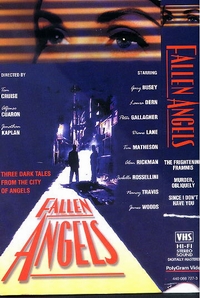
Fallen Angels


I bought, um, maybe last Summer three VHS cassettes very cheap from a thrift store. They contained all the episodes of the second season of the neo-noir TV mini-series Fallen Angels (1995) whose episodes were based on stories by famous and not so famous pulp and noir writers of bygone days. I don't know if the series has been released on DVD, but I think the purchase was a nice bargain. I don't also remember if the series was ever shown in Finland or if it came here only on video.

The series is uneven. Some of the episodes are pretty mediocre, some due to the weak original story, some due to weak directors or actors. I think the weakest is "Tomorrow I Die", based on Mickey Spillane's short story (from Cavalier, February 1956). It's just not believable and all the action these people make seem wrong. The ending is downright laughable.

Agnieszka Holland's "Red Wind", from the Raymond Chandler story (Dime Detective, January 1938), feels pretty uneven too: the artificial studio look, with the sets that you never mistake for reality, doesn't quite fit the Chandler I know, and Danny Glover as the black Marlowe - even though he's quite good - seems only a joke. The plot is what it is - I'm sure that if Holland had sent Chandler a telegram asking "Who killed who? And who doublecrossed who?", Chandler would've sent back a telegram saying "I don't know."

Some of the strongest ones include "No Escape", based on a Bruno Fischer story (from Detective Tales, January 1949) and written by Scott McGehee and David Siegel, the makers of Suture and The Deep End. The story is strong and it's easy to see why McGehee and Siegel were drawn to it - in the story, the female lead faces the same kind of obstacles as in The Deep End. In this, everything is just more violent and menacing.

Also strong is "The Professional", from a David Goodis story (as Professional Man, Manhunt, October 1953), directed by Steven Soderbergh, who's shown his love and interest for noir in several films. This one, written by Howard Rodman, plays with the idea that the professional killer of the story is actually a homosexual. The style is cool and detached, but also seems a bit too artificial for Goodis - at least the story has been taken into a timeless art deco world, that's pretty alien to Goodis. I think Rodman is going to talk about this episode at NoirCon.

Other episodes include two Cornell Woolrich versions which were okay, a Dashiell Hammett piece ("Fly-Paper", from Black Mask, August 1929, in which Christopher Lloyd makes a believable Continental Op) and a boxing story written by Evan Hunter. That was okay, too, but I don't seem to remember much of it now. The Walter Mosley piece, "Fearless", seems a bit out of context here, since it's the only new story in the bunch. It's set just after WWII, though. (The story was first published in the anthology Spooks, Spies, and Private Eyes in 1995.)

One of the weakest points in the series is actually the retro feel. Okay, the sets are nice, music is great, it's just that it's too obvious. Saxophone, guns, smoking, cocktails, the art deco lounges at hotels... it becomes a bit corny in the end. And it's corny in the epilogue that was directed by Phil Joanou - at least when you watch it nine times. What's corny is that every woman looks like their hair was made in 1995 and not in 1945 or 1955. (With the possible exception of Marcia Gay Harden in "No Escape".)

Nice try, though, and I'd really like to see another Fallen Angels: another nine episodes of classy neo-noir. Maybe you could do it now with new stories. There's lots of interesting, intriguing, electrifying, utterly satisfying noir out there, you know.

Tuesday, February 26, 2008

Stephen Marlowe and my curse

Prolific paperbacker and historical novelist Stephen Marlowe died last Friday. This is no news to anyone following the vintage hardboiled scene, but I just wanted to say that now I finally know I'm jinxed. I've killed several old writers and authors by sending them letters and lately e-mails asking for interviews and general questions about their careers: Hugh Cave, Jack Williamson, Bruce Cassiday... and now Stephen Marlowe.

We changed some e-mails two months back and I got his permission to use a Chet Drum story for Isku, and earlier this week I thought I'd send him an e-mail asking for an interview for my Pulp fanzine. His wife answered that the offer is kind, but Stephen is in the hospital. He'll recover and then we'll see about the interview, the wife said. Two days later I heard he was dead. I'm so sorry.

This has been known as the Ashley curse, due to Mike Ashley who performs similar feats, but there's a subcategory called the Nummelin curse.

I haven't actually read much by Stephen Marlowe, but he was consistently entertaining, if nothing else. His Blonde Bait, reissued by Stark House Press last year, is a very good James M. Cain -ish story set in a ski resort. Try it if you like classic hardboiled noir. If I had a publisher of my own, I'd publish a new translation of Blonde Bait. (It was published in Finnish in the early sixties, under the title Vaaleaverikkö syöttinä, and is easily locatable in the second hand book shops, if you want to try it. You should.)

Bill Crider has a nice slide show for him in his blog.

PS. I don't know if Clayton Matthews is dead, but his wife, Patricia Matthews, died rather recently. I interviewed Mr. Matthews four years ago.

Thursday, January 17, 2008

Great cover on Swedish paperback


Here's a great cover for the Swedish translation of Talmage Powell's memorable novella-length story, "Sudden, Sudden Death" (AHMM, 1957; anthologized many times). The story was published in Sweden in 1971 in a series of mini-sized paperbacks (roughly 9 x 14 cm and 120 pages). The illustration, which I like very much and which is the reason I bought the book, is probably Spanish in origin. The Swedish title means "To Hate till Death".

The mini-paperbacks never really caught on in Finland. There was a series called Mikro-kirjat in the late fifties (they published three science fiction novels, may have to do a post about them later) and later on there was only one series, aimed at female readers.