Aiemmin sarjakuvakustantajana tunnettu Arktinen Banaani laajentaa ensi syksynä pokkareiden ja myös dekkareiden puolelle. Sarjan dekkarit keskittyvät uuteen kovaksikeitettyyn ja noir-dekkariin, jotka ovat tällä hetkellä vahvassa nousussa sekä Yhdysvalloissa että Englannissa, sekä isoissa kustantamoissa että erikoistuneissa pienkustantamoissa. Arktisen Banaanin dekkaripokkareissa kunnioitetaan lajityypin perinteitä tyylikkäillä kuvitetuilla kansilla.
Sarjan ensimmäiset kirjat ovat Duane Swierczynskin Keikkakuski (The Wheelman, 2005) ja Allan Guthrien Viimeinen suudelma (Kiss Her Goodbye, 2006). Kirjat ilmestyvät lokakuussa.
Keikkakuski kertoo Patrick Lennonista, pankkirosvojen käyttämästä keikkakuskista, jonka paras etu työssään on, että hän on mykkä. Philadelphialaisen Wachovia-pankin ryöstö näyttää aluksi sujuvan ihan kohtuullisesti - mitä nyt pitää ajaa autolla pankin ovi rikki ja pamauttaa lastenvaunuja työntävä nainen pois tieltä -, mutta sitten joku puuttuu peliin ja täräyttää isolla pakulla keikka-auton kylkeen. Patrick Lennonin elämän painajaismaisin viikonloppu alkaa: hän herää, kun häntä ollaan työntämässä mustassa ruumissäkissä rakennustyömaan putkeen...
Viimeinen suudelma kertoo Joe Hopesta, karusta ja hiukan yksinkertaisesta koronkiskurin apurista, jonka tärkein työväline on pesäpallomaila. Joe Hope tulee aamuyöllä keikalta kotiin vain saadakseen kuulla, että joku on tappanut hänen teini-ikäisen tyttärensä. Masennuksesta ja juopotteluputkesta toivuttuaan Joe päättää kostaa.
Duane Swierczynski (s. 1972) iski itsensä läpi amerikkalaisten dekkarinlukijoiten tietoisuuteen toisella romaanillaan Keikkakuski, joka kertoo mykästä luottoajajasta. Tämä joutuu vaikeuksiin, kun huolella valmisteltua pankkikeikkaa onkin seurannut myös venäläisten mafia. Keikkakuski on 24-tv-sarjan ja 1950-luvun kovaksikeitettyjen rikospokkareiden risteytys: reaaliajassa kulkeva trilleri, jossa ei ole tyhjiä hetkiä.
Duane Swierczynski on nuoren polven amerikkalaisdekkaristien ehdotonta kärkeä, joka on kirjoittanut myös Marvel-yhtiön sarjakuvia, kuten X-Meniä ja Cablea. Hänen muihin romaaneihinsa kuuluvat The Blonde (2006) ja Severance Package (2008).
Allan Guthrien (s. 1965) debyyttiromaani Viimeinen suudelma löi dekkaripiirit ällikällä: kertomus pesäpallomailaa aseenaan käyttävästä koronkiskurin apupojasta, jonka tytär kuolee epämääräisissä olosuhteissa, on samaan aikaan inhimillisen lämmin että pirullisen väkivaltainen. Kirjallaan Guthrie oli myös ehdokkaana tunnetussa Edgar-palkintokisassa, joka myönnetään vuosittain parhaalle ilmestyneelle rikosromaanille.
Allan Guthrie on skottilaisen hardboiledin uusi mestari, jota on verrattu Irvine Welshiin ja Denise Minaan. Hän vain kirjoittaa väkivaltaisempia kirjoja.
Guthrien muuta tuotantoa ovat romaanit Two-Way Split (2006), Hard Man (2007), Kill Clock (2007) ja Savage Night (2008).
Monday, June 23, 2008

Thursday, June 19, 2008
Finished things
I feel like a million bucks. The reason: I finished some hours back the first draft of the translation of a major new American hardboiled caper novel. I'm a bit too busy to write about the whole thing more fully, but you can guess what that novel is, when I tell that I burst out laughing when I received a spam e-mail two or three minutes after completing the job - the message "came" from "Wachovia bank". (And you may remember that I've hinted at the past on this blog and probably elsewhere, too, that I'll be editing a series of crime paperbacks. More on this later. Stay tuned.)
 The newest issue, No. 2, is a bit smaller than the previous one, from the last year, but it was only due my lack of time. There's not, for example, an old story from the archives (the last issue had two, one by Otso Kantokorpi and one by Jussi Kylätasku, both Finnish writers). There are more translations than original Finnish stories - Ässä has stories by JT Ellison, Patti Abbott, Patricia J. Hale, Pearce Hansen, Todd Mason and John Weagly. The Finnish writers in the issue are Pasi Karppanen, Tapani Bagge, Salla Simukka and myself. (Well, okay, Tapani's and Salla's stories are old - they were published in a flash fiction series I edited for a weekly paper, Valo, last year.)
The translation is not the only thing that was finished lately. Yesterday I picked up from the printers the latest issue of Ässä. You may remember that my hobby is to publish small press crime magazines (or fanzines; I don't know what word I should use). Ässä is the kid brother of the family. It contains only stories under 1,000 words, preferably even shorter. It's the world's smallest pulp mag, a magazine with flash fiction stories.
 The newest issue, No. 2, is a bit smaller than the previous one, from the last year, but it was only due my lack of time. There's not, for example, an old story from the archives (the last issue had two, one by Otso Kantokorpi and one by Jussi Kylätasku, both Finnish writers). There are more translations than original Finnish stories - Ässä has stories by JT Ellison, Patti Abbott, Patricia J. Hale, Pearce Hansen, Todd Mason and John Weagly. The Finnish writers in the issue are Pasi Karppanen, Tapani Bagge, Salla Simukka and myself. (Well, okay, Tapani's and Salla's stories are old - they were published in a flash fiction series I edited for a weekly paper, Valo, last year.)
 The picture accompanying this post was just too hilarious not to use: when I went to the printers, the magazines were wrapped in a pink paper. That's just too cute!
The cover illo is by anonymous - I found it in a sixties' book that dealt with media violence.
Happy Midsummer's Eve to everyone!
Wednesday, June 18, 2008
Se on Ewers, ei Ebers!
(Just something that bugs me.)
Minua on tänään ärsyttänyt Waltari-kirjoittelussa toistuva virhe, jonka mukaan Waltarin suomentaman Horst Wesselin (suom. 1933) kirjoittajan nimi on Hans Heinz Ebers, kun se on Hanns Heinz Ewers. Virhe lähtee nähdäkseni vuoden 1982 kirjasta Mielikuvituksen jättiläinen, jossa Eila Pennanen kirjoitti nimen väärin ja se toistuu Panu Rajalan kirjassa Noita palaa näyttämölle ja Reijo Vahtokarin ja Risto Lindstedtin viime vuonna ilmestyneessä kuvapainotteisessa elämäkerrassa! Ja kaikki kirjoittavat nimen samalla tavalla väärin.
Toivottavasti Rajalan syyskuussa ilmestyvässä elämäkerrassa nimi on oikein.
Minua on tänään ärsyttänyt Waltari-kirjoittelussa toistuva virhe, jonka mukaan Waltarin suomentaman Horst Wesselin (suom. 1933) kirjoittajan nimi on Hans Heinz Ebers, kun se on Hanns Heinz Ewers. Virhe lähtee nähdäkseni vuoden 1982 kirjasta Mielikuvituksen jättiläinen, jossa Eila Pennanen kirjoitti nimen väärin ja se toistuu Panu Rajalan kirjassa Noita palaa näyttämölle ja Reijo Vahtokarin ja Risto Lindstedtin viime vuonna ilmestyneessä kuvapainotteisessa elämäkerrassa! Ja kaikki kirjoittavat nimen samalla tavalla väärin.
Toivottavasti Rajalan syyskuussa ilmestyvässä elämäkerrassa nimi on oikein.
Sunday, June 15, 2008
Dan Sontup on Scott Meredith

Oops... sorry, my memory of this little piece was that it was more about Sontup's career, but it's almost only about his stint at Scott Meredith's literary agency. But here goes nevertheless. There's first someone's (I don't know whose) question and then follows Sontup's answer:
When I was a beginning writer back in the 70s, teachers 'in the know' advised beginners to avoid the Scott Meredith Agency, saying he would only demand money for a reading and after getting the money would tell the author the story had no chance in the market. Do you think that was true? I never sent him anything. Maybe I missed the boat.
Here's how it worked back in the '50s (can't speak for the setup in the '70s). I started with Scott on what was called the "fee desk." Writers would pay $5 for a reading and evaluation, of which the fee desk editor got $2. Our instructions were to type at least a two-page report on each submission. (An interesting sidelight here. Lester del Rey had reworked on old Czech manual typewriter with English alphabet keys for Scott. It required a real heavy hand on the keys, but it had one big advangage -- the characters were very large type. This meant I could do the required two-page report with less wordage than a conventional manual typewriter, which the other editors used -- and this was important when trying to do as many $2 fee reports as possible in a day to make some money at the end of the week.) Also, in each report, we had to be sure to mention Scott's book, Writing to Sell, and in the case of fiction, delineate what Scott called "The Plot Skeleton," which reduced the amount of space you'd have to devote to actually discussing the submission itself. Also, when rejecting the submission, we were to make sure it was worded
so that the writer couldn't come back and say, for instance, "Well, if that's all that's wrong with the story, I'll revise it and send it back to you." The rejection had to be final and irrevocable to forestall repeat submissions of obviously
unsalable material.
If we found a manuscript that might have salable potential (which would be a rare find), we were to pass it on to the editor at the "pro desk." who at that time (a little name dropping here) was Evan Hunter, and who would make a final decision on the marketability of the manuscript. I estimated that I read through more than 200 manuscripts when I first started with Scott before I found one that I could pass on.
So, to finally answer your question -- yes, a good story would get consideration and, if marketable, would be taken on by Scott. Needless to say, this hardly every happened, because most of the submissions were from people who had not yet learned how to write.
As I said earlier, Sontup wrote this for the ShortMystery e-mail list. Tapani Bagge, who's a personal friend, is a member of that list and e-mailed this to me several years back. I've also joined since, but I don't have the time to follow the discussions there.
I've also included the only book-length work Sontup wrote (at least that I know of) - it's a novelization of the M-Squad television series, under the pseudonym David Saunders. I haven't read it.
Saturday, June 14, 2008
Coming posts
After posting the Jory Sherman bibliography I remembered another item I have sitting on my computer that might be of interest - a short memoir by crime fiction writer Dan Sontup that he wrote for the ShortMystery e-mail list some years (five, six?) back. (It's on another computer, not this laptop I'm usually working on, so I won't post it now.)
I'm also getting back to writing about Mika Waltari's older books. I'll be writing about his humorous adventure novels under the pseudonym Leo Rainio and after I'll do a brief post about his mystery novels featuring Frans J. Palmu. I'll also try make a post with the covers of his American paperback translations.
I'm also getting back to writing about Mika Waltari's older books. I'll be writing about his humorous adventure novels under the pseudonym Leo Rainio and after I'll do a brief post about his mystery novels featuring Frans J. Palmu. I'll also try make a post with the covers of his American paperback translations.
Thursday, June 12, 2008
And Jory Sherman's bibliography...
 (Someone once talked about how blogs could be sexy... You couldn't get any sexier than this. Steamy stuff, let me tell you!)
After writing a brief post about Jory Sherman it occurred to me that I once received Sherman's bibliography from librarian and pulp/SF fan Denny Lien. I think he got it from the Contemporary Authors database - I hope I'm not doing any copyright infringement posting the bibliography here. It's couple years old, and I believe Mr. Sherman has written some new books in the interim. There are so many books here I got tired pretty soon to try to italicize the books' titles...
So Many Rooms, Galley Sail Publications, 1960. [poetry]
My Face in Wax, introduction by Charles Bukowski, illustrated by Bobbie Blume, Windfall Press (Chicago), 1965. [poetry]
Lust on Canvas, Anchor Publications, 1965.
The October Scarf, Challenge Books, 1966.
The Sculptor, Private Edition Books, 1966.
The Fires of Autumn, All Star Books, 1967.
Nightsong, All Star Books, 1968.
(Under pseudonym Cort Martin) Blood Jungle, Triumph News, 1968.
(Under pseudonym Cort Martin) The Star, Dominion (San Marcos, CA), 1968.
(Under pseudonym Cort Martin) Quest, Powell Publications, 1969.
(Under pseudonym Cort Martin) The Edge of Passion, Saber Books, 1969.
MAN, WOMAN AND BEAST: A Clinical Study of Bestiality. Venice Books, 1971.
The Love Rain, Tecumseh Press, 1971.
(Under pseudonym Frank Anvic) The All Girl Crew, Barclay, 1973.
(Under pseudonym Frank Anvic) The Hard Riders, Barclay, 1973.
There Are Ways of Making Love to You, Tecumseh Press, 1974.
(Under pseudonym Frank Anvic) We Have Your Daughter, Brandon Books, 1974.
(Under pseudonym Frank Anvic) Bride of Satan, Brandon Books, 1974.
Gun for Hire, Major (Canoga Park, CA), 1975.
(Under pseudonym Charlotte A. Sherman) The Shuttered Room, Major, 1975.
Ride Hard, Ride Fast, Major, 1976.
(Under pseudonym Wilma Tarra) Her Strange Needs, Carlyle Communications, 1976.
(Under pseudonym Wilma Tarra) Trying Out Tricia, Carlyle Communications, 1976.
Buzzard Bait, Major, 1977.
Satan's Seed, Pinnacle Books (New York City), 1978.
Chill, Pinnacle Books, 1978.
The Bamboo Demons, Pinnacle Books, 1979.
Hellfire Trail, Leisure Books (Norwalk, CT), 1979.
The Reincarnation of Jenny James, Carlyle Books, 1979.
The Fugitive Gun, Leisure Books, 1980.
Vegas Vampire, Pinnacle Books, 1980.
The Phoenix Man, Pinnacle Books, 1980.
House of Scorpions, Pinnacle Books, 1980.
Shadows, Pinnacle Books, 1980.
Dawn of Revenge, Zebra Books (New York City), 1980.
Mexican Showdown, Zebra Books, 1980.
Death's Head Trail, Zebra Books, 1980.
Blood Justice, Zebra Books, 1980.
Wier Hell, Zebra Books, 1980.
Bukowski: Friendship, Fame, and Bestial Myth, Blue Horse Publications (Augusta, GA), 1981.
Duel in Purgatory, Zebra Books, 1981.
Law of the Rope, Zebra Books, 1981.
Apache Arrows, Zebra Books, 1981.
Boothill Bouy, Zebra Books, 1981.
Hard Bullets, Zebra Books, 1981.
Trial by Sixgun, Zebra Books, 1981.
(Under pseudonym Cort Martin) First Blood, Zebra Books, 1981.
My Heart Is in the Ozarks, illustrated by Sherry Pettey, First Ozark (Harrison, AR), 1982.
The Widow Maker, Zebra Books, 1982.
Arizona Hardcase, Zebra Books, 1982.
The Buff Runners, Zebra Books, 1982.
Gunman's Curse, Pinnacle Books, 1983.
Dry-Gulched, Zebra Books, 1983.
Wyoming Waon, Zebra Books, 1983.
Tucson Twosome, Zebra Books, 1983.
Blood Warriors, Zebra Books, 1983.
(Under pseudonym Walt Denver) Pistolero, Zebra Books, 1983.
(Under pseudonym Hank Mitchum) Stagecoach Station 8: Fort Yuma, Baam (New York City), 1983.
Death Valley, Zebra Books, 1984.
Red Tomahawk, Zebra Books, 1984.
Blood Trail South, Zebra Books, 1984.
Song of the Cheyenne, Doubleday (New York City), 1987.
Wier of the Wolf, Walker Co. (New York City), 1987.
Horne's Law, Walker Co., 1988.
Eagles of Destiny, Zebra Books, 1990.
The Arkansas River, Baam, 1991.
The Medicine Horn: Book One of the Buckskinners, Tom Doherty Associates (New York City), 1991.
An Early Frost, White Oak (Redwood City, CA), 1992.
Grass Kingdom, Forge (New York City), 1994.
Trapper's Moon, Tor (New York City), 1994.
The Rio Grande, Baam, 1994.
The Columbia River, Baam, 1996.
The Barons of Texas, Forge, 1997.
The Baron Range, Tom Doherty Associates, 1998.
The Baron Brand, Forge, 2000.
The Ballad of Pinewood Lake, Forge, 2001.
(He's not a slow writer - and it's no wonder he's become blind in his old age.)
Edit: I thought I'd look on Abebooks and found quite easily some books the Contemporary Authors bibliographer hasn't noticed:
 Incest: The Big Taboo, Venice Publishing Corp, 1966.
Secret World of Incest, Pendulum Books, Atlanta, GA, 1967
I Thee Wed, PEC, San Diego, CA, 1967
The Lips of Eros, Pendulum Books, 1967
The Summer Man, Challenge Books, 1967
The Passion Killer, Triumph Books, CA, 1968
Under the pseudonym Frank Anvic I find these books that are not on the CA list - of course it's possible that Anvic was a house name and Sherman wrote only those that are mentioned above.
His Mother's Arms, Barclay House 1969
Troubleshooter, Brandon House 1973
The Safari Women, Brandon House, n.d.
The Austrian Connection, Brandon House 1974 ("The assignment: Smash the huge international smuggling ring. The agent: Brad Saber. His abilities: Unique. His Achilles' heel: Women!")
Bonnie Does It Better, Beeline 1978
Some of these - at least The Austrian Connection - should be included in Al Hubin's bibliography of crime fiction. Will let him know.
Edit part two: I heard from James Reasoner that Blood Jungle, mentioned in the original Contemporary Authors bibliography, was published under the pseudonym Cort Martin and not under his real name. I'll add this info to the list as well.
Edit part three: I added a new pornographic book I happened to find (Man, Woman and Beast) when I was looking for something else.
Edit part three: I added a new pornographic book I happened to find (Man, Woman and Beast) when I was looking for something else.
Jory Sherman's interview
A nice interview with Jory Sherman, ex-beat poet and Western paperbacker, who's had a long career, starting out with poetry and eating free in poetry cafés, then writing paperbacks for low-end paperback houses and then getting on with the adult Westerns of the eighties and then rising to prosperity. In Finland he's not well known, even though he's had a handful of Westerns translated, mainly in his Gunn series, and two horror paperbacks.
Tuesday, June 10, 2008
Algis Budrys dead
Heard earlier today that American science fiction writer Algis Budrys has died. When I read the obits by Ed Gorman and Todd Mason, I was a bit sorry that my reading of Budrys has remained only with Rogue Moon. I didn't like it, but it was one of those cases when you just can't get into a book, no matter how hard you try. I'll have to try it - or some other Budrys - again, since Ed and Todd, whose taste I've found to be trustworthy, both like him so much.
Budrys is very little known in Finland. I've found only one translation by him: "The Distant Sound of Engines" from 1959 became "Moottorien kaukainen kumu" in the fanzine Aikakone 3, in volume 2. (It's somewhere around 1984 or 1985.) I remember reading this when I was a teenager and simply not realizing what really happened in the story. Haven't read it again.
(This must be one of the sorriest obits you've ever read.)
Budrys is very little known in Finland. I've found only one translation by him: "The Distant Sound of Engines" from 1959 became "Moottorien kaukainen kumu" in the fanzine Aikakone 3, in volume 2. (It's somewhere around 1984 or 1985.) I remember reading this when I was a teenager and simply not realizing what really happened in the story. Haven't read it again.
(This must be one of the sorriest obits you've ever read.)
Kaksi vähäistä tekstiäni
(Just talking about some of my lesser writings.)
Posti toi tänään kaksi kirjaa, joissa kummassakin on tekstiäni: Suomen tietokirjailijoiden juhlakirjan He kirjoittavat öisin - mutta miksi? sekä sarjakuvamaagi Vesa Kataistolle tehdyn juhlakirjan Vesantologia. Kummatkin omalla tavallaan hienoja. Tietokirjailijoiden kirjan saatavuudesta en tiedä, mutta Vesantologiaa ilmeisesti saa ostettua toimittajilta, Ville Hänniseltä ja Otto Sinisalolta. Vesantologiassa on sarjauvia muun muassa Milla Paloniemeltä, Pertti Jarlalta, Ville Rannalta ja Kati Kovacsilta, ja kaikki kuvaavat tavalla tai toisella juhlakalua, jäljittelemätöntä maamme eturivin miestä Vesa Kataistoa. (Jolla oli blogikin jossain vaiheessa, mutta päivityksiä ei ole, krhm, vähään aikaan näkynyt.) Hauskimmat jutut on Ville Rannalla (jota olen muutenkin ihaillut jo vuosia) ja Pertti Jarlalla (tämä on paljon hauskempi kuin yliarvostettu Fingerpori: kirvestä Karviselle!).
Oma tekstini Vesantologiassa käsittelee Teuvo Teutori Koskisen sarjakuva- ja kuvitusuraa. Vasta jälkeenpäin muistin, että juhlakirjoihin tehdyissä teksteissä olisi asiallista mainita myös juhlakalu - riittäköön nyt kun totean, että tämä on juttu, jonka Vesa on minulta taannoin päätoimittamaansa Sarjainfoon tilannut. (Vielä myöhemmin jälkeenpäin tajusin, että kyllähän minun jutussani näkyy monissa juhlasarjiksissa esiintyvä piirre: kissat! Vesa K. on tunnettu kissojen ystävä. Mainittu Pertti Jarla repii siitä vaikuttavaa huumoria.)
Tietokirjailijoiden kirjassa oleva teksti löytyy täältä. Kirjaan pannusta tekstistä on otettu pois sanat "turuilla ja toreilla", kun puhun vaatimattomasta kirjakauppiaan urastani - en tiedä miksi, kun se kuitenkin on totuus (olen myynyt kirjoja ainakin Porin ja Harjavallan toreilla, mahdollisesti jossain muuallakin). Mutta kirjaan päätyi myös järkyttävä virhe. Kuten huomaatte, olen kirjoittanut ainoan varsinaisen työpaikkani pienellä ("ylioppilaslehti"). Nyt kirjassa lukee, että olisin ollut töissä Ylioppilaslehdessä! Toivottavasti kukaan ei nyt erehdy luulemaan, että yritän isotella. Olen siis ollut töissä kaksi vuotta (ja sivarissa vuoden) Turun Ylioppilaslehdessä. Helsingin Ylioppilaslehden toimitusta en ole koskaan edes nähnyt.
Posti toi tänään kaksi kirjaa, joissa kummassakin on tekstiäni: Suomen tietokirjailijoiden juhlakirjan He kirjoittavat öisin - mutta miksi? sekä sarjakuvamaagi Vesa Kataistolle tehdyn juhlakirjan Vesantologia. Kummatkin omalla tavallaan hienoja. Tietokirjailijoiden kirjan saatavuudesta en tiedä, mutta Vesantologiaa ilmeisesti saa ostettua toimittajilta, Ville Hänniseltä ja Otto Sinisalolta. Vesantologiassa on sarjauvia muun muassa Milla Paloniemeltä, Pertti Jarlalta, Ville Rannalta ja Kati Kovacsilta, ja kaikki kuvaavat tavalla tai toisella juhlakalua, jäljittelemätöntä maamme eturivin miestä Vesa Kataistoa. (Jolla oli blogikin jossain vaiheessa, mutta päivityksiä ei ole, krhm, vähään aikaan näkynyt.) Hauskimmat jutut on Ville Rannalla (jota olen muutenkin ihaillut jo vuosia) ja Pertti Jarlalla (tämä on paljon hauskempi kuin yliarvostettu Fingerpori: kirvestä Karviselle!).
Oma tekstini Vesantologiassa käsittelee Teuvo Teutori Koskisen sarjakuva- ja kuvitusuraa. Vasta jälkeenpäin muistin, että juhlakirjoihin tehdyissä teksteissä olisi asiallista mainita myös juhlakalu - riittäköön nyt kun totean, että tämä on juttu, jonka Vesa on minulta taannoin päätoimittamaansa Sarjainfoon tilannut. (Vielä myöhemmin jälkeenpäin tajusin, että kyllähän minun jutussani näkyy monissa juhlasarjiksissa esiintyvä piirre: kissat! Vesa K. on tunnettu kissojen ystävä. Mainittu Pertti Jarla repii siitä vaikuttavaa huumoria.)
Tietokirjailijoiden kirjassa oleva teksti löytyy täältä. Kirjaan pannusta tekstistä on otettu pois sanat "turuilla ja toreilla", kun puhun vaatimattomasta kirjakauppiaan urastani - en tiedä miksi, kun se kuitenkin on totuus (olen myynyt kirjoja ainakin Porin ja Harjavallan toreilla, mahdollisesti jossain muuallakin). Mutta kirjaan päätyi myös järkyttävä virhe. Kuten huomaatte, olen kirjoittanut ainoan varsinaisen työpaikkani pienellä ("ylioppilaslehti"). Nyt kirjassa lukee, että olisin ollut töissä Ylioppilaslehdessä! Toivottavasti kukaan ei nyt erehdy luulemaan, että yritän isotella. Olen siis ollut töissä kaksi vuotta (ja sivarissa vuoden) Turun Ylioppilaslehdessä. Helsingin Ylioppilaslehden toimitusta en ole koskaan edes nähnyt.
Monday, June 09, 2008
Huoratron: Finnish electro at its most fierce
Check out the latest video $$ Troopers by Huoratron, the Finnish hard bleep act. May not work best on a computer screen, but the video is great and the track.. um.. rollicking?
Sunday, June 08, 2008
Review of Con Sellers's Red Rape
Here's a great review of Con Sellers's Red Rape, rather dubious sleaze-cum-hardboiled-action paperback from the early sixties. Should probably check more stuff at the Conelrad site, but am too tired at the moment. (Thanks to Steve Lewis for the link!)
John Benteen's Fargo
James Reasoner reviews one of the Fargo paperbacks by John Benteen AKA Ben Haas (also AKA Richard Meade and some other pseudonyms). I've also liked these, and other Western paperbacks Ben Haas wrote.
Moorcock and I
Forgot to say (actually forgot all about it myself) that my short piece on an old sleaze film called The Smut Peddler (1965) appeared on Earl Kemp's fanzine here. Should probably point out that this is the first time - and probably will be the last - when I'm in a same publication with Michael Moorcock.
There was a comment on the film by a long-time science fiction fan called Mike Deckinger in the next issue of Earl Kemp's fanzine. I'll quote it in here:
"Of course I remember The Smut Peddler. It was released at a time when the more innocent and carefree nudies (as exemplified by Russ Meyers’ early contributions), were beginning to fade from view, and ushered in the era of the “roughies”; B&W independent films that featured ample flesh displays and undue amounts of violence and misogyny. The key developers of “roughies” included the incredible husband and wife team of Michael and Roberta Findlay, Barry Mahan (Errol Flynn’s drinking buddy), the delectable Audrey Campbell, star of the “Olga” series. and our very own William Rotsler.
The crusty character, in the still from The Smut Peddler also played the titular lead (adorned in scabby make-up and prosthetics), who, as noted, is only glimpsed in the trailer. The trailer itself was a marvel of manipulative direction. Since one of the shadowy plot elements centered on the production of a girly magazine called Dream Girl, re-enactments of an S&M photo-shoot were presented as if they foreshadowed actual scenes within the final product.
However, the sweaty viewer was not totally deceived. Additional unrelated scenes of European glamour girls rounded out the viewing experience.
Roughies only remained for a few years. Once the envelope was pushed to the limit, with the advent of hard-core, non-simulations, the soft-core genre dwindled and then disappeared.
I can understand that The Smut Peddler has become a rarity, but a sought-after rarity? Truly stunning."
There was a comment on the film by a long-time science fiction fan called Mike Deckinger in the next issue of Earl Kemp's fanzine. I'll quote it in here:
"Of course I remember The Smut Peddler. It was released at a time when the more innocent and carefree nudies (as exemplified by Russ Meyers’ early contributions), were beginning to fade from view, and ushered in the era of the “roughies”; B&W independent films that featured ample flesh displays and undue amounts of violence and misogyny. The key developers of “roughies” included the incredible husband and wife team of Michael and Roberta Findlay, Barry Mahan (Errol Flynn’s drinking buddy), the delectable Audrey Campbell, star of the “Olga” series. and our very own William Rotsler.
The crusty character, in the still from The Smut Peddler also played the titular lead (adorned in scabby make-up and prosthetics), who, as noted, is only glimpsed in the trailer. The trailer itself was a marvel of manipulative direction. Since one of the shadowy plot elements centered on the production of a girly magazine called Dream Girl, re-enactments of an S&M photo-shoot were presented as if they foreshadowed actual scenes within the final product.
However, the sweaty viewer was not totally deceived. Additional unrelated scenes of European glamour girls rounded out the viewing experience.
Roughies only remained for a few years. Once the envelope was pushed to the limit, with the advent of hard-core, non-simulations, the soft-core genre dwindled and then disappeared.
I can understand that The Smut Peddler has become a rarity, but a sought-after rarity? Truly stunning."
Friday, June 06, 2008
A better cover for Kirsti Ellilä's book

Tein sen sitten saman tien: muokkasin Kirsti Ellilän Outoa rakkautta -kirjan kantta. En osannut tehdä sitä Photoshopissa enkä osannut tehdä värillistä PDF:ää, joten tein kannen Pagemakerissa ja tulostin sen ja skannasin uudestaan - siksi kuva on hailakka ja siinä on moiretta ja ties mitä. On tämä silti parempi kuin alkuperäinen.
(See below. This is my redesign of Kirsti Ellilä's book, Strange Love (it combines elements of women's romance and science fiction and crime and was published in the same series of books for which I've edited some, i.e. the porn anthology I've mentioned from time to time). The cover illo is by Jukka Murtosaari. I know designing book covers is difficult and I most certainly know this should be much better, but still I do think this would do better justice to the illo and wouldn't be so clumsy.)
Thursday, June 05, 2008
Some obscure and more obscure animated cartoons
 I've been watching some pretty forgotten or unknown animated cartoons lately. I don't really know why I like to waste my time on these kind of things, but hey, what else would I write about on this blog? Um.. was this blog supposed to be about pulp fiction? Or my writer's life? Nah, screw that.
And some of these I even enjoy.
The best of the bunch was undoubtedly a DVD collection of Gene Deitch's animations. Deitch is an oddity in the American animation business, since he skipped the US after having worked for Terrytoons in the late fifties and early sixties, and moved to Prague, Czechoslovakia to produce his films with the Eastern bloc animators and artists. Some of the stuff he produced with artists like Zlatko Grgic is interesting, surrealist take on the American animation's most familiar stuff, like a bigger animal chasing a smaller animal and never succeeding. Deitch has a big, black bird chasing a worm. The bird runs on its feet, it doesn't seem to fly (well, it uses some sort of a helicopter in one scene). There are some really surreal moments in these animations, while at the same time they are easily watchable like the Roadrunners or Tom & Jerry.
Deitch also made his own Nudnik cartoons - it's said that the character is based on his own creation for Terrytoons, called Floofle. These were also made in Prague in 1960-1964, and released through Paramount as theatrical shorts. Nudnik (Oiva Tumpeloinen in Finnish) is a small, human-like character who doesn't succeed in anything. He seems like a homeless person - occasionally he lives in buildings to be demolished. There's a feel of silent comedy in these shorts, and one easily thinks of Charles Chaplin or Buster Keaton watching Nudnik. I liked these a lot, but Kauto got bored. Ottilia liked Nudnik to a certain extent. I had to watch these all by myself...
I don't think these have ever been shown in Finland - the DVD collection (Oiva Tumpeloisen seikkailuja 1-2) must've been the first instance, even though some of the Czech stuff Deitch produced was shown on telly when I was a kid. If anyone knows more, I'd really like to know.
 Now, to a bore called David & Sandy. The film was made in Hungary, which is why I bought the old VHS cassette from a thrift store - I thought it might be one of those artsy Eastern bloc animations I have a great liking for. But no. No no no. It seems that this was an independent production - in Hungary in the late eighties that may have been possible - and that this was intended for international distribution. The film has a feel of American animation, but the art is worse and the characters are very unappealing, especially the kid, David, in the lead, with his bulging eyes and small nose. (And the humans have only four fingers - I find this almost repulsive, even though with ducks or mice it's perfectly okay.) The plot is stupid, with lots of stuff thrown randomly in, from space aliens to a toy museum of the future. Kauto seemed to be interested in the movie, but I solemnly swear I'll never watch it again. (The terrible Finnish dubbing may have something to do with my dislike of the film, but the art was still awful and the plot clichéd and stupid.)
 Last but not least, Vuk or The Little Fox by Pannonian Studio, also Hungarian, seemed a lot better, with nice animal characters, but the Finnish dubbing of the ancient VHS cassette was so bad that it seems unprobable I'll watch this to the end. It's been said that this has been the second biggest box-office hit ever in Hungary. No wonder - the little fox, Vuk, is cute. If I have the time to sit through this, I'll report back.
Kirsti Ellilän novellikokoelma Turbatorilta

Kirsti Ellilän novellikokoelma Outoa rakkautta Turbatorin m-sarjassa ilmestyi maanantaina. Kirja sisältää kuusi novellia, joista kaksi on ilmestynyt aiemmin Reginassa, kaksi Portissa ja kaksi on tätä kirjaa varten kirjoitettua. Kirjan tarinat edustavat jonkinlaista kauhun, scifin ja dekkarin rakoihin putoavaa romanttista viihdettä.
Kirjaa saa ainakin Akateemisesta kirjakaupasta sekä Pienestä kirjapuodista ja Turun yliopiston kirjakaupasta, mutta sitä voi myös tilata suoraan kustantajalta: lounaisranta@pelipeitto.fi. Hintaa en valitettavasti tiedä.
Kansikuva on Jukka Murtosaaren piirtämä. Kuva on hyvä, mutta en ole itse kovin tyytyväinen kannen asemointiin; koetan jossain vaiheessa vähän leikkiä kannella ja kansikuvalla ja tehdä paremman ehdotuksen. Tässä on liikaa tyhjää.
(Announcing a new book in a series I've had a hand in.)
Tuesday, June 03, 2008
My newest work: MACHINES
I've forgotten - as I've been doing something else besides blogging (which is a healthy sign, isn't it?) - to promote my newest book. There's not much to promote, though: the print run of MACHINES is a measly 30 and I've already sold and given away the majority.
MACHINES is one of my rare forays into experimental poetry (you never know what I'm up to) and is of a found text type. The four-page poem consists only of a import manual I found in an Indian guidebook from the fifties. (Exhilaratingly obscure, isn't it?)
The booklet has the ISBN title, though, so it's a legitimate publication. Be sure to grab one, while you still can - your future might depend on the breadth of your Nummeliniana collection.
Here's what my friend Jussi Parikka said about MACHINES:
"Hieno kokoelma, hämärästä lähteestä. Hyvin vaikuttavaa! :-) Tulee mieleen italialainen futurismi + seonnut teknoarkeologi, jolla luettelovimma. Toimisi hyvin ääneenluettuna (vrt. uudelleen italialainen futurismi.) / A fine collection, from an obscure source. Very impressive! :-) Reminds me a bit of Italian futurism and a crazed technological archeologist with a list mania. Would work well read out aloud (cf. again Italian futurism.)"
(Will scan the cover later on.)
MACHINES is one of my rare forays into experimental poetry (you never know what I'm up to) and is of a found text type. The four-page poem consists only of a import manual I found in an Indian guidebook from the fifties. (Exhilaratingly obscure, isn't it?)
The booklet has the ISBN title, though, so it's a legitimate publication. Be sure to grab one, while you still can - your future might depend on the breadth of your Nummeliniana collection.
Here's what my friend Jussi Parikka said about MACHINES:
"Hieno kokoelma, hämärästä lähteestä. Hyvin vaikuttavaa! :-) Tulee mieleen italialainen futurismi + seonnut teknoarkeologi, jolla luettelovimma. Toimisi hyvin ääneenluettuna (vrt. uudelleen italialainen futurismi.) / A fine collection, from an obscure source. Very impressive! :-) Reminds me a bit of Italian futurism and a crazed technological archeologist with a list mania. Would work well read out aloud (cf. again Italian futurism.)"
(Will scan the cover later on.)
Thursday, May 29, 2008
Pre-Robinsons
I posted a list of robinsonades before Robinson Crusoe on one of my other blogs here. The list is in English, the short foreword is in Finnish.
Wednesday, May 28, 2008
Erotica almost out
My newest book is - almost - orderable. Erotica: 69 Exciting Classics of Literature I've written in collaboration with Ville Hänninen and Vesa Sisättö will be out in September, but you can take a look here. In Finnish, of course.
Beside some bona fide classics à la Marquis de Sade and Georges Bataille, I wrote about the readers' letters in the Finnish porn mags and the Finnish sleaze paperbacks of the seventies. And lots else - the job was almost crushing. Ville said after finishing his entries that he'll never read erotic literature again.
Beside some bona fide classics à la Marquis de Sade and Georges Bataille, I wrote about the readers' letters in the Finnish porn mags and the Finnish sleaze paperbacks of the seventies. And lots else - the job was almost crushing. Ville said after finishing his entries that he'll never read erotic literature again.
Fun stuff heard at the gym
I went to the gym to do some workouts after a long break. The gym guy was talking with some people at the front desk, who had probably been asking for some advice, seemingly about losing weight, even though the girl whom the guy talked to was exceptionally slender and slim. When I walked in and started to wave my club card, I heard the guy say: "We know from Auschwitz that the extra kilos always go away. Even the fat Jews lost all their lard there."
Tuesday, May 27, 2008
Christa Faust's Money Shot
I was sorry when I didnt' have time to write more about Christa Faust's excellent Hard Case outing Money Shot that came out earlier this year. Luckily James Reasoner provides us with a good and thorough review.
Friday, May 23, 2008
Teeemu Tairan suositeltava blogi
Haluan vain suositella ystäväni Teemu Tairan blogia. Uskontotieteen tutkija ja monipuolinen kirjoittaja Teemu käsittelee blogissa laajalti monenlaisia asioita, psykobillystä ranskalaiseen filosofiaan.
Lisään sen oikealle linkkilistaan, niin kuin pari muutakin blogia. Detectives Beyond Borders on hyvä dekkariblogi, jota seuraan itse vähän satunnaisesti, mutta jossa on aina jotain kiinnostavaa - ja monesta eri lajityypistä. Lee Goldbergin Writer's Life on hyvä paikka, jos haluaa tutustua amerikkalaisen kirjailijan ja tv-käsikirjoittaja-tuottajan elämään - ja samalla tuohtua tämän fanifiktiota käsittelevistä mielipiteistään.
(Just recommending some blogs.)
Lisään sen oikealle linkkilistaan, niin kuin pari muutakin blogia. Detectives Beyond Borders on hyvä dekkariblogi, jota seuraan itse vähän satunnaisesti, mutta jossa on aina jotain kiinnostavaa - ja monesta eri lajityypistä. Lee Goldbergin Writer's Life on hyvä paikka, jos haluaa tutustua amerikkalaisen kirjailijan ja tv-käsikirjoittaja-tuottajan elämään - ja samalla tuohtua tämän fanifiktiota käsittelevistä mielipiteistään.
(Just recommending some blogs.)
Monday, May 19, 2008
Mika Waltari writing as Kristian Korppi

(Now, finally to something I've promised almost a week ago. Well, maybe it was only last Wednesday.)
The world knows Mika Waltari as the writer of The Egyptian and some other historical novels that mix adventure, philosophy, occasional overwriting and literary themes. When Waltari published his The Egyptian (originally titled Sinuhe egyptiläinen) in 1945, he had been writing fiction (and drama and poetry and some non-fiction) for exactly 20 years. His first short stories came out in an otherwise forgotten magazine called Juttutupa/Story Shackle in 1925. He published short stories under the pseudonym Karl Detmold (it was sometimes typeset wrong, for example as Kaarlo Detmold). Some of the stories are already in the horror mold, some of them are pure adventure, while some are whimsy love stories. He wrote in his memoir that the publisher of Juttutupa paid better for the love stories.
In 1925, Waltari also published his first book, Jumalaa paossa/On the Run from God, which is a religious adventure story (of novella length, some 70 pages). Waltari was later ashamed of it, for a good reason - the story is clumsy and full of naïve religious propaganda. (It may've been the hand of the religious publisher. Waltari has only said that he had to rewrite the original manuscript to get the thing published. What I'd pay to see the first draft!)
 In 1926, he published a collection of short stories under the byline of Kristian Korppi. He'd used the nom de plume also on some poetry he'd published in a collection of young poets, and he would use it for a year or two in short stories he wrote for the fictionmags of the time. It translates as "Christian Raven" and shows a direct Poe influence.
The collection is titled The Dead Man's Eyes, with the subtitle Stories From the Threshold of the Unknown, and in the book there are eleven stories some of which are quite readable even today - though Waltari later said he hoped the book would remain forgotten, and it remains unreprinted, save for three stories.
Those three stories are the best in the bunch. "Auringonlaskun saari" has even come out in English - in the book Johanna Sinisalo edited in 2005, The Dedalus Book of Finnish Fantasy. "The Isle of Setting Sun" could've very well been published in Weird Tales or Adventure or some other pulp magazine of the period, and it might be reminiscent of, say, Clark Ashton Smith, if it were not for the fact that it precedes Smith's work by some years. Waltari's story is strong sword and sorcery, with fantastic overtones.
The other two stories that have been reprinted are "Muumio/The Mummy" and "Punainen kolmio/The Red Triangle". The former one is pretty standard fare, but still effective story-telling about a curse of a mummy a Finnish archeologist finds in Egypt. "The Red Triangle" is much stronger: it tells a story of a young student who buys a skull and a dagger from an auction and finds himself getting drawn into a mystery that involves a beautiful woman. The story is ripe with S/M eroticism, with the young student fantasizing about decapitated heads.
Both "The Red Triangle" and "The Isle of Setting Sun" have a mysterious triangle in them - in the latter Vikings find a mystery woman in a room in the shape of a triangle, and in the former the student gets obsessed with drawing a perfect triangle. One might notice there's influence of H. P. Lovecraft, but it's 99 % certain that Waltari never knew Lovecraft's name. (Someone should take up the Red Triangle and form a mythology around it...)
Other stories in the book are more standard. The most horrific is "Kirotut silmät/The Cursed Eyes" in which the protagonist drowns a newborn baby in a bog and afterwards chops the mother by axe. In a manner reminiscent of Poe, the protagonist narrates his own story with a maniacal tone.
Also adventurous is "Oopiumihoure/The Opium Dream" in which a strange man tells about his adventures in India, becoming a yogi and then falling in love with a beautiful woman... "Mustat orkideat/The Black Orchids" features a huge black dog, which seems to possess mysterious forces - this might also be the work of Lovecraft ("The Hound", 1924), but it also brings The Hound of the Baskervilles into mind.
As I said, only three stories of the bunch have been reprinted in Finnish (in a book called Lukittu laatikko ja muita kertomuksia/The Closed Box and Other Stories), but I don't see why the whole book has to remain unread. Some of the stories could've been written by many American or English authors, and in comparison Waltari has nothing to be ashamed of.
It has also been commented on as a rare entry in horror in the annals of Finnish literature, but even a quick look at some of the fiction mags of the 1920's reveals that there was lots of horror being written in Finnish. Some of the stuff made its way into books.
(Next: Waltari's humorous adventure novels as by Kapteeni Leo Rainio. Sorry, by the way, about the black and white scan of the Korppi book - I had to take a photocopy at the university library and they don't have colour copiers. The cover is, I presume, by Sylvi Kunnas.)
The Bookaholics' Guide to Book Blogs
I finally got my hands on The Bookaholics' Guide to Book Blogs (Marion Boyars, 2007). The publisher had asked a permission to cite Pulpetti in the book and I was curious to see what they'd have to say about me.
There were two citations, the first one being about Ki-Gor and the Finnish translation I found in an otherwise forgettable magazine and the second one about Harry Etelä whose horror stories I collected in a small volume last Fall. Pulpetti is in the chapter called "Fan Blogs, Obsessives and the Extreme", which is fine by me. What's simply great is that Harry Etelä gets mentioned in an English book! I'm sure he'd've appreciated. (Here's hoping this will boost the sales, which have been pretty low so far.)
Rebecca Gillieron writes:
For a European perspective it is also worth checking out Finnish writer Juri Nummelin's Pulpetti. At the tender age of thirty-five he has already written a number of books on the history of cinema, rare first names, Western writers and foor, but pulp fiction is his real passion. That he really knows his stuff is self-evident, take a look at this post about finding a rare magazine at a flea market, as you will almost see him salivating, the enthusiasm is so infectious (...)
The whole book seems quite interesting, a bit essayish and humorous, but usually on the analytic side. Lots of citations, which might make for uninteresting reading, if one's not interested in the particular item. The book has chapters on many different types of blogs, some of bthem being very literary, some being very pulpish and trashy (like Bookgasm or Groovy Age of Horror), some being about the whole internet business and the change of book publishing. Sarah Weinman gets mentioned coupla times.
PS. FictionBitch wasn't particularly impressed. Here's James Carson at BlogCritics.
There were two citations, the first one being about Ki-Gor and the Finnish translation I found in an otherwise forgettable magazine and the second one about Harry Etelä whose horror stories I collected in a small volume last Fall. Pulpetti is in the chapter called "Fan Blogs, Obsessives and the Extreme", which is fine by me. What's simply great is that Harry Etelä gets mentioned in an English book! I'm sure he'd've appreciated. (Here's hoping this will boost the sales, which have been pretty low so far.)
Rebecca Gillieron writes:
For a European perspective it is also worth checking out Finnish writer Juri Nummelin's Pulpetti. At the tender age of thirty-five he has already written a number of books on the history of cinema, rare first names, Western writers and foor, but pulp fiction is his real passion. That he really knows his stuff is self-evident, take a look at this post about finding a rare magazine at a flea market, as you will almost see him salivating, the enthusiasm is so infectious (...)
(...) his blog makes for some interesting reading, if for no other reason that as an example of the in-depth knowledge and passion that fan bloggers have for their chosen field/idols.
There's a slight error. Rebecca Gillieron writes that I'm offering copies of Jungle Stories - a rare pulp magazine! I was only thinking that if someone might be interested in the article about the Tarzan clones in my own pulpish fanzine, Pulp, I've got copies left. (The thing is settled. Rebecca Gillieron said to me in an e-mail that they'd change it for the second printing.)The whole book seems quite interesting, a bit essayish and humorous, but usually on the analytic side. Lots of citations, which might make for uninteresting reading, if one's not interested in the particular item. The book has chapters on many different types of blogs, some of bthem being very literary, some being very pulpish and trashy (like Bookgasm or Groovy Age of Horror), some being about the whole internet business and the change of book publishing. Sarah Weinman gets mentioned coupla times.
PS. FictionBitch wasn't particularly impressed. Here's James Carson at BlogCritics.
Zekial Marko AKA John Trinian dead
I just got an e-mail from a relative of crime writer Zekial Marko (also known as John Trinian) announcing he died on the 9th of May. It was also revealed that his birth name was Marvin Leroy Schmoker, which I don't think was public information before.
I also don't recall seeing any notice about his death before, but here's a short obit, which doesn't say much about his novels. (He wrote some half dozen crime paperbacks, one of which (Once a Thief) was translated in Finnish as Rotta ulos kolostaan in the Ilves paperback series. It's an excellent story about a criminal who gets out of the jail.)
I also don't recall seeing any notice about his death before, but here's a short obit, which doesn't say much about his novels. (He wrote some half dozen crime paperbacks, one of which (Once a Thief) was translated in Finnish as Rotta ulos kolostaan in the Ilves paperback series. It's an excellent story about a criminal who gets out of the jail.)
Friday, May 16, 2008
Sorry, too busy

Promised some articles about Mika Waltari. Sorry, things have been pretty hectic, will have to wait till the next week.
Check out this, however - it's an interview of Jari Teilas, who's written an extensive book on the battle of Little Bighorn. The interview is in English, the book is in Finnish. Parts of this book have been previously published in the Ruudinsavu magazine I edit. The book will be out in June and I hope it gets every bit of success it deserves!
Check out this, however - it's an interview of Jari Teilas, who's written an extensive book on the battle of Little Bighorn. The interview is in English, the book is in Finnish. Parts of this book have been previously published in the Ruudinsavu magazine I edit. The book will be out in June and I hope it gets every bit of success it deserves!
Wednesday, May 14, 2008
Mika Waltari
As you've probably guessed, I've been busy. With the usual various assortements I try to get daily done*, I've been working on a book about Mika Waltari who's the most famous Finnish writer outside Finland (maybe in here, too).
As you probably can guess by now, my book will be about his lesser-known works. Which means it's largely about his early career and his pulp magazine and other fictionmaggish contributions. I'll be writing a series of articles about those here in Pulpetti for the next few weeks and I'll be starting with his horror story collection, Kuolleen silmät / The Dead Man's Eyes, as by Kristian Korppi, from 1926. It's a much-sought collector's item which I couldn't possibly afford myself, but luckily the university library has a copy.
So, stay tuned! (Maybe tomorrow or on Friday.) If you want to prep yourself, try to locate a copy of The Dedalus Book of Finnish Fantasy, ed. by Johanna Sinisalo. It includes a translation of Waltari's sword and sorcerish novellette "Island of the Setting Sun" from the Korppi collection. Sinisalo's book came out in 2005. I'm pretty sure people like Bill Crider and James Reasoner would like Waltari's story.
* Which means: translating two books, one into Finnish, one into English, and typing and editing a collection of Finnish Western stories that will be out in November, and rewriting my crime novel manuscript. I'll get back to all these in due time. Forgot to mention that I revised and sold a manuscript that I'd already thought had went to limbo: FinnLectura will publish a history of cinema I wrote, targeting the book for teenagers and preteens (apparently I failed, since they are aiming the book at adult students!).
As you probably can guess by now, my book will be about his lesser-known works. Which means it's largely about his early career and his pulp magazine and other fictionmaggish contributions. I'll be writing a series of articles about those here in Pulpetti for the next few weeks and I'll be starting with his horror story collection, Kuolleen silmät / The Dead Man's Eyes, as by Kristian Korppi, from 1926. It's a much-sought collector's item which I couldn't possibly afford myself, but luckily the university library has a copy.
So, stay tuned! (Maybe tomorrow or on Friday.) If you want to prep yourself, try to locate a copy of The Dedalus Book of Finnish Fantasy, ed. by Johanna Sinisalo. It includes a translation of Waltari's sword and sorcerish novellette "Island of the Setting Sun" from the Korppi collection. Sinisalo's book came out in 2005. I'm pretty sure people like Bill Crider and James Reasoner would like Waltari's story.
* Which means: translating two books, one into Finnish, one into English, and typing and editing a collection of Finnish Western stories that will be out in November, and rewriting my crime novel manuscript. I'll get back to all these in due time. Forgot to mention that I revised and sold a manuscript that I'd already thought had went to limbo: FinnLectura will publish a history of cinema I wrote, targeting the book for teenagers and preteens (apparently I failed, since they are aiming the book at adult students!).
Monday, May 12, 2008
It's my birthday
I turned 36 last Saturday. I had a birthday party last Friday in a local club with my friend Rooper whose actual birthday was on Friday. Six of our friends played records and we also were DJ's for a while. I played some classics like Samantha Fox's Touch Me and Sabrina's Boys... the crowd was wild.
We also had a bit of a show. I played - with Kauto's acoustic toy guitar (or actually ukulele, since it has only four strings) - some of the old songs I recorded back in the late eighties, under the name Yuri. They were some sort of acoustic punk or hardcore punk, with songs lasting from two seconds to thirty. Some of the titles I played: Kill Kill Kill, I Am a Dead Milkman and Exaggerate. The whole gig lasted for about five minutes - at least that's what I hope.
My kid brother Matias (of The Demars fame) was also there and we reconstructed some of the songs we recorded at the approximately same time under the group name The National Panasonic Boys. We had a bunch of other toy instruments beside the ukulele and we switched them between songs. Some titles: The Echoing Sound of Space, I Eat Bread, The Vengeance of Robots and We Screw You (Bylsimme sinut in Finnish; we didn't know 20 years ago what the word "bylsiä" really means).
I hope to be able to post some of the songs on my MySpace account or on YouTube. Mind you, I really can't play or sing, but it was fun. This may be the beginning of my second career. (I've never performed live and only four of my songs have ever been released, and then it was only limited edition of compilation C-cassette called Kuolleena haudattuja/Buried Dead.)
We also had a bit of a show. I played - with Kauto's acoustic toy guitar (or actually ukulele, since it has only four strings) - some of the old songs I recorded back in the late eighties, under the name Yuri. They were some sort of acoustic punk or hardcore punk, with songs lasting from two seconds to thirty. Some of the titles I played: Kill Kill Kill, I Am a Dead Milkman and Exaggerate. The whole gig lasted for about five minutes - at least that's what I hope.
My kid brother Matias (of The Demars fame) was also there and we reconstructed some of the songs we recorded at the approximately same time under the group name The National Panasonic Boys. We had a bunch of other toy instruments beside the ukulele and we switched them between songs. Some titles: The Echoing Sound of Space, I Eat Bread, The Vengeance of Robots and We Screw You (Bylsimme sinut in Finnish; we didn't know 20 years ago what the word "bylsiä" really means).
I hope to be able to post some of the songs on my MySpace account or on YouTube. Mind you, I really can't play or sing, but it was fun. This may be the beginning of my second career. (I've never performed live and only four of my songs have ever been released, and then it was only limited edition of compilation C-cassette called Kuolleena haudattuja/Buried Dead.)
The Zelazny Code
Hard Case Crime has announced the publication date - and the breath-taking action cover by Chuck Pyle (any relation to Howard Pyle, by the way?) - for Roger Zelazny's The Dead Man's Brother that was cancelled by Berkley in 1972.
I mentioned the book here and offer some bits of the publication history. It's not much, though.
I mentioned the book here and offer some bits of the publication history. It's not much, though.
Tuesday, May 06, 2008
My library - in Finnish
Posted a lengthy essay/memoir/article/whatever about my library and the books I've been amassing for the past 20 years on the literary blog Nono. Check it out. Alas, in Finnish.
A German publisher of artsy pulp
 I just stumbled on (thanks, Al!) the site of a German publisher Pulpmaster that specializes in translations of American, British and Australian hardboiled writers with cult values: Charles Willeford, Paul Cain, Derek Raymond, P.J. Wolfson... They also seem to have some German writers, the names of which I don't really recognize.
The style of the covers is pretty distinct - I don't know whether this kind of expressionist style would work anywhere else except in Germany.
Tuesday, April 29, 2008
A sudden relief
Just got a letter announcing that I received 1,500 euro grant for my book projects. Whoa! This is actually a big relief, since I really didn't know how I was going to finance my summer. (And I haven't received any grants for almost two years! You motherfu... okay, let's leave it at that, shall we?)
I'll get back to normal soon as I get the current projects out of my hands.
I'll get back to normal soon as I get the current projects out of my hands.
Thursday, April 24, 2008
The great Sulake Fuse meme of 2008
Actually couldn't resist blogging, when I saw that I'd been memed by Peter Rozovsky of Detectives Beyond Borders. The meme goes like this:
1. Pick up the nearest book.
2. Open it to page 123
3. Find the fifth sentence.
4. Post the next three sentences.
5. Tag five people, and acknowledge who tagged you.
The nearest book, erm, I even hesitate to mention what it is, but you know my fascination with... ah well, let's leave it at that, shall we? The second nearest is:
Korjausopassanasto: englanti-suomi-englanti, ed. by anonymous, Tieto-Nikkari 1981.
It's a small technical dictionary, mainly for words about cars. There are no sentences, but here goes nevertheless:
sulake fuse
sulattaa melt
sulkuhana shut-off (cock)
I like the last one, don't you, too? (As for tagging someone, I'll resort to what Duane Swierczynski did with the same thing.)
1. Pick up the nearest book.
2. Open it to page 123
3. Find the fifth sentence.
4. Post the next three sentences.
5. Tag five people, and acknowledge who tagged you.
The nearest book, erm, I even hesitate to mention what it is, but you know my fascination with... ah well, let's leave it at that, shall we? The second nearest is:
Korjausopassanasto: englanti-suomi-englanti, ed. by anonymous, Tieto-Nikkari 1981.
It's a small technical dictionary, mainly for words about cars. There are no sentences, but here goes nevertheless:
sulake fuse
sulattaa melt
sulkuhana shut-off (cock)
I like the last one, don't you, too? (As for tagging someone, I'll resort to what Duane Swierczynski did with the same thing.)
Still sick
My absence and the lack of posts is mainly due to the fact that I've been sick for over a week now, with the goddamnest flu I've ever seen. And what's funny - yeah, real funny - is that Kauto and Elina got it, too.
Will try to get back on my feet next week. In the meantime: do read Christa Faust's Money Shot, it's funny and sharp and very violent.
Will try to get back on my feet next week. In the meantime: do read Christa Faust's Money Shot, it's funny and sharp and very violent.
Wednesday, April 16, 2008
Sweden's private eye novels
Anders Engwall, from Sundsvall, Sweden, commented a bit about the lack of private eyes in Finland, and it occurred me to ask him about fictional private eyes in Sweden. Here's his comment:
There have been at least two hardboiled PI series in Sweden, if you include investigative journalists among PIs. I can't recall any novels about professional private detectives at all.
Anders Jonason wrote three novels about journalist Dick Mattsson between 1953 and 1959. There was also a fourth crime novel in 1963 about a different journalist.
Jonason also translated many novels, perhaps most notably among them Charles Willeford's Hoke Mosely series. That makes Jonason the only one who has ever translated Willeford into Swedish.
Christer Nygren wrote a series of I believe eight novels about journalist Tommy Westfelt from 1986 until 1998. These are all set in my home town Sundsvall, except that's never stated openly in the books. For us who know the local geography it's obvious, though, and a fun bonus.
These two series are the only I can think of at the moment, unless you also count the well known but rather semi-boiled Harry Friberg series written Stieg Trenter between ca 1943 and 1966. Friberg was not a journalist, but close - a news photographer.
Come to think of it, there are preciously few Swedish hardboiled books at all outside of police procedurals. I have heard good things about the recent Snabba cash by Jens Lapidus, though. Then again, I have read excerpts from it and my initial thought was that short sentences alone certainly does not make you the Scandinavian James Ellroy. I.e. I was not impressed.
Here are a few links to brush up your Swedish.
http://sv.wikipedia.org/wiki/Anders_Jonason
http://sv.wikipedia.org/wiki/Snabba_cash
We got to talk more about the matter over Facebook and here's his additional comment:
Of the Stieg Trenter titles I have only read Roparen. It was years ago, but as I recall it was a solid, competent medium-boiled whodunnit (wow, how is that for non-committal?). I remember I really enjoyed the 1980s TV series based on some of his books, though.
One promising thing I forgot is that we recently have had two translations of Jim Thompson published by two different publishers. This lot has THE GRIFTERS and Anthony Neil Smith:
http://www.kaliberforlag.se/
These guys published THE KILLER INSIDE ME and are also about release THE LAST GOOD KISS by James Crumley:
http://www.modernista.se/redanm/entry.asp?ENTRY_ID=22
There have been at least two hardboiled PI series in Sweden, if you include investigative journalists among PIs. I can't recall any novels about professional private detectives at all.
Anders Jonason wrote three novels about journalist Dick Mattsson between 1953 and 1959. There was also a fourth crime novel in 1963 about a different journalist.
Jonason also translated many novels, perhaps most notably among them Charles Willeford's Hoke Mosely series. That makes Jonason the only one who has ever translated Willeford into Swedish.
Christer Nygren wrote a series of I believe eight novels about journalist Tommy Westfelt from 1986 until 1998. These are all set in my home town Sundsvall, except that's never stated openly in the books. For us who know the local geography it's obvious, though, and a fun bonus.
These two series are the only I can think of at the moment, unless you also count the well known but rather semi-boiled Harry Friberg series written Stieg Trenter between ca 1943 and 1966. Friberg was not a journalist, but close - a news photographer.
Come to think of it, there are preciously few Swedish hardboiled books at all outside of police procedurals. I have heard good things about the recent Snabba cash by Jens Lapidus, though. Then again, I have read excerpts from it and my initial thought was that short sentences alone certainly does not make you the Scandinavian James Ellroy. I.e. I was not impressed.
Here are a few links to brush up your Swedish.
http://sv.wikipedia.org/wiki/Anders_Jonason
http://sv.wikipedia.org/wiki/Snabba_cash
We got to talk more about the matter over Facebook and here's his additional comment:
Of the Stieg Trenter titles I have only read Roparen. It was years ago, but as I recall it was a solid, competent medium-boiled whodunnit (wow, how is that for non-committal?). I remember I really enjoyed the 1980s TV series based on some of his books, though.
One promising thing I forgot is that we recently have had two translations of Jim Thompson published by two different publishers. This lot has THE GRIFTERS and Anthony Neil Smith:
http://www.kaliberforlag.se/
These guys published THE KILLER INSIDE ME and are also about release THE LAST GOOD KISS by James Crumley:
http://www.modernista.se/redanm/entry.asp?ENTRY_ID=22
Tuesday, April 15, 2008
More power to University of Chicago
Just saw this on the Rara-Avis mailing list, from David Thompson of Busted Flush Press:
University of Chicago Press has plans to reprint ALL of Richard Stark's Parker novels, publishing 3 per season... the first three this fall, the next in the spring. I contacted several people at UC (and they could not have been nicer!) and stressed the importance of sticking with their publication plans up to #7 and beyond, since these are the toughest to find, and they assured me they're in it for the long haul.
University of Chicago Press has plans to reprint ALL of Richard Stark's Parker novels, publishing 3 per season... the first three this fall, the next in the spring. I contacted several people at UC (and they could not have been nicer!) and stressed the importance of sticking with their publication plans up to #7 and beyond, since these are the toughest to find, and they assured me they're in it for the long haul.
Monday, April 14, 2008
Tapani Bagge's new story in Thrilling Detective
I mentioned Tapani Bagge's not-quite-private-eye-hero Onni Syrjänen in my previous post. As it happens, Thrilling Detective's Kevin Burton Smith put up a new Onni story late last night. Here it is.
Sunday, April 13, 2008
Jorma Napola's one-off private eye novel from 1962

Private eye novels have never been big in Finland. I don't really know why, but I have some thoughts: private eye is a product of a culture that relies much on individuals and their right to do something, to correct things, to have a vengeance. Finland is pretty much a culture that relies on authorities, on the fact that someone else takes care of things. (Of course there are regions which resemble more Wild West, but more on them later. Perhaps.)
Private eyes in Finnish literature can be counted with one man's fingers. Reijo Mäki has Vares, Markku Ropponen has Otto Kuhala, Ari Paulow has Jesse Hackman.. and there you go. Tapani Bagge's Onni Syrjänen is not really a private eye. In the seventies there were some writers who dabbled in the genre, like Matti Kokkonen and Totti Karpela, but their legacy has not endured. (One distinctive point in Finnish P.I. novels is that they pretty much go for the parody of the genre, especially Reijo Mäki's Vares, or at least are very jokey.)
One shiny example of a good Finnish private eye novel is Ruuvikierre by Jorma Napola. The Finnish title might translate as "The Big Screw". I read the novel for the first time just recently, when I was suffering a bad case of stomach complaint.
The private eye hero in the novel is one Jaakko Piira, who mentions couple of times having been in the war and having fought first against the Soviets, then against the Germans. Piira is your typical private eye, tired, lonely, suffering from melancholy, could be an alcoholic. The book starts with Piira complaining that he's got no job. All he has is him and a spider weaving its web in a corner of his office. He gets a job, though - a nice and coy young lady asks him to check upon a man who was living in her and her aunt's house as a tenant and is now disappeared. Piira promises to look into the matter and finds himself getting woven up in a web of deceits and lies and blackmail. There are couple of murders and some cops who don't really like Piira.
The book was first published in 1962 and the author, who worked as an art critic and journalist, had won the first prize in a crime novel contest a big publisher called WSOY had put up. Napola won also the second prize, but more on that later.
Ruuvikierre has its share of clichés, but if you happen to enjoy these particular clichés, you'll enjoy Ruuvikierre too. There's a strong noirish tone in the book and the style is fittingly hardboiled. Napola also does a nice job getting those American clichés smuggled in Finnish settings, even though at times I found Piira's wisecracking a bit too un-Finnish. You know, we're not really accustomed to people yapping all the time. There are some implausibilities in the plot and I didn't really believe in the scene that took place in a rehab center, but all in all I really much liked this book. As for the foreign readers, suffice it to say that this could've been published in English and no one would've noticed any difference.
Timo Kukkola, who's written the history of Finnish crime literature, doesn't give much weight to Napola's novel and says only that it's a weak attempt to bring the American influence in Finland. He seems to think that hardboiled literature is only what Chandler and maybe Hammett had to offer and says - at some other point - that the fourties should be left alone. Yet he writes page after page about some locked room mysteries and mansion murders.
 Kukkola seems to have some joy when he gets to mention that Napola didn't write another novel. He didn't know it all. A small paperback publisher called Viihdeviikarit (and the man behind it, Kari Lindgren, also the man behind Book Studio and now Book Man) put out in 1981 a novel called Ministeri on murhattu/A Minister Has Been Murdered - by Jorma Napola. The back cover told that Napola had won the second prize in the crime novel contest mentioned above, but WSOY didn't want to publish two novels by the same writer (I don't know why they didn't use a pseudonym), so it had remained unpublished for almost 20 years and Viihdeviikarit had dug it up. I remember reading the cheap paperback for at least two times in my teens.
I didn't remember much of it, though, when I decided to reread it after having finished Ruuvikierre. The books don't really resemble each other, except that both have men of principle in the lead. Neither will back down. The murder in the latter book seems impossible at first, but Napola doesn't give much thought to that and focuses more on bitter human intercourse. The book ends in noirish tones of despair and bitterness, even though it's really nowhere as bleak as Ruuvikierre. It's not as humorous either and the plot is not as intriguing as in Ruuvikierre. Ministeri on murhattu seems also to have some tones of the Maigret novels by Simenon.
Jorma Napola's both books deserve rereading and perhaps Ruuvikierre should be reprinted again as an affordable paperback.
Friday, April 11, 2008
Lehtien julkkis- ja viihdeuutisoinnista
(Sorry, just something I just had to say.)
Hesarin älykköraadilta kysyttiin tänään, onko järkeä siinä, että laadukkaina itseään pitävät lehdetkin kirjoittavat julkkisasioita - viitattiin esimerkiksi Hesarin Paris Hilton -uutisointiin. Monet älyköt olivat kriittisiä.
Omasta puolestani Paris Hiltonista saa uutisoida, kunhan vastapainoksi lehdessä on muutakin. Mitä se sitten on? Samoilla kulttuurisivuilla Hesarissa oli iso, mutta aika vaatimaton arvio Kirsi Pihan Italia-aiheisesta kirjasta, jonka anti vaikutti olevan vielä vaatimattomampi kuin arvion: kliseistä jaaritusta ihanasta matkailumaasta. Jos Hesarin kokee asiakseen kirjoittaa Paris Hiltonista, niin kulttuurisivuilla ei kyllä saisi antautua tällaiseen, varsinkin kun juttu toimi samalla Kirsi Pihan suoraan sanoen vaatimattoman lukupiiriblogin mainoksena, ja on vaikea uskoa, että jos joku muu olisi tehnyt vastaavan tasoisen "ihanan" matkakirjan, niin siitä ei olisi julkaistu kuin tonnin pituinen pätkä, jos sitäkään.
Hesarin älykköraadilta kysyttiin tänään, onko järkeä siinä, että laadukkaina itseään pitävät lehdetkin kirjoittavat julkkisasioita - viitattiin esimerkiksi Hesarin Paris Hilton -uutisointiin. Monet älyköt olivat kriittisiä.
Omasta puolestani Paris Hiltonista saa uutisoida, kunhan vastapainoksi lehdessä on muutakin. Mitä se sitten on? Samoilla kulttuurisivuilla Hesarissa oli iso, mutta aika vaatimaton arvio Kirsi Pihan Italia-aiheisesta kirjasta, jonka anti vaikutti olevan vielä vaatimattomampi kuin arvion: kliseistä jaaritusta ihanasta matkailumaasta. Jos Hesarin kokee asiakseen kirjoittaa Paris Hiltonista, niin kulttuurisivuilla ei kyllä saisi antautua tällaiseen, varsinkin kun juttu toimi samalla Kirsi Pihan suoraan sanoen vaatimattoman lukupiiriblogin mainoksena, ja on vaikea uskoa, että jos joku muu olisi tehnyt vastaavan tasoisen "ihanan" matkakirjan, niin siitä ei olisi julkaistu kuin tonnin pituinen pätkä, jos sitäkään.
Thursday, April 10, 2008
Larry Block killing Castro
Hard Case Crime's latest newsletter tells us that in January 2009 they will be publishing a book by Lawrence Block that has never been reprinted and - if I understood correctly - never been acknowledged as a work of Block. Check it out here. The cover is, as usual, great and the theme interesting, to say the least.
And what was the original book? It was called Fidel Castro Assassinated, published under the pseudonym Lee Duncan, by Monarch in 1961. Sorry, can't find no cover scan. Maybe Bill Crider has this on his shelves?
I just hope Fidel gets to live to see the day the reprint comes out. Maybe Hard Case Crime could send him a copy - if the embargo has ended by then.
And what was the original book? It was called Fidel Castro Assassinated, published under the pseudonym Lee Duncan, by Monarch in 1961. Sorry, can't find no cover scan. Maybe Bill Crider has this on his shelves?
I just hope Fidel gets to live to see the day the reprint comes out. Maybe Hard Case Crime could send him a copy - if the embargo has ended by then.
Wednesday, April 09, 2008
Lee Raintree: Dallas, the Finnish version

I was very fascinated by what Steve Lewis wrote at the Mystery*File blog about Con Sellers, a paperback hack who wrote lots of pornography, some crime and adventure, some soapish saga, some science fiction. I noted in Steve's posting that Sellers has been credited with writing, under the pseudonym Lee Raintree, the official novelization of the Dallas TV series which I'm sure you remember so well that I don't have to find a link for it. I've been wondering about the book for some years now and been fiddling it in thrift stores and such. Now I found out who really wrote it - and as it happens, we were today on a flea market trip to Salo with Elina and I found a nice copy of the book with a dustjacket!
What? A dustjacket? You'd think the book would've been published as a paperback, but no. We take things seriously here in Finland. Con Sellers/Lee Raintree's Dallas came out here as a hardback and with a very artful cover by Pekka Loiri (who's one of the most important illustrators that has been working in Finland for some 30 years now). The book looks more like a piece of Polish poster art than a TV tie-in paperback!
Nevertheless, I've been interested in Con Sellers's career for reasons other than Dallas. The book that Steve Lewis was reading - one of the three paperbacks taking place in the Korean war - has been translated and I will be including them in the sequel of Pulpografia I'm slowly (that should read: "slooooooooooowly") putting together. Pieces like this are always very encouraging and I'd really much like to see more reviews of forgotten paperbacks of yesteryear. Maybe I could do a list of what I need and people around the world could participate in this? Right?
Here's a link discussing Sellers's a must-be-rare paperback Red Rape and here's a link seemingly containing a men's mag story by Sellers!
PS. The Finnish private eye writer I promised earlier is coming next. Unless I decide to write about Lucio Fulci first.
Monday, April 07, 2008
YYA-sopimus ja minä
(This is about Finnish history and politics. Would be too difficult to write about it in English. Next: a Finnish P.I. writer from the sixties. That I'll write in English.)
Viime sunnuntaina tuli kuluneeksi 60 vuotta YYA-sopimuksen allekirjoittamisesta. Se tarkoittaa sitä, että vuonna 1978 samasta sopimuksesta tuli kuluneeksi 30 vuotta. Olin tuolloin kuusivuotias - tai tietysti viisi-, koska sopimuksen allekirjoituspäivä kerran oli 6.4., reilu kuukausi ennen syntymäpäivääni.
YYA-sopimus ei ollut mitään peruskauraa. Sitä juhlittiin perusteellisesti ja ympäri maan. Porissakin järjestettiin oma, ilmeisesti Suomi-Neuvostoliitto-seuran masinoima juhla, joka pidettiin Pohjois-Porin yläasteen juhlasalissa Pormestarinluodossa. Paikalla oli paljon tärkeitä ja hienoja ihmisiä. On mahdollista, että isäni - joka oli tuolloin Porin asukasyhdistysten neuvottelukunnan (tai vastaavan) puheenjohtaja - piti paikalla puheen. Varmasti kaikki porilaiset poliitikot ja paikkakunnan media olivat paikalla. Epäilen, että myös Satakunnan Kansan toimittaja oli lähetetty tekemään juttua, vaikka lehti oli tuolloin hyvinkin pappishenkisen kokoomuslainen.
Muistan, että olimme siellä isoveljeni kanssa myymässä arpoja - tunsin itseni tärkeäksi pitäessäni kädessäni sellaista alumiinista rengasta, johon arvat on kiinnitetty. Edustimme ehkä pioneereja - Pohjois-Porin pioneerien kokoontumispaikka oli Aaltosen Jaskan äidin luona Toejoella (Jaska soittaa nykyään rumpuja Nuorissa Vihaisissa Miehissä; tai soitti ainakin kun näin bändin viimeksi noin neljä vuotta sitten Pormestarinluodon Asukasyhdistyksen markkinoilla*). Toinen vaihtoehto on, että olimme paikalla asukasyhdistyksen kautta.
Mitään muuta en muistakaan. Arvat.
Vuonna 1988 ei vastaavaa tilaisuutta ehkä järjestetty tai jos järjestettiinkin, en ollut mukana.
* Tai sitten ei. Wikipedia-artikkeli ei mainitse Jaskaa. Ehkä se oli jokin muu bändi tai Jaska oli vain tuuraaja. Oli miten oli, sain aikoinaan Jaskalta rikkinäisen akustisen kitaran, johon kirjoitin "This machine kills fascists" ja tein noin sata akustista punk-biisiä kotimankalla. Niitä on vuosia myöhemmin julkaistu Lal Lal Lal -levymerkin koostekasetilla Kuolleena haudattuja.
PS. Hesarin sunnuntaisivulla väitettiin, että Neuvostoliitosta tuotiin clearing-sopimuksen takia kaikkea, mikä vähänkin liikkui. En ihan usko. Tuotiinko muka tätä autoa jossain vaiheessa Suomeen?
Viime sunnuntaina tuli kuluneeksi 60 vuotta YYA-sopimuksen allekirjoittamisesta. Se tarkoittaa sitä, että vuonna 1978 samasta sopimuksesta tuli kuluneeksi 30 vuotta. Olin tuolloin kuusivuotias - tai tietysti viisi-, koska sopimuksen allekirjoituspäivä kerran oli 6.4., reilu kuukausi ennen syntymäpäivääni.
YYA-sopimus ei ollut mitään peruskauraa. Sitä juhlittiin perusteellisesti ja ympäri maan. Porissakin järjestettiin oma, ilmeisesti Suomi-Neuvostoliitto-seuran masinoima juhla, joka pidettiin Pohjois-Porin yläasteen juhlasalissa Pormestarinluodossa. Paikalla oli paljon tärkeitä ja hienoja ihmisiä. On mahdollista, että isäni - joka oli tuolloin Porin asukasyhdistysten neuvottelukunnan (tai vastaavan) puheenjohtaja - piti paikalla puheen. Varmasti kaikki porilaiset poliitikot ja paikkakunnan media olivat paikalla. Epäilen, että myös Satakunnan Kansan toimittaja oli lähetetty tekemään juttua, vaikka lehti oli tuolloin hyvinkin pappishenkisen kokoomuslainen.
Muistan, että olimme siellä isoveljeni kanssa myymässä arpoja - tunsin itseni tärkeäksi pitäessäni kädessäni sellaista alumiinista rengasta, johon arvat on kiinnitetty. Edustimme ehkä pioneereja - Pohjois-Porin pioneerien kokoontumispaikka oli Aaltosen Jaskan äidin luona Toejoella (Jaska soittaa nykyään rumpuja Nuorissa Vihaisissa Miehissä; tai soitti ainakin kun näin bändin viimeksi noin neljä vuotta sitten Pormestarinluodon Asukasyhdistyksen markkinoilla*). Toinen vaihtoehto on, että olimme paikalla asukasyhdistyksen kautta.
Mitään muuta en muistakaan. Arvat.
Vuonna 1988 ei vastaavaa tilaisuutta ehkä järjestetty tai jos järjestettiinkin, en ollut mukana.
* Tai sitten ei. Wikipedia-artikkeli ei mainitse Jaskaa. Ehkä se oli jokin muu bändi tai Jaska oli vain tuuraaja. Oli miten oli, sain aikoinaan Jaskalta rikkinäisen akustisen kitaran, johon kirjoitin "This machine kills fascists" ja tein noin sata akustista punk-biisiä kotimankalla. Niitä on vuosia myöhemmin julkaistu Lal Lal Lal -levymerkin koostekasetilla Kuolleena haudattuja.
PS. Hesarin sunnuntaisivulla väitettiin, että Neuvostoliitosta tuotiin clearing-sopimuksen takia kaikkea, mikä vähänkin liikkui. En ihan usko. Tuotiinko muka tätä autoa jossain vaiheessa Suomeen?

Sunday, April 06, 2008
Jukka Murtosaari and his two visions of Philip K. Dick (and other illustrations)
 I thought I'd post more covers by Jukka Murtosaari, whom I mentioned earlier and posted his illustrations he'd sent to Hard Case Crime. These five are all previously published and they are all books. I don't have his magazine and fanzine illustrations handy, even though I have some warm reminescences of his pin up illos for fanzines like Spin and Tähtivaeltaja. Maybe some day... (Following the links you'll find some other covers he's done, some he's done for my own fanzines.)
First we have two Philip K. Dicks. These came out in a short-lived series FAN that strived to publish classic and new SF and fantasy, but for some reason failed to gather interest in the book-buying public. Maybe the selections in the series were too varied, including books from Robert E. Howard to Rudy Rucker and Nancy Collins. Also, some of the covers for the books were ugly, but not those by Jukka. The logo of the series was done by Martti Ruokonen, one of the foremost illustrators and graphics working in Finland.
 The first one is for Martian Time-Slip (orig. 1961, in Finnish in 1993) and the second one is for one of the best of Dick's novels (and one of the best SF novels ever), The Man in the High Castle (1962, in Finnish in 1992). I think Jukka captures the latter's essence very well, with a humorous style.
 Jukka's Moorcock

Here's a pretty good one by Jukka. It's a cover from 1993 for Michael Moorcock's The War Hound and the World's Pain (1981; it's a very good adventure/horror/fantasy novel in its own right). The Finnish title means "The Warrior of the World's Pain".
Jukka's Outsider

This one is from the eighties. It's one of the serials by Outsider aka Aarne Haapakoski, one of the most prolific and important Finnish pulp fiction writers (and one of the most overrated, if you ask me), that a publisher dug out from fiction magazines to be published as large paperbacks. The stories are mostly harmless humorous adventure.
(For the Finnish readers: Tämä ilmestyi alun perin Savon Sanomien viikkoliitteessä vuosina 1961-1962. Aluksi se oli radiokuunnelma, joka esitettiin vuonna 1961.)
And here's yet another one

Sorry for not having a better (or bigger) scan. I took this out from the publisher's website, thinking they'd sport a better one, and didn't scan my own copy. Nevertheless, the book is one of those that I've edited - it's a reference work to North American western writers (there are one or two Canadians, so it's not strictly about American writers). Jukka's cover illo is very beautiful and harmonious.
Thursday, April 03, 2008
Jukka Murtosaari's covers for Hard Case Crime

 Say what? Did you ever hear about this? A Finnish guy working for Hard Case?
My friend, Jukka Murtosaari, who's been illustrating fanzines, magazines, books and other commercial stuff for over twenty years is hard looking for work. In Finland the markets for illustrated covers are nearly non-existent, and Jukka's been looking for work at European Disney. He tried to jump the Hard Case wagon and sent their boss, Charles Ardai, these two beautiful perfectly pulpish action covers, painted with oil. He was told everything was OK, but they wanted that all the illustrators working for them are American. Too bad for everyone.
If anyone's interested in purchasing these covers for use or willing to ask Jukka for more work, feel free to drop me a line in e-mail or post a comment.
Wednesday, April 02, 2008
Runoja tekstiviesteistä
Unohdin äsken sanoa, että kirjoitin lähes tahtomattani tekstiviestiaiheisia runoja pari päivää sitten ja postitin ne Min Dikt -blogiin: tässä.
Ulkoministereistä
Suomessa olisi nyt tilausta poliittiselle salaliittoromaanille. Pääpahiksena nuori NATO-hinkuinen poliitikko, joka on vuosia toiminut ulkomailla. Hänen takanaan CIA, Pentagon, vapaamuurarit...
Toinenkin bestseller syntyisi nopeasti. Olen itse asiassa aivan varma, että joku kustantaja on jo sopinut tai sopimassa jonkun kirjoittajan kanssa Ilkka Kanervan elämäkerrasta. Se myy like a motherfucker, niin kuin sanotaan. Idea vapaasti käytettävissä. Itse en ole käytettävissä kirjaa tekemään.
(Umm.. this is about our minister of foreign affairs. The Eliot Spitzer of Finland.)
Toinenkin bestseller syntyisi nopeasti. Olen itse asiassa aivan varma, että joku kustantaja on jo sopinut tai sopimassa jonkun kirjoittajan kanssa Ilkka Kanervan elämäkerrasta. Se myy like a motherfucker, niin kuin sanotaan. Idea vapaasti käytettävissä. Itse en ole käytettävissä kirjaa tekemään.
(Umm.. this is about our minister of foreign affairs. The Eliot Spitzer of Finland.)
Sunday, March 30, 2008
Allan Guthrie's promo video for Savage Night
Do I hear right? Allan Guthrie says that he's vegetarian and a teetotaller? Is that a fact?
Here he talks a bit about this coming book Savage Night.
Here he talks a bit about this coming book Savage Night.
My first porn book out
The porn collection Asentoja I've edited is out; it's a book of mainly vintage stories from sex mags and such. The release party was on Friday and the book came out of the printers only 1½ hours before. As you may gather, there was lots of media around and I got to read porn aloud in television! I was wondering whether people would start yelling me at street: "There's that lewd monster from the telly, see, granny, I told you he's from around here, you got your rotten tomatoes ready?" But no such luck.
Can't post the cover (by Matti Helenius) right now and neither can I post any other stuff, except some links: here's the local newspaper (if you look closely at the picture, you can see me at the back) and here's the Hömpän helmiä blog. Kansan Uutiset also made a big article about the book (and about me in general, with nice pictures of our study; I'll be posting them soon so there will be books to recognize for Bill Crider).
Okay, then I'll change languages: Olen lueskellut omaa esipuhettani nyt pariin otteeseen ja todennut sen riittämättömäksi. En muistanut sitä kirjoittaessani ollenkaan esimerkiksi Mies-lehteä, joka ilmestyi jo 1960-luvulla, ja jossa muun muassa Kaarlo Nuorvala kirjoitteli pikkutuhmia novelleja. (Ja hänellähän olisi ollut sidos Turkuun (ja elossa oleva leski), joten hän olisi ollut oiva lisä kirjaan.) Mies-lehdessähän ilmestyi myös käännettyjä tosi- tai "tosi"-reportaasijuttuja, joita ryyditettiin aika kovilla eroottisilla kuvilla.
Toinen asia, jonka kokonaan unohdin, oli Annikki Ant-Wuorinen, jonka seksuaalisia tunnustuksia luettiin Hymystä korvat punaisina 60-luvun lopulla ja joka avasi varmasti mahdollisuuksia julkaista seksijuttuja aikakauslehdissä. (Sama varmaan pätee osittain myös Tabe Slioorin muistelmiin (joista olen aina ihmetellyt, miksei kukaan ole julkaissut niitä kirjana; ehkä sen takia, että kukaan ei halunnut asioida rva Slioorin kanssa).) Ant-Wuorisen tarinoista julkaistiin kirjakin, Hymyn kustantama pokkari, jonka ilmeisesti haamukirjoitti Veikko Ennala - mainitsen Ennalan esipuheessa, mutta en sitä, että hänellä oli laajalti luettu palsta Hymyssä, jossa hän ruoti ihmisten seksiä käsitteleviä kirjeitä. Ne avasivat tietä pornolehtien lukijakirjeille. (Ennalahan myös siis kirjoitti seksinovelleja lehtiin.)
Kolmas asia, jonka tajusin vasta jälkeenpäin, että vaikka kirjassa usein ollaankin varsin rivoja ja tuhmia, niin kaikki seksi on aika heteroa. Minulla oli harkinnassa Eino Säisän novelli Rakastaa-kirjasta, jossa on harvinainen lesboaihe (ja vielä ihan asiallisesti käsitelty), mutta novelli itsessään ei ollut kovin kaksinen (siinä on hivenen keinotekoinen intertekstuaalinen viite erääseen Hemingwayn novelliin) ja Rakastaa-kirjasta on teoksessa jo kaksi novellia, joten viime hetkellä ajattelin, että antaa olla. Ehkä ensi kerralla, kyllä minä toisen tämmöisen teen, jos kustantaja löytyy. Ja ne Riku Korhosen ja Tuomas Kyrön lukijakirjeet Erotiikan Maailmasta ehdottomasti mukaan!
Sitäkin mietin, että pornon, erotiikan ja seksin välisiä eroja olisi esipuheessa voinut valaista - sikäli kuin olisin osannut. Kustantaja sanoi julkaisutilaisuudessa, että Asentoja-kirjassa ei ole mukana ollenkaan pornoa, itse en menisi sanomaan ihan noin, mutta en menisi kynällä osoittelemaan, mikä jutuista on pornoa ja mikä "pelkkää" erotiikkaa. Omasta puolestani äänestäisin aina kunnon pornon puolesta, erotiikalla on taipumus luisua tekotaiteelliseksi (sana josta en yleensä pidä) ja pitkästyttäväksi jaaritukseksi, josta on lopulta käyttöä vain Imagen huono seksikuvaus -kilpailuissa. Toisaalta Asennoissa oleva Petra Oinosen eli Susu Petalin pari vuotta sitten Reginassa ilmestynyt "Kolme fantasiaa" on aidosti kiihottava juttu, jossa on ehkä enemmän pelkkää erotiikkaa, eikä pornografiaa. Määrittelyt ovat vaikeita ja niiden puolelle asettuminen on vielä hankalampaa, mutta haluaisin kovasti puolustaa kirjoitettua pornografiaa ja haluaisin, että sitä olisi enemmän (ja että se olisi laadukkaampaa).
PS. The publisher told me afterwards that he'd been in the release party of the Finnish translation of David Reuben's Everything You Always Wanted to Know about Sex etc. There was some drunk, too, who wasn't there writing a story or anything. After all the other questions had been proposed by the journalists, the guy got to standing up and said: "The most important question about sex: when can I have some?"
Can't post the cover (by Matti Helenius) right now and neither can I post any other stuff, except some links: here's the local newspaper (if you look closely at the picture, you can see me at the back) and here's the Hömpän helmiä blog. Kansan Uutiset also made a big article about the book (and about me in general, with nice pictures of our study; I'll be posting them soon so there will be books to recognize for Bill Crider).
Okay, then I'll change languages: Olen lueskellut omaa esipuhettani nyt pariin otteeseen ja todennut sen riittämättömäksi. En muistanut sitä kirjoittaessani ollenkaan esimerkiksi Mies-lehteä, joka ilmestyi jo 1960-luvulla, ja jossa muun muassa Kaarlo Nuorvala kirjoitteli pikkutuhmia novelleja. (Ja hänellähän olisi ollut sidos Turkuun (ja elossa oleva leski), joten hän olisi ollut oiva lisä kirjaan.) Mies-lehdessähän ilmestyi myös käännettyjä tosi- tai "tosi"-reportaasijuttuja, joita ryyditettiin aika kovilla eroottisilla kuvilla.
Toinen asia, jonka kokonaan unohdin, oli Annikki Ant-Wuorinen, jonka seksuaalisia tunnustuksia luettiin Hymystä korvat punaisina 60-luvun lopulla ja joka avasi varmasti mahdollisuuksia julkaista seksijuttuja aikakauslehdissä. (Sama varmaan pätee osittain myös Tabe Slioorin muistelmiin (joista olen aina ihmetellyt, miksei kukaan ole julkaissut niitä kirjana; ehkä sen takia, että kukaan ei halunnut asioida rva Slioorin kanssa).) Ant-Wuorisen tarinoista julkaistiin kirjakin, Hymyn kustantama pokkari, jonka ilmeisesti haamukirjoitti Veikko Ennala - mainitsen Ennalan esipuheessa, mutta en sitä, että hänellä oli laajalti luettu palsta Hymyssä, jossa hän ruoti ihmisten seksiä käsitteleviä kirjeitä. Ne avasivat tietä pornolehtien lukijakirjeille. (Ennalahan myös siis kirjoitti seksinovelleja lehtiin.)
Kolmas asia, jonka tajusin vasta jälkeenpäin, että vaikka kirjassa usein ollaankin varsin rivoja ja tuhmia, niin kaikki seksi on aika heteroa. Minulla oli harkinnassa Eino Säisän novelli Rakastaa-kirjasta, jossa on harvinainen lesboaihe (ja vielä ihan asiallisesti käsitelty), mutta novelli itsessään ei ollut kovin kaksinen (siinä on hivenen keinotekoinen intertekstuaalinen viite erääseen Hemingwayn novelliin) ja Rakastaa-kirjasta on teoksessa jo kaksi novellia, joten viime hetkellä ajattelin, että antaa olla. Ehkä ensi kerralla, kyllä minä toisen tämmöisen teen, jos kustantaja löytyy. Ja ne Riku Korhosen ja Tuomas Kyrön lukijakirjeet Erotiikan Maailmasta ehdottomasti mukaan!
Sitäkin mietin, että pornon, erotiikan ja seksin välisiä eroja olisi esipuheessa voinut valaista - sikäli kuin olisin osannut. Kustantaja sanoi julkaisutilaisuudessa, että Asentoja-kirjassa ei ole mukana ollenkaan pornoa, itse en menisi sanomaan ihan noin, mutta en menisi kynällä osoittelemaan, mikä jutuista on pornoa ja mikä "pelkkää" erotiikkaa. Omasta puolestani äänestäisin aina kunnon pornon puolesta, erotiikalla on taipumus luisua tekotaiteelliseksi (sana josta en yleensä pidä) ja pitkästyttäväksi jaaritukseksi, josta on lopulta käyttöä vain Imagen huono seksikuvaus -kilpailuissa. Toisaalta Asennoissa oleva Petra Oinosen eli Susu Petalin pari vuotta sitten Reginassa ilmestynyt "Kolme fantasiaa" on aidosti kiihottava juttu, jossa on ehkä enemmän pelkkää erotiikkaa, eikä pornografiaa. Määrittelyt ovat vaikeita ja niiden puolelle asettuminen on vielä hankalampaa, mutta haluaisin kovasti puolustaa kirjoitettua pornografiaa ja haluaisin, että sitä olisi enemmän (ja että se olisi laadukkaampaa).
PS. The publisher told me afterwards that he'd been in the release party of the Finnish translation of David Reuben's Everything You Always Wanted to Know about Sex etc. There was some drunk, too, who wasn't there writing a story or anything. After all the other questions had been proposed by the journalists, the guy got to standing up and said: "The most important question about sex: when can I have some?"
Thursday, March 27, 2008
Roth covers

I'm putting up this up since someone asked to see what the original cover for Philip Roth's The Breast looks like.
 Edit: just thought that I should post the Finnish cover also. It's more erotic, even though not actually very erotic. It's by one Raimo Raatikainen. (Thanks to Ville for the scan!)
Wednesday, March 26, 2008
Jonathan Craig's So Wicked, So Lovely
Bill Crider read an old Jonathan Craig paperback that I've been recommending. Check his thoughts out here.
Tuesday, March 25, 2008
Unsung pulp hero Art Crockett
 Some weeks back James Reasoner wrote a review of an issue of Two-Fisted Detective Stories on his blog, and I couldn't help noticing that one of the writers in that magazine was one Art Crockett. I remembered having seen the name somewhere before. I did some brain-work and I sure remembered that it was in the introduction to a true crime anthology Murder Plus that was edited by Marc Gerald in 1992.
Gerald writes about the time when he was recruited to work for True Detective magazine that was focused on true crime. He goes on for quite a while about Crockett:
My boss was Art Crockett. Pushing seventy, he wore a fedora over his horseshoe of hair and a cardigan vest over white starched shirts. He walked with a cane, had a lame eye, a wisecrack for every occasion, and a two-pack-a-day
cough though he'd recently cut down to a half a pack a day. Doctor's orders.
If Art looked and acted the part of the wizened, tough-guy editor, he had a right to. He had lived the life.
Raised a few blocks up from our office, Art received a Bronze Star and a Purple Heart as a radioman with the 100th Infantry Division in World War II. After his discharge, he worked a series of unsatisfying jobs - in a salt factory, a refrigeration plant, and as an elevator repairman. Then, with a wife and two kids to support, Art quit his day job, rolled the dice, and began hammering out plots fast and for money - a penny a word.
His first stories appeared in second-generation detective fiction pulps like Manhunt, Pursuit, Menace and Conflict. In the early 1960's, he edited a bizarre string of
sex-cum-violence magazines, unreasonable facsimiles of legitimate men's adventure titles like Argosy and True that featured lavishly illustrated covers of dolled-up girl-Nazis equipped with leather, whips and chains. When they folded, Art left for greener pastures of the True West publications. It was a short stay, for they, too, closed up shop, and when they did he turned to True Detective.
Art was a considerable literaty talent although thirty-five years of high-speed writing had taken its toll. When necessary, he could still knock out a masterful yarn. Mostly,
he just churned out tawdry blurbs and titles on his Royal manual, circa 1936, something he could do like nobody's business. ("The poor joker on the floor was literally beaten to death. That was bad enough. But what his blood-dimmed eyes beheld before the end came may have been even worse." Or "It was the ultimate humiliation for the man who was obsessed with sex, and no power on earth could stop her as she approached him with her menacing knife.")
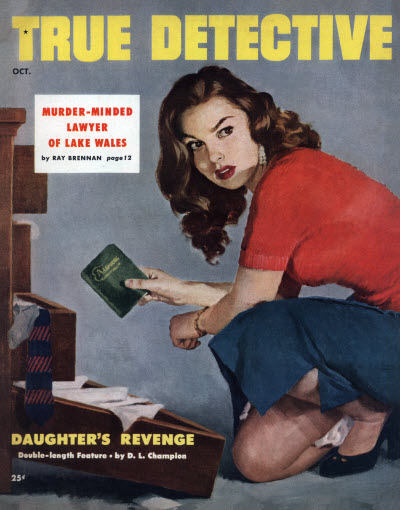 Gerald also says that Crockett died of a heart attack in June 23, 1990. If Crockett was in his seventies in 1988, when Gerald came to work for True Detective, he must've been born in 1918 or thereabouts.
Gerald mentions also other writers who wrote lots of true crime stories: Jack Heise, Bud Ampolsk, Bill Kelly, Bill Cox and Walt Hecox. Of the names, I can find real fiction writing credits only for Walter Hecox. (The Bill Cox here seems to be Bill G. Cox, so he's not the pulp and paperback writer William R. Cox.) Gerald calls Jack Heise "all-time pulp great", but I can't find any support for the claim of him being a pulp writer. But then again, Gerald seems to equate true crime mags and pulp mags. (This guy may be the same Bill Kelly Gerald refers to.)
Here's a list of Art Crockett's and Walter Hecox's crime stories from the Fictionmags Index.
By the way, Gerald's book is a great anthology: it features stories by writers like Robert Bloch, Jim Thompson, Bruno Fischer, Lionel White, Dashiell Hammett and Harlan Ellison, almost every story being pulled from a true crime magazine. Mention is also made of Charles Burgess and Robert Faherty, whose rare entries in book-length writing Gerald speaks of admiringly. Has anyone read Burgess's The Other Woman, published by Beacon in 1960, or Faherty's Swamp Babe, published by Crest in 1958?
Edit: Based on what Allen Hubin found, it seems probable that Art Crockett was born in 1921.
Arthur Lyons dead
American private eye writer and film noir enthusiast Arthur Lyons has died. He's one of those American crime writers who have mysteriously been untranslated in Finnish. Almost only sign of him in Finnish is the video release of Slow Burn (1986), a TV film based on one of his Jacob Asch novels (the Finnish title of the movie is also Slow Burn). I haven't seen it myself, but I've talked about it with Tapani Maskula, the Turun Sanomat movie critic and one of the best experts on American crime cinema in Finland (and maybe in the whole world as well), and he said he liked the film very much.
Here's a lengthy piece by J. Kingston Pierce at The Rap Sheet, and here's Steve Lewis and Mystery*File, providing bibliographic info.
Here's a lengthy piece by J. Kingston Pierce at The Rap Sheet, and here's Steve Lewis and Mystery*File, providing bibliographic info.
Wednesday, March 19, 2008
Poe's Arthur Gordon Pym
 I read the recent Finnish translation of Edgar Allan Poe's only novel, The Narrative of Arthur Gordon Pym (it came out from Teos, translated by Jaana Kapari, who's most famous for her work on the Harry Potters). It's the first translation almost in hundred years, since the last one came out in 1915, if I remember correctly (it came out in two parts and I've seen it only once, and then it was only the first part and it had no covers and was missing some of the last pages - so you can gather it's pretty scarce; the actual first edition from 1903 I haven't seen).
The book isn't exactly a part of the Poe canon. There are parts which are boring as hell. Some of the bits are powerful. Everyone thinks the book stops in the middle of the action - maybe it was due to Poe's alcoholism or something like that. Poe constructs, however, a pretty thick theoretical (and also rather jokey) frame around the narrative that's supposedly written by the real Pym, and ending the book as it does must've been Poe's deliberate decision. Nevertheless, the ending with the scream "Tekeli-li!" is sure to get stuck in the reader's mind.
 I found out that Poe got some inspiration from J.C. Symmes's theory of Hollow Earth that were circulating around the time Poe wrote his novel. It makes the ending even more powerful. No wonder that Jules Verne wrote a sequel to the novel, called The Antarctic Mystery. (Here's a pace of Poe-related fan fiction, there may be some stuff related to the Pym adventure.)
I wrote a review of the novel for the Kulttuurivihkot magazine. It will be out only in some months, so I thought it would be appropriate to already post it. It's here (in Finnish, of course). Note on the text: I didn't think that the translator Kapari had much evidence for her suggestion that the book might be autobiographical, but there seem to be others who think the same, and actually it seems it's a consensus on the book. I don't really see much relevance to the idea of reducing the book to Poe's life, and I can't quite gather how all this relates to the idea of the United States's identity, as some scholars seem to say. Maybe I should've gone to greater lengths about this.
(By the way, here's my earlier take on Poe's short stories.)
Subscribe to:
Posts (Atom)