Showing posts with label British pulp. Show all posts

Thursday, June 05, 2014

Pulpografia Britannica to the printers

Just sent my Pulpografia Britannica to the printers. Here's the cover by Ville Manninen who did spectacular job.

It was a 15-year work. This at least should prove I'm no ADHD person, even though the idea crosses my mind every once in awhile.

Here's the list of authors tackled in the book:

Ray Alan
Eric Ambler
W. Howard Baker
John Boland
David Brierley
Jonathan Burke
Peter Cave
Johnny Cello
Peter Chambers
Philip Chambers
Leslie Charteris
James Hadley Chase
Peter Cheyney
Hugh Clevely
Basil Copper
John Creasey
Paul Denver
Adam Diment
Rex Dolphin
John Drummond
F. Dubrez Fawcett
P. A. Foxall
Stephen Frances
Pete Garroway
Tudor Gates
John S. Glasby
Berkeley Gray
Sean Gregory
Leonard Gribble
Angus Hall
Roger Hamilton
Rex Hardinge
Edwin Harrison
Jack Higgins
Harry Hobson
Hartley Howard
John Hunter
Warwick Jardine
Hank Janson (the pseudonymous efforts of the unknown authors)
George Joseph
Harold Kelly
Arthur Kent
Bill Knox
H. L. Lawrence
Brian McDermott
Arthur MacLean
Wilfred McNeilly
James Moffatt
Stanley Morgan
James Munro
Victor Norwood
Flann O'Brien
Peter O'Donnell
D. J. Olivy
Anthony Parsons
Bryan Peters
John T. Phillifent
Hugh C. Rae
Desmond Reid
Colin Robertson
Angus Ross
Kenneth Royce
Jimmy Sangster
Julian Savarin
Frederick E. Smith
Gordon Sowman
James Stagg
Jack Trevor Story
Rosamond Mary Story
Frank Struan
Martin Thomas
E. C. Tubb
Walter Tyrer
Gerald Verner
John Wainwright
Vernon Warren
Ronald Wills

Wednesday, May 21, 2014

Kenneth Royce

Of all the British pulpsters and paperbackers I've been covering in my forth-coming book, there have been only a few writers whose work I've really been fond of. I don't know why this is, but it's something I've been noticing for the past dozen years: I like American stuff more than British, and this is the case even with films and music. Give me The Sonics anytime over The Rolling Stones or The Dead Kennedys over The Sex Pistols!

But there are indeed some British crime writers whose work I really like. Kenneth Royce is one of them. He writes in clear prose that keeps the story moving, he creates interesting characters with just a few lines, they are likable even though they are not heroes, his plots are unpredictable and original. Too bad he's not very well known these days. I'm not sure if he's known at all. He does have a Wikipedia page, though. He's had three Finnish translations, all in pulpy paperbacks and with not interesting covers (see below).

Of the two translations, the first two have Royce's serial character, Spider Scott, as the hero. He's a former master burglar, who's gained his nick name with his skills in climbing. He climbs any wall. In the beginning of the first Spider Scott book, The XYY Man (1970; Ansa ilman muuta in Finnish; the original name comes from the "fact" that most of the male criminals have an extra chromosome). Scott is lured by some secret organization to break and entry the Chinese embassy or his brother's career in the police force is threatened. Spider Scott doesn't want that, so he complies - and has to kill the Chinese ambassador in order to stay alive. And now he has to flee everyone. This is a very intriguing thriller, to the last page.

In the second Spider book, The Miniatures Frame (1972; Tie murhaan in Finnish), the plot is even more original. Spider is taken into a committee that's supposed to make the prisons better places for the prisoners. The head of the committee is a rich asshole who collects art and antique. Spider is lured by the man's teenage daughter into a secret chamber the man has in his house and Spider spots two extremely valuable miniature paintings he's stolen ten years ago! The man threatens Spider with the jail, but Spider fights back. Spider Scott was developed into a TV series, but I've never seen it.

The third translation, The Stalin Account (1983; Tappavat varjot in Finnish), is an interesting spy novel the plot of which starts in the 1920s and the attempt of the Soviet bolsheviks to turn Brits into communists and then spies for the Soviet Union. What follows is a tragic love story between a Soviet spy and a young British girl. The thing comes again alive in the early eighties when the woman of the love story dies almost entirely alone, nurtured only by her nephew. When the elderly woman dies, her diary also goes missing. It all ties around the story of Stalin's son, Jacob. It's a very interesting spy novel with believable characters and believable history.

I haven't read any other books by Royce, but I come across them, I'll be sure to take a look. George Kelley says in his entry for Royce in The St. James Twentieth Century Crime and Mystery Writers that some of Royce's best books are The President Is Dead (1988), Fall-Out (1989) and 10,000 Days (1981). The last one should prove interesting as it's about the ending of oil.

Monday, May 19, 2014

Michael AKA Mike Hervey, pt. 2

I promised to say something about short story writer Mike Hervey's short stories. I covered what I know of his life in this post. It's not much and lots is mere speculation.

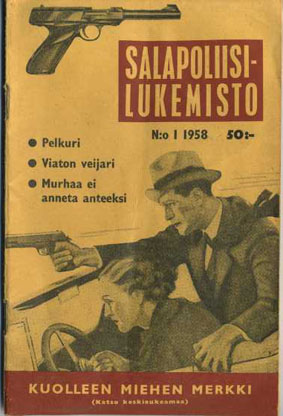
Same goes for his short stories. I can't say I read them carefully, many I only eyed lazily. Lots were translated in Finnish and published in mags in the late fourties and the fifties. As you remember, he had a magazine to his own name in Australia, called The Mike Hervey Detective Monthly Magazine. The Finnish magazine called Salapoliisilukemisto (Detective Digest; see photo) seems to have taken its stories from that magazine, since it had issues that contained only stories by Hervey! And many were straight from the Australian magazine.

Hervey was as prolific as hell, writing over 3000 short stories in a span of ten years. That must show in the quality of his stories. Many are pretty simple, focusing on the twist at the end, as in the story "Death of a Widow" (1953). There's not much description of the scenery, nor is there much character development. Most of the characters are what's usually called stock characters: detective, police officer, career criminal, deceitful babe, disappointed wife, etc. In "Nick to the Rescue" (1953) that's almost of a flash fiction length we get both the career criminal and the deceitful babe. There are some variations, though. "Death on Wheels" (1953) is about a race driver who's forced to win in a race. If he loses, he'll be killed.

Some of the stories are science fictional, for example in the story called "In the Year 2500" (I don't know the original title, and I don't even know what really takes place in the story). "You Can't Deceit Faith" (the original title missing, probably from 1953) is about foreseeing the future and clairvoyance.

I realize this isn't much, but it's a start! There's not much info on Mike Hervey in the web.

Wednesday, May 14, 2014

Michael AKA Mike Hervey, pt. I

My forth-coming book on British paperbackers doesn't really cover the writers who specialized in short stories. There are two reasons for this: there were only few translations from those who wrote only short stories, and then again I haven't had enough resources to check the magazines that could've carried British writers' stories. The American pulpsters were covered in great length by mainly a one magazine, the Lahti-based Seikkailujen Maailma (The World of Adventures; see this post in English by me), but none were specialized in British pulps.

I do have sketchy entries for some writers from whom I found only short stories. One of them is Michael AKA Mike Hervey. Not many have heard of him during the past 30 or 40 years. He had lots of stories and serials translated in Finnish pulp and other fictionmags in the fifties. The magazine called Salapoliisilukemisto (The Detective Digest or some such) had issues that had only stories by Hervey in them!

Now, who was Mike Hervey? He seems a pretty enigmatic character in his own right. He wrote lots of cheap paperbacks for mushroom publishers like Forsyte and Mitre in the 1940s and 1950s. Many of his books are one-act plays or skimpy short story collections. The books have hardboiled titles like Dumb Witness or No Excuse for Murder. (The book in the picture is from 1946, hardback from Alliance, yet another publisher I've never heard of.) This guy wrote a lot.

But not for a great many years. Seems like his first book (Save Your Pity) came out in 1943 and his last one Crime a la Carte in 1953. His career lasted only ten years, yet he's said to have written 3,500 short stories.

There's something fishy about Mike Hervey. The Science Fiction and Fantasy Encyclopedia tells us more. He was born in 1915, but he told everyone he was born in 1920. His birth name was apparently Mark Hockman, but he used the name Mark Hoffman. Then he changed it into Michael Hervey. And then, in the early fifties, he moved to Australia. Therein he edited a magazine called The Mike Hervey Detective Monthly Magazine that a publisher called Transport put out. The magazine seems to have contained only stories by Hervey himself. (The Finnish digest I mentioned earlier probably picked its stories from this magazine, and only hell knows how the stories found their way into Finland.) And then it stopped in 1953. (The years are uncertain.) The SFF encyclopedia tells us Hervey died in 1979. What did he do for the last 26 years of his life?

And what was with the name changes and all? Was Hervey a swindler? Changed names to deceive those whom he owed money to? Or was he just a guy down on his luck who couldn't find any reasonable way to make his living? Anyone know anything about Mike Hervey? Did he change names again living in Australia and write something entirely else?

How are his stories then? I'll get back to them in a later post, now I'm slightly drunk and getting soon to get to bed.

Monday, May 12, 2014

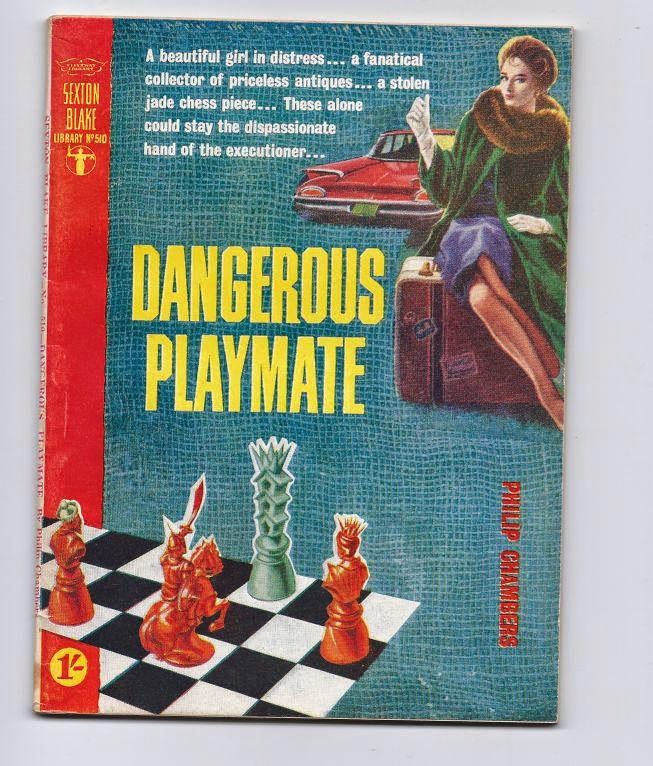
Philip Chambers and Sexton Blake

Philip Chambers is a writer almost next nothing is known of. He was born in 1936, is possibly dead by now, wrote six Sexton Blake stories in the early sixties and nothing else. I've skimmed through his Blake story Bullets to Bagdad (1960) in which a secret organization is planning to take over the government in Iraq and take their oil supplies. In the story Blake's boss is and old man called Craille. He's the leader of the British counter-intelligence organization, as secret as the criminal organization in the book.

Here are some of Chambers's Sexton Blake covers. Pretty good ones, too, but I don't know the illustrator. There's a signature in Keep It Secret!, it seems it says "S. Barany".


Tuesday, May 06, 2014

Sean Gregory's serial hero Mack Regan

I'm sure not many of you have heard of Sean Gregory, not even by his real name, Harry Hossent. He started out in the early 1950s writing cheap crime hardbacks for Hamilton under the house name Jeff Bogar. He went on to write more thrillers in the sixties under his real name. He seems to have dropped out of the publishing business in the early seventies.

As by Sean Gregory he wrote some short paperbacks for the Tit-Bits Books paperback series in the early 1950s. (At least I think they were paperbacks, but I'm not 100 % certain. Hope someone can confirm this. I believe the books accompanied the issues of the Tit-Bits magazine.) His stories in that series were for some reason or another translated in Finnish in a paperback series called Max Strong (who was an Australian series character, but that's another story altogether). I've browsed through the three stories, here's a lowdown.

All the stories came out originally in 1954. The hero, appearing in all three stories, is one Mack (short for Mackenzie) Regan. He's a Hollywood PR agent, but in what I believe was the first story in the series, Murder Bangs a Big Drum, he's still trying make his living in Ohio. He gets a phone call from a Hollywood producer, who asks Regan to come down to Hollywood to prevent a young actor's name appearing in headlines. Reason: he's disappeared. It all ties down to a hazy union job. In Murder Makes the Corpse Regan is asked to write a book on an undertaker firm. He agrees, but finds out soon there's something fishy about the outfit. Murder Is Too Permanent finds Regan working for a gangster called Ricky Vescino. He wants Regan to make way for his beautiful wife and escort her into high society, but at the same time his own life is being threatened as someone wants to blow up his car.

The stories are old-fashioned private eye fun, nothing more, but nothing less, though. As I didn't really read the stories, I can't say how well they hold up, but if you come across them, I'll advise to take a look. Seems, though, that the Tit-Bits Books are hard to come by.

One more thing: Harry Hossent-Sean Gregory came up with some strange names for his stories. This seems a staple in this kind of private eye stuff. There are Bats Moloney, Lex Hupner, Alvar Domonici, Rafe Engels, Bull Gregow and Jed Yurfy, and there's also a heavy called Griff, which is a nod to a house name of British mushroom jungle publishers.

Photos accompanying the post are the covers of the Finnish editions of Sean Gregory's stories.

Thursday, April 17, 2014

John Wainwright: four crime novels

As I mentioned earlier, I read four novels by British writer John Wainwright to be mentioned in my forth-coming book on British crime paperbackers. I've been at it for over ten years and I thought it would finally come out next Summer, but we'll have to see about that, as I still have loads of work to do. But now John Wainwright has finally been done with.

Wainwright is best known - if known at all today - for his police procedurals. He wrote some dozens of them saying he got his inspiration from Ed McBain and his 87th Precinct series and that clearly shows. The settings are realistic and Wainwright shows some critical insight into the society he writes about. There are lots of characters, all colourful. The police are a mixed bunch, some of them are almost crooks themselves, taking law into their own hands, some of them just look on from the side and realize there's no use getting mixed with their colleagues' doings. The actual crooks are very much crooks: sleazy low-life scum. This is one of the weakest things in Wainwright's police novels. He shows real contempt when he writes about the lower class people and their inhabitats. In Wainwright's novels there's also lots of dialogue. One can imagine being in a police station amidst all the nervous talk and shouting.

I read The Big Tickle (1969; Kurja päivä kuolla in Finnish) and Talent for Murder (1967; Huhtikuun murhat in Finnish) and liked the latter more, even though the former is more clearly set in the reality of the streets. The novel suffers from bad Finnish translation though.

Wainwright also wrote some middle-class tragedies. I read two of them, The Distaff Factor (1982; Tuomion jälkeen in Finnish) and Cul-de-sac (1984; Umpikuja in Finnish). Georges Simenon spoke highly of the latter, and it is indeed the better of the two in its depiction of a sad marriage that ends in the death of the wife. It's already declared an accident, when an eye-witness comes forward saying it was a murder, done by the woman's husband. Cul-de-sac is a dense book with a pleasing climax. I hope I'm not giving anything away saying Wainwright uses the same technique that made Gillian Flynn famous with her Gone Girl.

The Distaff Factor starts with a promising idea: the husband of a middle-class woman is declared guilty of maiming and killing three prostitutes. This one also has a twist in the middle and yet another in the end, but I wasn't entirely satisfied. The book drags somewhat in the middle and the end climax is both misogynistic and somewhat implausible. Yet it also shows Wainwright could really write tragedy.

Wainwright wasn't a paperbacker in his native land, but his books came out in paperback here in Finland, that's why I'm including him in my book.

Wednesday, March 19, 2014

Bibliographic puzzle: Ronald Wills/Hans Vogel: What Comes Next?

I've dealt in my research with some bibliographic problems before, but this one is a real puzzle. I don't even know where to start.

Okay, there's a paperback published in Finnish in 1955 called Hän ei tullut kotiin. It translates back as "He Never Came Home" or some such. It's a private eye novel about kidnapping of rich kids. Now, there's no book under this title (or actually there almost is, but it's not this one). The Finnish translation is credited as by Ronald Wills. There really was a writer called Ronald Wills. His real name was Ronald Wills Thomas. He lived from 1910 to 1969 (or possibly 1955) and wrote crime novels starting from 1950, ending in the early sixties. He used pseudonyms, such as Jeff Bogar (a house name) and James Cadell.

As Ronald Wills he published four crime novels in the early fifties, but they all seem to have something to do with fishes and fishing, and this here novel doesn't, so it's not any of them. What is it then?

The Finnish translation - at least my copy doesn't - doesn't give away the original title, but the bibliography of crime fiction published in Finnish and the Finnish National Library database both say it's What Comes Next? Now, that is a real novel, published in 1953 by the paperback house Scion. It was published under the house pseudonym Hans Vogel. And sure enough, the Finnish book has Hans Vogel as the hero. (Can you think of a more un-American name for a private eye?) But this isn't over yet. The British pulp and paperback scholar Steve Holland says in his blog that What Comes Next? features one Scud Keddell as the hero. And "He Never Came Home" doesn't have anyone called Scud Keddell. (And furthermore What Comes Next? isn't supposed to be written by Ronald Wills. Actually Ronald Wills doesn't seem to have written anything under the Hans Vogel house name.)

So, what gives here? Is this written by someone else entirely than Ronald Wills? Is this something entirely else written under a pseudonym by Ronald Wills, but published in Finland for some reason under his real name? Anything written as by Jeff Bogar doesn't even remotely sound like the book at hand. Or is this something that's been published only in Finland? As you might remember, while doing my first book, Pulpografia (on American crime paperbackers), I found out there were some dozen American books that were never published in the US, but published in Finland and/or Scandinavia.

different book published as by Hans Vogel
What's the book about? Oh, that's a different issue altogether. The book is a sorry mess, but somehow intriguing. Hans Vogel is a private eye working for the FBI (which, by the way, is spelled as FIB in the Finnish book), he handles very special cases. Now, there's a gang kidnapping small children of rich families and Vogel is hired to investigate the matter. He uses some strange methods that don't seem very professional. We never believe that this is a real private eye. Also we never believe this really takes place in the US, which is quite common for the early British crime paperbacks.

There are some truly odd moments throughout the book. Hans Vogel is for example tortured by boiling his feet in hot water. His skin peels off, but somehow he manages to still walk and drive a car. Okay, he admits he feels pain. There's also an odd perversion for talking about Nathaniel Hawthorne all the time - or actually "Nat", as Hans Vogel calls him. In the end Hans Vogel gets the kidnappers with the help of some 13-year old kids who are out playing Wild West with real-looking guns. The book is filled with erotic scenes, but nothing happens in them, they are just Vogel's descriptions of good-looking ladies in erotic costumes, such as silky night gowns. And this is what drove writers and publishers to jail?!

This is in no way a good crime novel, let alone a good novel, but there's something fascinating about the badness and weirdness of it. But the main thing here is the bibliographic puzzle. Can anyone help? I'd really love to solve this, but I don't know where else to look.

Tuesday, March 18, 2014

Basil Copper's Mike Faraday

In my on-going research into British pulp and paperback crime writing, I read the two novels by Basil Copper translated in Finnish. Both have Copper's private eye Mike Faraday as the hero, and both are pretty basic old-fashioned hardboiled private eye stuff.

Flip Side (1980, translated as Kuoleman kääntöpuoli/"The Flip-Side of Death") puts Faraday delve into the international jewel trade. Snow Job (1986, Älä huoli huomisesta/"Don't Worry About Tomorrow", meaningless title if there ever was one) has Faraday look into the drug trade, even though he doesn't know that from the start. Copper knows his business: in the end Faraday is investigating another case than he's originally hired to investigate. He runs into corpses and beautiful, but deceitful ladies, heavies with guns in their hands, all that stuff that's been known since Black Mask and Dime Detective made the cliches popular. The books were entertaining enough and Copper keeps the story moving, but there's still one problem: I've almost forgotten what happened in them.

Basil Copper also wrote some high-regarded horror stuff which I haven't read. He also wrote the Solar Pons stories after August Derleth died. I think I've read some of Derleth's Solar Pons stories, but none of the Copper ones.

The books in the picture above. The right one has the cover illo by Kari T. Leppänen, who's best known for his work in the Phantom magazine for the Swedish publisher. It's quite nicely done, but it's also pretty static for a hardboiled private eye novel.

Friday, December 13, 2013

Friday's Forgotten Book: H. L. Lawrence: The Sparta Medallion

H. L. Lawrence wrote only two books. The other one, called both The Children of Light (1960), is the better-known of the two, since Joseph Losey based his Hammer-thriller The Damned on it - and it's a pretty good film, too, almost completely without the usual clumsiness of many Hammer thrillers. Lawrence's other book is called The Sparta Medallion and it was published one year after The Children of Light.

It's a pretty solid thriller, with a decidedly British bent on it. It stars a British geologist on his way to South America. He meets a strange German in the plane. The plane crashes however and only three people are left to survive: the geologist, the German and an air hostess. The German is killed in the jungle in mysterious circumstances, the air hostess is captured by the Indians and the geologist is left to survive in the jungle with the German's stuff, so when he's found he's thought to be the German. The man finds out soon there was something mysterious about the German and his belongings, and as he reaches Lima, several people are trying to kill him and take the suitcase that belonged to the German. The geologist however makes nothing out of the stuff therein.

It all comes down to a large, world-wide conspiracy that harks back to the Nazis, but Lawrence deals with it nicely in just 160 pages (I checked: the British first hardcover edition has 160 pages, the Finnish paperback has 139 pages). Nothing larger than life, just a nice solid thriller. It's a wonder Lawrence wrote nothing more. If someone has an explanation, I'd like to hear. Seems like he worked in advertising, maybe he ran out of time to do extra work.

More Forgotten Books here.

Wednesday, December 04, 2013

Paul Denver: The Deadly Chance (1973)

Okay, I'm cheating here a bit. This is one of the books I'm including in my forth-coming book on British paperback crime fiction. I only browsed through the book while cycling at the gym. I think that's enough for this book, which isn't exactly quality stuff.

Paul Denver was one of the pseudonyms used by the British writer Douglas Enefer. He has no Wikipedia entry, but there's always Goodreads. I've read some of his books starring private eye Michael Power, they are mildly ok, mediocre but still entertaining enough. (Actually I first thought, over ten years ago when I was writing my first book, Pulpografia, that Denver was American.) Enefer also wrote some Cannon novelizations as by Paul Denver, and the titular The Deadly Chance is one of them. I believe the story went like this: when the bona fide American Cannon novelizations (written by Richard Gallagher) ran out, the British publisher World Distributors asked Denver to write more of them. And that's just what he did. I don't know whether Denver wrote on an outline or a screenplay of an episode or whether he just made it all up. I'll have to check that out.

The first problem is that Denver/Enefer can't write like an American. There's always a feeling someone's cheating. Denver/Enefer is clever enough though to keep descriptions at minimum. The dialogue also gives the Britishness of the author away, but that doesn't happen all that often in the Finnish translation (though it at times adds layers of its own). The story is a bit silly with its depiction of a small town drug scene, but there's a twist that might keep the reader interested. I say "might", because I skipped lots that went on interim. There's something tired about the book.

There are good British paperback crime novels out there, but this doesn't seem to be one of them. Included is the Finnish edition from 1976, published in a series that consisted only of TV novelizations.

Edit: I changed the publisher from Consul to World Distributors. They put out the Cannon novelizations written by Paul Denver. Consul published earlier paperbacks by Denver.

Friday, November 22, 2013

Friday's Forgotten Book: Frank Struan: Murder's So Unpleasant (1954)

In my on-going, but sporadic study of British paperback crime fiction, I read, almost in a jiffy, a short booklet by Frank Struan, called Murder's So Unpleasant. The Finnish title translates literally as Murhat ovat epämiellyttäviä. It was published here in a cheapo paperback series called Max Strong.

Frank Struan's real name was Graham Fisher, and all I know about him is that he was born in 1920. I don't know if he's still alive; probably not. He used the Frank Struan pseudonym in a series of stories that were published in the legendary British magazine called Tid-Bits in the early fifties. I've never seen these, but I believe one story filled out an entire magazine. If I'm mistaken, do correct me. Fisher wrote some thrillers still in the seventies, but that's all on him.

Murder's So Unpleasant is a mock-American hardboiled crime novel with a private eye hero called Johnny July. If he's a series character, he should be included in the Thrilling Detective listing. I don't know that yet, but I'll check it out. In this outing, Johnny July is hired to guard a wealthy business man, but he dies - in a closed room! - before July gets a chance to make out just from whom the man's supposed to be guarded from. There are two beautiful women involved in the case, the young bride of the deceased and her sister who seems to be after the man's inheritance. Or some such. I wasn't actually paying much attention and it's been already days since I read the booklet.

And this is what this book was really about. It's an one-hour entertainment, nothing more. There are notable gaps in the plot and Johnny July isn't a very interesting character, but I didn't really mind as the stuff went on with some speed. There are many references to Chandler. The city of the story is Bay City, Chandler's fictional city, and Johnny July is mugged and taken to a mental institute to be held there just like Marlowe in Farewell My Lovely.

I'm not sure how easily one could obtain stuff like this. The Finnish translation is easily found and cheap, though. The Finnish edition's cover art is by Spanish Portada Noiquet.

More Forgotten Books here.

Tuesday, November 05, 2013

More info on the Brian McDermott mystery

I was in contact with the archive of the Otava publishing house, who put out the book that left me astounded some days back: Brian McDermott's The Battles, called Tuntematon tilaa näytännön in Finnish. Here's the original post on the subject.

So, the Otava publishing house still has the contract made with Brian McDermott. Unfortunately the contract didn't tell if McDermott's book was already published in book form in English, but the contract retained the possibility that the Finnish publisher could also use it as a serial in a film magazine. And a friend of mine happened to have the said magazines at hand, and - ta-taa! - Brian McDermott's story was indeed published as a serial in a magazine called Elokuva-aitta (Film Storehouse or some such in translation) in 1966-1967. This leaves the question: was McDermott's story published as a serial also in English? I don't seem to be able to find any trace on this possibility, though, but it's still a viable explanation.

However, there's also a possibility that McDermott wrote the story exclusively for the Finnish audience. It was said in the magazine that McDermott was a popular figure in Finnish television due to the BBC language program called Walter and Connie in which he performed. It was also said that the characters in the novel resemble the Walter and Connie of the show, so it's possible McDermott based his characters on them. (I still haven't had the chance to read the book, so can't comment on that.)

Friday, October 25, 2013

Another bibliographic mystery: Brian McDermott

Now off to another mystery surrounding a book published in Finnish, supposedly translated from English, but seemingly not in English.

Brian McDermott's Tuntematon tilaa näytännön ("The Unknown Man Orders a Play" or some such, pretty awkward name, if you ask me) came out in a big publisher's paperback series called Crime Club in 1968. The original name is supposed to "The Battles". Now, there's not a book called "The Battles" written by Brian McDermott. Actually there's not a book called "The Battles" by any writer, at least prior to 1968. One Brian McDermott did publish a crime novel called Who Killed Robin Cock?, but that was in 1981. And that's his only crime novel, possibly only novel.

What gives here? There are some American paperbacks published in Finland that were never published in the US: two private eye series by Grover Brinkman and I. G. Edmonds, a crime novel by Bruce Cassiday, possibly four or five air war novels by Robert Sidney Bowen. I think Edmonds also has a war novel in Finnish that didn't come out in the US. It is entirely possible that Brian McDermott, whoever he was, didn't manage to sell this book to British (or US) publishers, but managed to land it in Finland. (The book wasn't published in Sweden. I didn't check Norway's or Denmark's national libraries' catalogues, but I'll do that at some point.)

So, who was this Brian McDermott? I haven't as yet read the book, but given the title it's possible or actually likely that he was the actor Brian McDermott who died in 2003, writing on his own experiences.

Can anyone help me with this? Who was McDermott's agent, if he had any? Did someone reading this blog know McDermott? Is someone reading this blog related to McDermott? (One thought comes to mind: could Who Killed Robin Cock? be the same novel that circulated through many publishers, landed only in Finland in 1968, but was finally published in 1981 in the UK?)

Wednesday, October 23, 2013

The Lando series as by Tex Kirby?

One of the Finnish Landos:
"Don't Show Mercy, Lando"
There are fourteen books published in Finnish paperback series as by "Tex Kirby". The books are westerns and they feature one Brad Lando as the hero. Now, there seems to be at least two Lando books published by British cheapo publisher John Spencer (in their Badger paperback imprint), called Lone Gun Renegade (see photo below) and Arizona Manhunt (both 1971). But I can't seem to be able to find any info on the other Brad Lando books. In the Finnish editions they are clearly announced to be translated from English as they have such original titles as "Wildcat Breed" and "Trial by Gunsmoke". For some reason or another, Lone Gun Renegade isn't one of the Finnish Landos.

But there's nothing on them in any place I can think of. Pat Hawk's pseudonym catalogue credits John S. Glasby having written two Lando titles, but there simply are no other Tex Kirbys or Landos in Abebooks for sale - I even went through all the "original" titles in the Finnish Tex Kirby books and checked whether Abebooks had them.


These could of course be anything: something penned by German writers with hoax English titles; something written by English writer or writers, but left unpublished in the UK and published only in Scandinavia (or even only in Finland); something penned by someone else entirely, but published for some reason in Finnish under different name or title. Similar things have happened in the past.

Edit: I edited this, since there were some errors in my posting. Pat Hawk's pseudonyms catalogue does indeed list Lone Gun Renegade and Arizona Manhunt as written by John S. Glasby, but other than that, there's nothing.

Wednesday, October 09, 2013

Peter Chester: Murder Forestalled

As many of you may remember, I've been doing a book on British paperback crime writers for years now – actually for over ten years... I now decided as I'm kind of between jobs that I'll finish the book no matter what and publish it myself before the next summer.

I don't have the time to read all the books I don't find necessary to read. I've already read six or seven books by Dennis Phillips (1924–2006) who wrote under many aliases. His Peter Chambers (sic) books are light-fare private eye novels and his Philip Daniels books are mediocre thrillers. I noticed I hadn't read Murder Forestalled (1960) that came under his Peter Chester by-line. I found a small description of the book's plot at Amazon and decided to help future historians by blogging it. These kind of descriptions are hard to come by on forgotten British crime fiction. The Thrilling Detective site has an entry for Mark Preston who was "Peter Chambers's" private eye hero, but not for Johnny Preston who featured in "Peter Chester's" books.

I don't seem to be able to find the original cover, so here's the Finnish paperback cover (which is by Robert McGinnis and from altogether different book).

So, here you go: "Barbara Porter came into private eye Johnny Preston's office because she was in trouble. She was being blackmailed and some crook was demanding a thousand dollars from her...money she just didn't have. She wanted Preston to get rid of the blackmailer...but when she told him the crook's name was Jack Mahoney, he knew someone had already attempted the job. As Mahoney lay dying in hospital another mobster came in and finshed him off. And with the blackmailer well and truly dead, Preston found himself right back on the case again."

And oh, by the way, don't mix this Peter Chester with the convicted murderer. Nice to see some traffic here, though!

Monday, October 07, 2013

Harry Hobson and the Hank Janson series

I just posted the bibliography of Harry Hobson's outings in the British Hank Janson series on my bibliography blog here. Anyone know anything about Hobson? Nothing much seems to be available.

Thursday, March 28, 2013

Stanley Morgan: The Courier

In my on-going exploration of British crime and adventure paperbacks, I dipped into The Courier by Stanley Morgan. I left it pretty soon when I noticed it wasn't crime-related, but I thought I'd say something about it.

Stanley Morgan seems to have a bit of a cult following these days, since he has a fan-based website - and it's quite good, too. There's something about him and his books that feels like targeted towards the recent laddie and GQ culture with its tailored, expensive suits, sports cars and pretty dames. Though I'm fond of pretty dames and well-tailored suits myself, I find the culture surrounding them pretty dated and even abrasive. The hero of The Courier is one Russ Tobin, the hero of Morgan's long series of books, free-wheeling bit-actor whose sexual escapades the book follows. There's an add for other books in the series in which Russ Tobin is called "romeo-rapist". Nice touch, eh?

I started to read this, since Morgan has one thriller translated in Finnish, Octopus Hill. Anyone read that?

One thing that comes to mind: the difference between the British and American sex paperback is that there are more crimes and more angst-filled feel of punishment in the American sleaze. And free-minded as I'm about all things related to sex, I find the American way more fascinating.

Friday, February 22, 2013

Friday's Forgotten Book: My Bonny Lies Under the Sea

Ray Alan was the pseudonym of one Joseph Lawrence Valls-Russell (born probably in 1922, died in 2007) of whom not much is known. Seems like he was a career soldier at one point, but the only thing that's most assuredly known about him is that he wrote two spy thrillers under the Ray Alan by-line. The earlier book came out in 1963 under the title My Bonny Lies Under the Sea, the latter, The Beirut Pipeline, came out in 1980. I don't know what he did between those books.

Ray Alan is the also the name of the hero of My Bonny Lies Under the Sea. He's a British journalist who's asked to come to Lebanon by a friend to investigate some fishy affairs. Of course there are murders, chases, mysterious tough guys, beautiful ladies etc. The book is pretty talkative and repetitive and also a bit too complicated as I lost myself in all the schemes, but there are also some better scenes throughout. At times the book resembles a hardboiled private eye novel, but it's still firmly a spy novel. The big stakes are about the Cold War stuff, uranium and other minerals used in nuclear weapons. Seems like "Ray Alan" knew quite a lot about the Middle East, which makes me wonder if he served there during the WWII or worked there as a diplomat. If someone knows something about Valls-Russell, I'd like to hear more.

Sorry, couldn't find the original cover, so you'll have to do with the Finnish cover. It uses a Bertil Hegland cover that, for all I know, might be the original Swedish cover for Ray Alan's book.

More Forgotten Books here.

Friday, February 15, 2013

Friday's Forgotten Book: Adam Diment: The Dolly Dolly Spy

Adam Diment's The Dolly Dolly Spy (translated in Finnish with a misleading title Nukkevakooja) was an enormously popular spy novel published in 1968 that's largely forgotten these days. It does seem to have some sort of a cult following, though, which I can understand, but not easily relate to.

I did enjoy the book mildly. The book has lost some of its shock value - I mean, we have seen quite a lot of free sex and the use of mild drugs since 1968, there's not much to it anymore. But it's still entertaining, even though in the case The Dolly Dolly Spy there's also lots of old-fashioned sexism to it. A blogger wrote that Adam Diment's Philip McAlpine makes Ian Fleming's James Bond books feel like they were written by Andrea Dworkin!

The main problem for me in The Dolly Dolly Spy was that the book was too episodic. There's not much coherence to it. I'm the first to admit this was probably something Diment was aiming at, but it doesn't work very well (though it does work in some books). The first part of the book is pretty good, and so is the end, but the middle part drags - and none of them have much to do with each other! It does, however, add to the overall parodic quality of the book. The parody goes well with Philip McAlpine's character, since he couldn't be less interested in the Cold War affairs and he gets rather pissed off by the fact that his employers want him to help an old Nazi officer escape.

Adam Diment's story has been interesting, read for more here and here.

More Forgotten Books here.