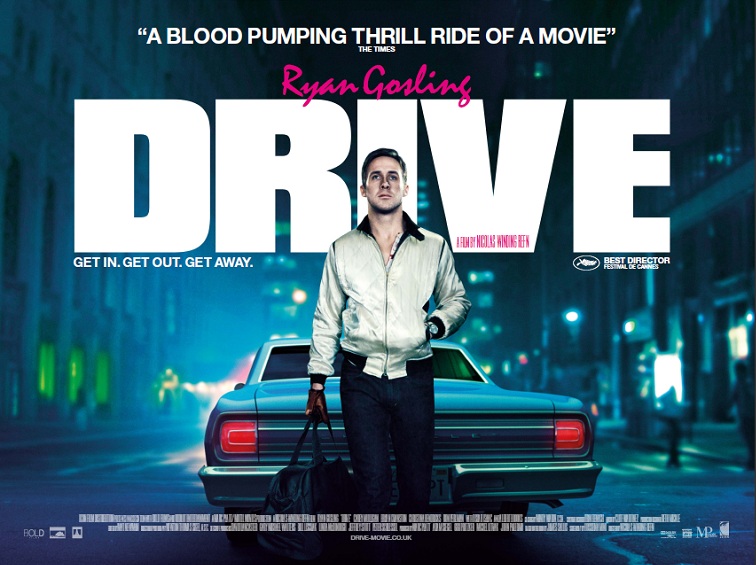
James Sallis's Drive came out from a small publisher in 2005. It was picked by up for a reprint by a big publisher in 2006. I read it the same year and fell in love.
Drive was translated in Finnish, due to my efforts, in 2009 under the title
Kylmä kyyti. Already at that time, we knew there were plans of the movie based on the book (with Hugh Jackman starring), but we had to wait until this year to finally get the film.
And what a movie it is! Surely handled, with a very cool, detached style, directed by
Nicolas Winding Refn, a Danish filmmaker whose
Pusher trilogy is one of the great crime classics of the late 20th and early 21st century. This is his first Hollywood movie, and there's a sort of Nordic melancholy to it. The action scenes are great being somewhat elliptic, with something always left out. There are some very good actors in the film, with Albert Brooks and Ron Perlman rising above the others. Ryan Gosling who's replaced Jackman looks very neat in his scorpio jacket, well-fitting skinny jeans and driver's gloves. Visually the film's almost like the eighties blown to heaven, the feeling that's enhanced by the use of very cool eighties' kind of synth pop in the soundtrack. The driving scenes are really stylish, almost totally without a sound.
Yet I was somewhat disappointed. Sallis's novel is a ballad of great beauty, love and sadness, yet Winding Refn really can't portray these feelings with quite the same verve as he does loneliness and compulsion. The results are too mild, too conventional. It's a serious drawback for the film.
But I have to give credit to the screenwriter Hossein Amini making a clear narrative out of Sallis's non-chronological novel. I felt, though, the film lacked something when the story was made linear. I can't quite put my finger on it, but it might have something to do with the metafictional quality of Sallis's novel. The film also lacks what might be the most superficial aspect of Sallis's book, the dropping of the names of other writers, like Borges and Cervantes. They actually serve a purpose in the book that's more intellectual than the film (and is not ashamed to show it), but maybe luckily they were dropped out from the film.

With those fell something else, though. I really love the novel's ending, the words with which it transforms into a ballad, a story of a heroic bandit who managed to right some wrongs and who, after that, rose to mythic heights, but still feels having a loss, missing something he once loved or cared for. Let me quote directly from Sallis himself (mind you, this is a spoiler, so if you haven't read the book or seen the film, beware!):
"Far from the end for Driver, this. In years to come, years before he went down at three a.m. on a clear, cool morning in a Tijuana bar, years before Manny Gilden turned his life into a movie, there'd be other killings, other bodies.
Bernie Rose was the only one he ever mourned."
(You know, Sallis is developing a sequel to Drive. Those are the words he can hang on to.)
So maybe Winding Refn's film is the film Manny Gilden (a scriptwriter in the book, left out from the film) did? Then again, I was also a bit shocked to be reminded that there's a bond between Bernie Rose and Driver, the aspect that the film never mentions. Well, films based on books don't have to have the same things in them, but I thought this particular aspect is one of the things that makes Sallis's book so great.
 I never blogged about Only God Forgives, even though I liked it to a certain extent. It was very exciting and interesting and extremely well done and beautiful in all its gore, though I never knew what Nicolas Winding Refn was talking about in his film.
.jpg)