Friday, December 24, 2010

Wishes for Merry Christmas...

...with this nice pulp-styled boxer shorts package I discovered while I was shopping for Christmas gifts. I thought for a minute I'd buy them for Kauto, my son, but I wasn't sure whether he likes boxer shorts, as he doesn't wear them, so instead I just took a photo. I think this is very well done.

So: Merry Christmas and all that!

Thursday, December 23, 2010

Cuban film The First Charge of Machete

Before my Christmas wishes I wanted to say something short about a stupendous film I recently saw: it's a Cuban agit prop/art film The First Charge of Machete from 1969, directed by Manuel Octavio Gómez. It's a retelling of the Cuban rebellion against the Spanish in the 1860's, but the point in the film is how it's made: it's as if the style of the sixties' cinéma vérité style had been invented already in the mid-19th century and the movie was made as if the rebels, the Spanish officers and several people on the street were interviewed by the film crew, and there are lots of hand-held camera shots. The main point in the film, though, is that the film has been artificially rendered almost totally black-and-white, there are scenes in which the pictures have no grey areas anywhere. You could almost say: "Sin City, eat your heart out! These guys did it already!"

Especially the battle scenes that have been shot with hand-held cameras are very, very striking. You could say: "Steven Spielberg, eat your heart out!" I mean, these guys did already 40 years ago what Spielberg tried to do with his Saving Private Ryan. There's also no sentimentality that jars the Spielberg film. The First Charge of Machete is also clearly a political film: there's no doubt it's about the Cuban revolution and also the Vietnam war, with the Spanish playing the role of the US, telling that they only want to bring peace and comfort to the Cuban people who've asked for their presence during these troubled times. The machete of the title refers to the only weapon the poor Cubans have. It's the fist of the proletariat, the film seems to be saying. (I wonder if Robert Rodriguez has seen this. I mean, doesn't his Machete have the same theme?)

The Cuban film meets of course quite a few problems, especially the question why the film has deteriorated so badly if the film as a medium existed already in the 1860s? If they have come to the same narrative conclusions as the original cinéma vérité directors of the 1950s and 1960s (Jean Roach, the Maysles brothers, D. A. Pennebaker etc.), why does the film look it's over hundred years old? It would mean that they  made the first films already in the late 18th century, not late 19th century, as the case is now.

But this doesn't really marr the film's impact. The battle scenes are very, very exciting, one of the most exciting ever put on celluloid.

Here's a longish quote from the book The Film as Subversive Art (thanks to Mies Mikkonen for the quote):

"Possibly the most "aesthetic" and "experimental" of revolutionary Cuba's films, this outstanding work utilizes high contrast photography, overexposure, and solarization to create the faded chiaroscuro and poetic authenticity of the period it depicts. The film deals with an 1870 uprising against the Spanish occupation troops in Cubam in which the machete originally used to cut sugar cane, becomes a weapon of people's warfare. The portrayals of decadent upper classes and heroic peasants are sharp and incisive, and distancing devices - such as the characters addressing the camera - are used the induce attitudes of analysis instead of involvement. The emergence of such a strongly poetic work within the Cuban film industry testifies to the divergent aesthetic tendencies permitted expression within the revolution."

eBay has a DVD on sale.

Tuesday, December 21, 2010

The new issue of Isku out now!

Here's a link to the latest issue of Isku, my crime fiction webzine. Check it out: stories by Harry Shannon, Morris Hershman, Rob Kantner, Tuomas Saloranta, S. J. Hintsala and the Nova winner Tomi Jänkälä! It's a treat, even though I say it myself. And here's also the cover.

Thursday, December 16, 2010

Dave White: When One Man Dies & The Evil That Men Do

I've said earlier that I really don't care about the recent private eye characters whose problems are worse than their clients. The major exception here is Reed Farrel Coleman, but on the whole I'd rather the private eyes would disappear if they turned sideways.

This didn't stop me enjoying Dave White's two novels, When One Man Dies (2007) and The Evil That Men Do (2009). In them, the private eye hero Jackson Donne suffers from many problems: he's only 28 and yet he's an alcoholic, his former colleagues at the police hate him, he's done nothing much to educate himself, he's alienated from his family and his girlfriend left him and died later from something Jackson Donne did.

In When One Man Dies Jackson Donne is having a drink and consoling himself for his ex's death, when an old, a bit weird but harmless man is run over by a car outsider the bar. Donne feels he has to look into the old man's death - he used to share drinks with the guy, after all -, but he runs into trouble when his old nemesis at the police force starts to investigate the same accident, only to do harm to Donne. Dave White spins an interesting story with many interlocking incidents, and even though the twists in the story sometimes feel a bit forced, it remains intriguing to the end. Jackson Donne's past mistakes in the police force are drawn into the center of the story, and it seems like he can never escape them.

The Evil That Men Do is the more powerful novel of the two and Jackson Donne is really deep in the story of his sister who asks Donne to check into what their old and ill mother has been talking about their granddad. Donne's PI license was taken out in the aforementioned book, but he decides nevertheless he can do this last favour to his family and to his dying mother. He finds out soon that there's a maniac on the loose to avenge something ancient to his family - but just what it is is clear only in the end, if even then. White tramples the ground between the plausible and the implausible, but manages to stay on the clean side with this.

There's one thing I didn't get accustomed easily: When One Man Dies is narrated both in Donne's first person narration and the third person narration in the other sections. In The Evil That Men Do Donne is being narrated through a third person narrative, which makes more sense. There are also scenes set in the late thirties, when White tells just what tragic happened in the past.

In the end feels like there can be no future for Jackson Donne. I asked Dave White if there are plans for other Jackson Donne novels, but he said he doesn't have a publication date for his next novel. I'm hoping there will be a new Donne book, if only to see what White does to make Donne rise from the ashes. (He writes in his blog, though, about a new manuscript. [Link above.])

Dave White is, by the way, a good example of how one can rise from the on-line ghetto of crime literature. The bunch of Jackson Donne short stories were first published in different venues in the web before White published his first book. And here's hoping he'll publish many more!

Friday, December 10, 2010

Hard Case Western

I've said it as a comment to a blog post here and there, but let's make it official: besides their great Hard Case Crime line, Charles Ardai should've set up also a line called Hard Case Western. Many of the Western novels of the late fourties, fifties and early sixties could also be catered to the audience of the hardboiled and noir literature, and many of the books from bygone decades would very well be worth reprinting.
This idea came to me many years ago, but I was reminded of it, when Cullen Callagher started posting reviews of hardboiled westerns on his delightful blog, Pulp Serenade. You can see some of the reviews here (Harry Whittington: Desert Stake-Out), here (A.S. Fleischmann's Yellowleg, basis for an early Peckinpah film), here (Frank Castle's Dakota Boomtown) and here (Gil Brewer's rare entry into the genre, Some Must Die), but do read all of his blog, I guarantee it's worth your while.

All of those novels could well be published under the Hard Case Western by-line. I have some other recommendations:

Marvin Albert: Posse at High Pass, Fawcett 1964 (Albert wrote also excellent crime novels as Al Conroy and different other nyms; this is a great Western thriller)
Jack April: Feud at Five Rivers, Dodd Mead 1955 (Broadway script writer's only Western novel, great noirish atmosphere in a story of revenge)
Frank Castle: Brand of Hate, Tower 1966 (Cullen said nice things about Dakota Boomtown, this is a very good tale about guy who sells guns to Indians, but winds up being double- and triple-crossed)
Merle Constiner: Short-Trigger Man, Ace 1964 (if there's a blueprint of a hardboiled Western, this is it)
William R. Cox: Comanche Moon, McGraw Hill 1959 (unbearably suspenseful thriller of the people trapped by Indians, noir in its tones of despair and disappointment)
H.A. DeRosso: .44 (need I say anything more about this?)
Steve Frazee: Desert Guns, Dell 1957 (became a bad film with Roger Moore, but the book is gripping, full of action)
Philip Ketchum: Harsh Reckoning, Ballantine 1962 (is there a more noir title than that?)
James B. Chaffin (Giles Lutz): The Wolfer, Belmont 1962 (weird story about wolf-hunters, living in caves, full of action)
Richard Meade (also known as Ben Haas): Big Bend, Doubleday 1962 (man has to go to Mexico to avenge wrongs)
D.B. Newton: The Wolf Pack, Bantam 1953 (great thriller about a gang terrorizing a whole city, compares to The Violent Saturday and preceded it by two years)
Dudley Dean (also wrote as Dean Owen): Six-Gun Vengeance, Fawcett 1953 (great claustrophobic and hysterical noir)
Gordon Shirreffs: Too Tough to Die, Avon 1964 (just gotta love that title! Boetticher-like minimalism and hardboiledness)
Luke Short: Blood on the Moon, 1948 (I haven't read this one, but the film that was based on this, with Mitchum, would be just too great to pass)

Any early Western by Brian Garfield would also fit the bill, and so would anything by Donald Hamilton, whom Hard Case Crime has already reprinted. A later addition could be Jack Ehrlich's The Fastest Gun in the Pulpit from 1973: funny and violent. I'm also sure many new writers would like to try their hands at a Western, and I'm sure someone like James Reasoner has a noir Western in him, and so do Joe Lansdale, Tom Piccirilli and others.

Having said all of the above, I do know that the market for Western paperbacks is limited and that the market for paperbacks is diminishing, but who says one can't have a dream?

Monday, December 06, 2010

My essential noir

The Psycho Noir blog has posted fascinating lists of essential noir novels by some writers and other noir aficionados. You can see the lists here. I posted my list on Facebook and thought I'd post it here as well. It's merely a scratch and I did it in a hurry and I'm sure it's missing many important titles. Hardboiled is not included, hence no Chandler, Hammett or Ross Macdonald. One late addition, not mentioned in Facebook, would be Reed Farrel Coleman's The James Deans - in it the ordinary PI stuff forms into a great and depressing noir read.

James M. Cain: The Postman Always Rings Twice/Postimies soittaa aina kahdesti
Jason Starr: Fake ID (ilmestyy ensi vuonna suomeksi nimellä Väärä rooli)
Kevin Wignall: Who Is Conrad Hirst?/Kuka on Conrad Hirst?
Charles Willeford: The Director/The Woman Chaser
Dan J. Marlowe: One Endless Hour
Jim Thompson: possibly Killer Inside Me, but I've always liked The Getaway more (Tappaja sisälläni, Pakotie)
James Ellroy: The Big Nowhere/Suuri tyhjyys
Scott Phillips: The Ice Harvest/Jäätävää satoa
James Sallis: Drive/Kylmä kyyti
Vicki Hendricks: Miami Purity
Dave Zeltserman: Killer
Peter Raben The Anatomy of a Killer/Tappajan anatomia
Camus: The Outsider/Sivullinen
Jean-Pierre Jonquet: The Gold-Diggers/Kullankaivajat
Jean-Patrick Manchette
Jacques Tardi and Leo Malet: 120, Rue de la Gare (and I mean the graphic novel, since the original novel doesn't actually rise much above mediocrity)
Gil Brewer: Little Tramp/Tyttö hurjana
Harry Whittington: The Murder Web/Murhaverkko
James McKimmey: The Squeeze Play
Tedd Thomey: Killer in White/Valkotakkinen tappaja
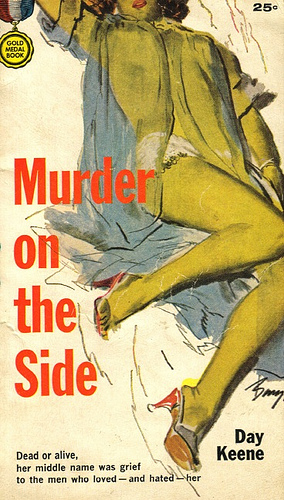
Day Keene: Murder on the Side/Ansa
H.A. DeRosso: .44.

Saturday, December 04, 2010

The new issue of my fanzine, Pulp

I just finished editing and publishing the newest issue of my fanzine, Pulp, that's been an on-line publication only for the past few months. Here's the link to the issue's editorial - it has links to all the articles. Following them is the best way to read the articles in order. For some reason or another, I messed up the order that I'd carefully planned ahead.

The articles are about the "Gordon Davis" war paperbacks by Leonard Levinson and the war-themed science fiction written in Finland plus there are three book reviews, one of them being about the book I compiled, Kari Suomalainen's crime stories.

Wednesday, December 01, 2010

The Narrow Margin and some other film noirs

I've watched all the film noirs the Finnish Broadcasting Association has been showing in the theme series for the past few months, but for some reason I've neglected to write about them. I'll try to remedy that, but a short post will have to suffice for two films.

Richard Fleischer's The Narrow Margin, although excellent at times, is not really a film noir. It's more of a thriller, with a hardboiled hero. But noir? No way. Charles McGraw is one of the most hardboiled guys ever (he would've made a great Mike Hammer) and his action throughout the film carries some noir overtones, but all in all the film's just a thriller. 

At that it's great at times. Fleischer knows how to edit a fight scene and build up suspense. There's just one thing I don't get: there's this well-known gangster and his wife, and no one knows what the wife looks like! Was the guy ashamed of his wife and never went anywhere with her? (I remember liking Peter Hyams's new version of this in the early nineties, but I notice it's received quite a lot of negative reviews.)

Nicholas Ray's On Dangerous Ground on the other hand is truly noir, even though the ending is upbeat and optimistic. Well, it should be, since everything before it is gloomy and dark and pessimistic. Robert Ryan is great as the hard-hitting cop who's lost all his hope and just keeps on beating the baddies and snitches. Bernard Herrmann's music and the opening scenes reminded me strongly of Taxi Driver - and the both films share lots of issues about alienation and loneliness. Travis Bickle was in Vietnam, Ryan's character must've been in the WWII. (I liked Herrmann's music during the other parts as well.) 

Yet the film is of great beauty. Some of the scenes carry the solemn grace of a silent film, of a Dreyer or a Sjostrom. I got into a debate with a friend of mine whether the ending was believable, but I said it doesn't matter when you're doing something this beautiful and touching. I found myself crying in the end. 

Thursday, November 25, 2010

Gordon Davis's AKA Leonard Levinson's Death Train

It's not Friday, but I think this could be linked to Patti Abbott's Friday's Forgotten Books series of blog posts.

I wrote earlier about a war paperback by Gordon Davis that was for some reason published in Finnish as by "Steve Jenkins". The real name behind the pseudonym was Leonard Levinson, a prolific paperback writer from the seventies and eighties. Late last night I finished the other Gordon Davis novel published in Finnish, called Kuoleman juna. It's the literal translation of Death Train, and it's the first book in Davis's Sergeant series.

Just like the earlier "Steve Jenkins" novel, this was also fluently written and quite fastly and crisply paced, without much padding. Some of the scenes with historical figures, like Eisenhower, could've been left out, but then again they are not very long. The battle scenes are short enough and there's enough action to keep the reader's interest going. The main character, Mahoney, is delightfully cynical - I think it's him on the cover. There are some sex scenes, but Davis/Levinson has just enough style to make them plot points, not just loose scenes with sex. I'm not sure, though, whether the scene with a young nun, Mahoney bursting with lust to break her virginity, was done with good taste. Well, then again Mahoney decides to pull out.

I'd like to read more of Levinson's work, as he seems a writer who knows how to spin a yarn and keep it tight, but there are no more translations (I think) and ordering these from abroad seems a bit silly. I was thinking I'd try to compile a Levinson bibliography with the help of Hubin's biblio, Abebooks and Pat Hawk's pseudonyms catalogue, but I won't do it now. Later on I'll write a more thorough article in Finnish about these two books and post it on the Pulp magazine blog here. Here's Bill Crider on one book by Levinson, the non-genre The Last Buffoon.

Tuesday, November 23, 2010

Duane Swierczynski's The Blonde and Ken Bruen's London Boulevard out in Finnish in 2011

Commercial follows, in Finnish:

Arktisen Banaanin kevät 2011 pitää sisällään kaksi kovaa dekkariuutuutta: Keikkakuskin kirjoittajan Duane Swierczynskin hengästyneesti ryntäävä scifi-trilleri Vaaleaverikkö sekä irlantilaisen kovaksikeitetyn rikoskirjallisuuden supernimen Ken Bruenin ensimmäinen suomennos, kohta elokuvaksikin tuleva London Boulevard.

Vaaleaverikkö on raju kaahaus läpi öisen Philadelphian, 24 tunnin jännäri, jossa ei ole tyhjiä hetkiä. Naisella on veressään tappava virus ja uudeksi uhriksi joutuu viaton, avioero-oikeudenkäyntiä odottava toimittaja. Kirjasta sanottua: "OK, so we have hot girls, self-replicating killer-spy nanomachines, journo-suckers, affable hit-men, double-secret government cadres; are we forgetting anything? OH YEAH, a severed head in a duffle bag!"

Bruenin London Boulevard on ovela pastissi Billy Wilderin klassikkoelokuvasta Sunset Boulevard, mutta omillaankin toimiva kovanlyyrinen, haikean väkivaltainen rikosromaani. Elokuvan pääosissa ovat Keira Knightley ja Colin Farrell ja sen ohjaa Scorseselle käsikirjoituksia tehnyt William Monahan.

Vaaleaverikön kansikuvan on piirtänyt Ossi Hiekkala. Lisätietoa löytyy kustantajan sivuilta.

Monday, November 22, 2010

The cover for my vampire anthology

Here's the cover for my forth-coming vampire anthology. The book's title translates as "The Lust for Blood: Finnish Vampire Stories". This is not the final version, but gives you some taste. The illustrator is Timo Ketola.

Friday, November 19, 2010

Sarah Waters's The Night Watch and Fingersmith

I guess this could qualify as a Forgotten Books post, even though the books in question are not forgotten in the least. I've seen Forgotten Book posts about Edgar Rice Burroughs and Christa Faust's Money Shot, so I guess the rules are not very strict.

I've finally completed my share of the reference book on historical novelists. I read two of Sarah Waters's novels, the only two translated in Finnish, and liked them quite a bit. Doing this book has been quite a task. As you may remember, I didn't like Arturo Perez-Reverte's books and I almost ended up hating Robert Harris's novels on Cicero. I must confess skipping pages a lot. There were also other writers that left me utterly cold. The one exception - before Waters - was Tracy Chevalier, who writes in a terse prose I happen to like, and she handles difficult themes (women's oppression and stuff like that) pretty deftly.

One could compare Sarah Waters to Chevalier. Both write about women's oppression and their silence in the by-gone centuries. Sarah Waters adds a theme of being lesbian in the Victorian age. Both write books that are not easily categorized - they have elements of a crime novel, they have some experimental bits in their books (Waters has less of them), both are eminently readable. Waters harks back to Charles Dickens and his time, while Chevalier is a strictly 20th century writer, with a style maybe reminiscent of Jean Rhys.

Fingersmith is more strictly a historical novel, set in the 1860s. Some low-lifes, portrayed grotesquely à la Dickens, are trying to get money out of a peculiar old guy living in a mansion outside London, collecting pornography. They force a young girl to be a maid in the house and one of the low-lifes starts to flirt with the daughter of the old man in order to get married and inherit the old man. Everything seems to succeed well, but then Waters throws a very nice twist in the tale and manages to bring new themes into her book: the violent treatment of women in the mental institutions. There's yet another twist in the book, which makes it a relenting read. The last hundred pages are very exciting and tense. The love story between the two girls is touching, and Waters's view of Victorian pornography is interesting.

The Night Watch is set in London during the bombings of WWII. The book is episodic and starts from the end, moving towards the events taking place first. It works marvellously, even though the book didn't hold my interest as well as Fingersmith. The scene in the middle, with the abortion going wrong, is very, very strong.

I recommend these two books quite highly.

Tuesday, November 16, 2010

New posts on other blogs

I've been busy on the blog front, but I'll just have to post links to my recent posts instead of producing original material here on Pulpetti. Both links are in Finnish.

My essay on the greatness of Carl Barks. My main point: Barks is one of the few (or only even) comic artists that you can read and appreciate and with whose characters you can empathize with, both when you're young and when you're old. (And during the time between, of course.)

The entry for pulp writer Paul Ernst from my 2000 book, Pulpografia. I also snitched Ernst's listing from the Fictionmags Index and posted it here. (I'd link to the Fictionmags Index, but the links don't stay put, which is a pity.) And oh, here's a good review for the recent collection of Ernst's pulp writing. In English.

Monday, November 15, 2010

My article on the Knight Rider

I posted my article (in Finnish) on the latest incarnation of the Knight Rider TV series here on one of my other blogs.

Wednesday, November 10, 2010

Where Danger Lives

In the on-going film noir series of the Finnish Broadcastig Association (or Corporation?) John Farrow's Where Danger Lives was shown last week. Tonight they'll be showing Angel Face by Otto Preminger, and I'll be glued to our sofa opposite to the television set.

I've been a bit disappointed in some of the films, most in Anthony Mann's Desperate and Ulmer's Ruthless, but Where Danger Lives was top-notch. Robert Mitchum as the fall guy with a head injure, Faith Domergue as the psychotic woman, with only 24 hours to escape their fate... I couldn't but love the film, except for the ending, which was way too happy. They should've let... well, let's not spoil it. (Googling for the film I found this crime film blog: Where Danger Lives.)

Sorry for not having written more often (and in more depth about Farrow's film), but I've been very busy. This week I've written one book review, two articles (one on the newest incarnation of the Knight Rider TV series, one on Carl Barks and how he's really the greatest comics artist there ever was) and one friggin' long lecture on the history of Finnish fantasy literature. I'll be delivering it tomorrow in the city library of Pori, the town I spent the first 18 years of my life.

And oh, I also wrote a short story, for another anthology of absurd stories, this time set mainly in Turku. And oh, the earlier anthology of absurd short stories came out today.

And all this time I keep thinking: get back to work. Sounds like the so-called stress they talk about, huh?

Wednesday, November 03, 2010

Abraham Polonsky's Force of Evil

Republicans seem to have won in the election. Oh my...

One good example that there have been good Americans is Abraham Polonsky's noir masterpiece Force of Evil (1948). Okay, I know there are lots of people willing to give bad credit to Polonsky, because he was a known Communist. I don't think however that anyone can say that Force of Evil is anti-American. It's a well-thought and well-constructed story of what capitalism does to people. Polonsky's genius is in noticing that it destroys people even when taken to the underground culture of organized crime, i.e. numbers racket. The most concerned he is about those little people who can't fight back: the unemployed, elderly, widowers, young lonely women...

Force of Evil is a story of two brothers, one rising up fastly in the gangster world, one giving people a little piece of hope by organizing a small-time numbers business and employing a steady group of people who seem to have nothing much left in their own lives. John Garfield, who plays the successful brother, has to decide whether to force his brother out of the business. The organized crime works like the banks or the other big monetary institutions in capitalism - and everytime violence and destruction ensue. It's like a force of nature, force of evil.

Polonsky directs and writes with verve. The film hasn't dated a bit. It's even a bit difficult to follow, since Polonsky keeps the story moving with such a fast pace and the dialogue reveals only the most necessary bits. Force of Evil resembles and predates Sopranos or The Wire with several decades. I'm pretty sure some of the characters in Sopranos have been modelled out of some of the characters in Force of Evil.

But is Force of Evil noir? The ending is upbeat, no matter what happens to John Garfield's brother. Garfield decides he'll fight the evil of organized crime that is capitalism. If we think that noir is something utterly grim and hopeless, then Force of Evil isn't noir.

This is another film noir that's based on an earlier novel, Ira Wolfert's Tucker's People from 1938. Anyone read that? Comments?

Monday, November 01, 2010

Two Ken Bruen films coming - and the first Finnish translation

Ken Bruen's excellent noir novel London Boulevard (2001) will be published in Finnish by Arktinen Banaani next Spring. The film based on the book will hit the big screen in the UK on November 26th and in the US February 2011. Which will probably be the European release date as well - and also the release date of the Finnish edition.

Here's the trailer and some more info for the film, written and directed by William Monahan, starring Colin Farrell and Keira Knightley. The book is a clever pastiche on Billy Wilder's Sunset Boulevard, but also a hard-hitting crime novel in its own right.

Ken Bruen's other novel, Blitz (2002), will also be released as a film pretty soon. The film will star Jason Statham, which might turn some people away, but the trailer here seems as gritty as they come.

Thursday, October 28, 2010

Roberto Faenza's Copkiller AKA Order of Death AKA Corrupt

Any movie that has Harvey Keitel beating Johnny Rotten and shouting "You want me to kill you? You want me to kill you?" is good.

Huh? Harvey Keitel and John Lydon of the Sex Pistols fame in the same film? Yes, it's happened once - and it's the only feature film Lydon appears in. "What film?" you ask. Ever heard of Roberto Faenza's Copkiller? It might be better known as Order of Death, the original European releasing title, or Corrupt (or even Corrupt Lieutenant). I hadn't heard of it, when I bought it for ten cents at a thrift store some months back. It had Harvey Keitel, and I thought, sure I'll buy this, even though the ugly VHS cassette looked cheap and ugly.

The film isn't very cheap, but it is ugly. Someone's killing drug cops with a kitchen knife. Keitel is a neurotic lieutenant in the drug department. He leads a double life, living in a luxurious (but empty) apartment with another cop. John Lydon is a creep, who gets obsessed about Keitel and starts following him. He comes to Keitel and claims he's the cop killer. Keitel beats Lydon and locks him up in the bathroom of his luxury apartment. Complications ensue. The ending is very, very baffling.

Copkiller is somewhere between an European art film (the director Faenza is Italian, a late-comer to the new Italian cinema, starting out only in the seventies) and a hardboiled American cop film, without any of the cop film clichés. Keitel's edgy nervousness is all over the scenery, and watching him one feels like he's ready to start punching anybody. No explanations to anyone's actions are given, not even in the end. There's a scene (with charming Sylvia Sidney as the grandmother) where Lydon's character's past is being explained, but in the end all the explanations are futile. This is a hard-hitting film that will leave you gasping for breath.

Copkiller is not an entirely successful film in the whole, but I think it has something to do with the film's troubled production history: it was made already in 1981, but released only in 1984, mainly due to the troubles Lydon had with his band, Public Image Limited. They had done the soundtrack for the film, but the studio was keeping the movie on the shelves for some reason or another. There were also some complications with some of the members of the band, and the soundtrack was never used. Instead there's a very nice and eerie score by none other than Ennio Morricone, using an electric bass, a horn section and some toy horns or some such. The versions available (I'm not sure if this is released in DVD*) are much shorter than the original length. The version I saw was somewhat over 90 minutes, while Faenza's cut was somewhere around 113 minutes. I believe the missing scenes contain dialogue between Keitel and Lydon - there's not much of that in the 90-minute version I saw, and yet someone complains at IMDb that the film has too much talk and not enough action. Those missing scenes might've explained some of the baffling stuff that takes place in the film. All this having said, I must say that some of the scenes are a bit clumsy and the action of the police in the end seems stupid.

This is based on a novel by Hugh Fleetwood. I've read the one Finnish translation from him, Melkein tavallinen tyttö (The Girl Who Passed for Normal, 1973), his first novel, but it was 20 years ago and I can't remember anything about it. Having seen this I'll try to find the book - and maybe some other novels by Fleetwood as well. I don't recall seeing any discussion on him at any crime fiction blog or other crime fiction venues. Fleetwood is also credited with the screenplay.

* Seems like it is, but under the stupid title Corrupt Lieutenant, in the series that's called The Bad Cop Chronicles. Looks like the film can be downloaded via many peer-to-peer sites, but I won't direct you to them. 

Review of my sleaze novel

Henri Waltter Rehnström in the Tampere University student paper: "Lausteen himokämppä on mielenkiintoinen poikkeus pornokirjallisuudessa, koska se on kirjoitettu erittäin hyvin. Sen ansiot ovat nasevan räävittömässä kielessä, jota on vaikea nauramatta lukea." See the link here.

English edition: "The Lust Cabin of Lauste is an interesting exception in porn literature, because it's written so well. It's so lewd it's hard to read without laughing." 

Sunday, October 24, 2010

Isabel Allende's Zorro

I have a confession to make: I've never read a real Zorro novel by Johnston McCulley. From the classic Zorro movies I've seen only the seminal Tyrone Power version from 1941. (I'm not even sure if I've seen any of the Antonio Banderas versions.) But even with this minimal grasp of the matter I can say Isabel Allende's prequel to McCulley's Zorro (2005) is a bit boring attempt that never reaches the feeling of high adventure that would be required. I read the book, because Allende is included in the reference book of historical writers I've been working on. (The reference book is late and it feels like I'm never getting it out of my hands. Aaargh!)

Allende has done her work pretty carefully, but it seems she's been watching only the films and hasn't read McCulley's novels (from what I can gather). She makes the historical references quite accurately, to my mind, and she develops Diego de la Vega's character carefully. I thought the part in the Spanish War against Napoleon was the best part in the book - exciting, enthralling, adventurous. But the problem with her book is exactly that: there's not enough adventure. I'm sure many McCulley fans would like Allende's novel more if it just had more sword fights. You feel like Allende was thinking she was doing a serious historical novel, like many of her other novels are, and remembering every now and then that this is supposed to be a swashbuckling adventure. Paradoxically, her more serious, more literate historical novels are more entertaining than her Zorro. (That said, I must admit that I just dropped one of her books, Portrait of Sepia: too repetitive, too much familiar aspects, too much lecturing about the history of Chile.)

It's a small wonder none of McCulley's Zorro stories were ever translated in Finnish - I'm not really sure why this never happened. There have been some abridged versions in some obscure Disney anthologies not many friends of literature would dare to look at, and I think I've seen one version in an old Finnish pulp magazine in the fourties. Would it be about time?

We had the Disney TV series in Finland of course, and Steve Frazee's novelization of that, cut into shorter chunks and published as separate books - I loved those books as a kid and I think I loaned them out of the library at least five or six times. Given that, it's a small wonder that I never sought out any of McCulley's Zorros. (And I'm really not sure whether I ever saw the TV series as a kid.)

Did you know that this early nineties TV series of Zorro also had a series of paperback novelizations? By the series creator, Sandra Curtis, published under the byline of "S. R. Curtis"? Curtis is known to the Zorro aficionados for her non-fiction book Zorro Unmasked. Six of Curtis's novels were published in Finnish in 1992, when the series was on the Finnish television, but they are not mentioned in the Wikipedia article for Zorro. I had an opportunity to ask about these from Sandra Curtis herself and she admitted the books have never appeared in English language, albeit there have been many translations in many languages. Haven't read any of these, but I've been going to, since I'd like to run a Zorro issue in Ruudinsavu/Gunsmoke, the magazine of The Finnish Western Society. (I did a bibliography of the paperbacks and posted it on the Pulpetti's bibliographic section here.)