 I've been compiling the new issue of Ruudinsavu (= Gunsmoke), the official magazine of the Finnish Western Society. I've been dreaming about the issue dedicated to the Zorro phenomenon, to the movies and comics and other stuff that's been made about him. It seems like it's now coming true, with me writing the article on Johnston McCulley who originally invented the character and wrote the first stories about him.
McCulley wrote four novel-lenght stories about Zorro, but weirdly enough only the first seems to have been published in book from. Can this be true? And the first one, originally "The Curse of Capistrano", later published as The Mark of Zorro, the title of the Douglas Fairbanks film of 1920, is now available only in the POD edition from Wildside Press. (It's okay, but it has an ugly cover, with McCulley's name written wrong ("McCully") and the book has some formatting and scanning errors.) How can this be? McCulley died in 1958, so his work is technically still under copyright - except seemingly for The Mark of Zorro, since I don't think Wildside Press is paying anyone anything for the rights of book. Is there a problem with McCulley's heirs? I notice Googling around that there's been talk about the collected Zorro short stories coming from Black Dog Books, but so far nothing.
Back to the actual book. "The Curse of Capistrano" was published in All-Story Weekly in 1919, making Zorro one of those long-living heroes originated in the pages of a pulp or other fiction magazine, just like Tarzan or Sherlock Holmes. The story was fast made into a movie and hence the book was getting to be known as The Mark of Zorro.
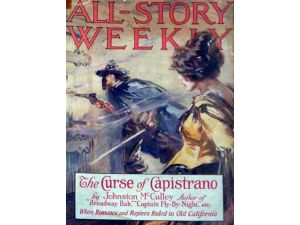
I'd really like to read the other McCulley Zorros, but it seems it's almost impossible, unless I pay some real money for the old pulps they were published in. (Make sure to note these Zorro tie-ins from Sandra Curtis that to my knowledge have never been published in English.)
The weird things don't end here, by the way: McCulley's Zorro was never published in Finnish. We've had only the movies and the Disney TV show and Steve Frazee's novelization of it.
Other Forgotten Books at Patti Abbott's blog here.


