Monday, August 15, 2011

Kauto soon seven and..

..going to school! Tomorrow actually. I'm soon beginning to put him into sleep. Wish me luck! He's not very easy in these matters, let me tell you. But how time flies by! I'm just proud to have kept him alive. He's a very smart kid, reads, calculates with big numbers, runs like a lightning, but these seven years haven't been very easy. The old cliché says "I wouldn't change a day", but I'd really like to change one or two. Yet, I love the kid very, very dearly.

The picture is from 2009, I think. The hipster clothes were picked by him.


Sunday, August 14, 2011

Hard Case Crime

Life magazine offers a run-down of the Hard Case Crime covers here.

Tuesday, August 02, 2011

Tuesday's Overlooked Film: Mikey and Nicky

I've been trying to watch Elaine May's Mikey and Nicky for weeks now. "Trying?" you ask. Yes, trying. The VHS I've bought years ago from a thrift store is a mess and makes your eyes wet with tears: the picture is fuzzy and scratched to begin with, but the main thing is that the picture size is wrong. I can make it just about right by zooming the television screen, but then the captions disappear. And it's pretty important to understand what the guys in lead - Mikey and Nickey - say, because they talk all the time. Talk talk talk, that's what the film is about.
But there's also a plot. John Cassavetes plays Nicky, a small time crook, who's afraid a mobster is trying to kill him. Peter Falk is Mikey, Nicky's friend, whom Nicky calls for help. They wander around the city, hit some bars, visit some women, try to stay away from the mobsters. And talk all the time. Ned Beatty plays a hitman, who's really looking for Nicky.

It's no wonder John Cassavetes is in this, since the film looks a lot like one of his. The conversations between Mikey and Nicky seem improvised, and Elaine May shot the film with three cameras, sometimes letting the cameras roll for minutes after Cassavetes and Falk had disappeared from the focus. May crossed the budget with several million dollars (something she did later on with more disastrous results in Ishtar) and the film got only a limited release. I don't know if it's easily available on DVD.

If it is, I think I'm gonna drop this VHS into a river and get done with it. I can't bear to watch it. The film is a good experimental noir from the seventies, on par with Taxi Driver, Night Moves, The Killing of a Chinese Bookie and others, so it's highly recommended if you can stand two hours of rambling conversations. And oh, I think this influenced Sopranos. The picture Elaine May gives about the mob and the small crooks affiliated with them is pretty similar to David Chase's masterpiece. (Same goes for James Toback's Fingers, a very good film I saw a couple years ago, but failed to write about here in Pulpetti.)

More Forgotten Films at Todd Mason's blog.

Monday, August 01, 2011

Lionel White's only Nick Carter

Lionel White, the writer of Clean Break and other classic caper thrillers, wrote only one novel under a pseudonym, and it's a Nick Carter. Here it is, in a great blog by a guy called Scott, in Denver, Colorado. Wonder why White wrote a Nick Carter novel? I guess he needed the money.

Friday, July 29, 2011

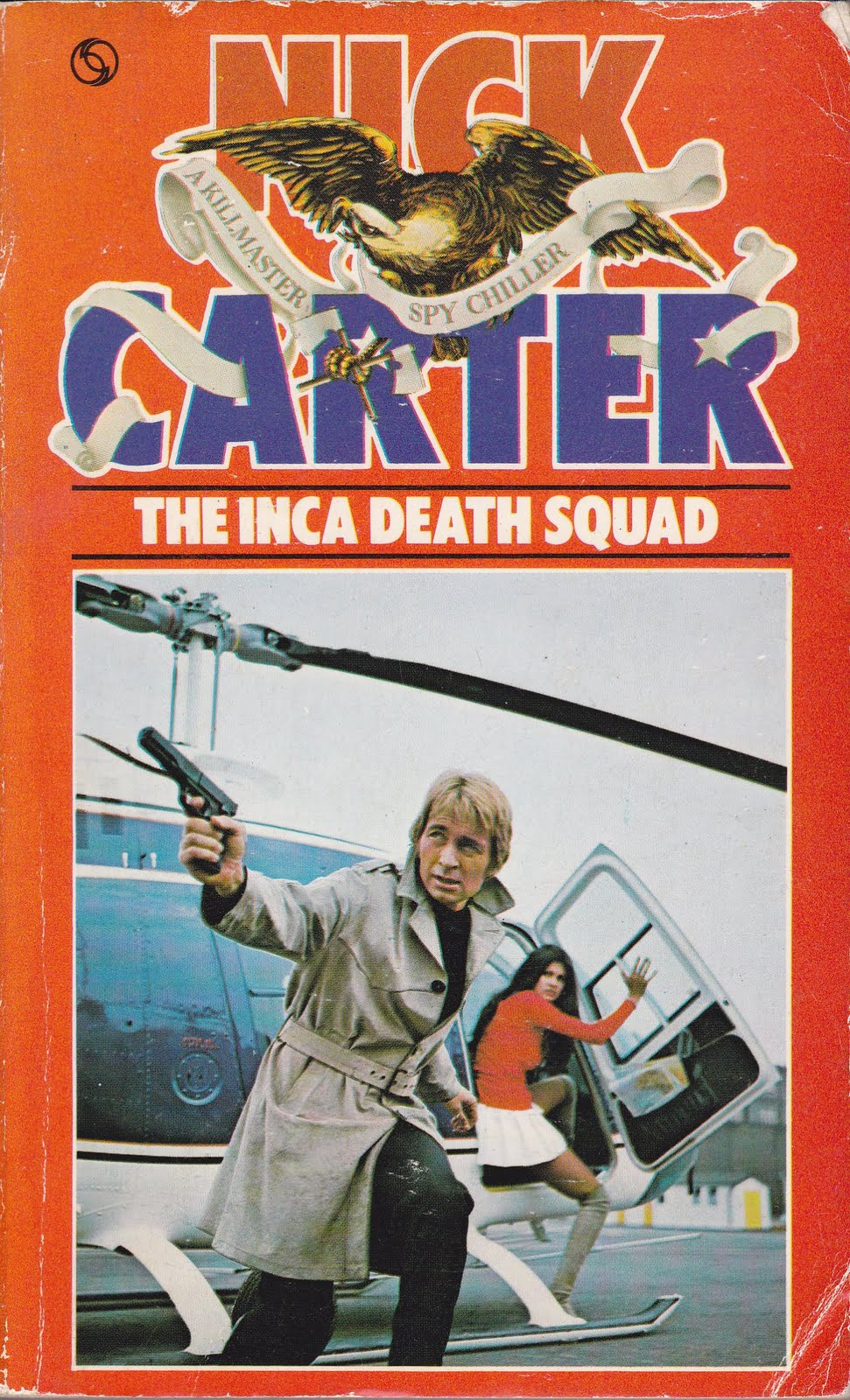
Friday's Forgotten Book: Martin Cruz Smith: Nick Carter: The Inca Death Squad

Now, that's a great name for a book, isn't it? This is one of the better Nick Carter paperbacks from the early seventies, published in 1972 in fact, and known to have been written by Martin Cruz Smith early in his career, before he hit it big with Gorky Park and other thrillers. I haven't read any of those, but I've read two of his Nick Carters, but this was the first I read in English. And it's good I read it, since it's a lot better book in its original language. The Finnish translation may be abridged, but I didn't check, since my Nick Carters are somewhere away in a box.

Martin Cruz Smith's Nick Carter narrates his own adventures, which brings the book closer to the hardboiled school of writing (Dennis Lynds's Nick Carter is also a first-person narrator). Smith's style is hardboiled in its own right, and Nick Carter gets to make some pretty good wisecracks. The action scenes are crisp. The setting is a pretty inventive one in the series, Chile just after Salvador Allende was elected president. Carter: "I just wonder if there will ever be another election." Just year after this Pinochet killed Allende with help from CIA - irony of history there, huh?

Smith reveals his fascination towards the Soviet Union that's prevalent in Gorky Park: the bad guy in the book is a Soviet minister who makes a deal with AXE that Nick Carter escorts him during his trip in Chile. Smith is also able to make some sense out of the series stablemate, the beautiful and willing ladies with whom Nick Carter makes love every moment.

What about the Incas? There's a great battle scene with an Inca warrior, but I didn't think Smith made the best possible use with the Inca angle. After the battle the Incas just vanish and no one seems to discuss them anymore. Nick Carter even finds an ancient tomb, but tells no one about it, even though one of the characters is a museum director. Salvador Allende, by the way, makes some brief appearances throughout the book.

I'd like to quote some passages from The Inca Death Squad, but I don't think I have patience for trying to find some. I read this on our trip to my mom's, and I can guarantee it served its purpose very well. And it goes on to show how the old-fashioned pulp literature (yeah, yeah, I know, not real REAL pulp, but you know what I mean) enabled many writers to hone their skill before hitting it big. And what's best, this is only appr. 160 pages.

The picture accompanying this post is the British edition (Tandem, 1973). More Forgotten Books here.

Wednesday, July 27, 2011

Todd Strasser: The Good Son

I remember Joseph Ruben's film The Good Son (1993) mainly from seeing the Finnish translation of the novelization by Todd Strasser on the supermarket racks. I knew Macaulay Culkin's career had gone downhill and had read somewhere (remember: this was when the internet meant only some awkward e-mail software) that Culkin was playing a baddie in the movie. I'm always interested when actors I don't care for (or even hate) play baddies. (Take Bill Murray for instance. I hate him in comedies, but he's wonderful for example in John McNaughton's Mad Dog and Glory.)

I didn't know at the time, though, that The Good Son was already some years old and that it hadn't come to Finnish theaters in the first place. I still don't know why this was. Maybe it was because the Jamie Bulger case - the British censors even cut some seconds away from this film after the tragic event. The film was released here only on video, and the movie tie-in book by Strasser was published roughly at the same time. To this day, I haven't seen the film.

But I've now read the book. Todd Strasser seems to be a well-regarded YA author, but this, alongside with the movie tie-in of Super Mario Bros (!), is his only book translated in Finnish. He writes smoothly, but somewhat unimaginatively, at times retorting to clichés. The story is interesting, though, and it should be, since the screenplay for the film was written by Ian McEwan. Now, I'm not his biggest fan (I've read only his first, The Cement Garden, 1978, and I haven't liked the films based on his books, like Paul Schrader's The Comfort of Strangers), but given his statue he should be able to come up with something worthwhile. And yes, the story of The Good Son is intriguing and even thrilling, even a bit implausible at times (the 12-year old boy should get caught for his actions many times, as he leaves lots of clues behind him). I just don't get what the story is about. Is it about mothers who care their kids to the borders of insanity? Is it about dads missing out on their sons' lives? Is it about the fear of death or is it about the love that conquers all fears? Maybe McEwan's original script is more complex than Strasser's pretty simple narration (or Ruben's film which I haven't seen) and his points are just missing in this.

It's interesting, though, that Ruben has an auteuristic touch of doing stories about dysfunctional families: The Stepfather (from the Donald Westlake script!), Sleeping with the Enemy and this. There might be more in his filmography. But then again, he's also done Money Train...

There's a minor, but interesting anecdote in this: when I talked about the Finnish publisher of the book, Kari Lindgren (he of the Book Studio), he said that The Good Son (Serkkupoika in Finnish) was his best-selling movie tie-in ever, based only on the video release. What gives here?

Edit: I was mistaken about Bill Murray playing in a David Mamet film. I got him mixed up with Steve Martin, who's very good in Mamet's The Spanish Prisoner. I fixed that now. 

Tuesday, July 26, 2011

Tuesday's Overlooked Film: The Adventures of the American Rabbit

I'm sure this means huge nostalgia to many Americans, but I hadn't even heard of the film when I ran into it at a thriftstore on an old VHS cassette. The Adventures of the American Rabbit is an indie-produced, but mainly Japanese-made American animated film. I'm sure there's a financial analysis somewhere in this, but I can't make it. (The film's title in Finnish is Jenkkijänis, by the way, which is an almost literal translation. It was never shown in theaters here.)

I've been carrying obscure animated films home on VHS for some years now, many of them remain unwatched, some I take a glimpse at by myself, but I managed to make my kids to watch this with me. Maybe they thought it was cute to have a rabbit as a superhero, but eventually they pretty much wore out. The film is dated, the animation is not very imaginative and the story lacks pace and coherence (just who is the old guy saying that the rabbit in the lead must become a superhero?). I was also a bit suspicious of the film's concept: a rabbit changing into an American superhero and fighting the baddies... but luckily the idea of being American in the film is having fun and hanging out with your friends in a bar listening to the music. One might want to take a closer look at the film's politics, though, but I wasn't in the mood and didn't really pay attention to the film all the time myself. One point, though: the name of the band in the film is The White Brothers, which seems to say the blacks are not welcome.

I thought this was only a mildly interesting curiosity, but then again I hadn't seen it as a kid. When I posted about this in Facebook, I got many responses from people younger than me that this was a favourite in the eighties in Finland as well. That goes on to show that one doesn't know everything.

Here's IMDb on the film. And here's more Overlooked Films. Edit: after checking out some links and Googling for more, I found that the famous internet person Christian Weston Chandler has talked about this film and has used it as inspiration for his - seemingly notoriously bad - own comics. Hadn't heard of Christian Weston Chandler before!

Here's the opening credit sequence:


PS. I made better with watching Budd Boetticher's 7 Men from Now: taut and very short, expertly paced Western thriller, with Randolph Scott and Lee Marvin. Burt Kennedy's excellent script with an excellent twist or two in the middle. Highly, highly recommended, though I'm sure all the people reading this blog have seen it. You should, if you haven't!

Sunday, July 24, 2011

The Norway killer

As you're probably aware, there's been a huge massacre in Norway, with over 80 people killed, all young social democrats in the party camp. Here's Guardian's run-down of the incident. This is a devastating thing, but it shows clearly that not all the terrorists are Muslims, like some people try to claim. You can see the killer was a white guy, from a well-to-do family, and a Christian.

Edit: apparently not a Christian, but someone who believed in Christian culture and its values and ethic, as opposed to the "evil" Muslim world.

Edit pt. 2: Here's another article in Guardian, titled "Norway's tragedy must shake Europe into acting on extremism".

Sunday, July 17, 2011

Day Labor, the Official blog of Crimefactory Magazine: Video Interview—Duane Swierczynski

Day Labor, the Official blog of Crimefactory Magazine: Video Interview—Duane Swierczynski: "In the last four years, there’s been a near holy trinity of pulp writers who, in my eye, can do no wrong: Joe R. Lansdale Charlie Hust..."

Some books I've read recently: Bruen, Gischler, Marc Behm, Finnish sleaze

The Annual Summer Reading Report!

I usually try to read something non-work related during the Summer holidays, but with me and my precedence for crime fiction, it's pretty hard to say if it's work or not to read Ken Bruen or Victor Gischler. Bruen's London Boulevard I picked up to be translated in Finnish quite recently and Gischler has been on my possible-to-be-translated list for some time now.

The Pistol Poets was the first of his actual crime books I've read, though. It was actually a bit different than I'd thought it to be - can't really say what I expected, but certainly not a university satire! The Pistol Poets is more than that, since it's also a great crime novel with lots of dark humour and tough violence in it. Gischler spins the multifaceted yarn very well, makes it seem very easy, and many characters are full of life, though not many of them are worthy idols, more like low-life trash! Very heartily recommended, if you're not familiar with his work. (Here's my earlier take on his Vampire A-Go-Go. It was funny as hell, but a bit juvenile at some places.)

Ken Bruen's The Guards was his first Jack Taylor novel for me. I've read earlier London Boulevard, which I liked (with some reservations toward its nature as pastiche), and Rilke on Black, which I thought lacked plot. The same could go for The Guards as well. I'm not sure whether it was just me, but I thought the book should've had more strictly plot-related stuff to it. I couldn't even warm myself up to Bruen's style, though I liked it in London Boulevard. And Bruen's habit of dropping crime authors' and films' names is only a knowing wink that doesn't bring much new to the books themselves.

I'm in the middle of Marc Behm's Eye of the Beholder (1980; in Finnish as Vaanijan silmässä, Book Studio 2002; translated by Mika Tiirinen [the same guy who's done the Finnish Wignalls!]). It's a classic of weird noir, a decidedly non-psychological psychologic crime novel, with a private eye hero, called only Eye, whose existence we soon begin to suspect. Very original, but also, I think, a bit dated. It may be due to the Finnish translation that's not very rich in tone. But then again I think Behm went for monotony. I'd like to hear some comments on this.

I also read a Finnish sleaze paperback from 1979, anonymously published Kova kovaa vasten (The Tough Get Going or something like that). It's a private eye novel, with lots of sex scenes and almost non-existent plot - it's there and it seems to make sense, though one forgets what happened before the last 50-page orgy. Some of the sentences read like it was written by a "real" writer, but I don't know who it is. No one's done any research into these books in Finland, which is a pity.

As usual, I'm sure I'm forgetting something... I haven't read as much as I would've liked to, but there's still Summer left!

Tuesday, July 12, 2011

Tuesday's Overlooked Film: Pendulum

Watched this forgotten thriller from the late sixties a couple weeks ago and my memories are already fading a bit, which seems to be implying there's not much in the film, but it's still quite interesting.

Pendulum is a Hitchcockian suspense film about a police lieutenant, who's captured a seriously ill-minded rapist, but done it in a wrong way and a young Liberal attorney gets the man free. The lieutenant is mad jealous about his wife, who seems to be having an affair. Suddenly the wife and her lover are killed. Who's the killer, the rapist or the lieutenant, who's just using the rapist's threat as an alibi?

Pretty well-made, with some good actors, but also with some not-so-good ones, plus the beautiful and stylishly dressed Jean Seberg (she's not very lively in the film, which I'm sad to admit), this merits a second look. The outcome of the drama isn't as obvious as it might seem at first, and I wouldn't label this as fascist as Roger Ebert has done. Still the film seems to be defending strong law enforcement.

More Overlooked Films at Todd Mason's blog. Above I posted the old VHS cover, which is exactly how I watched this.

Monday, July 11, 2011

The first review of Mynämäen motellin munamällit

My friend Sami Myllymäki posted this mini-review of my new sleaze novel, Mynämäen motellin munamällit/The Spunk Gang of Mynämäki Motel:

Käsi käy ja lastit lentävät peräänantamattomalla tahdilla! Mikael X. Messi lykkää kakkoskirjassaan isomman vaihteen sisään, ja kovuusaste hipoo jo ebenholtz-luokkaa! Ylilyövän raadollisuuden ja pimeäntylyn huumorin rajoilla taiteileva Mynämäen motellin munamällit on retropornokirjallisuuden tuleva klassikko ja kesän 2011 ehdottomin 'kehtaako tätä lukea julkisella paikalla' -kokemus!

In rough translation:

Mikael X. Messi hits a bigger gear in his second book, and it's almost as tough as an ebenholtz tree! Dark and brutal humour strikes hand with over-the-top wretchedness. The Spunk Gang of Mynämäki Motel is a future classic of retro sleaze and the absolute "you don't want to read this in public" experience of the Summer 2011!

Robert Silverberg joins Hard Case Crime

This just out from Charles Ardai:

Five-time winner of the Nebula Award, five-time winner of the Hugo Award, author of acclaimed, mind-bending fantasy novels that have won praise from people like Jonathan Lethem and Michael Chabon, Bob began his career writing under fake names for the last surviving pulp magazines. For the very last issue ever of TRAPPED DETECTIVE STORY MAGAZINE, the editor asked if he could supply a complete novel, and Bob did, an action-packed suspense thriller about a government agent going undercover in the Philadelphia Mob to root out a master currency forger from within. The issue of TRAPPED appeared on newsstands in 1962 -- and after it went off sale a few weeks later, this work by Silverberg vanished. It never appeared under the author's real name, never appeared in book form -- never appeared in any form for the past half-century.

And it's a great read.

So... in April 2012, Hard Case Crime will be giving BLOOD ON THE MINK its first-ever proper publication, including a new afterword by Silverberg discussing the novel's genesis and his work for the pulps, as well as two short stories he wrote for the pulps that have a connection to the novel, and that also haven't seen the light of day for more than 50 years.

And here's the link. Great cover! 

Tuesday, July 05, 2011

My new sleaze book out

My new sex/sleaze/adult paperback novel is out. It's called Mynämäen motellin munamällit (which you don't want to try to say out loud, unless you're a Finn). It takes place in a roadside motel and boasts of cast of wild and unpredictably horny and violent characters. I dare say it's a pretty wild ride. It's a sequel of sorts to my earlier sex novel, Lausteen himokämppä (The Lust Cabin of Lauste), as it shares one character (the beastly police officer called Virtanen).

Here's an intentionally silly picture of me and the book. Note also the young and fresh mustache I decided to grow.

Thursday, June 30, 2011

The new issue of Isku out

The new issue of Isku, my crime fiction webzine, is out. Check it out! The fourteenth (!) issue contains short stories by Pearce Hansen, Patti Abbott (in translation, that is), Seppo Tuisku (a vintage story from the late fifties), Jussi Katajala and Tarja Sipiläinen. Pretty good lineup, that.

Monday, June 27, 2011

Jason Starr: The Pack

As everyone who's been reading this blog for long, I'm a stout admiref of Jason Starr. He writes tough and bleak noir with warmth towards his sociopathic protagonists and antiheroes. He doesn't much revert to mere pastiche of noir clichés and I think he's one of the best examples of how noir can be meaningful literature, both as art and entertainment. It's a small wonder Starr isn't better known.

His later books have gotten more a thriller-like aura, with more pages and bigger issues. There have been talks about big movie adaptations (I seem to have heard about David Fincher buying the option to Panic Attack) and I certainly hope there will be a HUGE movie from his newest novel, The Pack, which I just finished late last night. It's a crime novel like all his earlier novels, but it's also a horror novel. It's also a social satire, in which Starr gets to depict his usual pathetic sociopaths and everyday psychopaths. The middle-class life that Starr writes about is full of anxieties, uncertanties and loneliness. When something bad happens, there's no one out there for you. You're always on your own. Except for a few lunatics, who pray on your bare soul.

In The Pack this theme gets very real, as the protagonist, Simon Burns, ends up in a pack of werewolves. They are very cool guys, seemingly getting along well with their masculinities, taking crap from no one, especially their exes and employees, and Simon, recently fired from his job and spending frustrating life as a stay-home-dad, feels suddenly a burst of new energy. The feeling is misleading, but I'm not telling you more. Starr puts some new twist to the werewolf angle and there's some nice irony in how the werewolf leader combines the utter masculinity and an urge to kill. Jason Starr talks about the theme more in Spinetingler's interview here.

But then again, there's some padding. I can't get away from that. There's too much telling about how someone feels or behaves and about the reasons for that behaviour. Fake ID and Nothing Personal and all the other early novels by Starr have no padding. Is this the price we have to pay to get bigger recognition for a great writer like Jason Starr?

Tuesday, June 21, 2011

Tuesday's Overlooked Films: Hell's Hinges, The Terror of Tiny Town, The Phantom Empire, Les Petroleuses

We had our annual Summer meeting of the Finnish Western Society last Saturday. We (seven guys) were at a log cabin in Karkkila, a small town somewhere near Helsinki, and watched at least three western films in the whole. One we watched in part, and one we took a look at.

The best of films was no doubt William S. Hart's silent western, Hell's Hinges (1916). It's a solemn religious drama, in which Hart is a heartless killer who falls in love with a young woman and says goodbye to his past. Hart is very believable as a ruthless assassin. Despite being in black and white and silent, this was the only film that held our interest throughout its whole run. (Well, not everyone's. Someone said: "Next one will have to be a colour film!") I'd really love to see more of Hart's films.

The cult favourites, The Terror of Tiny Town and The Phantom Empire, however wore us out. The first one, famous for its all-midget cast, was way too traditional. Replace the midgets with grown-ups, and I'm sure not many would remember the film, let alone watch it. The Phantom Empire we couldn't make ourselves to watch through. It's just not suited to watch in entirety. I'm sure it would work better with a 20-minute episode every week, just as it was meant to be screened. Both films are better as ideas than as finished products.

The French film, Les Petroleuses/Frenchie King from the early seventies, has the advantage of sporting two very beautiful women in the lead, namely Brigitte Bardot and Claudia Cardinale. We couldn't come to an agreement which one is more beautiful. But the film is sadly a spectacle of disjointed events, some very colourful and mildly funny. There's just no coherence to it, which goes on to show that the French prefer spectacle to story-telling. Still, Bardot is very hot in her black outfit, and Cardinale is very, very lovely.

We also took a glimpse at an abysmally bad The Wackiest Wagon Train in the West that was put together from the episodes of Dusty's Trail. That's a TV show I'll never want to see. We lasted about 15 minutes.

I don't know if Todd Mason is making his usual round-up, since there's only one guest post in his blog here. Maybe there's more to come.

Friday, June 17, 2011

Friday's Forgotten Book: James Hadley Chase: Sucker Punch

Here's a link to an old post about James Hadley Chase's Sucker Punch. More forgotten books at Todd Mason's blog here.

Tuesday, June 14, 2011

Tuesday's Overlooked Film: At Close Range

I found this small classic from the eighties I'd never seen in a thrift store. It was an old VHS cassette, but it cost only 20 cents, so I thought I'd grab it. I'm glad I did, since it's a pretty decent film, although not a masterpiece.

At Close Range is a piece or rural noir, with young Sean Penn as the son and Christopher Walken as the father and also as the leader of a ruthless gang of criminals who operate in a small Pennsylvania town. Penn and Walken don't really know each other in the beginning of the film, as Penn lives with his mother (played by wonderfully understated Millie Perkins) and the family tries to reject the father. Penn leads an unhappy life with his mother and gets attracted to his father's exuberant way of life. Complications ensue, and the ending is a tragedy. There are other familiar faces in the crowd: Mary Stuart Masterson as Penn's girlfriend, Christopher Penn as the brother of Sean (as in real life), Crispin Glover as one of Penn's friends lured by the criminal life, David Straithairn and Tracey Walter as members of the gang. There's also Kiefer Sutherland, but I recognized him only in the last scenes.

There are lots of nice touches here and there and some of the scenes are very well done. Some of the small-town scenery and atmosphere reminded me of Twin Peaks. The climax is gripping, with lots of stylishly done shootings. The story about a father and a son allying and then fighting fiercely each other has overtones of a classical tragedy. There's still a feel of distance that might leave you cold. I'm sure this doesn't work well on the small screen. My main grudge, though, is that while Walken is an excellent actor, I just don't buy him as the leader of a Hicksville gang of criminals. Yet the film goes on to show that not all the Hollywood films of the eighties supported the Reagan-era ideology of keeping families under the Father's Rule, as critic Robin Wood has claimed.

The director of At Close Range, James Foley, has an interesting filmography, with lots of noirish films, but seems like he's never done a really good film, though Glengarry Glen Ross comes very close. Some say After Dark, My Sweet is one of the best Jim Thompson films, but I'm not sure if I've seen it.

More overlooked films here.