
Sunday, January 25, 2015
A star is born
This was born early today, at 6 a.m. this morning. It's a girl. Mom and baby are doing fine.

Tuesday, January 20, 2015
Tuesday's Overlooked Film: The Last Starfighter
 A teenage guy is so good at an arcade game about shooting spaceships that he gets shanghaied into space and fights enemy spaceships. I believe this film was sold to producers on that line, but for some reason it works pretty well, even though it's still silly.
I remember seeing posters and ads for The Last Starfighter (called Viimeinen suuri seikkailija / "The Last Great Adventurer" in Finland, maybe they thought referring to "space" would scare the audience) and feeling sorry for not seeing the film. We didn't have a VCR at our house, so I wasn't able to see even it on video at the time. Not long ago I bought the film on VHS cassette for 20 cents and was able finally to watch it.
The Last Starfighter was directed by Nick Castle whose other films are not much of interest to me, with a possible exception of his first feature, T.A.G.: The Assassination Game. Castle of course was the guy behind Michael Myers's mask in Halloween. The Last Starfighter was an early example of incorporating computer graphics into a feature film alongside with Tron. I believe this one was more successful commercially*, but it's nowhere near the innovative graphic look of Tron, although The Last Starfighter is more entertaining than Steven Lisberger's stiff movie. The Last Starfighter benefits from two good veteran actors, Dan O'Herlihy and Robert Preston. Lance Guest as "the last starfighter" isn't bad either. He should've had a better career. The main plot about the battle in space is silly and clichéd, but the aliens look delightfully goofy.
I would've loved this as a kid, and there's still enough charm for me to like it even that I'm now a cynical adult. More Overlooked Films here (when the time comes).
* In IMDb's biography for Lance Guest it is said: "He was told that Starfighter reportedly made no money on it's initial release, so he returned to the theatre", but Wikipedia states thus: "The Last Starfighter was a financial success, earning over $28 million on an estimated budget of $15 million."
Saturday, January 17, 2015
Paul D. Brazill: Guns of Brixton
Guns of Brixton was the last book I read during the Christmas holidays that had nothing to do with work. It was perfect for that: a mix between Guy Ritchie's hyperkinetic crime movies and Irvine Welsh's lowlife scum novels. I don't need to recap the plot, here's a good outline from Out of the Gutter.

That said, I must note that I lost my way amidst all the lowlife in the book. There are quite many characters, maybe one or two many, and perhaps too many scenes are about new characters making their way into the story. Guns of Brixton gets too convoluted in the end, and I read the last pages having lost some of my interest. There are also more typos near the end, so perhaps Paul D. Brazill himself got lost in his own text! Available as an e-book, for example here.
Here's also Paul's blog, full of interesting news items and interviews with new noir authors!
Tuesday, January 06, 2015
Michael Marshall: The Straw Men
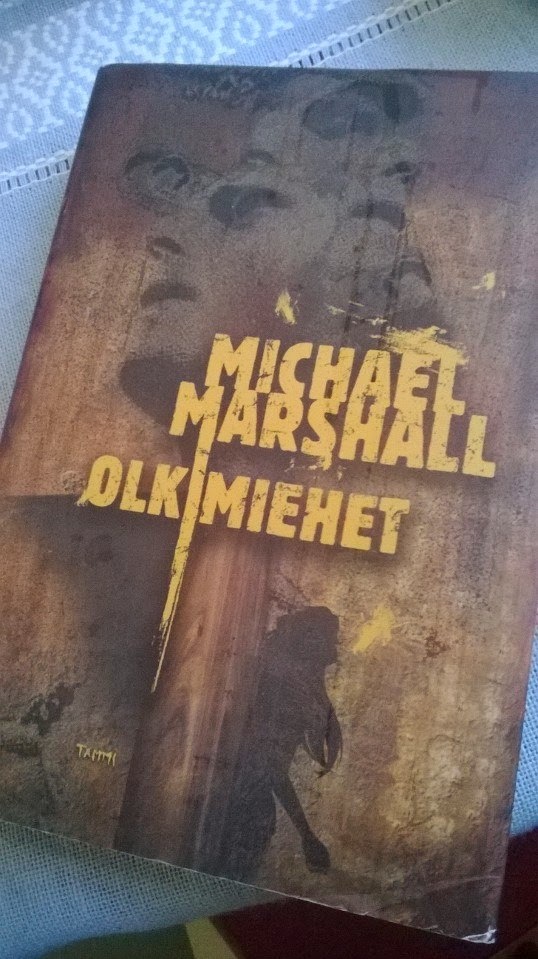 |
| the Finnish translation |
The Straw Men is a very clever and frightening take on the serial killer genre - genre that I'm not very interested in. Michael Marshall gives the phenomenon a nice historical and even mythical explanation and creates a conspiracy thriller that one won't easily forget. There's not much a reader will guess beforehand, and the climax is very exciting.
The only bad thing about the book is that it was written in the early 2000's and there's just too much talk about the internet, ADSL cables, IP addresses and such. It's dated already - probably was dated even five years ago. Marshall should've seen it coming, though the plot points about the internet must've been quite original in 2001 when the book came out.
Wednesday, December 31, 2014
Frank Castle: Lovely and Lethal
 After Brian Evenson's weird and effective The Open Curtain I thought I'd be in the mood for something lighter, maybe something old, maybe something pulpy (or paperbacky). I have tons of old paperbacks in my shelves, but not enough to time for them. So I thought I'd read one.
I read two or three westerns by Frank Castle when I was doing my book on American westerns paperbackers called Kuudestilaukeavat ("Six Guns" in English) and liked them well enough to try one of his crime novels. I picked up Lovely and Lethal, a Gold Medal paperback from 1957, and started it - and pretty soon dropped it and moved on to something else.
Lovely and Lethal is a bit like a private eye novel, but the hero of the book, one Jeff Normand, is actually a lawyer moving to a small town and getting acquainted with both the high society and the low-life of the place pretty quickly. He meets a beautiful dame, whose sister had possibly killed herself, but in odd circumstances. Normand starts to unravel the mystery behind the sister's death.
Castle's prose style is flat and not very interesting, not even very hardboiled, though I remember his westerns were pretty tough. The characters in Lovely and Lethal are pretty much stock. There's too much talk, not enough action. So Lovely and Lethal proved a bit boring and thought I'd read something else instead. And the book has a boring cover. Where's Robert McGinnis when you need him? There are enough sultry babies in the book to warrant a nice GGA cover!
Here's my earlier post on Frank Castle and his later crime novel "Sowers of the Doom" that seems to have been published only in Finland, and here's Castle on Steve Lewis's MysteryFile blog. I'm beginning to think that the book published in Finland only was the last one on Castle's career, unless he moved on to markets where he used only pseudonyms, writing porn or some such, and the pseudonyms have never come to light.
I'm now reading Michael Marshall's The Straw Men and enjoying it more.
Monday, December 29, 2014
Brian Evenson: The Open Curtain
 I'd ordered Brian Evenson's The Open Curtain on a whim when I noticed someone post about it on Facebook. It looked intriguing, and based on a short description of the plot it reminded me of the manuscript I've been working on. Now that I read The Open Curtain, I can tell it really doesn't resemble much what I've written so far, but let me tell you that I'd really like to be able to write as well as Evenson - and just as daringly and as unpredictably as Evenson! The Open Curtain really grabbed and scared me, even though there are virtually no hallmarks of the horror genre.
Yet The Open Curtain is clearly a horror novel. It's terrifying and very distracting. The main character is a teenage guy Rudd, who seems a bit autistic and lives with his Mormon mother. His father has been dead for some time now, and Rudd finds some letters in a garage that seem to reveal he has a half-brother, called Lael, living somewhere else with his own mother. At the same time Rudd has to make an essay on history for school, and he stumbles on an article on an old murder case in which there was a possibility of an old Mormon ritual of a blood atonement. There were lots of bizarre elements in the murder, such as an accomplice the existence of whom was never proved. All these elements start to show in Rudd's life and toy with his identity that seems to fall apart. The twist in the middle made me almost pee in my pants.
This is something David Lynch might have written, but all the elements are actually very down-to-earth and realistic. Even the 100-year-old murder was a true case. Evenson describes it with a chilling minuteness, and the whole novel is written with minimalist preciseness that's quite scary. To know that blood atonement was a true doctrine in the Mormon faith makes The Open Curtain really effective as a horror novel. Yet Evenson never really gives any sure answers. The end might be a bit of a letdown, but it's the only alternative imaginable.
Someone said (I don't remember anymore where I saw the comparison) that if Jim Thompson were alive today, he'd write like Brian Evenson. Based on The Open Curtain, Evenson is a more literary writer, but there are same elements, for example the use of the unreliable narrator and the disintegration of the identity. (And taking a look at Evenson's Facebook page, I notice there's a discussion on Thompson in which Evenson says: "Have read almost all of Thompson, who I really love.")
I'll definitely be reading more Evenson. There are no Finnish translations, but if I have anything to say about the state of affairs, there will be.
Saturday, December 27, 2014
New publisher in the works
 A new Finnish publisher announced its first three books just before the holidays. I had something to do with all of them, so I'm a bit obliged to say something about them, even though the books are in Finnish. The new publisher is called Putki Kustannus (never mind the translation, it doesn't make much sense) and it works only via Lulu. The books are print-on-demand, which is still a novelty in the Finnish book industry, but it's a bit cumbersome to make the books in Lulu, since they don't offer Finnish ISBN codes (or any ISBN codes for that matter), so they are a bit invisible and won't automatically be catalogued in the Finnish National Library system.
But on to the books! Remember my 12-hour novel I wrote some years ago? I thought initially I wouldn't publish the book, but when Jukka-Pekka Kervinen e-mailed me about his idea to publish pulp-styled literature in print-on-demand and asked for help, I thought immediately about my manusript. It fits here perfectly, and the story was actually better than I remembered. The book is called Älä soita sinivuokoille, Joe Novak, which translates roughly as "Don't Call the Coppers, Joe Novak" (Novak being the private eye hero of my one previous novella and various short stories).
I also put together a small anthology of crime and horror stories, some of which were previously published, mostly in my fanzines Isku and others. Some of the stories were previously unpublished, though, for example Harri István Mäki's wonderful story about Edgar Allan Poe's relationship with Annabel Lee. The book is called The Last Shot according to Tuomas Saloranta's sleazy story of a revenge falling over a porn dealer. The first line: "Start jerking off."
 The third book is Petri Hirvonen's short story collection Kuolevan jumalan yö ("The Night of the Dying God" in English) that I put together from the stories I've published in various mags through years. There are some western stories, a pirate story with horror overtones, some eighties-style action, some revenge stories, all told with energy and a good eye for violent action. Petri is a little-known pulp writer who's done some Finnish Jerry Cotton stories and the FinnWest western series. Putki Kustannus is also putting out his novella Kalmankylväjä ("Deathsower" or some such) that takes place somewhere in the Central America. The body count is massive in just 100 pages. Both Petri's and my book have forewords or afterwords that explain what's going on.
There are other books coming out from Putki Kustannus: a criminous short story collection by Teemu Paarlahti, a collection of my Mikko Jarmo short stories that mix private eye genre with silly alternative history themes, a collection of flash fiction crime stories I ran in my mag, Ässä, and a collection of my reviews and articles on American hardboiled fiction. I've been also working on a small collection of obscure Finnish pulp short stories from the thirties and fourties, but there are some copyright problems I'll have to resolve. There's possibly also a western short story collection coming from Sami Myllymäki.
Here's more in Finnish on my other blog.
Tuesday, December 23, 2014
William F. Nolan: The Black Mask Murders
 To commemmorate the holidays I started to read William F. Nolan's The Black Mask Murders that Tapani Bagge loaned me already some years ago. The book features Dashiell Hammett as the first-person narrator, Raymond Chandler and Erle Stanley Gardner feature as sidekicks. All of them wrote for Black Mask, one of the best known and the most influential pulp magazines of the pre-WWII era. Some other writers also get mentioned, just as F. Scott Fitzgerald.
The book is an amiable pulp pastiche, if nothing more. Nolan writes well and the era is created pretty convincingly, but somehow I never really believe these guys really are Hammett, Chandler and Gardner. Perhaps Hammett, narrating his own story, comes closest. It comes off clear though that Nolan knows his stuff and knows how to keep the story moving. The plot sure moves along fast.
I'm now reading Brian Evenson's horror novel The Open Curtain. Seems pretty intriguing so far.
I've been a bad blogger for some time now (and I do know that it's bad blogging to blog about how bad you're at blogging), but I'll try to remedy that in the near future. I've had too little time on my hands, which shows here at Pulpetti. I'm not sure, though, whether I'll be able to squeeze in more hours or even minutes, since we'll be having our second child in the end of January (my third, I feel a bit old). There's not knowing how much the baby will keep me busy. (I can't believe this is the first time I've said this at Pulpetti, but that shows how much I've been able to think about blogging.)
Merry Christmas to all!
Tuesday, December 09, 2014
Tuesday's Overlooked Film: Fear Over the City
A grinning serial killer is hunting the women of Paris, inspector Le Terrier is hot on his trail. This is the basic and simple premise behind Henri Verneuil's Fear Over the City (Peur sur la ville) that came out in 1975. I just saw it last night on a 35 mm print, though it was somewhat faded and full of scratches.
There's much of Italian giallos in this film, and indeed it was partially financed by Italian producers. The Italian feel was heightened by English dubbing, which, while it wasn't badly made in itself, also added to the feel of unintentional humour. The film is at times an uneasy mix between serious thrill-seeking suspense film and a comical, almost self-parodist slapstick. Jean-Paul Belmondo in the lead as Le Terrier made his own stunts and one never really knows whether the scenes are thought to be funny or not, even though Belmondo was clearly at risk here.
In the end, it's only a middling film, with some nice touches here and there, but also with some ludicrous stuff here and there and everywhere. Some of the latter parts are very funny, some aren't. There are some beautiful women to be killed later on, which always makes me squirm a bit. The character of the serial killer is quite intriguing, though, his grin is scary. (I was told that the actor doing the killer's part was Italian, which also may have something to do with the giallo atmosphere.)
The best thing about the film is Ennio Morricone's eerie music. Check out the trailer below. Might've been better in the original French.
More Overlooked Films here at Todd Mason's blog. [Though seems like no post is up yet.]
There's much of Italian giallos in this film, and indeed it was partially financed by Italian producers. The Italian feel was heightened by English dubbing, which, while it wasn't badly made in itself, also added to the feel of unintentional humour. The film is at times an uneasy mix between serious thrill-seeking suspense film and a comical, almost self-parodist slapstick. Jean-Paul Belmondo in the lead as Le Terrier made his own stunts and one never really knows whether the scenes are thought to be funny or not, even though Belmondo was clearly at risk here.
In the end, it's only a middling film, with some nice touches here and there, but also with some ludicrous stuff here and there and everywhere. Some of the latter parts are very funny, some aren't. There are some beautiful women to be killed later on, which always makes me squirm a bit. The character of the serial killer is quite intriguing, though, his grin is scary. (I was told that the actor doing the killer's part was Italian, which also may have something to do with the giallo atmosphere.)
The best thing about the film is Ennio Morricone's eerie music. Check out the trailer below. Might've been better in the original French.
More Overlooked Films here at Todd Mason's blog. [Though seems like no post is up yet.]
Thursday, December 04, 2014
Overlooked Film weekend at the cabin: Stake Land, Leonard Part 6, Angst, Samurai Cop etc.
 |
| Stake Land |
Jim Mickle: Stake Land: pretty good gritty vampire apocalypse film from the director of Cold in July. ***½
Steven Knight: Hummingbird: tedious noirish film about an Afghanistan veteran (Jason Statham) trying to make wrongs right. Statham can't act serious stuff, but that's not the only problem here. Knight has done better stuff before (writing Dirty Pretty Things and Eastern Promises) and since (directing Locke), but this is just boring. **
Paul Weiland: Leonard Part 6: truly absurd Bill Cosby vehicle that Cosby has tried to keep off the air,.The film has some great moments, but is simply too long, some scenes seem to go on forever. * or ****
Ben Kamras: Life on the Line: shitty home video released in 1995 on VHS and later on DVD, with Finnish people speaking (bad) English. Everything is horribly wrong in this film by the son of a Finnish film mogul and theater owner. The film has some very, very bad fight scenes, the hits miss by a mile. I laughed so hard I thought I was going to die. * or *****
Aurora Productions: S.O.S.: some truly weird moments were had with this: catchy pop songs about Christians being harassed by a mob of soldiers and bar codes being tattooed on people's foreheads in praise of Satan, anti-evolutionist praises and what not. I'd found this on VHS not knowing what to expect, but this was truly something. Possibly shot in Australia. I understand the Family cult behind this has been accused of child abuse and other sex crimes. Some truly disturbing shit on them in the web. Can't really give stars to this.
Michael Bay: Pain & Gain: too long, but still up there with Spring Breakers as one of the essential neo-neonoirs of the 2010s: slick and shallow, full of spectacle, with a heart of pure satire. ***½
Jan Svankmajer: Surviving Life: I've liked Svankmajer's wild and surreal animations, but this didn't satisfy me much, seems like he's not very good with feature films. **
David Ayer: Sabotage: it's no wonder Schwarzenegger's comeback movie didn't make much impact with the audience: all the characters are unpleasant and the story line is botched (possibly because of the producer's interference), but there are still some of Ayer's trademarks: fast and meaningless dialogue and the tension between the bad cops and the worse cops. **½
 Gerard Kargl: Angst: intimate and disturbing depiction of a serial killer released from prison and going on a killing spree in an isolated house. Banned in many European countries and possibly in the US as well, but still very intricately shot by Zbigniew Rybczynski and well acted. ****½
Anthony Mann: Strange Impersonation: strong noirish melodrama with an identity switch, suffers from a slack ending. ***
Arim Shervan: Samurai Cop: laughably and entertainingly ridiculous straight-to-video cop flick from the early nineties, shot possibly with a VHS camera. Lots of very bad acting and editing. Still a bit too long. A sequel is being made as I write. * or ****
Efren Pinon: The Killing of Satan: incomprehensible Philippine horror/fantasy film. Might've been a contender, but wasn't, save for some scenes here and there. * (After this we watched a Finnish VHS video from the early eighties in which a Finnish escape artist talks about his faith. I don't know why we bothered.)
Franck Khalfoun: Maniac: intelligent reworking of the dubious slasher classic by William Lustig. The POV technique works well: we almost never see Elijah Wood's face. ***½
Joseph Zito: Invasion USA: inept and stupid Chuck Norris vehicle with a wildly implausible plot to overthrow the US government. Yeah, right. Other guys seemed to love this. *½

Saturday, November 22, 2014
Joe R. Lansdale: The Thicket
 Joe R. Lansdale's The Thicket (2013) is a bit like Cormac McCarthy wrote a novel from a treatment by Robert E. Howard: it's a weird, brutal and merciless story that moves on with the speed of a bullet, set in the desolate wasteland of the early 20th century Texas.
The Thicket is a western that pulls no punches. Everything is dirty and violent, but Lansdale makes the people he writes about come alive. The reader cares for them and really wishes no harm would come to them - and then Lansdale makes the worst happen. The bad guys are really scary. The Thicket is truly a gripping read.
The book loses some of its momentum after the first half, and some of the characters lose their spark a bit (especially prostitute Jimmie Sue, who seems very vibrant at first), but the first half and the climax just before the end is some of the best stuff I've read all year. Can't wait for the movie to come out.
Sunday, November 16, 2014
100 American Crime Writers out - already in 2012!
I hadn't earlier noticed that 100 American Crime Writers, edited by Steven Powell, is out - has been actually already from 2012! The book looks good based on the Google Books page and some blog reviews I came across (here and here, for example). I was mentioned, and still I didn't notice!
I haven't received my contributor's copies, I'll have to get in touch with someone! Wonder if this is still doable. Now if only I'd remember if I wrote something for 100 British Crime Writers - I have a nagging feeling such a book was in the making at the same time...
Here's Steven Powell's interesting crime-oriented blog Venetian Vase.
I haven't received my contributor's copies, I'll have to get in touch with someone! Wonder if this is still doable. Now if only I'd remember if I wrote something for 100 British Crime Writers - I have a nagging feeling such a book was in the making at the same time...
Here's Steven Powell's interesting crime-oriented blog Venetian Vase.
Thursday, November 13, 2014
Everybody Lies out
My newest book, the short story anthology Everybody Lies, is finally out. It's available here - and of course it's in Finnish and the actual title is Kaikki valehtelevat, which is the literal translation of James Reasoner's story in the book.


The book consists of some 20 criminous short stories from writers like Reasoner, Jason Starr, Kevin Wignall, Duane Swierczynski, Vicki Hendricks and Patricia Abbott. All of the stories came previously out in my mags Isku, Ässä and Seikkailukertomuksia (= Adventure Stories), that were self-published pastiches of old-time crime rags. All the translations have been edited and proofread carefully. It's a nice and varied collection of new hardboiled and noir writing, especially since almost none of these writers are available in Finnish at the moment. Most of the stories were translated by me, but some of them were translated by some of my talented friends, namely Antti Autio, Tapani Bagge, Sonja Lahdenranta and Lotta Sonninen. Thanks for them for the big help!
The beautiful cover was envisioned by a friend of mine, Jenni Jokiniemi, who works as a designer. This was her first book cover, if I understood correctly. I hope to collaborate with her more in the future.
Here's the table of contents.
I'm actually doing another collection in the same vein, of the flash fiction stories I published in Ässä. I've been asking for permissions from writers, but not all have responded. If you read this and remember having received an e-mail or a Facebook message from, please do respond!
Wednesday, November 12, 2014
Some sword and sorcery stories: Robert E. Howard, C. L. Moore, Manly Wade Wellman
 A week ago I had a feeling I'd like to read something that wasn't work-related in any way. As usual, I had some trouble finding something suitable to read even though I have some 5,000 books in my shelves.
However, I picked up a Finnish anthology of old sword and sorcery stories, mainly from Weird Tales, but also from some other pulp mags. The book is called Mustan jumalan suudelma AKA Black God's Kiss after the story by C. L. Moore in the book. Of the stories I read, Moore's was the best. It's full of surreal images and still it moves with a breakneck pace. Very beautiful and thrilling. The story came out first in Weird Tales in 1934.
The other stories I read were Robert E. Howard's novella-length "The Black Stranger" (1934-1935, unpublished in Howard's life-time, published in 1953 in abridged form and in 1987 in original form) and Manly Wade Wellman's "Thunder in the Dawn" (Amazing Stories 1939). Wellman's story was a bit slow and dated, I didn't feel the thrill of adventure in this, even though the premise is pretty good: a stone age warrior is really the Hercules of the Greek lore and is the cause of Atlantis sinking in the ocean. Howard's story pits Conan against some pirates and settlers, in the story everyone deceives one and another. It's a great read, though I still preferred C. L. Moore.
The striking cover in the book was drawn by Jukka Murtosaari, a friend of mine, who's studied classical American illustration art for decades now - and it clearly shows. The editor of the book is one Markku Sadelehto, who's done a good day's work bringing American pulp fiction to Finnish readers, as he's edited tons of anthologies for different publishers for over 20 years now. His magnum opus is the edition of the collected stories of H. P. Lovecraft. The sixth and final volume came out just two months ago.
Alas, I didn't have time to read more of the stories from the book. I've read this when it came out some 20 years ago, but don't remember much of it.
Thursday, November 06, 2014
Laura Lippman: The Innocents
 I was looking for something easy to read between some work-related books and grabbed Laura Lippman's The Innocents I'd bought from a thrift store earlier. I'd read one or two of Lippman's Tess Monaghan novels and thought they were pretty good. I knew this wasn't part of the series, but I knew it was a stand-alone book, and thinking I'd read it in a jiffy started to read it. (Tess Monaghan makes a short appearance, though, giving the story an extra boost.)
Instead it turned out to be a serious mainstream novel, with an episodic and a bit labyrinthine structure, with people's lives mingling with each other's lives, criss-crossing in time and place. Lippman gives hints there's something bad in the past of people she writes about, but she reveals it a bit by bit, very slowly, but enticingly. I didn't read this in a jiffy, but I still enjoyed it quite a bit. It could've been shorter, but that's just me.
Seems like this was published in the US as The Most Dangerous Thing. I found a British edition that has an alternate title. (Explains why this can't be found from Lippman's site with that title.)
Tuesday, November 04, 2014
Tuesday's Overlooked Film: Godzilla vs. Mechagodzilla

It's been months since I last wrote an entry to this blog meme.
I don't know if anybody noticed, but yesterday marked the sixtieth birthday of Godzilla AKA Gojira. The first Godzilla film premiered on third of November in 1954 in Japan, and I helped organize the showing of one of the later Godzilla films, Godzilla vs. Mechagodzilla, at the Finnish Film Archive screening here in Turku, Finland. It was shown on 35 mm film, in a Cinemascope picture.
The film is a hoot. It's very, very hilarious. It's fast-paced, it never slows down, which is a normal handicap for bad and campy pictures: they are slow. There's always something going on in Godzilla vs. Mechagodzilla even though none of it makes sense. Cigar-smoking space invaders in silver suits? Check. A huge cyborg pretending to be Godzilla? Check. An ancient Japanese god living inside a cave? Check. A woman singing praise to the said god on a beach with a nice orchestrated background? Check. A mysterious Interpol agent masquerading as a freelance journalist in a long coat trying very hard not to look suspicious? Check. Mysterious gangsters turning into monkeys when they die or even get hit? Check. Name it, and you probably have it in the film.
Highly recommended, lots of laughs guaranteed. More Overlooked Films coming up at Todd Mason's blog here.
Monday, October 27, 2014
Gillian Flynn's Gone Girl and Dark Places
Some of you might remember I had some gripes about Gillian Flynn's bestselling chick noir novel Gone Girl (here's my short review, I wrote a more detailed review in Finnish). I liked Flynn's earlier novel, Dark Places, more, and it's out in Finnish in a good translation. It's darker and more believable and the seedy and unpleasant atmosphere is very well realized. The plot unravels slowly, Flynn knows how to make the reader turn pages without reverting to easy gimmicks.
I ran into a good review of Gone Girl at the Rara-Avis e-mail list, written by Mark Nevins. I asked for Mark's permission to publish the review here and he complied. I think he is pretty spot on on some of the weaknesses of the novel. So, here goes.
Gillian Flynn, GONE GIRL (2012)
While I'm probably the last person in American to have finally gotten around to reading GONE GIRL, I'll still try to avoid spoilers in this review--which will be hard to do, so consider stopping reading now if you're planning to pick up this novel any time soon.
Gillian Flynn has written an incredibly clever novel in GONE GIRL, and it's worth reading the book just to see how she creates a complicated and layered narrative puzzle, somewhat along the lines of THE USUAL SUSPECTS or THE SIXTH SENSE. Nothing is what it seems in the "perfect" marriage of Nick and Amy Dunne, and the reader is forced to try to make sense of how the pieces of the story fit together via Nick and Amy's alternating first-person chapters, made more difficult by the fact that each of them has multiple "personas" as well.
Most readers seem to think GONE GIRL gets better after the "reveal" in the middle. While I saw the reveal coming, I nevertheless felt the second part of the novel was weaker than I would have hoped, given the fantastic set-up. When Flynn has to shift from narrative cleverness (and her construction of the narrative and all of its many moving parts is very very clever indeed) to real psychological depth, she comes up a bit short. While the first half of the novel promises something truly new, the resolution feels a little too much like the standard mass market thriller, including stock characters such as the creepy doting rich lover and the powerhouse slick attorney.
One of my biggest problems with the book is that I found neither of the two main characters in any way sympathetic: other writers working in the "doomed noir" space (e.g., the obvious candidate, James M. Cain) somehow make us root for bad people to succeed. My other big problem is that the overall tone of the book's prose is a bit too "chick lit" for me. GONE GIRL flirts with postmodern structure and unreliable narrators in ways reminiscent of Italo Calvino or Vladimir Nabokov, and it dances with dirty, twisted characters similar to those you might find in books by Charles Willeford or Jim Thompson, and yet the result is a book that falls somewhere in the comfortable middle, also known as the top of the NEW YORK TIMES bestseller list for fiction. (Which may have been the author's objective after all, and who am I to quibble with that?)
I would in the end genuinely recommend GONE GIRL--if only because it's such a phenomenon, and a clever construction--but I think readers well-versed in the classics of noir are likely to find it a little "lite." (On another note, I will be intrigued to see how the book will be adapted to film, since what makes the book so interesting can really only be achieved on the printed page.)
I ran into a good review of Gone Girl at the Rara-Avis e-mail list, written by Mark Nevins. I asked for Mark's permission to publish the review here and he complied. I think he is pretty spot on on some of the weaknesses of the novel. So, here goes.
Gillian Flynn, GONE GIRL (2012)
While I'm probably the last person in American to have finally gotten around to reading GONE GIRL, I'll still try to avoid spoilers in this review--which will be hard to do, so consider stopping reading now if you're planning to pick up this novel any time soon.
Gillian Flynn has written an incredibly clever novel in GONE GIRL, and it's worth reading the book just to see how she creates a complicated and layered narrative puzzle, somewhat along the lines of THE USUAL SUSPECTS or THE SIXTH SENSE. Nothing is what it seems in the "perfect" marriage of Nick and Amy Dunne, and the reader is forced to try to make sense of how the pieces of the story fit together via Nick and Amy's alternating first-person chapters, made more difficult by the fact that each of them has multiple "personas" as well.
Most readers seem to think GONE GIRL gets better after the "reveal" in the middle. While I saw the reveal coming, I nevertheless felt the second part of the novel was weaker than I would have hoped, given the fantastic set-up. When Flynn has to shift from narrative cleverness (and her construction of the narrative and all of its many moving parts is very very clever indeed) to real psychological depth, she comes up a bit short. While the first half of the novel promises something truly new, the resolution feels a little too much like the standard mass market thriller, including stock characters such as the creepy doting rich lover and the powerhouse slick attorney.
One of my biggest problems with the book is that I found neither of the two main characters in any way sympathetic: other writers working in the "doomed noir" space (e.g., the obvious candidate, James M. Cain) somehow make us root for bad people to succeed. My other big problem is that the overall tone of the book's prose is a bit too "chick lit" for me. GONE GIRL flirts with postmodern structure and unreliable narrators in ways reminiscent of Italo Calvino or Vladimir Nabokov, and it dances with dirty, twisted characters similar to those you might find in books by Charles Willeford or Jim Thompson, and yet the result is a book that falls somewhere in the comfortable middle, also known as the top of the NEW YORK TIMES bestseller list for fiction. (Which may have been the author's objective after all, and who am I to quibble with that?)
I would in the end genuinely recommend GONE GIRL--if only because it's such a phenomenon, and a clever construction--but I think readers well-versed in the classics of noir are likely to find it a little "lite." (On another note, I will be intrigued to see how the book will be adapted to film, since what makes the book so interesting can really only be achieved on the printed page.)
Monday, October 13, 2014
Richard Moore and Barry Malzberg on Donald Westlake's The Getaway Car
 I spotted this nice mini-review of Donald Westlake's non-fiction collection, The Getaway Car, by Richard Moore on the Rara-Avis e-mail list and asked for his permission to republish it here. Richard, ever the gentleman, gave his permission. It was originally posted to the PulpMags e-mail list.
The Getaway Car by Donald E. Westlake and edited by Levi Stahl (University of Chicago 2014) is a fascinating collection of Westlake’s non-fiction. It is a must for Westlake fans but anyone interested in writing will find it worthwhile.
It includes Westlake’s “The Hardboiled Dicks” first delivered in a May 1982 lecture at the Smithsonian Institute in Washington, DC and later published in The Third Degree. I was at that lecture and it is hard to believe it was over 30 years ago. I remember thinking the lecture was toned down in a couple of spots prior to publication but I will need to find what I wrote for a fan publication at the time for any specifics. It remains a great analysis of the work of the private eye.
One short piece that fascinates me is “Light” an unpublished manuscript found in Westlake’s files and apparently written in 1997 or 1998. His 40th novel “The Ax” was a departure that got great reviews, sold surprisingly well, and caught his publisher’s attention. His return to the world of Parker after a hiatus of more than 20 years in “Comeback” also created a stir.
Suddenly, expectations were raised. He had another novel finished but it was no longer deemed suitable as a follow-up to “The Ax.” He told his agent “It’s a little late for me to have second novel problems, but that is what this is.”
I noticed that the Wall Street Journal has just published an appreciation of Westlake and a nice review of Stahl’s fine collection by William Kristol, editor of the National Review. I rarely agree with Mr. Kristol on anything but I share his enthusiasm for Westlake. I would not go quite as far as Krystol, who said Westlake was “the greatest modern American novelist.”
Here's also writer Barry Malzberg's comment to Richard Moore, published here with Mr. Malzberg's permission:
As I wrote Lawrence Block off-list a week or two ago, "I am being escorted however reluctantly to belief in Donald E. Westlake as the greatest 20th Century USA writer." A refugee for half a century now from the precincts of quality lit and its bias, I am perhaps unthrilled but also embraced by this inference. No writer alive or dead has given me more pleasure per capita than Donald Westlake. I wish he had not been such a nasty son of a bitch (at least to me) but as Murch's mother would point out, the best route does not usually parallel the most scenic route.
GET REAL shows a 75 year old writer going out at the top, his gifts not only undiminished but soaring. The two posth, the last novel, and the last published in Westlake's lifetime shows his gift not only intact but still growing. The posthumously published novels are sensational, in fact THE COMEDY IS FINISHED, dealing with the same essential national dilemma as AMERICAN PASTORAL outdoes Roth's great novel as social and literary document.
Wednesday, October 08, 2014
Errors circulating about Gil Brewer's career
I just spotted this blog post via the Facebook group for Gil Brewer fans. It's a review of The Vengeful Virgin, Brewer's novel that was reprinted by Hard Case Crime some years ago. (Mind you, I've never read it, maybe it's about time!) There are some glaring errors I want to point out.
First of all, Gil Brewer didn't start writing at the age of seven. He was born in 1922, so he couldn't have started out in pulp magazines in 1929! It was his father. I know where this originates from: the St. James to The 20th Century Crime and Mystery Writers, but I believe it's been corrected in later editions. Anyone should see it's plain wrong, but apparently not.
Second, Gil Brewer didn't hit the pages of Black Mask, but then again, his first novel was published in 1950, and Black Mask ceased publication in 1951! And as for someone not publishing in Black Mask, let me point out that Fredric Brown - whom we all consider a genius, right? - published only one story in Black Mask. And Manhunt that has been one of the most influential crime short story magazines in history was Brewer's mainstay for years.
First of all, Gil Brewer didn't start writing at the age of seven. He was born in 1922, so he couldn't have started out in pulp magazines in 1929! It was his father. I know where this originates from: the St. James to The 20th Century Crime and Mystery Writers, but I believe it's been corrected in later editions. Anyone should see it's plain wrong, but apparently not.
Second, Gil Brewer didn't hit the pages of Black Mask, but then again, his first novel was published in 1950, and Black Mask ceased publication in 1951! And as for someone not publishing in Black Mask, let me point out that Fredric Brown - whom we all consider a genius, right? - published only one story in Black Mask. And Manhunt that has been one of the most influential crime short story magazines in history was Brewer's mainstay for years.
Tuesday, October 07, 2014
Tuesday's Overlooked Film: The Shining

Well, most certainly Stanley Kubrick's The Shining, based on one of Stephen King's best-known books, is not an overlooked movie. It is to me, though, since I have never seen it on big screen, and it's been years since I saw it on TV. The screening of the Finnish Film Archive last night remedied this, and I can say the film blew my mind. I've had some problems with Kubrick's films - maybe even all of them -, but they are very cinematic to the edge of maniacal perfection.
Almost everything in The Shining is honed to perfection: the camera drives (remember that Francois Truffaut said Kubrick started out copying Aldrich's camera drives!), weird shooting angles, Jack Nicholson's acting (I wouldn't blame him on overacting on this, as many have done, he's masterly at timing his bursts), the use of music... There are some problems in the film, though: the use of Scatman Crothers's character is mechanic and doesn't bring much to the thematics of the film, and the ending is a bit abrupt.
However, the biggest problem is this: who cares what happens to these people? As the French critic Jacques Rivette once said, Kubrick makes films about machines to other machines. Shelley Duvall's wife is irritating, always almost bursting out in tears, Danny Lloyd's little boy is fascinating, but I think Kubrick could understand his kind of autistic kids. And you never really know what makes Nicholson's Jack Torrance tick. It's of course the basic idea in the film: you never really know... but one would hope for some clues. The film and its story and people exist in a fictional maze that's closed from the other society. It fascinates only as a game, even though it's a really suspenseful game.
This is my first foray into this theme in months. Here's a link to Todd Mason's blog where all the things happen, and here's a link to the previous gathering.
Subscribe to:
Posts (Atom)