Showing posts with label pulp fiction. Show all posts

Friday, July 03, 2026

My book Pulpografia 2 out


I was finally able to finish and publish the sequel to my first book, Pulpografia, called simply Pulpografia 2. The earlier book came out in 2000, and I wrote the first articles for the new book already two or three years later, so the book has been over twenty years in the making! 

The old book was more about private eye books, and hardboiled and noir writing, with some older spy novels thrown in. There were also Don Pendleton and some other writers of the men's adventure genre. 

This new book concentrates on the newer paperbacks, mainly from the 1960's, 1970's and 1980's, but there are also a scattering of older writers, like Seymour Shubin, whose delightful Anyone's My Name I read only some few years back. (It's not actually a paperback in a strict sense, but I couldn't but add the book, and I also found a true adventure story by Shubin in a Finnish men's magazine, which makes him more pulpish.) 

There are lots of keywords for the men's adventure writers, and I must say I'm really not fond of the genre. Many books are written poorly and there's simply not enough action. Many of the series focus on a group of men, and they all talk before the action commences. What's the thing with that? There are also many Nick Carter writers, and man, do they vary! Some are very good, and some are very bad. I also had a chance to talk with some authors (for example the poets Henry Rasof and Stephen Williamson, whose The Dubrovnik Massacre must be the worst in the Nick Carter saga - but they shared some funny anecdotes). I got to thinking that someone could make some money reprinting some of the better Nick Carters. For example, Martin Cruz Smith did some fantastic work with the books. But I guess the owner of the rights is an obstacle, and maybe contracts prohibit reprints. One author stood out in my opinion: Ralph Hayes, whose Taggart books seem very good in their genre. I found Con Sellers' career also very interesting, and he was an intriguing writer. 


The new book isn't the only or the first sequel to the earlier Pulpografia, since I've also published a book on Western paperbacks (called Kuudestilaukeavat, "Six-Guns") and books on British crime paperbacks and American sleaze paperbacks. They were called, respectively, Pulpografia Britannica and Pulpografia Erotica. (There's also a small volume on Western short stories published in Finnish in different fictionmags, called "Five-Guns".) I call the new book a direct sequel to Pulpografia, and the others are thematic sequels. 

Alas, the book is only in Finnish. My attempts to publish in English (look here) haven't been very successful, but of course I do know that the glory days of my blog have been long gone. If I had published the book, say, fifteen years ago, someone would've probably recognized me as the author of Pulpetti. Then again, for some reason or another, I didn't get the e-book in Amazon, and Dark Places and Little Tramps is only available in print, which makes the book pricey. 

Here are some links to the reviews of the books I write about in my book: Don Smith, Lee Raintree aka Con Sellers, Michael Brett, George Snyder. 

Friday, May 14, 2021

Peter Keyes's sleaze / hardboiled novel The Love Odds

Okay, here's still another crime-cum-sleaze paperback from the sixties. I already finished my book on the subject, and I'll write about it more in the near future, but wanted to share this one. 

As I wrote earlier, I think sleaze writer Peter Keyes was really Andrew J. Collins, who'd started out in the crime pulps in the fourties. I read the three books as by Keyes that have been translated in Finnish. They are: By Sex Possessed (Brandon House 1966), The Love Odds (Brandon 1967) and Hardrock Romeo (Brandon 1967). By Sex Possessed was the weakest of the three, but Hardrock Romeo had some interest in it because of its sociopathic country & western singer lead. 

The Love Odds was the most interesting one of the trio, mainly because it seems like it was a write-up of an earlier pulp novellette or a novel. The hero is one Steve Wayne, who is almost like a private eye, clearing up the financial problems of firms and such. He's asked to find out who's taking a casino's money in Las Vegas. He meets two tough mobsters, Al Terry and Manny Zugg, who run the casino, and suspects them from the beginning. The mobsters buy Wayne a girl to make love with, but also to spy on him. Wayne also meets the owner of the casino, who's of course a good-looking dame, and has sex with her as well. The shattering climax takes place in the desert outside Vegas, where Wayne and his partner are told to dig their own graves, while the criminals have their way with the women of the story. The scene is actually quite gruesome and even disturbing.

There's some implausibility to the plot and of course it's all too short and not very memorable, but I thought I was entertained while reading this. If anyone's read Collins's pulp crime stories, I'd be interested to hear if he has one with Steve Wayne and the casino's money. 

Thursday, December 22, 2016

Friday's Forgotten Book: John Dinan: Sports in the Pulp Magazines

As I wrote in my earlier post, I have a new book out. It's a collection of articles and essays on different kinds of genre and pulp fiction, and there's also one on sports fiction. This essay I wrote specifically for the book, since I ordered John Dinan's book on the subject years ago, called Sports in the Pulp Magazines, thinking I could compile a small fictionmag around some pulp short stories, but to this day I haven't been able to come up with anything. I read the book and wrote the article, and now it's in the book. Since the book is in Finnish, here are some words on it in English. I'll try to keep this short, but we'll see how that comes about.

The first pulp magazines were of the general variety, but in the 1920's they started to specialize in certain genres. Sports were also beginning to get more professional at the same time, and the first sports celebrities, such as Jack Johnson, emerged. So some pulp magazine publishers started to publish magazines publishing only sports material, not only fiction, but also columns, interviews, biographies, stuff that resembles more sports journalism than what we usually associate with pulp magazines. The first sports pulp magazine was Sport Story Magazine, published by Street & Smith, one of the biggest pulp publishers. The first issue came out in 1923. The second sports pulp was Fight Stories, that started appearing in 1928. It specialized in boxing stories.

In the 1930's and especially after the Berlin Olympics there started to be more sports pulps, as the American readers were enthusiastic about the American athletes winning the games. In 1936 three more magazines were born: Ace Sports, Thrilling Sports, and Star Sports Magazine, and the next year saw eleven more. Some more came later in 1938 and 1939. The Second World War caused difficulties for the pulp mags and their publishers, but after the war there were more new magazines, but not so many as before the war. John Dinan points out interestingly that some of the pulp publishers also had a hand in organizing the sports leagues, such as Gerald Smith of Street & Smith. He was one of the founders of the All-American Football Conference that was supposed to compete with NFL.

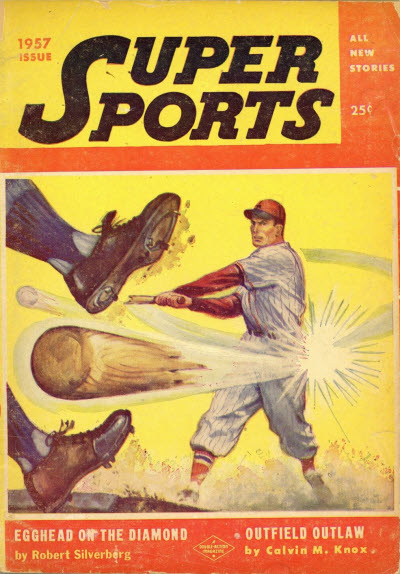
Some of the sports pulps survived till the fifties, and the last ones were published as late as 1957. Some of the later mags include Ten Story Sports and Super Sports.

John Dinan has counted the number of different sports in Street & Smith's Sport Story Magazine. The results are not very surprising: the most popular sports were football, fighting and baseball, with basketball probably the fourth. Tennis, golf, track & field and ice hockey were also popular, but none of them had their own titles like the more popular disciplines, though the basketball titles weren't successful.

Dinan lists some of the better known sports authors, such as Robert Sidney Bowen and William Campbell Gault.  He lists also some authors known for their work in other genres who also dabbled in sports fiction, such as Max Brand, Johnston McCulley and Stephen Marlowe. He also writes quite widely about Robert E. Howard's Dennis Dorgan stories. There were also sports writers who wrote non-fiction for the pulps, such as Jack Kofoed. Dinan seems to have read some of the stories of these writers, but on some others he relies on other sources.

Dinan's book on the subject has lots of fascinating information, but it's not organized very well. I don't know why Dinan has decided to list some of the best known sports novels that have nothing to do with the pulp magazines, and he also claims Paul Gallico was a pulp writer, though most of his stuff came out in the slicks, such as Saturday Evening Post. Dinan's earlier work on the history of the pulp magazines, The Pulp Western, was riddled with errors and an assumption that the pulp mags were aimed for young readers, but Sports in the Pulp Magazines seems more solid in that regard. I didn't check all the details, but you can check some of the facts yourself here at the sports pulp magazine section of the Galactic Central/Fictionmags Index site.

I said at the beginning of this post that I've been thinking about compiling and publishing a sports fiction mag myself. I once had a permission to use one of Stephen Marlowe's sports stories (there weren't many to begin with), but I couldn't get my hand on them. (And then Marlowe died.) Now I have a permission to use a Robert Silverberg story (he wrote a handful in the late fifties, mainly on baseball), but I don't have any! If someone sees this and can send me a xerox or a scan or even a digital photo of a Silverbob sport story, I'd be a happy man! Interim, I've decided to compile an anthology of old Finnish sports stories, as I've come across quite a many while doing some other research on Finnish fictionmags.

More Forgotten Books at Patti Abbott's blog here. Happy Holidays to each and everyone!

Monday, October 26, 2015

Charles Beckman (1920-2015)

I just heard from James Reasoner that Charles Beckman died two weeks ago. He was probably the last real pulp magazine writer alive - I can't think of anyone else, after Hugh B. Cave, Jack Williamson, Frank Kelly, Ray Bradbury, and Elmore Leonard have all passed away.

Beckman's career wasn't straight-forward. He wrote for the crime and western pulps, he wrote for the sleaze houses in the mid-to-late sixties, he wrote for the men's magazines, he wrote for the romance publishers with his wife, he also wrote some non-fiction on jazz - he was a jazz drummer first. Beckman's first published short story was "Strictly Poison" in Detective Tales, October 1945.

Beckman got active just before the end, compiling two collections of his old pulp tales: Suspense, Suspicion & Shockers, and Saddles, Sixguns & Shootouts. I have the first one, but haven't had time to check into it. Note also the new biography Pulp Jazz available from CreateSpace. The book also seems to have a bibliography of Beckman's writing, but I thought I'd also include one myself, here at my bibliographic sidekick blog.

I also published Beckman myself. I put out a small booklet (see above) containing two of his stories, a noirish hardboiled pulp story "Die Dancing, Kid!" (Detective Tales, January 1947) and a more thoughtful "Class Reunion" (AHMM, June 1973). The first one was published originally in Finnish in a magazine called Seikkailujen Maailma (The World of Adventures) and the translator remains unknown. The latter one was translated by my friend Tapani Bagge and published in a short-lived crime fiction mag RikosPalat (CrimeBits) in the late eighties. Both were republished by permission from Mr. Beckman himself, with thanks to James Reasoner and Walker Martin!

Wednesday, November 12, 2014

Some sword and sorcery stories: Robert E. Howard, C. L. Moore, Manly Wade Wellman

A week ago I had a feeling I'd like to read something that wasn't work-related in any way. As usual, I had some trouble finding something suitable to read even though I have some 5,000 books in my shelves.

However, I picked up a Finnish anthology of old sword and sorcery stories, mainly from Weird Tales, but also from some other pulp mags. The book is called Mustan jumalan suudelma AKA Black God's Kiss after the story by C. L. Moore in the book. Of the stories I read, Moore's was the best. It's full of surreal images and still it moves with a breakneck pace. Very beautiful and thrilling. The story came out first in Weird Tales in 1934.

The other stories I read were Robert E. Howard's novella-length "The Black Stranger" (1934-1935, unpublished in Howard's life-time, published in 1953 in abridged form and in 1987 in original form) and Manly Wade Wellman's "Thunder in the Dawn" (Amazing Stories 1939). Wellman's story was a bit slow and dated, I didn't feel the thrill of adventure in this, even though the premise is pretty good: a stone age warrior is really the Hercules of the Greek lore and is the cause of Atlantis sinking in the ocean. Howard's story pits Conan against some pirates and settlers, in the story everyone deceives one and another. It's a great read, though I still preferred C. L. Moore.

The striking cover in the book was drawn by Jukka Murtosaari, a friend of mine, who's studied classical American illustration art for decades now - and it clearly shows. The editor of the book is one Markku Sadelehto, who's done a good day's work bringing American pulp fiction to Finnish readers, as he's edited tons of anthologies for different publishers for over 20 years now. His magnum opus is the edition of the collected stories of H. P. Lovecraft. The sixth and final volume came out just two months ago.

Alas, I didn't have time to read more of the stories from the book. I've read this when it came out some 20 years ago, but don't remember much of it.

Saturday, September 22, 2012

Friday's Forgotten Book: The Mark of Zorro

I've been compiling the new issue of Ruudinsavu (= Gunsmoke), the official magazine of the Finnish Western Society. I've been dreaming about the issue dedicated to the Zorro phenomenon, to the movies and comics and other stuff that's been made about him. It seems like it's now coming true, with me writing the article on Johnston McCulley who originally invented the character and wrote the first stories about him.

McCulley wrote four novel-lenght stories about Zorro, but weirdly enough only the first seems to have been published in book from. Can this be true? And the first one, originally "The Curse of Capistrano", later published as The Mark of Zorro, the title of the Douglas Fairbanks film of 1920, is now available only in the POD edition from Wildside Press. (It's okay, but it has an ugly cover, with McCulley's name written wrong ("McCully") and the book has some formatting and scanning errors.) How can this be? McCulley died in 1958, so his work is technically still under copyright - except seemingly for The Mark of Zorro, since I don't think Wildside Press is paying anyone anything for the rights of book. Is there a problem with McCulley's heirs? I notice Googling around that there's been talk about the collected Zorro short stories coming from Black Dog Books, but so far nothing.

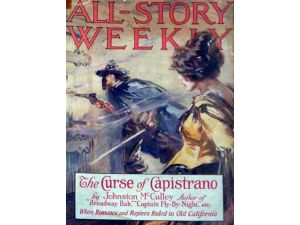
Back to the actual book. "The Curse of Capistrano" was published in All-Story Weekly in 1919, making Zorro one of those long-living heroes originated in the pages of a pulp or other fiction magazine, just like Tarzan or Sherlock Holmes. The story was fast made into a movie and hence the book was getting to be known as The Mark of Zorro.

The book is entertaining, and though it's dated in many ways (Zorro never kills anyone, except one guy in a duel and that's perfectly alright for everyone concerned), it's still a quick read. McCulley uses a highly sophisticated style, one he probably thought suits the early 19th century Spaniards, and at times it's a bit too funny - unintentionally. The book's also staged like a play, with far too few scenes for action and too many of them take place indoors. There are some good battle scenes to make up for the staginess. The basic gimmick - that Zorro and Diego Vega are one and the same guy - is basic knowledge to everyone now, so the book loses one of its advantages at first sight.

I'd really like to read the other McCulley Zorros, but it seems it's almost impossible, unless I pay some real money for the old pulps they were published in. (Make sure to note these Zorro tie-ins from Sandra Curtis that to my knowledge have never been published in English.)

The weird things don't end here, by the way: McCulley's Zorro was never published in Finnish. We've had only the movies and the Disney TV show and Steve Frazee's novelization of it.

Other Forgotten Books at Patti Abbott's blog here.

Tuesday, December 08, 2009

A new publisher, Dancing Tuatara Press

I just want to pay people's attention to a new pulp-related published, Dancing Tuatara Press, that operates under Fender Tucker's Ramble House. Dancing Tuatara Press seems to be John Pelan, who's had his hands in with many pulp-related reprint projects with other publishers. One of the coming books is a collection of Day Keene's old pulp detective stories! (Pelan is asking for help, see below.)

Here are the first Dancing Tuatara books:

http://www.ramblehouse.com/beastorman2.htm
http://www.ramblehouse.com/whistlingancestors.htm
http://www.ramblehouse.com/shadowonthehouse.htm
http://www.ramblehouse.com/sorcererschessmen.htm

Pelan is lacking these pulp stories by Keene and is asking around if anyone has copies:

League of the Grateful Dead - Dime Mystery 2/41
The Island God Forgot - Strange Detective Mysteries 10/41
Cupid's Corpse Parade - Dime Mystery 7/42
Keep out of My Coffin - Strange Detective Mysteries 9/42
$10,000 Worth of Hell - Strange Detective Mysteries 1/43
Brother, Can You Spare a Grave - Dime Mystery 7/44
If the Coffin Fits - Dime Mystery 3/45
Death March of the Dancing Dolls 9/45

Tuesday, February 03, 2009

Animal stories in pulps


There has been a lively discussion at the PulpMags e-mail liston animal stories in the pulp magazines, with which the members of the list meant stories in which the animal is the protagonist, a point-of-view character or even a narrator. Gerald W. Page mentioned many authors who specialized in them: Jim Kjelgaard, Paul Annixter, Anthony Rud, Harold Cruikshank. Rud especially wrote lots of animal stories - Page mentions having read one in which the hero was an Octopus!

Page sums up the genre saying:

Animal stories were almost always short, and generally easy to plot. But I enjoy reading them; and in the western pulps when you come across one they're always much more welcome than another short, hastily written story about a cowboy searching for rustlers or a gunman going up against the old sheriff would be.

Page also mentioned stories with elephants: "There are a surprising number of stories about elephants in the pulps as well. I recall one by Anthony Rud and a few others, more vaguely", he said and continued:

One of the Singapore Sammy Shay stories collected in "South of Sulu," is about elephants. "The Pink Elephant" from the October 25, 1930 Short Stories. There's also a fine circus story about Elephants in the August 1948 issue of Blue Book. It's "Elephant Boss" by Robert Barbour Johnson and concerns the efforts of one of an assistant elephant handler trying to protect elephants from the cruelty of a new boss.

I weighed in saying that I've found a western short story by Bertrand Shurtleff in which the main animal is a seal (called Velveena; I don't know where the seal got her name, since she lives wild in nature) and one story by George Cory Franklin with a horse called Rustler. I think it narrates its own stories - I'm not sure, I should check the original story.

But what especially caught my eye was Morgan Holmes's idea for a dinosaur anthology. When asked, he specified the possible contents:

Let's see, as to dinosaur stories. There are the two by Paul L. Anderson in ADVENTURE. One is T. rex vs. Triceratops. Another is Mammoth vs. Sabertooth at tar pit. There are at least two dinosaur stories in Wonder Stories, ("One Prehistoric Night, and I think another called "When Reptiles Ruled"). There is a Paul Annixter story from ADVENTURE around 1931. You could mine some dinosaur stories from THRILLING WONDER STORIES in the late 30s. There are probably some in the Tremaine era ASTOUNDING. I know there is one from WEIRD TALES in 1930 plus another by Edmond Hamilton (can't think of the title right now). Could always throw in "Before the Dawn" by Temple.

Holmes also continued developing new anthologies:

There are probably enough cave man stories to fill a companion volume. Howard Devore told me at pulp con once about his idea for a cave man anthology. It had the usual suspects as de Camp's "The Gnarly Man" and del Rey's "The Day is Done." I would not be in favor of those two because they are over-known. Go for the more obscure stuff. There is enough cave man fiction in Ray Palmer era AMAZING STORIES to fill a book alone. You could use Paul L. Anderson's Cro-Magnon stories, Robert E. Howard's "Spear and Fang," P. Schuyler Miller's "People of the Arrow." There are some cave man stories by Clifford M. Eddy, Jr., a buddy of Lovecraft's in WEIRD TALES from around 1924. I think there is at least one by Charles Willard Diffin in TOP-NOTCH in the mid-30s. Might be a fun book.

The conclusion:

So we have in theory: PULP DOG STORIES, PULP HORSE STORIES, PULP ELEPHANT STORIES, PULP ANIMAL STORIES, PULP DINOSAUR STORIES, PULP CAVE MAN STORIES, and for the hell of it do PULP TARZAN IMITATION STORIES, PULP BARBARIAN STORIES, PULP LOST RACE STORIES.

Thursday, December 04, 2008

L. Patrick Greene and James B. Hendryx

Here's another posting from pulp fan and SF/fantasy writer Gerald W. Page that he originally wrote on the PulpMags e-mail list. It's about L. Patrick Greene and James B. Hendryx, two old school pulp writers, and their series characters. (Greene on the left.)

As for Finnish translations, I believe Greene has only one novel, Timanttikuilu (published by Uusi Suomi in 1944 [must be the newspaper]), but I haven't been able to determine what the book's original title is. It's set in South Africa, that much I know without looking it up. As for Hendryx, there are some short stories translated from him, and I have an entry for him in my book Kuudestilaukeavat/Six Guns.

Both "The Major" and "Black John" are exceptional series, well written and entertaining, to say nothing of highly recommended.

L. Patrick Greene's stories of The Major are set in South Africa a few years later than H. Rider Haggard's Allan Quatermain stories, which they hold a superficial and sometimes not-so-superficial resemblance to. The Major is an Illicit Diamond Buyer (IDB), active in the theft of diamonds and their smuggling out of South Africa. The adventures are varied and interesting,
with the setting and background adding a lot of flavor to stories that sometimes are rather similar to American Westerns.

The characters of both The Major and the Hottentot Jim are well-drawn and entertaining. Greene's attitude toward native Africans is worth noting. He obviously admires and respects them in many ways, but there is a racist attitude running through the stories that rises a bit above the Colonialist level. The n word occurs quite frequently in the stories -- which is probably nothing more than honest reporting of how people spoke in Rhodesia and South Afirca in the twenties, thirties and forties, but it can be jarring and offensive.

Some of the stories in Short Stories are obviously connected, with recurring villains and obvious plot connections that suggest Greene was writing with the intention of joining three or four novelettes into a book.

The Major stories, as said, began in Adventure but mainly showed up in Short Stories. (Did they appear in England first?) Later stories by Greene in Adventure, as well as in markets such as Fiction House's Jungle Stories, did not feature The Major but are set in South Africa. On the basis of what I've seen he never set a story outside South Africa.

James B. Hendryx wrote Northerns. I've seen a bare handful of westerns from him, but for all practical purposes he was a specialist in stories set in the Yukon Territory of Canada in the period of the Gold Rush of 1898.

Hendryx appeared frequently in Short Stories, Adventure, Argosy and other of the leading general fiction pulps. His Yukon stories are generally related in that he had an assortment of characters who moved from one series to another. His main characters, certainly in Short Stories, were Corporal Downey, a Royal Canadian Mounted Policeman, and Black John Smith, an outlaw and con man who was sort of reformed and now ran a small community close to the Canadian-Alaskan border, where outlaws were welcome so long as they obeyed the law as interpreted by Black John while there. There was also a group of Sourdoughs who appeared often in various stories and series by Hendrix. I recently read a letter by him in Short Stories' "Story Teller's Circle" where he claimed the Sourdoughs were based on actual people he met in the Yukon during the twenties.

Hendryx was a highly professional writer with a good, non-obtrusive style and a graceful way of plotting. He could handle almost any type of story. About two months ago, for example, in either Short Stories or Adventure, I read a psychological short story by him (set in the Gold Rush) that, while not supernatural, was macabre enough that it could have appeared in Weird Tales. But most of his stories seem to be adventures, mysteries, or light humor.

The Black John stories are filled with humor, much of it sly and some of it edging toward black. Black John flees the U.S. after committing a robbery and finds a small comminuty on Halfaday Creek in the Yukon where many outlaws are holed up. Since most of them have arrived under an assumed name -- and since most of them assumed the name "John Smith," descriptive nicknames are added, so that the place is populated by the likes of One-armed John Smith, Pot Bellied John Smith, Red John Smith and so on. Now Black John and Old Cush, the proprietor of Cush's Fort, the general store, have set up a coffee name with slips of paper on which they've written names cribbed from a history book, so the newcomer can draw a name that isn't John
Smith, such as Alexander Jefferson or John Washington.

While Halfaday Creek is close enough to the line between Alaska and the Yukon that a man can avoid the police simply by taking a few steps westward, Black John instigates some rules. No murder, no robbery, etc. It doesn't matter what a man does before he comes to Halfaday Creek, but once he gets there, he better be an exemplary citizen. Black John doesn't believe in going to the law with his problems, so when a man of dubious character shows up, he deals with the problem, himself. And in the event, usually finds himself acquiring the man's ill-gotten gains. These are returned if the thief stole them from some individual or family. But if they belong to a
company or corporation, the money will end up in Black John's cache. Corporal Downey by now knows it's no use trying to arrest anyone in Halfaday Creek; but it doesn't matter because the people who live there don't break the law, at least not now.

If you have access to issues of Short Stories with these stories in them, I recommend them highly.

Thursday, November 13, 2008

Gerald Page on W.C. Tuttle

Pulp fan and science fiction and fantasy author Gerald W. Page wrote a lengthy piece on one of the forgotten pulp Western writers, W. C. Tuttle, on the PulpMags list some time ago. It was intriguing enough, so I asked Gerald (or Jerry, as he signs his posts) for a permission to post his essay here in Pulpetti. (I'll be publishing one of Page's older stories, "The City in the Syrtis", in my fanzine, Seikkailukertomuksia/Adventure Stories.)

In Finnish, there's one novel translated starring Hashknife and Sleepy. The novel in question is Diamond Knife (Timanttiloukku in Finnish, Kirjayhtymä 1968), which seems to have been published in a book form only in the UK (Collins, 1962). I don't know the original pulp appearance. Hashknife's name has been translated as Hakkelus.

There are also three stories in the Finnish pulp, Seikkailujen Maailma, one of them being a serial, "Katoavaa karjaa" in SM 11-12/1960-1/1961 (originally "Vanishing Brands" (originally Adventure, Jan. 1926). The serial stars Red Storm whose name has been translated as Palokärki Storm. The other two stories are "Lapsen ryöstö" (SM 12/1950; with marshall Jim Lane) and "Menneisyys herää elämään" (SM 9/1952) for which I haven't been able to find the original publishing info.

And here's Gerald Page:

W.C. Tuttle wrote westerns almost exclusively, and had at least five or six series going. During most of his career, you couldn't find him in a western pulp. He appeared in the general fiction magazines like Argosy and Short Stories.

His main series featured a couple of wandering cowboys named Hashknife Hartley and Sleepy Stevens. As I understand it, the series started in Adventure in 1917 as humor stories. But they transformed into a sort of easy-going action western typical of Tuttle. Our wandering heroes rode from place to place, always finding a town being overrun by rustlers or swindlers or bank robbers. They were prodded along by Bob Marsh, secretary of the Cattleman's Association, who would make use of them as range detectives - which they insisted they were not.

But Marsh knew that there were two great urges in Hartley's psyche. One, shared with Sleepy Stevens, was a desire to see what was on the other side of the next hill. But the other was an obsession to straighten out (he claimed he wasn't smart enough to solve them) any mystery he came across. The towns would all bear quite a resemblance to one another, as would the people they encountered. There would be an older sheriff, usually honest and with good intentions, though often in over his head. There would be a young man who was in love with a young woman, except that they were from families that their parents were feuding with one another. The sheriff would have a deputy with a sardonic, often somewhat dry sense of humor, who usually helped Hasknife and Sleepy get to the bottom of the mystery. Those deputies were so much alike that they seemed at times to transform the the series into stories about three men - one of whom changed his name but not his description or character, from story to story.

Because of all that, if you read a couple of Hasknife and Sleepy stories, you get the impression that there's not much there. But if you read several of them, it seems to me, you begin to detect small pleasures in the way Tuttle handles the formula. He has a fair, if unadventurous, knack for characterization, and his female characters can be quite original on occasion. At least they have the ability to occasionally surprise the reader by not being the same sort of cyphers female characters usually are in this sort of story. And though he doesn't write detective stories - his heroes usually guess the plot and a dying outlaw confirms it for them - he writes damned good little mysteries. These stories can be addictive and you quickly understand why they ran in the better pulps.

The Henry stories are even better.

Henry is Henry Conroy, a vaudeville comedian who comes across as being a lot like W.C. Fields. When vaudeville collapses, Henry finds himself stranded in a small town in Arizona. As a joke the townfolk elect him sheriff and as a joke he does a pretty good job. To go along with the spirit under which he was elected, he hires the town drunk as his deputy. The stories feature a lot of humor and for that reason, as well as the character of Henry himself, the formula sheriff vs. badguy stories take on a freshness that makes them seem more original than they are. I think a lot of people who hate westerns would enjoy the Henry stories. Those who like westerns would like them, too.

The Henry stories were set in the twentieth century, though much about his Arizona town seemed to have changed little from the nineteenth. Hashknife and Sleepy seemed occasionally to be working in a contemporary world, and occasionally to be definitely in the old west. You sometimes wondered if Tuttle actually knew what period he was writing about.

During the twenties and possibly into the thirties, Tuttle's main hero was a man with the unlikely name of Cultus Collins, a range detective and lawman who appeared in a number of short novels in Adventure, Short Stories and the like. Collins faded out. He reappeared in the 40s in a Hashknife and Sleepy story where he and Hashknife take down a gang of smugglers running drugs into the States from Mexico. I think that was Collins' swan song, though certainly not Hashknife's.

There was a series by Tuttle in the late forties and early fifties in Exciting Western about a couple of cowboys who seemed to be Hashknife and Sleepy played for laughs. I can't find a copy of Exciting Western to check their names right now. They were notably dumber than their horses and you wonder how the heck they could ever actually solve a mystery. There was also a series of short stories (Tuttle mainly wrote at around 20- or 25,000 words, a pretty good length for the kind of thing he wrote) in Argosy about a western town called Dogieville where the inhabitants would try out something such as a sport (baseball, foortball, etc.) or otherwise get involved in some comedy of errors in each story. At 5,000 words or so these stories are entertaining. But while Tuttle was often pretty good at lacing a "serious" story with humor, his attempts at outright humor often seemed strained. He didn't always write westerns, by the way. I've read two baseball stories by him, both about a pair of really stupid umpires working the minor leagues. They try much too hard to be funny and I don't recall them often succeeding. Ring Lardner and Robert E. Howard did it better.

I suspect a lot of modern pulp collectors, when they sit down to read a good story, pass up Tuttle. I suggest you give Henry a try - and if you can read two or three of them, Hashknife and Sleepy. Tuttle never takes himself too seriously and at least in the short novel length, never takes himself too lightly, either. He can be a lot of fun.

Saturday, August 09, 2008

Alan G. Ampolsk on his father, true crime writer Bud Ampolsk

Some months ago I wrote about Art Crockett who wrote for the crime digests of the fifties and sixties here. I just received a comment from Alan Ampolsk, who is the son Bud Ampolsk, mentioned in my post. Bud Ampolsk wrote for the same mags and also did some editing, and I asked Alan his permission to post his comment on top of the blog. Some of the pennames he mentions may have been unknown before this.

Apologies for the late-arriving comment, but I've only just discovered your post. Bud Ampolsk was/is my father (for more on the indefinite tense, see www.dementianights.com). Art Crockett worked for him on most if not all of the books you mention - my father was editorial director, and Crockett was an assistant editor. Later the roles were reversed - in the 90's my father worked for Crockett.

Gerald's information is mostly accurate but his chronology is off on one point -- Crockett didn't move in sequence from the men's adventure books to the western to the crime books. They were all produced simultaneously, and Crockett worked on all of them. The publisher was Reese Publishing, which at its height was putting out 17 monthly titles (including the men's books -- they used a different corporate name for them but it was the same organization). My understanding is that Crockett worked on all of them throughout. He wound up as editor of the crime books at a time when Reese had folded most of the other titles, so that's why it seems that he moved from one to the other.

You won't find much of my father's stuff under his own name because - apart from some of the late true-crime work - he used a variety of pen names, including Don Unatin and Bill Ryder.

I'd be glad to try to fill you in more, as best I can. Unfortunately my father isn't able to remember any of this anymore, but I can work from what he told me and what I lived through. I hope that's of some value.

PS. It seems that linking to the Fictionmags Index doesn't work, since the index is in constant state of being updated. Putting up long bibliographies here on Pulpetti wouldn't work (even though I'm known to have done it to great success), so I created another blog: Pulpetti Bibliographic Section. Here's the biblio for Art Crockett's and Walt Hecox's (mentioned in the original posting) crime stories and here's the biblio for Bud Ampolsk's stories under the pennames his son mentions above.

I'm going to talk about these writers with Alan later on and I'll post here what comes up.

Tuesday, March 25, 2008

Unsung pulp hero Art Crockett

Some weeks back James Reasoner wrote a review of an issue of Two-Fisted Detective Stories on his blog, and I couldn't help noticing that one of the writers in that magazine was one Art Crockett. I remembered having seen the name somewhere before. I did some brain-work and I sure remembered that it was in the introduction to a true crime anthology Murder Plus that was edited by Marc Gerald in 1992.

Gerald writes about the time when he was recruited to work for True Detective magazine that was focused on true crime. He goes on for quite a while about Crockett:

My boss was Art Crockett. Pushing seventy, he wore a fedora over his horseshoe of hair and a cardigan vest over white starched shirts. He walked with a cane, had a lame eye, a wisecrack for every occasion, and a two-pack-a-day
cough though he'd recently cut down to a half a pack a day. Doctor's orders.

If Art looked and acted the part of the wizened, tough-guy editor, he had a right to. He had lived the life.

Raised a few blocks up from our office, Art received a Bronze Star and a Purple Heart as a radioman with the 100th Infantry Division in World War II. After his discharge, he worked a series of unsatisfying jobs - in a salt factory, a refrigeration plant, and as an elevator repairman. Then, with a wife and two kids to support, Art quit his day job, rolled the dice, and began hammering out plots fast and for money - a penny a word.

His first stories appeared in second-generation detective fiction pulps like Manhunt, Pursuit, Menace and Conflict. In the early 1960's, he edited a bizarre string of
sex-cum-violence magazines, unreasonable facsimiles of legitimate men's adventure titles like Argosy and True that featured lavishly illustrated covers of dolled-up girl-Nazis equipped with leather, whips and chains. When they folded, Art left for greener pastures of the True West publications. It was a short stay, for they, too, closed up shop, and when they did he turned to True Detective.

Art was a considerable literaty talent although thirty-five years of high-speed writing had taken its toll. When necessary, he could still knock out a masterful yarn. Mostly,
he just churned out tawdry blurbs and titles on his Royal manual, circa 1936, something he could do like nobody's business. ("The poor joker on the floor was literally beaten to death. That was bad enough. But what his blood-dimmed eyes beheld before the end came may have been even worse." Or "It was the ultimate humiliation for the man who was obsessed with sex, and no power on earth could stop her as she approached him with her menacing knife.")

Gerald also says that Crockett died of a heart attack in June 23, 1990. If Crockett was in his seventies in 1988, when Gerald came to work for True Detective, he must've been born in 1918 or thereabouts.

Gerald mentions also other writers who wrote lots of true crime stories: Jack Heise, Bud Ampolsk, Bill Kelly, Bill Cox and Walt Hecox. Of the names, I can find real fiction writing credits only for Walter Hecox. (The Bill Cox here seems to be Bill G. Cox, so he's not the pulp and paperback writer William R. Cox.) Gerald calls Jack Heise "all-time pulp great", but I can't find any support for the claim of him being a pulp writer. But then again, Gerald seems to equate true crime mags and pulp mags. (This guy may be the same Bill Kelly Gerald refers to.)

Here's a list of Art Crockett's and Walter Hecox's crime stories from the Fictionmags Index.

By the way, Gerald's book is a great anthology: it features stories by writers like Robert Bloch, Jim Thompson, Bruno Fischer, Lionel White, Dashiell Hammett and Harlan Ellison, almost every story being pulled from a true crime magazine. Mention is also made of Charles Burgess and Robert Faherty, whose rare entries in book-length writing Gerald speaks of admiringly. Has anyone read Burgess's The Other Woman, published by Beacon in 1960, or Faherty's Swamp Babe, published by Crest in 1958?

Edit: Based on what Allen Hubin found, it seems probable that Art Crockett was born in 1921.

Tuesday, January 15, 2008

I.G. Edmonds's Big Eye books

I promised to say something about Ivy Gordon Edmonds's private eye books that have apparently been published only in Finnish. It took me quite a while to grasp that this was the only possibility for the books to exist and not to be found in the English crime fiction bibliographies. As I got confirmation from the Scott Meredith Literary Agency, this proved to be 100 % correct (even though they didn't know the books were published in Finland, and it seems they were not published in Sweden or Norway, even though that's what their records state).

Edmonds's hero in these four books is Greg Graves, private eye called Big Eye. He got his moniker from a reporter and is not pleased with it. He owns the Seven Seas investigation office and says that his holy things are "money, scotch and beautiful dames" (as if you didn't know that by now). He seems to be a bit of woman-hater, though, since he also says: "The women-hating hermits are the only real wise men in this crazy world."

It seems to me that the Big Eye books are parodies of the P.I. genre and the clichés it had reverted to in the fifties and the sixties. The Big Eye books remind one of Richard Prather's Shell Scott books, but are not anywhere near as funny.

There are four books translated in Finnish. I don't know the original writing years, but I should suspect they are from the early sixties and had been circulating around the paperback publishers before they found their home in the Northern Europe. One wonders why a cheap paperback publisher like Beacon didn't take these, or even a cheaper one, like Kozy Books. Maybe someone could dig these up and publish them in English for the first time... Hey Hard Case! If they only were better and funnier.

Big Eye and the Torrid Target, published as Etsi sinä - minä tapan (You Find - I Kill) in 1970, starts when Big Eye receives a call from a stripper, who says Big Eye is going to get killed. In Big Eye and the Scorched Bikini (Tulenarka bikini) Big Eye finds a curvy dame in his office, with a literally scorched bikini on her. (I don't have notes for the other books, it's possible I never read them.) The books, or at least some of them, were published with Robert McGinnis covers, which makes them rather nice.

There's also a war paperback published as by I.G. Edmonds, called The Devil Cheaters (Pirullinen tehtävä), that hasn't apparently been published in America.

I have I.G. Edmonds's address and will write him a letter later this week and will ask about these books. Will let you know if he answers!

Here's the bibliography:

Etsi sinä — minä tapan. Transl. Aila Virtanen. Viihdekirjat: Tapiola 1970. Originally Big Eye and the Torrid Target. 1969. [The original year is given in the book, but that must've been the year of the sale.]
Kuumaa tavaraa. Transl. Ritva Rekola. Viihdekirjat: Tapiola 1968. Originally Big Eye in Kiss or Kill.
Tulenarka bikini. Transl. H. Suikkanen. Viihdekirjat: Tapiola 1968. Originally Big Eye and the Scorched Bikini.
Villikissa. Transl. H. Suikkanen. Viihdekirjat: Tapiola 1967. Originally Big Eye and the Naughty Nudes.

And the war novel:

Pirullinen tehtävä. Transl. H. Suikkanen. Viihdekirjat: Tapiola 1967. Originally The Devil Cheaters.

Tuesday, December 18, 2007

Paul S. Powers, a review by Mike Ward


Mike Ward posted this review of pulp writer Paul S. Powers's hardback Western novel on the Fictionmags e-mail list and I asked for his permission to reprint it (it's not actually a reprint, since this is not a print media...). He said "yes", so here it is. It's pretty long. Here's a site dedicated to Paul S. Powers, who hasn't been very known even in the pulp fandom. Thanks to his daughter, his biography is easily available. Some of his old Westerns seem to be in print, though.

Review of "Doc Dillahay" by Paul S. Powers
Original hardcover publication: MacMillan, 1949


John Dillahay, Arizona rancher's son, teaches school, becomes a doctor, and marries the love of his life. Along the way we find he's a crack shot, a tough brawler when he needs to be, a smart medical man, and a faithful supporter of his friends.

I won this book as a prize in the most recent PGDF text-analysis contest, and I was going to write a basic review of it. But I discovered I don't need to, as someone has already written it for us:

http://www.amazon.com/Doc-Dillahay-Paul-S-Powers/dp/B0007EXZL0

The Amazon reviewer has read Powers' autobiography, and his comments about the book are informed by knowledge of the background story of the writer and his work.

While I was searching the web for further background on the author and the story, I was startled to discover Powers was a rare-book collector (what kinds of books? what happened to his collection when he died?!?!), and that he ended his days working in a bookstore in Berkeley CA -- where I almost certainly bought books from him.

http://www.azstarnet.com/altds/pastframe/accent/203592
http://www.presstelegram.com/ci_7294573

A small number of his short stories are currently indexed in the FMI:

http://www.philsp.com/homeville/FMI/s1843.htm#A72430
http://www.philsp.com/homeville/FMI/s1567.htm#A60962

All that said, I'll now do a meta-review of the book:

1. A novel, or a patchwork of short stories?

When a short-story writer does a novel, he needs to be careful that he isn't writing a bunch of shorts about a common character. This is exactly what short-story writer Powers did here.

We meet young John Dillahay, and he begins to grow wise. His odyssey from youth to medical school to adulthood is explicitly divided into "Book 1" and "Book 2," with most of medical school happening during the blank pages between the two sections. Many little things happen that shape succeeding events. Conflicts provide opportunities for growth. "Doc Dillahay" would segment easily into a TV miniseries; there may even be enough episodes for a thirteen-week season.

On the other hand, I hereby state that it's a novel. "Huckleberry Finn" and "Moby Dick," are just collections of episodes around central characters, and these are the stuff of Great American Novels. You have to be careful about this.

John Dillahay grows up; he chooses a career. He finds a mentor in Doc Ledinger, and their relationship is central to the rest of the book. Here I mention that the mentor is a crusty old geezer, a medical practitioner with a mysterious past, who is fully competent except when he is on one of his six-day drinking binges. By John's example, as a man who can survive bad luck without escaping into the bottle, his mentor is redeemed and becomes a grown-up again. Ledinger becomes an alternate
father-figure, who teaches him all he knows and then makes it possible for him to continue learning at a distant academy (where he will soon know more than his guru).

John goes off to medical school, and returns to take his place as an adult. He survives conflicts, both small and large. By the end of the book he has resolved the power struggles that he is party to: some by acceptance, some by negotiation, some by triumph, and even a couple by losing.

He loses the love of his life (so far) to his own brother.

John's birth father becomes sick, while John is far away at medical school. John is unaware of this, and therefore unable to help him' he is thus implicitly guilty for whatever happens to his father. Back in Arizona, a degreed doctor, still he is unable to keep his father from dying, of a disease far beyond the powers of currently modern medicine to cure; he curses his and medicine's ignorance for their failures.

He comes to a better understanding and acceptance of his place in the universe. He, along with most of the other surviving characters, achieves a happy ending. His adopted father-figure marries John's mother, thus becoming his father in fact. Calling Dr. Freud.

Our boy John discovers the true love of his life has always been near him since the earliest chapters. We all just need to look around us.

2. What's the book about?

Personal growth.

Medicine, specifically medical practice in the American western frontier, its strengths and its limitations. There's enough of this to make it kind of a novel about science. Powers used his childhood memories, of his father's medical practice, to make it all seem real in 1885 Arizona.

Family: support for the members of; betrayal and forgiveness; extension of familial group by adopting or marrying (as when his brother marries the niece of his father's business enemy); tradition; foreswearing of tradition.

The American West: It's not all (or even mostly) about gunfights at the corral. Mostly, the West was about families.

Alcoholism and the effects of alcohol on the western frontier. Alcohol as an internal escape, mirroring the external escape from the civilized parts of America. Alcohol as the destroyer of lives: John's dependence on his mentor provides the justification for his mentor's successful battle against binging and benders. The author is said, in the autobiography, to have had personal experience with alcohol.

Surpassing your father's estate (another call for Dr. Freud): John becomes a successful doctor, while his father fails as a rancher, just as he had failed before moving to Arizona. Was Powers working out personal family issues here?

Although his father is successful in organizing the small ranchers against the rich man's combine, he's forced to abandon ranching and take up storekeeping-a lower status occupation. There's an echo here of his parent's move to Arizona after earlier problems in another state; and this in turn echoes the long-ago move of the de la Haye family to Ireland -which led to an earlier reduction of the family's status. Family, again: maybe his father isn't anything much, but by heaven the
de la Haye family was pretty hot stuff back in Norman England.

3. Why did the author write the book?

Money, career, personal growth.

To work out personal family and career issues. Why am I here? Why is my market for short pulp fiction going away? What am I going to do about it? Why wasn't my Dad like Ludwig Ledinger? Or maybe he was, in the wrong ways.

4. Yucca City == Tombstone? Not exactly.

http://en.wikipedia.org/wiki/Gunfight_at_the_O.K._Corral
http://www.ghosttowns.com/states/az/tombstone.html

5. Doc Dillahay == Doc Holliday?

Nope. Dillihay may be Holliday spelled sideways, but I think Powers chose the name simply for its evocation of Arizona history. Holliday was a dentist, and more or less contemporaneous with Doc Ledinger, our protagonist's guide, role model, and mentor. Our boy John was just learning the ropes.

6. Mainstream work from a pulp writer?

Apparently so. Well, mainstream, if you consider a western a mainstream book.

Our author included a couple of jokes at the reader's expense, or maybe they were simply old WILD WEST WEEKLY tropes he couldn't shake. Hero John can beat up one of his larger and more noxious students, throwing him, deservedly, into the cesspit. He can shoot three cans tossed into the air with his pistol, Bam Bam Bam, just like that. He is, in fact, the best shot around; and him just a young feller; he outshot the cartridge salesman, we're told. In fact, his friends suggest a career as
a trick-shot marksman would pay better than doctoring.

During the big gunfight at the end of the book, John takes a brand-new rifle from the store (with the price tag still on it, so he knows it's in good condition!) and carefully wings all the bad guys attacking the Marshall and company holed up in the newspaper office. Dillahay reluctantly kills the syphilis-maddened Cullen La Mar, and his mentor Doc Ledinger reappears on the scene: not dashed to bits at the bottom of the mining pit, as everyone had feared, but safe and sound, having hidden in the outhouse during the battle.

7. Did you like the book? If so, tell why. Should I read it?

Yeah, it was worth the time spent. The sections about medical practice in 1885 are almost science-fictional; certainly they're fiction about science and technology. The American West background is interesting and well-drawn. The main characters generate some empathy in the reader; they are self-consistent and show human traits. Few of the things they do make the reader cringe for their stupidity. (Sometimes we cringe for John's obliviousness to things going on around him, but in these cases
it's an author's device to foreshadow later events.) You could read it and enjoy it.

Monday, November 26, 2007

Stuff about Finnish pulp fiction

I posted on another blog a bunch of entries I wrote for Thrilling Detective many years ago - but Kevin Burton Smith declined these, since they didn't meet his criteria for a private eye. One of the entries has a real P.I., though (Richard Rauta) - I'll have to rewrite it for Kevin. The foreword in the post is in Finnish, the rest are in English.

Wednesday, October 10, 2007

Frank Castle's Sowers of the Doom

Here's a book that has been somewhat puzzling to bibliographers, henceforth me. It's not known to have appeared in English at all, even though Castle was a paperback writer who published a lot of books in the fifties and sixties. The original title is given in the verso page: The Sowers of the Doom. Yet there's no book under this title.

Castle's book wouldn't be the first one. There are several examples of American paperbacks having been published only in Europe or even only in Scandinavia. When I was doing my Pulpografia, these books puzzled me as they'd puzzled Simo Sjöblom who'd done a massive bibliography of crime fiction in Finnish.

The books were a puzzle until I managed to make contact with Bruce Cassiday. He'd been writing pulps and paperbacks since the fourties and my letter found him near his 80th birthday. I contacted him because there's a Finnish paperback called Vain viisi tuntia (= Only Five Hours), with the original title given as The Heister. Yet, The Heister is not known to have been published in English. I wrote Cassiday asking about this and he wrote back saying that he and his agent couldn't sell the book that he'd written already in the early sixties in the US. They shopped it around in Europe. It ended up being published in Finland in 1968 and in Norway in 1971 as Blindgaten. Cassiday remembered it was first published in Sweden, but that appears not to have been the case. I sent him the Finnish copy of the book and he thanked me kindly sending me a chapbook collection of his old pulp crime stories (published by Gryphon Books).

After this I took a closer look into some books. Dean Owen's Hot Line, several WWII paperbacks by Robert Sidney Bowen, a spy novel by Joseph Chadwick, four P.I. novels by Grover Brinkman, another P.I. series by I.G. Edmonds... all turned out to be published only in Finland (some in Sweden, some in Norway). There are some that are certain (such as Brinkman and Edmonds), some that are not so certain (Dean Owen, Chadwick, Bowen).

For some reason or another, I didn't look into Frank Castle. Don't know why. I wrote about him later in my Kuudestilaukeavat/Six Guns that's about Western paperbacks published in Finnish and noticed he was hell of a writer. I highly recommend his Guns to Sonora (Berkley 1962), it's hardboiled and it's noir and also lots of violent action fun in which everyone tries to deceive each other. Also very good is Brand of Hate (Tower 1966). I have notes of Blood Moon (Fawcett 1960), but I don't remember reading it.

Not much is known about Castle. He started out in the late fourties writing for the pulps, mainly mags like Fighting Western and Leading Western. He also wrote for Ranch Romances. I don't know for sure, but I don't think these were grade A western pulps. He moved into paperbacks alongside tons of other authors when pulps died in the early fifties and penned also lots of crime novels, mainly for Fawcett Gold Medal. His Move Along, Stranger came out in 1954 and was his first Gold Medal offering. He also wrote westerns for the Ace Double line. Castle's known to have used Steve Thurman as his byline. Castle faded out in the late sixties. My notes say his latest novel is Lobo that came out in 1969 (from Belmont). I don't know what happened to him.

Sowers of the Doom must by from the same era or maybe from the mid-sixties. It came out in Finnish in 1971 and the copyright says "1970". Wouldn't bet on that. The book starts out pretty crisply (I'll try to translate back into English):

Cleve Haig sensed the death moving in the desert. He could smell it in his nostrils, he tasted it his mouth - and for the first time in his nice life he felt completely helpless: the woman behind him was pressing the gun barrel hard against on his back.
Cleve Haig is a millionaire's carefree son, who gets hijacked into the world of international intrigue and spying. There seem to be some terrorists on the loose in the American soil - and they have atom bombs. Cleve Haig joins the extra unit that fights the terrorists and falls in love with a woman who's also in the unit. Her husband has been reported killed in action, but there are also some doubts about her being a traitor.

Maybe it's the Finnish translation (they weren't always very good and many were abridged), but the book is a bit boring. It moves pretty fast, but the plot seems overtly complicated and the persons never come out alive and distinctive from each other. There are some nice action scenes throughout the book, but it's not very engaging in the whole. Maybe Castle wrote it in 16 hours - it certainly reads that way.

But nevertheless, I'd really like to know more about this and Frank Castle's fate. What came of him and what urged him to write his great noir westerns? And as I haven't read any of his crime novels, I'd like to hear about those. (And no, he didn't become The Punisher.)

Thursday, October 04, 2007

Lending libraries in Germany

Jürgen from Hamburg sent this to an earlier post and I thought it should pay to be published properly:

Thanks, Juri, for your inspiring blog. It's quite new to me and I enjoy seeing pulp from a Finnish point of view.
Lending libraries specializing in pulp fiction and subsequently publishers doing the same thing seems to be a phenomenon from the the 1930s to the 1960s. In Nazi-Germany they were flourishing as well with only the war putting an end to that. After the war it took on a new lease of life. 220 different publishers produced about 30 to 40 thousand individual titles from about 1950 to 1970. These titles were not available at bookshops, only at one of the 28.000 lending libraries in Western Germany. All that's left now is a small community of collectors. At Ebay there are always more than 300 titles of "Leihbuecher" available.
Juergen
Hamburg

Monday, September 17, 2007

Thursday, August 30, 2007

Joe L. Hensley dead and my grief about it

I read today that American author and jurist Joe L. Hensley died recently. I've never read anything by Hensley (unless a short story in an anthology), but I know the rough outline of his career and am pretty sure he was a good writer and a good man. Regardless of my pretty small knowledge of him, there's a sense of loss for me.

You see, I've been planning a one-off fiction zine to go along with Isku and my other fanzines. This one would be a sport story zine. Sport stories were a major genre in the original pulps and there were still some sport novels in the paperbacks of the fifties and sixties (and even in the seventies). Lots of writers known better from some other genres wrote for the sports pulps: Lester del Rey, Evan Hunter, James Blish, George O. Smith, William R. Cox... And these were intended for adult readers, not for kids, like sports literature in Europe and Finland quite easily is. Some of the stories were hardboiled in tone, some had crime and even murder in them. And I would've liked to try do a fiction fanzine with only sports stories in it. Maybe three or four Finnish ones, with one maybe a reprint, and of course a story from the vintage pulps themselves. Not a huge seller (as if my mags were huge sellers anywhere), but perhaps fun to do.

And Joe L. Hensley was one of the few writers alive who did stories for the sports pulps. I'd been thinking that I'd try to contact him - I believe I could've got his address or even e-mail quite easily. Then I would've written to him and asked him a permission. Then I'd have had to hunt for a suitable story. I know lots of pulp collectors and some collect sports mags, even though they don't seem to be very collectible in the US.

But no. With Joe Hensley gone, there's no one to ask.

(Well, on second thought, there's Robert Silverberg and then there's Milton Lesser, who's better known as Stephen Marlowe. And Robert Madle, who's also written some science fiction.)

Thursday, July 12, 2007

A major disappointment

I've given out misleading information. I thought Paul Malmont's The Chinatown Death Cloud Peril would be great, just what I wanted to read - but no. Hell, not indeed! I had to drop it even though I'd managed to make over the first half. The idea of writing a book about a couple of thirties' pulp writers (namely Walter Gibson, the creator of The Shadow, Lester Dent, the creator Doc Savage, and L. Ron Hubbard, the creator of, well, Dianetics; if you didn't know, he was a very prolific pulp writer in the thirties) is thrilling and intriguing, but Malmont can't get much out of it.

The book would've been better if Malmont would've written a mainstream novel about these authors and dropped the pulpish action bits which he couldn't handle interestingly enough. He has to resort to subplots and such which make the book slow down. Even the beginning, which should set the tone and put forth the mystery, didn't really grab my attention. The best scenes are with L. Ron Hubbard, who is clearly a liar and an opportunist, but it seems that Malmont holds the man in high regard based on what he says in his afterword.

What troubled me most is that Malmont felt necessary to drop authors' names and histories of publishing houses, such as Street & Smith. Some of these are absolutely unnecessary, such as mentioning Norman A. Daniels in one paragraph. And Malmont has a very annoying habit to make people talk about these matters in length in dialogue (one of the most boring scenes is the one in which L. Ron Hubbard talks about writing science fiction to a guy called Robert Heinlein who, in the book, hasn't as yet started his career as a novelist). It reminded me of goddamned The Da Vinci Code!