Tuesday, October 30, 2012

Tuesday's Overlooked Movie: Straight to Hell and assorted Western-themed oddities

Some weeks ago we held the annual summer meeting of the Finnish Western Society in which I've been the chairman for over ten years now. What we really do is publish the magazine called Ruudinsavu, meaning Gunsmoke, with articles, essays and reviews of all things western. In our annual summer meetings - this time not held during the summer, as you can see - we have a habit of watching some pretty stupid and outlandish western films, such as The Terror of Tiny Town or the Czech Lemonade Joe. This time we watched - or actually tried to watch - some five films. We really failed at three. Here's a lowdown.

The first one was Winnetou, the German-made film with Lex "Tarzan" Barker in the lead as Old Shatterhand. The scenery of the film shot in Yugoslavia was very nice and there was some nice action, but we had the film only with the Bulgarian subtitles and it wasn't even dubbed in English, so we pretty much gave up on it and went to sauna. [Edit: I fixed this bit, since it was explained to me that Barker played Old Shatterhand, not Old Surehand - just have to wonder where Karl May picked the names for his characters!]

After sauna we ate chili with tortillas and watched Alex Cox's Straight to Hell (1987), a film I'd always wanted to see, but for some reason always failed. I've liked everything I've seen by Cox (especially Repo Man and Highway Patrolman), but this proved to be a disappointment. Well, it was said to be disappointment already when it came out. There was still some pretty cool and outrageous pre-Tarantino violence and some familiar faces throughout the film. Not much sense in any sense of the word, though.

Then we tried to watch the only really good film in the bunch, the Portuguese sardine western (cf. spaghetti western) called Estrada de Palha, Hay Road in English. The story about a Portuguese translator of Thoreau trying to right some wrongs with his rifle reminds one very much of Budd Boetticher's and Monte Hellman's minimalist westerns, but it was so slow-moving the other guys didn't want to watch it. Here's the trailer, though.

Our host, Sami, had bought some Turkish pirated movies some years back and one of them was western-themed. I forgot the title already, but it was about a stupid jerk who truly loves his westerns and wears a Stetson all the time and beats the big town baddies just with his luck. Without any titles, we gave up on this pretty soon. I don't really know why we even tried. It was fun for the first 15 minutes, I guess.


The last film - and we were pretty wasted at this time - was the godawful The Legend of Alfred Packer (1980) that looks like some guys from the small town summer theatre get lost in the desert during winter and start eating each other in scenes that are lit only by candlelight. There's no word to describe this atrocity, but we did have some fun with it, especially with the beards everyone's wearing. I don't know why, but the ancient Finnish VHS cassette boasts the director of the film has won the Academy Award (actually it says he won the "Oskar", whatever that is), but I didn't know there were those for the worst films.

I think the other guys were left watching the 1994 Bad Girls, but I left home to get some sleep. It was a fun night, but not for everyone.

More Overlooked Movies here.

Wednesday, October 24, 2012

New publications

I just picked these new publications earlier today from the publisher and the printers. From the left: a small collection of Olavi Karjaliini's really weird stories from the 1830's, the new issue of Seikkailukertomuksia / Adventure Stories and the small booklet containing my translation of Ray Banks's hilarious PI story "Dirty Barry".

The Karjaliini book is a true oddity. I was going to publish it myself, but then it came to me to ask my regular publisher Turbator if they wanted to do it. And they did. These are very crudely written stories in dated vernacular, published in Elias Lönnrot's (the guy who did Kalevala) magazine Mehiläinen / Bee. None of them have ever been published in antiqua font, so I typed them up and wrote a short foreword. Turbator did a print run of 100.

The issue of Seikkailukertomuksia is the fifth and it will be the last one as I simply don't have enough time or energy to do these things or to broaden the reader base. The issue contains six stories:

Jussi Katajala: Hämäys (a new western short story by a good writer)

H. de Vere Stacpoole: Ihmeellinen muisti (published originally in Finnish Kiki 12/1929, translation by unknown, a mystery story by classic of the adventure genre, but I've been unable to locate the original title)

Iisakki Evä: Bora-Boran valkeapää: kertomus Etelämeren saarelta (published in Lukemista Kaikille 23/1934, originally probably a Swedish story, based on the fact that the story is accompanied by illos by a Swedish illustrator, Gunnar Ljungdahl - nevertheless the first real zombie story in Finnish I've encountered!)

Eino Leino: Laulu Vuorilammella (published in the book called Päiväperhoja, 1903), a weird, somewhat horrorish short story and a political allegory from the classic writer whose short fiction I've earlier published in Isku and Ässä

Juri Nummelin: Valkoisten jättiläisten valtakunta (the last installation of my sword and sorcery serial with the last Bjarmian in the lead, facing some white giants and their squid-like leader; will publish the serial later on as a paperback, fully edited and rewritten)

Hannu Väisänen: Mannerheim vignettes (some short-short stories about Marshal Mannerheim and his encounters with the classic adventure fiction heroes)

As for Ray Banks - well, he's Ray Banks. Go read the original story in English, it'll do you good. Both of my publications have very limited print runs. 

Friday, October 19, 2012

Friday's Forgotten Book: Robert Colby: The Captain Must Die

Thanks to Kindle and Prologue Books, I was finally able to read this magnificent crime paperback by Robert Colby that has been getting praise from the likes of Ed Gorman for some years now. I've earlier read some very good short stories by Colby and his paperback novel Beautiful but Bad (Monarch 1962), but this one has eluded me. Not anymore, of which I'm very glad.

The Captain Must Die (Gold Medal 1959) is one of those late fifties to early sixties noir paperbacks that tell about paranoia, broken dreams and people's hatred towards each other. This is firmly set in the world of well-being suburbs and tells about what's going behind the happy facade. This is also about the effects of war and the frustration that it breeds. Colby weaves his plot smoothly, albeit he has also fragmented it in a way that seems way ahead of its time - at least for a 50-year old crime paperback! Some scenes are very exciting and suspenseful. The ending may a be a bit too happy, though. (The cover lets us suppose it's a war novel. It's not - the war is in the background all the time.)

Here's Cullen Callagher on Colby's novel, and here's Ed Gorman, calling it a masterpiece. Here's Peter Enfantino's essay on Colby. Load the novel here. (And congrats to Prologue Books for doing this. There were some formatting and scanning errors in the Kindle version, but not so many that I'd actually complain.)

More Forgotten Books here.

Tuesday, October 16, 2012

Tuesday's Overlooked Film: The Strange One (1957)


I think this one really qualifies as an Overlooked Film, especially in Finland, where it's never been shown in the Finnish Film Archive's screenings and it was last seen in TV in 1971. There is a rather recent DVD, but there hasn't been much talk about the film, at least in the venues I follow. I managed to see the film last Monday, when it was - for the first time, I believe - shown in the Film Archive screening here in Turku.

The Strange One was made in 1957, during a time when there was discussion on the new wave of American film making and the likes of John Cassavetes, Shirley Clarke, Lionel Rogosin and Irving Lerner. Jack Garfein fits the bill perfectly. The Strange One is a somewhat noir-influenced film about sociopathic Ben Gazzara who bullies other cadets and freshmen around a military academy somewhere in the South. Gazzara, making his film debut here, is simply wonderful in his moves and gestures. He's great in that he makes sure he's actually the only likable character in the film, albeit his misanthropic attitude. All the other characters in the story are stupid or irritating, so the viewer gets to sympathize the wrong guy. There's a strong noir undercurrent in The Strange One, one we know from the work of Jim Thompson and Jason Starr.

You probably realize that "The Strange One" refers to homosexuality - the title could be given to a gay/lesbian sleaze paperback of the early sixties. There's lots of homosexuality in The Strange One, from the latent homosexuality manifested in Gazzara's violent threat to the obviously homosexual writer of the barracks who wants to call Gazzara "Nightboy", clearly a queer moniker. The depiction of homosexuals in the film isn't overtly sympathetic, though.

The ending of the film could've been stronger, but it also has a surprise not many can see. This is based on Calder Willingham's novel End as a Man - I have it, but have never read it, any comments on it? The script was also by Willingham, from the play he made from the novel.

The Strange One is an alluring film that was ahead of its time in its depiction of homosexuality and sociopathic behaviour behind the walls of an institution. Some have said it's an analysis of American fascism. Whatever name you give the phenomena it depicts, The Strange One is still a powerful film in its own, marred only by some staginess and some overblown acting. What's most curious about the film is that the director Garfein is an Auschwitz survivor! His other film, almost dialogueless Something Wild, seems also very interesting.

More Overlooked Films here.

Friday, October 12, 2012

Urban Waite: The Terror of Living

This debut novel by the 28-year old writer made its way, rather surprisingly, into Finnish. It's a very good crime novel, reminiscent of work by Cormac McCarthy (especially No Country for Old Men) and Robert Stone, at times perhaps by Elmore and Peter Leonard. Urban Waite isn't going for comedy, though, like the Leonards at times do.

The Terror of Living is a sad novel about oldish criminals and ex-cons. There's also a young marshal, who's trying to make past wrongs right and catch the dope peddlers. There's also the Vietnamese mafia and a serial killer who's sent to find the lost drug loot. There are some very ugly moments, but the over-all effect is melancholic and lonely. Waite's people are lost in remote landscapes and trying to grasp each other and failing to do so. Comes quite highly recommended.

The Finnish title is Pelon rajalla (On the Border of Fear or some such). Thanks very much for Karisto for publishing the translation! I'm a bit afraid the book will be lost amidst all the Scandinavian megabores and other superthrillers.

Wednesday, October 10, 2012

Tuesday's, er, Wednesday's Overlooked Movie: Best Seller

When I first saw this film back in the day, I was very surprised to see a clever, critical and well-thought crime film. It has stuck with me for years, but you know what happened when I just saw the film again for the first time in 20 years?

It wasn't that bad, really. Especially given that I found the VHS cassette in a trash bin, and the explosive first scene - the big caper with Nixon masks on the robbers - was left out from the TV-taped film. The film was still entertaining and interesting enough to warrant the revisit, but the film suffered from being too much from the eighties, you know, full of testosterone, but still with somewhat stilted narration. There are holes in Larry Cohen's script and the whole concept of the film seemed a bit implausible, but the character of James Woods is left vague enough to stir up interest. Brian Dennehy is his usual affable good, but I'm not sure if he's convincing as a cop author.

But still, criminally overlooked if you look at the eighties' cop films in general. Best Seller doesn't ask easy questions nor does it give easy answers. It's just that you don't really know what the question is.

Hey, Vince Keenan reviewed the movie here!

More Overlooked Films here.

Tuesday, October 02, 2012

My Kindle

I just bought a used Kindle via net and received it today. I've already registered it and downloaded - is that the right word here? - all the 81 free e-books I've earlier downloaded from Amazon for the Kindle Reader I've tried to use on my laptop. Seems like I've got a shitload of new noir and hardboiled from writers like Dave Zeltserman, Anthony Neil Smith and Roger Smith, with some classics from Prologue Books, like Whit Masterson and William Campbell Gault. If only I had some extra time in my hands...

Saturday, September 29, 2012

Al Nussbaum collection!

Al Nussbaum was a famous bankrobber and a friend and colleague of the hardboiled classic Dan J. Marlowe who churned out short stories in the early seventies. His son is now raising money to publish a collection of Al's stories.

Wednesday, September 26, 2012

My newest book

Here's the cover for my newest book. It's a collection of short stories with private eye Joe Novak, earlier published in my self-published magazines (Isku and Ässä) or in some one-off booklets. There are also two previously unpublished stories, my foreword and Tapani Bagge's short preface. The great pulpy cover is by Timo Ronkainen.

Here's the entry for Joe Novak that I haven't updated for Kevin Burton Smith in years, it seems!

The title of the book translates as "The Case of the Frozen Detective". All the stories are titled in this manner, there's "The Case of the Former Partner", there's "The Case of the Old Case", there's "The Case of the Stuttering Neighbour" (whom Joe Novak almost shoots). My favourite is "The Case of the Windowless Monad", but we just couldn't use it in a title. The caption on top translates as "Murders, gals and transvestite cops!" (There's only one, though.)

Tuesday, September 25, 2012

Tuesday's Overlooked Film: Goodbye, Uncle Tom

The mondo documentaries were a fad in the sixties carrying on till the seventies and even the early eighties. The genre was born in the hands of Gualtiero Jacopetti and Franco Prosperi in their dubious early film Africa Addio (1966) that was blamed for racism in its depiction of what happens to Africa after the white Europeans leave the continent.

I haven't seen Africa Addio, but I just recently saw another film by the same duo, called Addio Zio Tom AKA Goodbye, Uncle Tom (1971). It's another exploitation documentary, using lots of footage of sex, rape, killing, maiming and torture. It's also a political film, since it's about the rise of Black Power in America in the late sixties and about the slavery of the earlier centuries. All the scenes are acted out, as there are understandably no archive films about the time of slavery. This is by no means as clever as the Cuban The First Charge of Machete.

Goodbye, Uncle Tom is a very shocking film with all its violence and gratuitous sex, including even minors. It's clear that the directors want very much to condemn the exploitation of slave business and the bad treatment of the Africans, but still they use it to depict sex and violence to attract audience. Goodbye, Uncle Tom is a very confusing film: I really didn't know what to think about it. It's also a bit too long, but the main problem is that it never really gives the word to the Africans or the Black Power activists of the sixties (it even at times ridicules the African-Americans of the late sixties, either for the lack of political consciousness or at their funny seriousness), and with this gesture it becomes clear that Jacopetti and Prosperi want to shout at white Americans: "Watch out, the niggers are coming and it's all your fault!"

More Overlooked Films at Todd Mason's blog.

Edit: Earlier I had used Mondo Case as an example, but I was pointed out that I was actually talking about Africa Addio.

Sunday, September 23, 2012

More old animations

I watched the whole VHS cassette I mentioned earlier having the fifties' Disney animated short Susie, the Blue Little Coupe. Found out there were many interesting cartoons I had no prior knowledge of and some that were not very easily available in other formats when the cassette was published (which, by the way, took place in 1999, though I'd thought it would've been an older publication - perhaps it was a republication of an older one).

Billy Mouse's Akwakade, seemingly redistributed in the late sixties on television under another title (which I already forgot), a parody of an Esther Williams swimming film:

Parrotville Post Office, a 1935 cartoon by Burt Gillett made for Van Beuren Studios:


Dave Fleischer's Little Lambkin from 1940:


A Waif's Welcome, another Van Beuren animation directed by Burt Gillett:


Strolling Through the Park from 1949 made for Famous Studios. Sorry, no YouTube link for this. Quite stylishy animated, and there's also a sort of karaoke part for everyone to join the singing.

And finally Spirit of '43, a war-time Disney propaganda film, which I thought were not very well available in the nineties. Now they are of course available on DVD.

Saturday, September 22, 2012

Friday's Forgotten Book: The Mark of Zorro

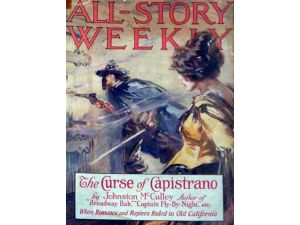
I've been compiling the new issue of Ruudinsavu (= Gunsmoke), the official magazine of the Finnish Western Society. I've been dreaming about the issue dedicated to the Zorro phenomenon, to the movies and comics and other stuff that's been made about him. It seems like it's now coming true, with me writing the article on Johnston McCulley who originally invented the character and wrote the first stories about him.

McCulley wrote four novel-lenght stories about Zorro, but weirdly enough only the first seems to have been published in book from. Can this be true? And the first one, originally "The Curse of Capistrano", later published as The Mark of Zorro, the title of the Douglas Fairbanks film of 1920, is now available only in the POD edition from Wildside Press. (It's okay, but it has an ugly cover, with McCulley's name written wrong ("McCully") and the book has some formatting and scanning errors.) How can this be? McCulley died in 1958, so his work is technically still under copyright - except seemingly for The Mark of Zorro, since I don't think Wildside Press is paying anyone anything for the rights of book. Is there a problem with McCulley's heirs? I notice Googling around that there's been talk about the collected Zorro short stories coming from Black Dog Books, but so far nothing.

Back to the actual book. "The Curse of Capistrano" was published in All-Story Weekly in 1919, making Zorro one of those long-living heroes originated in the pages of a pulp or other fiction magazine, just like Tarzan or Sherlock Holmes. The story was fast made into a movie and hence the book was getting to be known as The Mark of Zorro.

The book is entertaining, and though it's dated in many ways (Zorro never kills anyone, except one guy in a duel and that's perfectly alright for everyone concerned), it's still a quick read. McCulley uses a highly sophisticated style, one he probably thought suits the early 19th century Spaniards, and at times it's a bit too funny - unintentionally. The book's also staged like a play, with far too few scenes for action and too many of them take place indoors. There are some good battle scenes to make up for the staginess. The basic gimmick - that Zorro and Diego Vega are one and the same guy - is basic knowledge to everyone now, so the book loses one of its advantages at first sight.

I'd really like to read the other McCulley Zorros, but it seems it's almost impossible, unless I pay some real money for the old pulps they were published in. (Make sure to note these Zorro tie-ins from Sandra Curtis that to my knowledge have never been published in English.)

The weird things don't end here, by the way: McCulley's Zorro was never published in Finnish. We've had only the movies and the Disney TV show and Steve Frazee's novelization of it.

Other Forgotten Books at Patti Abbott's blog here.

Thursday, September 20, 2012

Jason Starr's Tough Luck Redux

Jason Starr's Facebook status from earlier today: "Handed in screenplay MICKEY PRADA (based on my novel Tough Luck) for Michael Rapaport to direct."

This is great news. Here's my old post on Tough Luck.

Wednesday, September 19, 2012

Ben Haas

Lynn Munroe has just posted an excellent essay and a thorough bibliography on Ben Haas in his website. Ben Haas was of course better known - at least here in Europe - as John Benteen, the writer of the delightful Fargo series. Lynn Munroe writes in length also about Haas's sex and sleaze paperbacks, many of which were previously unearthed.

I haven't read much Haas, but along with the Fargos I'll heartily recommend Big Bend as Richard Meade and some of his Lassiters and Cutlers. (Why not all of them? Because I have read only few. All have been consistently good.)

Oops! There's no Wikipedia entry for Haas! Work up one!

Tuesday, September 18, 2012

Tuesday's Overlooked Movie: Susie, the Little Blue Coupe

Finland also had its share of cheap VHS cassettes loaded with old animated cartoons that had fallen out of copyright, mainly from the small studios, like Van Beuren, and stuff from the thirties and early fourties. I've been buying them cheap from thrift stores and other places for some time now - not all of them are available on DVD, and as you are well aware, I'm interested in the history of animation (I even have an unsold manuscript on the subject).

But this I'd never seen - I didn't even actually know it existed. And I sure didn't know there were Disney films that have fallen out of copyright. The video cassette looked awful with a very bad recreation of the Little Blue Coupe on the cover, but since I pack a cell phone with a net access all the time, I was able to Google the film to know it was worth the 20 cents. Well, I might've bought it nevertheless.

This small film was directed by Clyde Geronimi, who later on directed lots of Disney feature-length classics, like Cinderella and Peter Pan (to be exact on this, he was one of the directors on those movies).

The cassette holds some half dozen other animated cartoons from the thirties and early fourties, but this was clearly the gem of the bunch. I'll probably write something more about the other movies later.

Move overlooked movies at Todd Mason's blog. 

Monday, September 17, 2012

New sleaze novel just coming up

As some of you are aware, I've self-published two sleaze crime paperbacks in 2010 and 2011. This year will see yet another sleaze novel, but it will be a double, just like the old Ace Doubles - or actually the Midwood Doubles might be a more appropriate reference point here!

The other book was written by a friend of mine who wanted to use the pseudonym Carlos Caramba. I'm still using my old moniker Mikael X. Messi. Both books have the same title: Runkkuloma Rivieralla. It means something along the lines of "Jacking Off at Riviera" and it refers to the idiotic Finnish title of Jacques Tati's Mr. Hulot's Holiday (I know, I know, they aren't at Riviera in the film!). It also refers to a once popular vacation spot at Masku, near the town of Turku, that's known as Riviera.

The cover photos are found material, the other one is from an old LP, the other one from an old C-cassette. I guess no one will come asking about copyrights.

Thursday, September 13, 2012

Just a work-related update

I've been working my ass off lately, writing articles and reviews for the magazine of the Finnish Western Society, Ruudinsavu (= Gunsmoke), getting some of my future books together (been working on several projects on Finnish history and the history of misanthropic thought - not much pulpish content here), translating Lovecraft's essay Supernatural Horror in Literature... He's an awful writer, you know? I think there must be more, but I keep forgetting. None of these bring much money, I'm sad to say. I keep reviewing some books from time to time, but for some reason or another they always end up on the boring side - the most recent example being a new thriller by Finnish writer Max Manner, which I barely managed through.

I'll try to work up some decent blog posts in the near future.

Tuesday, September 04, 2012

Patrick DeWitt: The Sisters Brothers

Catchy title, ain't it? I'm in a minority here, but the title is probably the best thing in the book that's been celebrated everywhere it's been published, including Finland. (Patrick DeWitt also came here to promote the translation. I was away travelling, otherwise I would've made an interview with him.)

Okay, I'll take some of that back. The Sisters Brothers is a book filled with lots of funny stuff, some of it absurd, some of it downright scary or nasty, some of it so disjointed it doesn't have much to do with the rest of the book. There's something demanding respect in the way DeWitt writes a western novel without any of the usual western themes. There's no juxtaposition of Wilderness and Civilization, there's no Shane character trying to decide into which world he belongs, there are no cattle drives, there are no lone cowboys, etc., etc.

The book is filled with intentional anachronisms, such as a hired killer demanding a low-carb dish, since he wants to lose weight. Almost none of these felt funny to me, only clever and not very clever at that. The forced cleverness was the most annoying thing in the book to me. The irony felt too obvious and too overworked. I thought this might be called "The Hipsters Brothers", since this is clearly directed to urban 25-30-year-olds who dwell in irony. Which is of course okay with me, if there are new western readers this way. But this wasn't for me, though I somewhat respect the gesture.

And I totally understand this is an old fart speaking here, but there are better ironic western novels out there, such as Charles Portis's True Grit. I'd also call forth Charles Locke's The Hell-Bent Kid. I admit I'm not particularly well-read in the revisionist anti-western western here, but some of the most-mentioned include Roy Chanslor's The Ballad of Cat Ballou, Ishmael Reed's Yellow Back Radio Broke-Down, Thomas Berger's Little Big Man and E. L. Doctorow's Welcome to Hard Times (made into a movie).

I don't see a line leading from them to DeWitt's novel. I don't honestly know what that means.

Monday, September 03, 2012

Peter Rozovsky on hardboiled

In his blog I too rarely read Peter Rozovsky has started a new series of posts: he looks into the classic American hardboiled crime fiction. Here are his posts on Lionel White, Edward Anderson (Thieves Like Us), James M. Cain, Dan J. Marlowe and Robert Silverberg (admittedly a small one) and finally Dan J. Marlowe (again!), Paul Cain and Jim Thompson. He has also some other fascinating posts on different subjects, go read them all!