(English summary: this is about blogs being published as print books.)
Ystäväni Tosikko kirjoitti Minna Hapulin blogikirjasta ja innostuin kommentoimaan melkein liuskan edestä. Siirrän kommentit myös tänne, ihan vain sen takia, että ne joskus julkaistaisiin kirjana:
Joku arvioi jossain lehdessä jokin aika sitten kolumnikokoelmia ja totesi, ettei lehdessä toimivista kolumneista saa kokonaista kirjaa aikaiseksi. Ne kuuluu lukea lehdestä aamukahvilla tai iltapäivällä bussissa. Sama pätee blogeihin. Ohitsevirtaavat ajatukset ovat juuri niitä. Aika, joka tekee kirjan kaikesta, on väliaikaisuutta juhliva ja ylistävä aika.
Hassua tässä on se, että ajatus ei ole mitenkään uusi. Blogien julkaiseminen kirjana liittyy nähdäkseni siihen romanttiseen myyttiin, jonka mukaan Tärkeän Ihmisen kaikki sanomiset on pantava kansien väliin. Maailmahan oli 1800-luvulla ja vielä 1900-luvun alussa kaiken maailman koottuja teoksia. Tehdäänhän niitä vieläkin, mutta kyllä niiden kulta-aika oli jo kauan sitten. Paitsi blogitekstien. Romanttinen ajatus Tärkeän Ihmisen satunnaisten sanomisten merkittävyydestä kokee nyt renessanssin.
Tämä ajatuskulkuni liittyy siihen, että selailin eilen illalla nojatuoliin rötkähdettyäni Tieteellisen sosialismin kirjastoon kuuluvaa teosta "Taiteesta ja estetiikasta", johon oli koottu kirjeistä, päiväkirjoista, artikkelin poikasista, kokonaisista artikkeleista ja arvosteluista kaikki, KAIKKI, mitä Marx ja Engels olivat sanoneet erinäisistä kirjoista ja kirjailijoista ja taiteesta ja musiikista ja muusta. Osan kohdalla ihmettelin vain, miksi ne oli julkaistu.
Tietysti sen takia, että Marxin ja Engelsin tieteellinen sosialismi on jonkinlainen Gesammtkunstwerk, jonka merkittävyys näkyy silloinkin, kun herrat keskustelevat venäjän kielestä ja sen erosta saksan kieleen nähden. Sama pätee kehen tahansa Tärkeään Ihmiseen, jonka kirjeet julkaistaan kymmenenä niteenä.
Wednesday, August 09, 2006

Saturday, August 05, 2006
An old Koululainen mag from 1972

Here's a Finnish fictionmag from 1972: it's Koululainen, meant for kids who can already read. There are some short stories and vignettes and some non-fiction stuff and of course crosswords etc. The cover is kind of scary, don't you think? I read Koululainen back in the late seventies and early eighties, but don't remember much of it.
Nothing much of interest in there, but I got it free from a flea market.
Old sneakers commercial

Very nice old Nokia sneakers commercial from the said issue of the Koululainen magazine. I'd buy any of these any day. (Yes, Nokia started out making tyres and sneakers.)
Friday, August 04, 2006
The Ilves series
Here's by the way a nice link to the Finnish Ilves series that published lots of American hardboiled classics, with some of the translations abridged, I'm sorry to say. (Usually the early ones in the series were abridged, the books from # 25 on are intact. And they are heavily recommended.)
And here's some more, with the Evan Hunter title I mention below.
And here's some more, with the Evan Hunter title I mention below.
Evan Hunter: The Evil Sleep!

Here's the original cover for the Hunter book I mention below. I didn't think it was a very good novel when I first read it, but then again the Finnish translation may well be abridged or otherwise not very good. It's about a musician who's on a heroin trip. It seems the book was rewritten and reprinted as by Richard Marsten under the title So Nude, So Dead (Crest 1956).
Rabe: Murder Me For Nickels

Read the Peter Rabe book I mentioned earlier. It was good, but there was just too much stuff going on and I kept being distracted from the book and it took me too long to get it finished. Kids and reading don't mix very well.
Rabe keeps up the tension with just so little that it's almost amazing: nothing seems to happen, yet there's lots of stuff going on all the time. Some of the scenes are hilarious, such as Jack St. Louis (the head guy in the book) getting the mixer removed from the thugs he's himself hired to damage the place. It's no wonder Rabe wrote one of the funniest Batman TV shows I've ever seen (the one in which Joker tries to get Batman into the madhouse; there's a scene where there's the lunatic squad of the police force driving on the road on their way to pick up Batman; there's also Alfred impersonating Batman and climbing up a wall).
There's just one small glitch in all this: the Stark House books are not very appealing. The covers are ugly, the books are too big and there's just too many printing errors (maybe due to scanning and OCRing process; wish they had more money to get someone to type them!). But I don't want to complain. They bring us the most wanted vintage noir and the books are quite cheap: the original Fawcett Gold Medal edition of the Rabe is about 50-60 $ in Abebooks. The Stark House reprint contains also another novel by Rabe and costs 20 bucks. (Plus shipping overseas, of course.)
The cover on top is the original one. It was used (as a mirror image) in Finland to accompany Evan Hunter's first mystery novel, The Evil Sleep! (1952; the Finnish title is Painajainen/Nightmare; it's Ilves # 31, 1963). It was published by a small outfit called Falcon and I understand it's pretty rare. The Finnish book of it is quite common and you can get it for five euros, tops. The lady in the cover, by the way, must have the best legs in the whole universe.
Wednesday, August 02, 2006
Flash Gordon in Finnish

I'm currently writing an article for a reference book on comic artists that my friend Ville Hänninen is editing. Here are some samples from the first Flash Gordon book that was published in Finland in 1938. The cover on the left was drawn - at least I suppose so - by a man called Martti Masala, who drew almost every cover for the publishing house Ilmarinen in the thirties and early fourties. I think it's a pretty good one, but those guns really look like Raymond Loewy cars.
Flash Gordon has been translated as "Iskevä Salama", which is actually more like "Striking Lightning" or some such. He was called Salama Gordon at times, which comes from Swedish. He was Blixt Gordon in Sweden (Blixt meaning "lightning").
You can see more Finnish Flash Gordons here (only covers). The larger site of Finnish SF comics here.
Flash Gordon in trouble
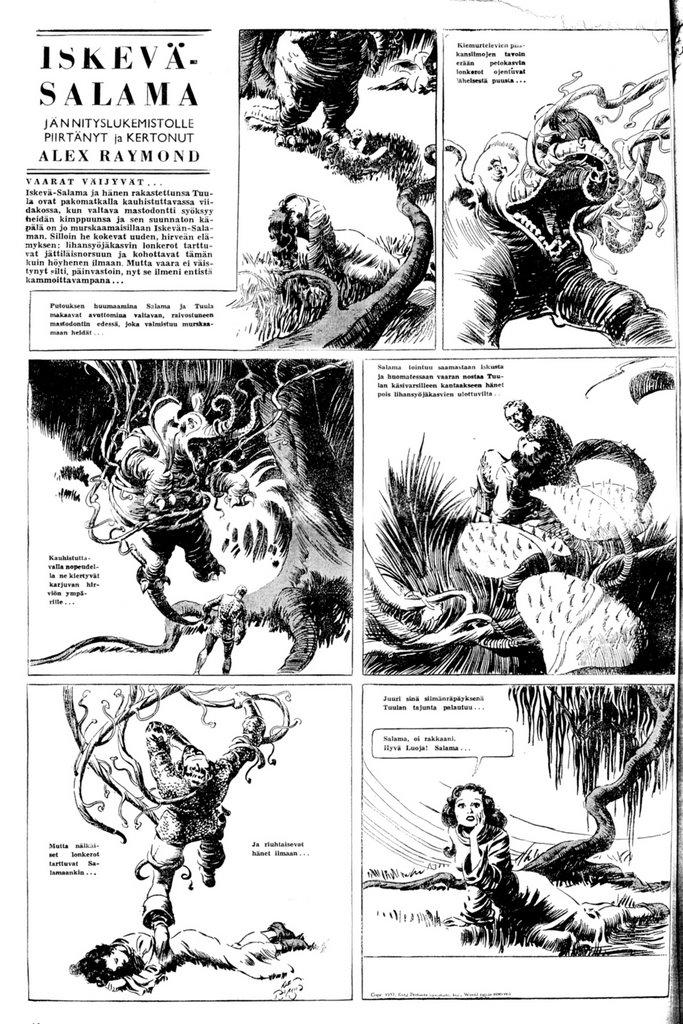
As he is always... Here's a page from the Finnish Flash Gordon album. Dale Arden is called Tuula in this, Tuula being a very common Finnish name. It sort of demystifies the whole stuff - like Flash Gordon really was James or Bill. (He's Jim in the pirated Israeli novels. I believe this site tells all about it, but can't read Hebrew.)
More Flash Gordon

Another page from the 1938 Flash Gordon album. Nice bondage scene and marvellous heroics. Flash Gordon has gills in this story - they were made (and finally removed) surgically.
Flash Gordon in Finland

Here's a logo that was used only once in the Flash Gordon book from 1938. The caption says "We sing of the guns and the brave". I don't know if this read also in the original Gordons.
The Flash Gordon series was originally published in Finland in the weekly story paper* Jännityslukemisto/Suspense Stories that was Ilmarinen's product.
* I hesitate to use the words "pulp mag" here, since Jännityslukemisto was never a real pulp. The paper is right, but the size is too big. It's too close to A4 (this standard size may not be too familiar for our American readers.)
Tuesday, August 01, 2006
Paperback reprint of Marton Taiga

There's not been many paperback reprints of Finnish vintage pulp fiction. Some formerly serialized novels of Outsider and Marton Taiga were published as large paperbacks in the late eighties (with cool covers of Jukka Murtosaari, who does illustrations for Isku and articles for Pulp), but formerly there wasn't much. In the mid-seventies, big Finnish publishing house Tammi tried to cash in with paperback reprints of some novels by Marton Taiga. They were originally published by Tammi in the late fourties. Taiga wasn't solely Tammi's author and published with several different outfits, such as Ilmarinen and Mantere that don't exist anymore.
For some reason, the Taiga paperbacks didn't catch on with the readers. I don't know why. The books were nice classic paperbacks, with illustrated covers. Maybe the high-brow Finnish literal culture had made people think that paperbacks are crap, that even these Marton Taigas are some ultraviolent avenger stuff. Even though they are pretty nice and harmless, slightly humorous gangster and adventure stories.
The book above was the first one in the long-running Porkkana/Carrot series that features a young kid called Kid Sparrow as its hero. He has burning red hair, hence his nickname. Carrot works as an errand boy for a big newspaper in New York. The illustrator is not known and the illustration is unsigned.
Monday, July 31, 2006
Back, once again
We just came back from a three-day trip to my mom's at Pori, a largeish town on the west coast of Finland. It's a very nice place during Summer. It's always a small wonder to me that you can swim in the Kokemäenjoki river now, when in my childhood it was strictly forbidden due to pollution and all! It's a new view to a very familiar place. We could've easily spent three more days in Pori, especially if we had had time to go to Yyteri and its marvellous beaches.
I did some book hunting and will be posting scans of the results. It seems now that Ottilia has finally been bitten by a flea market bug - she even demanded we go to a flea market today.
I've been reading a Stark House reprint of Peter Rabe's Murder Me For Nickels, which I can easily recommend.
I did some book hunting and will be posting scans of the results. It seems now that Ottilia has finally been bitten by a flea market bug - she even demanded we go to a flea market today.
I've been reading a Stark House reprint of Peter Rabe's Murder Me For Nickels, which I can easily recommend.
Friday, July 28, 2006
Kari Nenonen impersonating as Ralph Hayes

Bill Crider posted another bunch of scans of paperback covers from the seventies and early eighties on Flicker. There's a Marlowe Taggart book by Ralph Hayes included. Three of these came out in Finland in the early eighties, but in addition there were three more by a Finnish writer, Kari Nenonen. Nenonen is one of the most prolific Finnish paperback writers, with books ranging from women's romance to outright horror. I don't know why Nenonen wrote three more Marlowe books - whether the originals ran out or the Finnish publisher didn't have enough money to buy reprint rights.
The blurb of the last book in the series says: "Marlowe has just one principle: Live and let die!" Not very original, huh? The title means Dealings With Death or some such.
I've read only one novel by Ralph Hayes, who has written lots of stuff for men's adventure and western series. Pusuhuulet/Kissing Lips was published in a series of sex paperbacks in the early eighties, but I don't know its original title, since the Finnish edition doesn't mention it. The book is situated in a hospital and deals with the union strike! There wasn't lot of sex, though, and I thought whether it was a mistake to publish it as a sex novel or whether it should've found its place in a women's romance series. It wasn't bad, though, and I found Hayes's handling of the strike quite interesting.
If I can find my copy of Pusuhuulet, I'll post a scan here.
Thursday, July 27, 2006
AAAAAAARGH!!!
I spent the last week of our mutual holiday polishing the manuscript of The Dostoyevsky Reel to be able to send it to a crime novel contest, which I thought was due next Tuesday. Now that I got it finished and was ready to print it out, I checked the publisher's website to see whether there were any rules about lines and such and noticed that it wasn't due till 31st of August! AAARGH!
But, hey, now it's done and at least I wasn't late. Better early than never or something like that.
But, hey, now it's done and at least I wasn't late. Better early than never or something like that.
From Nick Carter to Lone Wolf
Bill Crider posted a nice slideshow on Flickr with a few dozen of seventies' men's adventure paperbacks. Check it out. The Nick Carter outing, The Coyote Connection, is by him and it's a pretty good one in the series.
Wednesday, July 26, 2006
Hassle my hoff

Just got The Dostoyevsky Reel finished. I'll read it through tomorrow and add some cigarette-smoking scenes.
Just to commemmorate this: here is a nice David Hasselhoff video and here's a very nifty commercial by him. (Thanks to Bill for the link!) And, oh, you can't go wrong with this. (Isn't the original by Nancy Sinatra? I remember liking the song.)
Maybe Hoff could play Harri Tanner, the hero of my novel? Do you think he could be a young sports writer in the early sixties' Finland who gets to play a private detective with deadly results? Too bad there's no scene with Harri Tanner without his shirt! Should add one and send the ms. to Hoff...Nah, just kidding. I'm thinking maybe Tom Selleck could do this one.
Tuesday, July 25, 2006
Mahtava nyrkkeilyaiheinen keskustelu
Kaikkeen sitä törmää, kun hakee tietoa. Yritin hakea netistä matskua siitä, millainen lyönti oikeasti on jabi, ja ensimmäinen hakutulos oli tämä keskustelu. Mahtavaa! Tässä on kyllä joku tulevan romaanini päähenkilö!
Various stuff

Am in the middle of editing The Dostoyevsky Reel, which doesn't look as bad as I first thought it was. It's at times quite good, even though I'm saying this myself. It's just that I've been forgetting that if it's situated in 1964, everyone should be smoking cigarettes - now there's none of that!
So, the holiday is drawing to a close. I'm actually anxious to get back to work, which probably means that the holiday was spent well.
***
Just finished Lewis Trondheim's Approximativement/Minä Lewis Trondheim (Asema 2005) which is one of the first and most important autobiographical graphic novels that have been very popular during the last three or four years. It's excellent, even though the masculine self-hate (sic!) Trondheim discusses is at times a bit overwhelming.
Read also the Hobbit graphic novel by Charles Dixon and David Wenzel. The recent translation has been harshly criticized in Finland and everyone's been wondering what the publisher was thinking. My bet is they were thinking about money, but the graphic novel isn't really that bad. It's too static at times and too close to Tolkien to really elevate into a moving graphic presentation - there's just too much captions. I don't know who really needs to read so much of them, especially when even in Tolkien there's too much babbling ("Well, my young reader, now you may ask what kind of a creature this Bilbo Baggins is" etc. etc.). But the art is pretty good, although very old-fashioned, and the story is still quite good and made me want to read more Tolkien. (Just don't got the time right now. Realized, though, that it's almost 20 years now when I read Silmarillion. Should tackle that again. And maybe try again some of his unpublished stuff.)
***
Kauto is talking more and more each day. He produces now quite comprehensible four- or even five-word sentences and you can actually talk with him. Once he came to me and said: "Jutellaan/Let's talk." Then I told him what had been going on that day etc., and he listened to me with care and answered when I asked him something. It's fun! (What's not fun is that he's still not very easy to get to sleep. Now he at least sleeps through the night...)
Sunday, July 23, 2006
Spillane and Bukowski
I promise to stop whining about Spillane after this, but this came to mind earlier today and I cant' resist... One of Spillane's traits is masculine self-pity. Hammer, tough guy though he is, is always in constant self-degradation and even self-hate. (This is evident also in the males of Sin City, who doubt and hate themselves.) This one reminded me all of a sudden of Charles Bukowski. In his books men, especially his alter ego, Henry Chinaski, pretend to be tough guys, but are actually feeling a pity for themselves. It just manifests in anger towards everyone else (especially women, whom he thinks should be wearing skirts, not trousers, which has always been oddly conservative of Bukowski who is, by most, regarded as a subversive writer). Just like in Spillane and Hammer.
So, my thesis is this: Spillane and Bukowski are two opposites of the same line. Bukowski is to mainstream literature what Spillane is to crime literature. Both even use same sort of clipped sentences. (And you do know that according to feminist literary theory, short hardboiled sentences are just an attempt to prevent any outside attacks towards male ego in not showing any sort of emotional impact.)
So, my thesis is this: Spillane and Bukowski are two opposites of the same line. Bukowski is to mainstream literature what Spillane is to crime literature. Both even use same sort of clipped sentences. (And you do know that according to feminist literary theory, short hardboiled sentences are just an attempt to prevent any outside attacks towards male ego in not showing any sort of emotional impact.)
Thursday, July 20, 2006
My Spillane

At long last... I must be the last one in the whole internet who starts writing about Mickey Spillane after his recent death.
First, let me put it this way: I don't really like Spillane's books and I strongly oppose everything his hero, Mike Hammer, stands for. But, second, let me also say that I admit to a certain fascination for the bruteness of Spillane's books. (And, thirdly, this makes me cringe a bit.)
I agree with Julian Symons who says in his Bloody Murder! that the most worrisome thing about Spillane is that Mike Hammer is a hero. He can easily wound or even kill someone with his gun or fists while interrogating a suspect (and he sure won't need any credentials from a judge or some such). I don't mind, say, Richard Stark's Parker killing off several people in a book, but Parker's not a hero. He's not doing what's right and no one is saying he does. Also Hammett's Op killing dozens of villains in Red Harvest is nothing to me: he's just a man doing his work. He's not to be admired.
Spillane's Hammer, on the other hand, is revenging wrong deeds done to him. If he's revenging the killing of a girl, it's because the girl liked him and he liked the girl. It's not for the girl, it's for him. To put it more academically, the killing is the only way for a man like Hammer to show his manliness, to retain his male identity. The crisis of masculinity after the WWII has been discussed almost to death, but given the evidence in Spillane's novels, there's no denying that masculinity was indeed in a crisis in the late fourties and early fifties.
Spillane was criticized severely throughout his career, but it seems that the clock is turning backwards and now he has even his civilized defenders. Someone said a while back at the Rara-Avis e-mail list that the myth of avenging angel lives in Mike Hammer and therefore Spillane's novels rise close to the truth, elevating close to art. I say that people should be able to oppose myths that are potentially dangerous.
Maybe it's the Finnish welfare state in me talking and I don't really understand the conditions of life in the US. It's also my leftist education, you might say.
But I also find Spillane a sloppy writer and weak plotter. He seems to have composed his plots of scenes in which Hammer is either shooting out with the bad guys or he is being tortured or preaching about how he's right. This makes some of his novels pretty boring, especially Kiss Me Deadly (which, admittedly, I've read only in a Finnish translation which may be bad or abridged or both). To me, it seems, there's nothing between those scenes of violence and action, while I'd really appreciate some insight into a character and milieu.
Well, some people say that Spillane was good at setting a tone. Well, um, yeah. What the guy had was an ear for good opening and ending lines:
The little guy's face was a bloody mess. (The Twisted Thing, 1966)
You walk down the street at night. It's raining out. (The Snake, 1964)
The "It was easy" sequence from I, the Jury (1947) is also noted. (My dad, who's been more leftist than I am now, said that it's a great scene. Who am I to contradict my father?)
What Spillane also had was influence. In the entry for Spillane in my Pulpografia I cite Max Allan Collins, Andrew Vachss and Frank Miller as authors who show Spillane's influence. What I left out - or maybe didn't even understand - that Spillane was one of the most influential crime writers ever. There wouldn't be Dirty Harry without Spillane, someone said a while back (and I really like the first Dirty Harry film). And without Dirty Harry, well, you know - dozens and dozens of films would've been left unmade. Same goes for books: whole genres could be wiped out were it not for Spillane. (Someone might say that the world would be a better place without, say, the executioner genre of the seventies.)
But influence doesn't make someone a great artist or author. But, well, Spillane himself said he's no artist or author, he's just a writer and writes what sells. Maybe he knew too well his own limits. But then a question comes to me: was he serious about his stuff? There are scenes in which Spillane comes close to self-parody. Is this what he really meant?
Richard Telfair offered a great parody of Spillane and Mike Hammer in his Monty Nash novels. Monty Nash says things like: "It takes a lot of man to kill a dame. I'm a lot of man." There's also no masculine anxiety in the Monty Nash books, which makes me more interested in them than Spillane. Maybe that's what it is: since I don't feel any anxiety about my own malehood (sorry for boasting!), I don't feel getting interested in Spillane's and Hammer's male anxiety.
Case closed? (The cover scan on top is a Swedish edition from the late fifties, with an illustration by Bertil Hegland. Sorry, it's only in b&w. An illo from a Finnish pulp can be found here. Finnish paperbacks, with lots of Spillane, here.)
Wednesday, July 19, 2006
Spillane kuollut/Spillane dead
As everyone knows by now, Mickey Spillane died couple of days ago. I'll write something more about him in a day or two, now I'll just post here what I wrote about the man in my Pulpografia (in Finnish, of course). There's a bibliography included, but only of those books that have been published in Finland in paperbacks (and before 1989). I'm not very positive towards Spillane, but I also admit that there are some things in this entry I'm not particularly happy with anymore. Let me get back to that later. (I'm on holiday, for chrissakes!)
Mickey Spillane (s. 1918) on yksi rikoskirjallisuuden ristiriitoja herättävimmistä kirjailijoista. Spillaneen jos kehen pätee vanha sanonta: häntä joko vihataan tai rakastetaan. Osa lukijoista pitää Spillanea epämiellyttävänä ja jopa fasistisena kirjailijana, jonka teokset puolustelevat väkivaltaa ja kehottavat ottamaan oikeuden omiin käsiinsä, osa lukijoista taas on sitä mieltä, että Spillane vain kuvaa hyvin omaa maailmaansa ja sen vainoharhaisuutta. Spillanen oikeistolaisuudesta ei kuitenkaan ole epäilystä, koska hän on itse määritellyt, että hän on niin oikealla, että putoaa reunan yli. Spillanen vaikutus näkyy kuitenkin muun muassa sellaisissa nykyisissä kirjailijoissa kuin Max Allan Collins (joka on tehnyt Spillanesta monografian One Lonely Knight), Andrew Vachss ja sarjakuvataiteilija Frank Miller (eritoten tämän Sin City -sarja, myös Hardboiled).
Spillanen teosten ominaislaadun takia harva pystyy suhtautumaan häneen neutraalisti ja kiinnittämään huomiota hänen teostensa tasoon. Nekin, jotka niitä vihaavat, myöntävät, että Spillanen teoksissa on jotain kiehtovaa tai että Spillane kertoo tarinansa vauhdikkaasti. Ne, joiden mielestä Spillane yksinkertaisesti on huono ja epäkiinnostava kirjailija, ovat vähemmistönä. Perusteltuja kriittisiä näkökulmia hänen tuotantoonsa on harvassa. Kiinnostavan analyysin on esittänyt John G. Cawelti, jonka mukaan Spillanen teokset jatkavat kaikessa kömpelyydessäänkin 1800-luvun lopun ja 1900-luvun alun evankelisen kirjallisuuden perinnettä. Niin niissä kuin Spillanen teoksissakin kuvataan sitä, kuinka yksilöt jumalaisen johdatuksen avulla selvittävät elämänsä ongelmat. Kummankin tarkoitus on didaktinen: Hammer näyttää, miten länsimaita riivaavat vitsaukset voidaan poistaa. Janne Mäkelä taas osoittaa esseessään kirjassa Murha ei tunne rajoja, että Spillanen teokset kuvastavat pääosin tiedostamattomasti niitä kriisejä, joihin perinteinen maskuliinisuus ajautui toisen maailmansodan jälkeen: ristiriidaton miesihanne ei ollut enää toimiva uudessa maailmassa, siksi syntyi Hammerin usein mahdottomaltakin tuntuva ristiretki ja siitä aiheutuva ahdistus (jonka nostalginen jäänne ovat Frank Millerin Sin City -sarjakuvat).
Spillane aloitti uransa 1930-luvulla käsikirjoittamalla sellaisia sarjakuvia kuin Captain Marvel. 1940-luvulla hän kehitteli muun muassa Mike Danger -nimisen sankarin, josta tehdyt sarjakuvat julkaistiin vasta pitkälti sodan jälkeen. Danger oli Hammerin esikuva, kun Spillane viimein julkaisi teoksen I, the Jury vuonna 1947; teos on suomennettu nimillä Minä olen tuomari (1953), Minä olen valamiehistö (1968) ja Minä, kostaja (1983). Spillanen kirjat olivat välittömästi suuri menestys — hänet mainitaan usein jopa maailman menestyneimmäksi kirjailijaksi. Suosiota auttoivat kovakantisten ensipainosten jälkeen otetut pokkariuusintapainokset, joiden myynti ampaisi heti kymmeniin miljooniin — ja painoksia otettiin kymmeniä, ellei satoja. Osaltaan Spillanen menestys edisti pokkareiden vallankumousta.
Spillanen kirjailijanuran ensimmäinen kausi päättyi jo 1952, jolloin hänestä tuli jehovantodistaja. Spillane aloitti kirjoittamisen uudestaan kirjalla Älä odota armoa (1962). Siinä Mike Hammer etsii alkoholisoituneena raukkana sihteeriään Veldaa; kirjassa on poikkeuksellisen paljon maskuliinista ahdistusta. 1960-luvulla Spillane kehitti myös Tiger Mannin, James Bond -tyyppisen vakoojan. Spillane piti taas tauon kirjoittamisessaan 1970-luvun alussa ja aloitti uudestaan 1980-luvun lopulla, minkä jälkeen hän on säännöllisesti julkaissut Mike Hammer -kirjoja.
Spillanen kirjoja on ilmestynyt suomeksi sekä kioskikirjoina että kovakantisina. Suuri osa hänen tunnetuimmista teoksistaan on julkaistu ainoastaan kioskikirjoina, näin esimerkiksi Kiss Me, Deadly.
My Gun Is Quick (1950) on julkaistu yhteensä neljänä eri käännöksenä, joista erikoisin on Avun jatkokertomus "Nimettömän tytön arvoitus". Nimillä Tästä alkaa kosto, Liipasin on herkkä ja Silmä silmästä suomennettu kirja on Spillanen toinen romaani ja siinä on samanlainen juonikuvio kuin kaikissa muissakin Spillanen teoksissa: Hammer tapaa tytön, joka tapetaan, ja hän päättää kostaa ihan vain siksi, että sattui pitämään tytöstä. Hammerin hahmoon liittyy omituista maskuliinisuuden tuskaa: ei ole enää muuta mahdollisuutta todistaa miehuutensa kuin tappaa ne, jotka uhkaavat heikkoja ja sortuneita. Juonenrakentajana Spillane on sen verran heikko, että tarinat kulkevat eteenpäin Hammerin raivonpurkausten ja toimintakohtausten avulla. Kohtaukset, joissa hän saa selville jotain, eivät yleensä ole kovin kiinnostavia.
Suutele minua, julmuri/Mike Hammer ja mafia (1952) on kirja, johon perustuu Robert Aldrichin ohjaama ja A. I. Bezzeridesin käsikirjoittama elokuva Kiss Me Deadly (1955). Elokuva on kuitenkin kirjaan verrattuna itsenäinen teos, jonka yhteydet kirjaat ovat melko hatarat. Aldrich ja Bezzerides ottivat kirjasta aloituksen — Mike Hammer ottamassa keskellä yötä kyytiin pakenevaa nuorta naista, joka hetken kuluttua kidutetaan kuoliaaksi — ja muutaman henkilön sekä kohtauksen, jossa Hammer löytää voimistelusalin vaatekaapista sen, mitä etsivät sekä mafia, poliisit että hän itse. Etsinnän kohde on elokuvassa muuttunut kahden miljoonan dollarin huume-erästä ydinpommiksi.
Edelleen kiistellään siitä, onko elokuva kriittinen Spillanen sankaria kohtaan vai ei. Kirja itsessään on pitkäveteinen eivätkä Hammerin raamatulliset vuodatukset paljon auta, kun juoni on jahkaileva ja henkilöt mielenkiinnottomia. Mafian pelko ei kirjassa myöskään tunnu perustellulta — ei ole ihme, että Aldrichin elokuvassa huumeiden tilalla on pommi, johon välillä viitataan Pandoran lippaana. Ydinpommi muodostaa uhan koko maailmalle, mukaan lukien Hammerin, mutta huumeet eivät häntä juuri uhkaa.
Spillanen kiinnostavimpia romaaneja on kuitenkin hänen 50-luvun tuotantonsa ainoa teos, jossa Hammer ei esiinny: Mies ilman muistia (1951) osoittaa Spillanen yhteiskunnallisen näkemyksen paljaimmillaan. Korruptoituneesta pikkukaupungista rikoksen takia häädetty mies — tai hänen kaksoisolentonsa — palaa ja puhdistaa kaupungin. Mies ilman muistia on Hammer-kirjoja kiinnostavampi, koska päähenkilö Johnny McBride ei ole jumalallisuuteensa uskova kostaja.
Erinomaisen Kiss Me Deadlyn lisäksi Hammer on esiintynyt valkokankaalla ainakin viisi kertaa. Varhaisin filmatisointi oli Harry Essexin Suomessa kielletty I, the Jury (1953), jossa britti Biff Elliott oli Hammer. Elokuva päätyi aikoinaan Martin Scorsesen ja Paul Schraderin Guilty Pleasures -listalle, lähinnä John Altonin upean kuvauksen ansiosta. George A. Whiten ja Phil Victorin ohjaama Aseeni on nopea (1957), jossa Robert Bray oli pääosassa, on huonossa maineessa. Roy Rowlandin ohjaama Älä odota armoa (Englanti 1963) on erityisen kiinnostava, koska siinä Spillane itse esittää Hammeria. Kuinka hyvin, sitä eivät hakuteokset yleensä kerro, mutta veikkaus on, että erittäin innostuneesti. Monet Spillanen ystävistä käyvät myös esittäytymässä elokuvassa. Samanlaista linjaa Spillane piti myös vuonna 1971 tehdyssä The Delta Factor -elokuvassa, jossa naispääosaa esittää Spillanen vaimo. Kirja perustuu Spillanen romaaniin Hurrikaani (1967). Armand Assante esitti Hammeria elokuvassa Minä olen tuomari (1982).
Televisio on niin ikään kohdellut Hammeria hyvin. Vuonna 1958 alkoi Darren McGavinin tähdittämä sarja, jota kuvattiin 78 puolen tunnin jaksoa, joissa jostain syystä ei nähty Veldaa lainkaan. Suomessakin on nähty sarjat Aika ei tunne armoa (1989) ja Mike Hammerin paluu (1986). Jälkimmäisessä esiintyi Stacy Keach. Vielä 1994 tehtiin sarjaa Come Die with Me: A Mickey Spillane’s Mike Hammer Mystery. Radiossa Hammer seikkaili vuosina 1951—52 sarjassa That Hammer Guy.
Spillanen muista romaaneista on filmatisoitu Mies ilman muistia. Victor Savillen ohjaama elokuva (1958) onnistuu kuvaamaan Spillanen maailman angstia paremmin kuin monet Hammer-elokuvat, joissa liian usein keskitytään toimintaan ja rikollisten tappamiseen. Erikoinen elokuva on James Edward Grantin Pelon ympyrä (1954), jossa Spillane esittää itseään! Mike Hammerkin käy esittäytymässä, häntä esittää Jack Stang. [Tämä on kuulemma juuri julkaistu dvd:llä.]
Hammer seikkaili sarjakuvassakin, mikä on sopivaa Spillanen sarjakuvakäsikirjoittajan taustan muistaen. Phoenix Features tuotti vuosina 1953—54 sanomalehtisarjakuvaa, jonka juonet teki huhujen mukaan Spillane itse. Sarjaa piirsi ja käsikirjoitti Ed Robbins. Sarja oli kuitenkin niin väkivaltainen, että yleisö ja moraalinvartijat vaativat sen lopettamista; viimeinen pisara oli kohtaus, jossa puolialastonta sänkyyn sidottua naista kidutetaan. Sarja lakkautettiin sen jälkeen, kun Spillane kieltäytyi lieventämästä juoniensa väkivaltaa.
Melkein koko Spillanen tuotanto on suomennettu, osa pelkästään kovakantisina, osa sekä kova- että pehmeäkantisina. Seuraavassa luetellaan ainoastaan ne teokset, joista on vain pehmeäkantisia kioskikirjasuomennoksia. Hämeenlinnalaisen Niteen Spillane-suomennoksista otettiin yleensä kolme painosta — ilmeisesti myöhempiä painoksia sensuroitiin, koska sivumäärät yleensä putosivat 20—30 sivulla. Jotkut suomalaiset lukijat ovatkin näitä laitoksia lukiessaan ihmetelleet, miksi Spillanea on pidetty niin väkivaltaisena kirjailijana.
Spillanelta on suomennettu myös muutama novelli tai pienoisromaani. Alun perin vain Englannissa kirjoina ilmestyneistä novelleista parhaat koottiin 1969 Signetin julkaisemaan teokseen The Tough Guys, joka suomennettiin 1990 nimellä Kolme kovaa. Kokonaan suomentamatta on ilmeisesti vain 1963 julkaistu novellikokoelma Me, Hood!, jossa seikkailee toisessa teoksessa typerän suomenkielisen nimen saanut Huppukaulus.
Romaanit:
Päähenkilö Mike Hammer lukuun ottamatta teosta Mies ilman muistia.
Kuolet ellet kerro. Suom. Risto Kalliomaa. Nide: Hämeenlinna 1953. 2. laitos Yksin yössä. Ässä 19. Suom. Sirkka Tuominen. Valpas-Mainos: Alavus 1970. 3. laitos Kuoleman käskyläinen. Mickey Spillane 5. Suom. Heikki Haveri. Kolmiokirja: Oulu 1984. Alun perin One Lonely Night. Dutton 1951.
Mies ilman muistia. Nide: Hämeenlinna 1954. 2. laitos Yhden on kuoltava. Ässä 5. Suom. Tapio Hiisivaara. Valpas-Mainos: Alavus 1967. 3. laitos Pitkä odotus. Mickey Spillane 4. Suom. Heikki Haveri. Kolmiokirja: Oulu 1983. Alun perin The Long Wait. Dutton 1951.
Minä olen tuomari. Suom. Topo Leistelä. Nide: Hämeenlinna. 2. laitos Minä olen valamiehistö. Ässä 12. Suom. Tapio Hiisivaara. Valpas-Mainos: Alavus 1968. 3. laitos Minä, kostaja. Mickey Spillane 1. Kolmiokirja: Oulu 1983. Alun perin I, the Jury. Dutton 1947.
Suutele minua, julmuri. Nide: Hämeenlinna 1955. 2. laitos Mike Hammer ja mafia. Ässä 10. Suom. Tapio Hiisivaara. Valpas-Mainos: Alavus 1968. Alun perin Kiss Me, Deadly. Dutton 1952.
Tästä alkaa kosto. Nide: Hämeenlinna 1953. 2. laitos Liipasin on herkkä. Ässä 15. Suom. Tapio Hiisivaara. Valpas-Mainos: Alavus 1968. 3. laitos Silmä silmästä. Mickey Spillane 2. Suom. Heikki Haveri. Kolmiokirja: Oulu1983. Julkaistu myös jatkokertomuksena Nimettömän tytön arvoitus, Apu 12—42/1951. Alun perin My Gun Is Quick. Dutton 1950.
Novellikokoelmat:
Lentäjä. Ässä 23. Suom. Seppo Pekkola. Valpas-Mainos: Alavus 1971. Alun perin The Flier. Corgi 1964. Sisältää novellit Lentäjä (1964) ja Seitsemän vuoden murha (1960), joista jälkimmäinen on suomennettu myös teoksessa Kolme kovaa. Book Studio: Helsinki 1990.
Sinä tappaja. Ässä 22. Suom. Seppo Pekkola. Valpas-Mainos: Alavus 1970. Alun perin Killer Mine. Corgi 1965. Sisältää novellit Sinä tappaja ja Yksinäinen mies.
Taisteleva huppukaulus. Ässä 21. Suom. Seppo Pekkola. Valpas-Mainos: Alavus 1970. Alun perin Return of the Hood. Corgi 1964. Sisältää novellit Taisteleva huppukaulus ja Bannermanien äpärä, joista jälkimmäinen on suomennettu myös teoksessa Kolme kovaa. Book Studio: Helsinki 1990.
Artikkeli:
Merenpohjan kirottua kultaa, Apu 23/1956. [Spillane kirjoitti kuivalla kaudellaan paljon artikkeleita mm. juuri sukeltamisesta ja esiintyi jossain sukellusaiheisessa tv-sarjassakin.]
Monday, July 17, 2006
Another Chase

I also read another James Hadley Chase when we were at the cabin a week ago. Neljä ässää/I Hold the Four Aces (1979) is strictly mediocre. It has a nice scam plot, but Chase is not very good at describing a female lead and there's a stupid butler character involved. The climax is also not violent enough.
Sunday, July 16, 2006
More Asterix comics from yours truly

Almost a year ago I posted some Asterix traversies I'd made while drawing with Ottilia. I promised then that I'd post another, older one in which Asterix is having a hangover. I couldn't find it at first and now when Ottilia dipped into some boxes last weekend it came to light. Here it is, for your (rather dubious) pleasure. It's called "Asterix and the Cleaning Day".
Asterix: Oh, it's so dirty! Obelix, come help me!
Obelix (throws an obelisk).
Asterix: What are you doing?
(The obelisk crushes Asterix's house.)
Obelix: Now you won't have to clean!
Asterix (angry): Darn!
Edit: Due to the Finnish Ä signs, the scan didn't first show bigger. I changed the title of the document and now it's clickable.
Kuka pyytää prekariaatilta anteeksi?
Hesari oli piilottanut kaupunkisivujen viimeiselle sivulle uutisen siitä, että poliisin mukaan vapun mellakoiden aikaan syttynyt makasiinien tulipalo ei ilmeisesti ollutkaan tahallinen eikä myöskään ilmeisesti liittynyt millään tavalla itse vapputapahtumaan, jossa kansalaisaktivistit juhlivat. Asia selvästi haluttiin piilottaa pois häpeällisenä - Helsingin Sanomathan uutisoi bileet ja tulipalon isosti ja julkaisi lukuisia pelottavia ja leimaavia kuvia tulen loimussa tanssivista prekaareista ja tuomitsi juhlan ja koko prekariaattiliikkeen melkeinpä järjestäytyneeksi rikollisuudeksi, johon yhteiskunnan pitää ottaa tiukka kanta. Samaa teki koko muukin media (Ilta-Sanomatkin julkaisi oikein aktivistikansion, josta sitten saattoi painaa naamat ja nimet mieleen), vaikka prekariaattiliikkeen esilleottamat asiat ovat todellisia ja koskettavat suurta joukkoa ihmisiä. Jännä nähdä, pyytääkö Helsingin Sanomat ja muu media anteeksi.
Jotain sinnepäin oli Jakke Holvaksen sunnuntaisivuille kirjoittama Sanojen takana -palstan osuus, mutta Holvashan onkin kesätoimittaja. (Hyvä kesätoimittajat! Hesarin kulttuurisivuillakin on pientä piristymistä, kun Ylioppilaslehden Esa Mäkinen on siellä toimittajana. Ei ole aina joko oopperaa tai heviä.)
Jotain sinnepäin oli Jakke Holvaksen sunnuntaisivuille kirjoittama Sanojen takana -palstan osuus, mutta Holvashan onkin kesätoimittaja. (Hyvä kesätoimittajat! Hesarin kulttuurisivuillakin on pientä piristymistä, kun Ylioppilaslehden Esa Mäkinen on siellä toimittajana. Ei ole aina joko oopperaa tai heviä.)
Friday, July 14, 2006
Jallu kolalla
Tänään Alkon jonossa edessäni ollut vanhahko mies osti kaksi jallupulloa ja sanoi myyjälle, että hän laittaa lantrinkiksi kokista ja pommacia. Hän kertoi vatkaavansa kuplat pois. "Mää haen sille patentin joku kerta." Myyjä: "Meinaaks ihan tosi?" Mies: "Eii, leikki leikkinä." Myyjä nopeasti ettei asiakas vain loukkaantuisi: "Ymmärsin kyllä vitsin."
Jallu on esillä muutenkin: lehden takana oleva kustantamo tuo takaisin vanhat Jallut eri vuosikymmeniä sekoittavina pakkauksina. Mainoslause väittää, että 60-, 70- ja 80-luvun Jallut olivat kiltimpiä kuin nykyään - mahtaako ihan noin olla? Muistan, että 70-luvulla pornolehdet olivat aika raisuja, joskus jopa inhottavia (luin niitä siis jälkeenpäin, en ole ihan niin vanha (tai varhaiskypsä)). Saattoi olla Kallekin, mutta jossain lehdessä esiteltiin kuvia teloituksista Iranissa islamistisen vallankumouksen jälkeen. Toivottavasti eivät julkaise niitä kuvia uudestaan...
(English summary: old issues of the legendary Finnish porn magazine, Jallu, will be published as nice retro packages. Check the link. It's nothing spectacular, though.)
Finally the Perutz cover

Here's the Finnish cover for Leo Perutz's and Paul Frank's Das Mangowunderbaum (note: not "Der", as I wrote earlier, but "Das"; I'm not very good at German). I suppose it's by Hugo Trentsch, but I'm not sure. The book was published as a part of the series called Kymmenen markan romaaneja/Ten Mark Novels, which concentrated on cheap popular literature.
One other item in the series is an early French gang novel Vainottu/Hunted by Francis Carco which I'm about to read, em, in a year or a decade or two. I believe one of Carco's novels was published in the legendary Black Lizard noir series in the eighties. (And it turns out that I was right.)
Thursday, July 13, 2006
Some crude animation here
The idea is funny, but you don't have to sit through it: Star Wars in ascii code. (Thanks to Bill Crider for the link!)
Super hero food
Here's a nice site about foods with super heroes on their package design. Thanks for Ville H. for the link!
Leo Perutz, Austria's expressionistic weird adventure writer

I promised also to say something about Leo Perutz, whose Der Mangowunderbaum (co-written by Paul Frank) I read while by the cabin last week. Its Finnish translation from 1930 is called Salattu voima/The Hidden Power, which is pretty appropriate - this guy really has some hidden powers!
It's a very mysterious and intricate novel, with a doctor getting called into the house of a known mountain climber and adventurer. His Indian gardener is sick after getting bitten by a exotic snake. It seems at first that the mountain climber is a crumpy old man, already falling into pieces, and next day he's as vigorous as you'd guess from his reputation. The man's daughter is a very beautiful young woman, but she acts like she's ten years old. Also her father won't allow her to see her reflection in a mirror and smashes them all. It's all revealed in the end and you just keep guessing.
It's no wonder Perutz wrote pretty much at the same time as the Germans dabbled in the weird expressionistic cinema - Perutz's novels could've made some interesting films.
Perutz was an Austrian writer who dabbled in mystic adventures. His best known novel is The Swedish Cavalier (1936) and it's surely one of the best historical novels I've ever read. It's something between Jorge Luis Borges and Rafael Sabatini (and sure enough, Borges praised Perutz highly). I've also read his The Master of the Day of Judgment, which beats the Dan Browns hands down. From Nine to Nine (don't know if this one has been translated in English) is also a very interesting story about a man who keeps running through the city with his hands hidden from sight.
So, Perutz is highly recommended, especially since there are quite recent English translations - all the Finnish ones are over 60 years old and hence a bit dated.
 |
| Perutz in 1928 |
.
Wednesday, July 12, 2006
Stansberry's The Confession

I finished this Hard Case Crime original earlier today and as I promised, I'll say something about it. (Very catchy start, eh?)
Stansberry writes very eloquently and beautifully, but I believe it was a part of his scheme to step into the mind of Jake Danser, the early nineties' shrink who deals with psychopaths, sociopaths and others capable of criminal deeds. It's Danser who's talking nice, not Stansberry. The plot is on the surface a very simple one: a man is accused of what he says he's not guilty of. But Stansberry adds layers to this and he shows clearly how the psychobabble we've been accustomed to for at least five decades now enables everyone to reason and redeem their thoughts and actions. No one is ever wrong. The Confession makes a very intriguing read and has a nice twist on the stock plot of a noir novel.
This said, it seemed to me that Stansberry had some difficulties in the mid-section of the novel and it dragged quite a bit. (This was also evident with some grammar and spelling errors that were absent almost everywhere else.)
I haven't read any of Stansberry's other novels, but I like the premise of Manifesto for the Dead in which the legendary paperbacker Jim Thompson solves a murder, while soaking himself in alcohol in the last days of his life during the early seventies.
Monday, July 10, 2006
Back
Just got back from the cabin yesterday. Spent a whole week there with Elina and the kids. Dad and his wife came by. Met also some fellow bloggers.
Will be getting back to some sort of schedule here. I'll be posting some pictures from the trip and writing about Leo Perutz and Domenic Stansberry. Don't know when that will happen, though.
Will be getting back to some sort of schedule here. I'll be posting some pictures from the trip and writing about Leo Perutz and Domenic Stansberry. Don't know when that will happen, though.
Sunday, July 02, 2006
Still on tour
Had to drop today by home to see how things are working out and read e-mails. Everything seems to be fine. We are going away on another trip tomorrow (on Monday, that is) and will be away for a week, hence no blogging.
Some points of note:
After several weeks of frustration and continuous whining it finally seems again that something is happening: two new non-fiction books may just be on their way, and the paperback line that I've mentioned here once or twice and that I'm supposed to edit seems to be okayed by the head honcho of the publishing house I've been talking with. (He was a bit drunk when we had a conversation, but so was I.) I'll keep you posted.
There is some new experimental poetry by me at Nokturno. At this time it's about transformations of some poems by Henrik Alcenius from the early sixties which were in turn transformations of poems by Pentti Saarikoski from his collection Mitä tapahtuu todella?/What's Happening Really/With Real?
And last, but not least: I sold some issues of Isku and Pulp to some costumers at the Vammala Old Books Days venue. One said he likes the Joe Novak stories I've been scribbling. He made my day.
See you on next Sunday (or Monday after that)!
Thursday, June 29, 2006
Off again
I'm on tour again until Sunday and won't be blogging - at least much.
By the way, there's an interview in English of the Finnish police procedural writer Matti Yrjänä Joensuu at Rap Sheet.
By the way, there's an interview in English of the Finnish police procedural writer Matti Yrjänä Joensuu at Rap Sheet.
Tuesday, June 27, 2006
Muistoja elokuvakerhoista
Kirjoittelin eräälle sähköpostilistalle muistoja Porista, elokuvateattereista ja elokuvakerhoista ja ajattelin ikuistaa viestin tänne:
> Ah, niitä muistoja Porin Adams-teatterista (jonka vierellä oli
> erinomainen levy- ja lehtidivari Ladyland). Wajdan elokuvia
> käytiin
> katsomassa muistaakseni jossain kirjaston yhteydessä olevassa
> työväenopiston kellaritilassa.
Joo, siellä olivat sekä kaupungin kulttuuritoimen Kinokellarin että Porin elokuvakerhon (Suomen toiseksi vanhin! perustettu muistaakseni -58, kun Turun elokuvakerho oli perustettu -56*)esitykset, kunnes Kinokellari (joka toimii edelleenkin) siirtyi Kinoon (hieno omaperäinen funkkistyylinen rakennus, jonka oli suunnitellut porilainen rakennusmestari Kalle Myntti 30-luvun alussa). Kinokin sitten lopetettiin (samoin kuin hieno 50-luvullavalmistetussa rakennuksessa toiminut Kino-Palatsi), kun valmistui kohtuullisen hauskan näköinen Promenaditalo (tai jotain sinnepäin), jossa oli jonkin aikaa Suomen modernein elokuvasali. Näin siellä "Matrixin", mutta tekniikasta ei ollut apua ja kyllästyin kertakaikkisesti.
Enemmän nautin elokuvista kerhoesityksissä, vaikka kuva oli laatikon muotoinen (väärät portit projektoreissa), toisen projektorin (siellä oli siis sentään yliheitto) äänet särisivät ja auditorion (siksi sitä kutsuttiin) lattia oli tasainen! Niskat tulivat kipeäksi ja persuukset puutuivat, mutta hei, ei mitään väliä jos näkee semmoisia leffoja kuin Hustonin "Wise Blood" ja Saylesin"Muukalainen Harlemissa" (joita en kumpaakaan ole sittemmin edesn ähnyt uudestaan!).
Adamsissa oli paljon lastennäytöksiä, pätkis-tyyliin, Chaplinin vanhoja ja piirrettyjä. Speden leffojen ensi-illat taisivat olla siellä. Visa Mäkisen leffat menivät kyllä mielestäni jossain toisessa teatterissa, Jaarlissa?
> Vaan purkutraktorit tulivat ja sinne
> hävisivät Adams ja Ladyland - nuoruuteni mukana. Et vähä
> haikeeta.
Joo, mielikuva on, että varsinkin Adams oli hieno rakennus. Nyt siinä on täydellisen mitäänsanomaton kerrostalo. Ladylandhan lopetti divarityyppisen toiminnan ja siirtyi BePOPiin (Suomen ensimmäinen postmodernistinen rakennus, suunnittelijana Jyrki Tasa) myymään levyjä TNT-nimen ottaneeseen uuteen liikkeeseen. Nyt sitäkään ei enää ole. En ole varma, mitä Turo (sukunimi häipyy mielestä) tekee nykyään.
Isäni osti aikoinaan pois kaikki Ladylandin alakerrassa myytävänä olleet kirjat, joista suuri osa oli sekulia. Kirjoja oli kuitenkin niin paljon, että isä joutui ajamaan kaupungin halki niin ettei hän nähnyt autostaan taakseen ja sivuilleen lainkaan. Itse ehdin ostaa Ladylandista parit levyt (isoveljelleni harmillisesti jääneen Red Skinsien älppärin ja jotain muutakin), mutta TNT:stä napsin 80-luvun lopulla melko säännöllisestikin levyjä. (Harmi vain, etten kauheasti niitä jaksa enää kuunnella, jotain Legendary Stardust Cowboyta. What was I thinking?!)
* Siis Porin elokuvakerho oli toiseksi vanhin tietysti silloin,kun se vielä toimi. Nyt sitä ei enää ole. Ehkä paperilla, en ole ihan varma. Olin hallituksessa 14-vuotiaana, mikä oli varmasti jonkin sortin rike. (Turun elokuvakerho on vielä, ja näköjäänihan hyvässä hoidossa. Nuorisossa on yhä voimaa!)
Toisessa viestissä jatkoin lyhyesti:
Muistin juuri, että teimme 30-vuotisjuhlalehteä vuodelle 1988, mutta emme saaneet aikaiseksi ja lehti siirtyi vuodella, jolloins en kanteen pantiin roheasti "31". Lehdessä on allekirjoittaneen teksti amerikkalaisen elokuvan nykytilasta, joka voi olla ensimmäisiä kertoja printissä, kun Suomessa mainitaan Spike Lee. Varma en tietenkään ole. Kahtryn Bigelowinkin mainitsen.
Monday, June 26, 2006
Author sucks
As you've probably surmised, I've had something else to think about than blogging. Mainly I've been thinking that I suck. There have been days when I've been thinking that I can't write, that I'm no good for this business, that I should be doing something entirely different, etc. etc. I've been saying to myself that what I should do is stop about thinking a career in fiction.
This was largely due to the Dostoyevsky Reel manuscript which I peeked at after printing it and it looked awful. Even though there is now a possibility of getting it published (now that it's situated in Finland, not just some America pastiche), it seems worse than the original Joe Novak version which relied on stock characters, but this should have totally original characters. It seems there are none. The dialogue is awful and there's no tension between the characters.
I'll keep saying to myself that rewriting may change everything. Here's hoping.. here's certainly hoping.
Ah well. I guess this happens to all the writers around the world. Is there a writer's guide that says how to get over your writer's blues?
There have been two events recently that merit a mention: I'm going to write a story for my friend Tapani to look at if it's suitable for publication for a forth-coming crime anthology he's editing. I received today a sizable sum of money - royalties from the previous name book I wrote with Elina.
I also finished today some test entries for a new name book - it's about Biblical first names. I'll send it our publisher tomorrow. We'll see what happens.
Sunday, June 25, 2006
Pantyhoses
Elina sells lots of stuff via HuutoNet, the Finnish equivalent of eBay. Usually she sells old and vintage clothing, mainly from the sixties and seventies that she amasses at thrift and charity stores, flea markets and recycling centres. Just recently she had five packages of different pantyhoses from the early eighties - she sold them to a man! Nothing wrong about that, I assure you (Elina has said that in these matters I belong to the most liberal 0,50 % of the male population in Finland), but there was something creepy about the man writing in an e-mail that he will call Elina and come to us and pick up the tights. I said "no way you're gonna be alone then".
Now she's making a package to send to the guy. I can sleep peacefully at night.
Now she's making a package to send to the guy. I can sleep peacefully at night.
Tuesday, June 20, 2006
My ex-Joe Novak novel

Finished the first draft of the Finlandisized version of my old Joe Novak novel, The Dostoyevsky Reel. It's now about Harri Tanner, a reporter whose friend asks him to look into some matters that concern a missing one-reeler. It's set in the early sixties and there's lots of discussion over movies and auteur theory etc., but hopefully not too much. It was saddening to give up all the fascinating Hollywood stuff, since the stuff made here in Finland has never been as fascinating to me.
It's a bit shorter than the American version with Joe Novak, but it's still only 37 000 words, which would make it a good Ace Double, as I said here earlier. I don't know if this is any better than the American version, but at least it's more marketable. I'm sending this off to a crime novel contest after reading and rewriting it first.
Here's also a mock cover I made for it some time ago. I've more or less given up the thought of publishing this myself. (May have to think about this twice, if I can't get it published.)
Chase: Knock, Knock, Who's There?

James Hadley Chase was an opportunist writer who changed his style to fit the current mood. In Knock, Knock, Who's There (1973) he has switched to Mafia stories that were a fad in the early seventies due to the Godfather movies. It's a story about Johnny Bianda, the bagman for a small-time mafioso. Bianda decides to get off the boat and robs the money he's gathered on his daily racket round. The book focuses on him trying to stay one step ahead of the Mafia guys. It's a bit weak in the middle, but all in all one of the better Chases. The ending is very cynical and not so flat as in the some other Chase novels I've read so far.
Monday, June 19, 2006
Pere Ubu
I found in a library a five-disc box of Pere Ubu, the classic American new wave band from the late seventies and early eighties. I'd liked the band's Dub Housing when I used to listen to it in the Pori's town library in the late eighties, but hadn't heard it since.
It attracts me even now, even though my preferences in music have changed quite a bit from that time. It's a good mix of weird noise and catchy melodies and riffs, somewhere between punkish pop and avantgarde, with tongue firmly in cheek. In one of the unreleased tracks in the collection they do a version of The Seeds's classic garage tune Pushin' Too Hard! They certainly have some roots in the sixties acid punk. (The Wikipedia link tells me that their first single "30 Seconds Over Tokyo" was dubbed a garage track by a critic.) At least it's never close to prog rock - heaven's sake!
I haven't seem much discussion of Pere Ubu lately, but they would seem to be a precursor to lots of postrock bands of the late nineties and 2000's, even though far more playful than band like, say, Mogwai. This from the Wikipedia site:
"In their songs, Pere Ubu imagined 1950s and 1960s garage rock and surf music archetypes as seen in a distorting funhouse mirror, emphasising the music's angst, loneliness and lyrical paranoia."
Friday, June 16, 2006
Woody Haut's blog etc.
An ugly post in Finnish, with ugly hyperlinks:
Woody Haut, Pulp Culturen ja Neon Noirin kirjoittaja, on perustanut blogin:
http://woodyhaut.blogspot.com/
Vielä ehtii, jos on nopea, tsekkaamaan dekkaristi John Rickardsin sivun Mystery Circus, jossa uudet alan tulokkaat kolumnoivat (sivu lopetetaan kohta):
http://www.mysterycircus.com/
Kevin Burton Smithin mahtava Thrilling Detective -sivu menee tauolle:
http://thrillingdetectiveblog.blogspot.com/2006/06/thrilling-detective-is-dead.html
Jos olette koskaan halunnut lähettää rahaa ulkomaille, niin nyt olisi oikea aika. Thrilling Detective on kaiken muun lisäksi julkaissut Tapani Baggen novellin englanniksi, mikä ei ole vähän.
Varsinainen sivu:
http://www.thrillingdetective.com/
Ja vielä yksi uudehko dekkariblogi:
http://therapsheet.blogspot.com/
Ja vielä tämmöinen outous, jollaista Suomessakin joku voisi pitää: Tribe-nimisen kaverin flash fiction -sivu, jonne ovat kirjoittaneet mm. James Reasoner, Duane Swierczynski, David Terrenoire ja monet muut nuoret ja vähemmän nuoret toivot:
http://tribe.textdriven.com/flash/
Tuesday, June 13, 2006
Me almost 20 years ago

A commentator said a while back that I looked "suitably bad-ass" in a photo I posted here. While I don't know about that, I do know that once I did look "suitably bad-ass". Just check out that mean look on that man's face! No wonder he turned out to be a hardboiled aficionado. (It's me in 1987 or 1988, making me 15 or 16.)
Some art brut

Here's still another drawing I wanted to save after Kauto had ripped it apart. It's a joint drawing by Ottilia and me. It's our family, even though Kauto (on the left) is depicted as an adult, not a one-year old he is now. (The skull with bunny ears was drawn by Ottilia.) Surprisingly I'm the smallest one and Elina isn't much bigger. The men falling down from the sky is, hmm, I don't actually know what it's about, but it felt like a good idea at the time.
The Finnish cover for Chase

Here's the very graphic, poster-like cover for James Hadley Chase's What's Better Than Money? / Raha on valttia. I don't know the illustrator.
Monday, June 12, 2006
Thanks for the fish

I got a fishbone in my throat last night. I had to go to a doctor, since I couldn't get it out myself. She couldn't see it, because it was too deep in there. She said that if it's still there in the morning, I could go and have it taken away in anaesthesia, which was a thought I didn't really like.
Luckily it was gone by morning, since I'd promised to take Ottilia to her swimming school at 8:30. After swimming myself for an hour or so, I've been very tired all day, but for some reason I couldn't fall asleep even though I tried twice. And I haven't really been able to do any work. I also have a bit of headache, which probably comes from too much sun.
I started another James Hadley Chase (Knock, Knock, Who's There, from early seventies) after finishing his What's Better Than Money? (1960). It was one of the best Chases I've read, even though there were many implausibilities and some of the scenes were just plain stupid, but in this Chase was able to build suspension. The ending was flat, though. I'll post the Finnish cover later on. (I don't know if the cover here is an original one. And it's dark as hell.)
Friday, June 09, 2006
Books read from the last couple weeks or days

Just a quick note on some books:
James Hadley Chase: Eve (1945; no American publication that I know of) - basis for a famous film by Joseph Losey (1962), but of little interest as a thriller, Chase doesn't really know how to make American settings plausible, this has characters Clive, Carol, Rex etc., which doesn't ring true; a Cainish story, but not enough plot; the paperback I have has a nice cover by someone signing as "Charles"
Day Keene: My Flesh Is Sweet (1951) - reprint from Stark House, coupled with Keene's debut novel, Framed In Guilt (1949), which I've read in a Finnish translation; at points overwritten, at points a bit over-elliptic and I had hard time following what happened, but a solid noir thriller nevertheless (I may yet to write more about Keene later on)
Scott Phillips: The Walkaway (2001 or so) - I liked Phillips's The Ice Harvest a great deal, nominating it one of the best crime novels I've ever read; this is both the sequel and the prequel, which Phillips pulls with most admirable skill: you just don't see the climax coming; yet it's also very different from the first novel
Steve Holland: The Mushroom Jungle (1993) - a good history of the British paperback boom of the 1940's and 1950's, with unbelievable stories of the publishers' cruelty: one publisher kept a writer in a cellar in order to have him write the promised two novels in a week, afterwards the publisher asked the writer to pay the rent for the cellar, since the guy had slept in there! another guy died from hunger and sickness just after not getting any advance money even though he'd delivered the manuscript in time, etc. etc. Highly recommended, even though the book's index is worthless, which I noticed only after having read the book and having made no notes!
Monday, June 05, 2006
Norbert Davis, once more

Here's my take on Norbert Davis from Pulpografia (in Finnish, of course):
Norbert Davis (1903—1949) julkaisi novelleja mm. Ace-High Detective Magazinessa, Black Maskissa, Detective Talesissa ja Pocket Detective Magazinessa. Davis on yksi tärkeimmistä pulp-lehtiin kirjoittaneista kovaksikeitetyistä rikoskirjailijoista, mutta hänen kirjailijanlaatunsa oli humoristinen ja jossain määrin parodinen, vaikkakin usein samalla surullinen. Davis jou-tuikin hankauksiin Black Maskin tosikkomaisen toimittajan Joseph Shaw’n kanssa, koska tämä ei halunnut julkaista Davisin kirjoittamia hassuja tarinoita, vaan vaati tältä tiukkoja, hammettmaisia novelleja.
Davis pärjäsi paremmin Dime Detectivessä, jossa hyväksyttiin hänen tunteikkuutensa. Lehteen Davis kehitti sellaiset sankarinsa kuin 1940 aloittanut takuumies William "Bail Bond" Dodd ja 1941 aloittanut Max Latin, josta kertovia tarinoita on sittemmin julkaistu omana niteenään. Latin on erinomaista ruokaa tarjoavan, mutta sikamaisen likaisen ravintolan omistaja ja yksityisetsivä, joka hoitaa asioitaan nimikkopöydästään.
Davis julkaisi 1940-luvulla neljä romaania: The Mouse in the Mountain (1943), Sally’s in the Alley (1943), Rendezvous with Fear (1944) ja Oh, Murderer Mine (1946). W. T. Ballard viimeisteli romaanin Murder Picks the Jury (1947) ja se julkaistiin salanimellä Harrison Hunt. Kahdessa ensiksi mainitus-sa romaanissa esiintyvät Davisin kenties tunnetuimmat sankarit, yksityisetsivä Carstairs ja tämän suunnattoman kokoinen koira Dane; näistä kertovat tarinat ilmestyivät alun perin Argosyssa. Kahta kirjaa pidetään erinomaisina esimerkkeinä siitä, miten absurdi ja nopea huumori voidaan yhdistää kovaksikeitettyyn kerrontaan. Jot-kut ovat tosin sanoneet, että valitessaan melkein parodisen huumorin Davis hylkäsi kovaksikeitetyn dekkarin.
Davis siirtyi parempien rahojen toivossa kiiltävälle paperille painettujen ns. slick-lehtien pariin 1943, mutta vähitellen hänen asiansa alkoivat mennä huonoon suuntaan. Vuonna 1948 hän kirjoitti 15 novellia, mutta myi vain yhden — slick-lehtienkään, sellaisten kuin Saturday Evening Post, talous ei sodan jälkeen ollut hyvällä mallilla. Chandler kertoo eräässä kirjeessään, että Davis pyysi häneltä lainaa. Viimeinen isku oli kahden tutun agentin kuolema. Davis tappoi itsensä heinäkuun 28. päivänä 1949.
Davisilta on suomennettu ainoastaan novelleja, mutta ne ovat kaikki taattua laatua. Erikoista kyllä, melkein kaikki suomennokset edustavat Davisin tuotannon totisempaa puolta, ja ne ovatkin ilmeisesti peräisin hänen 1930-luvun tuotannostaan. "Kuoleman laulu" on ankara, melkein elliptinen kertomus ravintolasta, jonka naislaulajan ympärillä käydään kovaa taistelua. Davis saa aikaan mainion film noir -tyyppisen tunnelman, mutta novellin ymmärtämistä haittaa suomennosvirhe: ensimmäinen sana kuuluu ’meitä’, kun selvästikin pitäisi lukea ’heitä’. Samassa Seikkailujen Maailman numerossa julkaistiin myös toinen Davisin novelli, tosin nimellä N. Davies, mutta oletan, että kyseessä on sama mies. "Kuolemaa paossa" on nimittäin sekin erinomainen kovaksikeitetty kertomus, jossa syyttömänä kuolemantuomion saanut mies pääsee vankilasta vain huomatakseen joutuvansa keskelle kosto- ja petoskierrettä. Davisin tyyli vaikuttaa tässäkin novellissa karskilta. Novellin lopetuksen onnellisuus onnistuu kylläkin pilaamaan tunnelman.
Toinen Davisin vankinovelli, "Horjumaton toveruus", on yhtä hyvä. Siinä vankilaan syyttömänä joutunut John Dale kiskaistaan keskelle monimutkaista huijausoperaatiota, jossa eräälle rikkaalle miehelle uskotellaan, että Dale on hänen kauan sitten kadonnut poikansa. Tässäkin novellin lopetus vaikuttaa turhan onnelliselta. "Tohtorin sijaisessa" nuori Richard Terry kostaa hänelle tehdyn vääryyden, jonka ansiosta hänen lääkärinuransa on loppunut. Novellissa on huimia huijauksia ja rajuja käänteitä ja öinen film noir -tunnelma on hyvin tavoitettu, mutta juoni on tarpeettoman monimutkainen. Davis kuitenkin selvästi pyrki tässäkin novellissa kuvaamaan tapahtumia realistiseen sävyyn.
Näitä huonompi on "Lempeäkasvoinen myrkyttäjä", jossa slummissa asuva tohtori Flame, epämuodostuneen näköinen mutta ihmisystävällinen mies selvittää myrkytystapauksen. Novellin juoni on turhan monimutkainen, mutta realistinen kuva slummielämästä on kiinnostava. Erikoista on se, että myrkyttäjä on pettynyt sosiaalityöntekijä. Kovin hyvä ei ole "Mieletön murha", jossa arkeologian professori selvittää kampuksella tapahtuvan murhasarjan. Novelli on selvästi liikaa kiinni vanhassa perinteessä ja sen kliseissä eikä juonikaan ole kovin innostava.
Davisin kohdalla muistetaan aina mainita, että hän oli kielifilosofi Ludwig Wittgensteinin suosikkikirjailija. Wittgenstein kirjoittikin kirjeessä ihastuneensa N. Davis -nimisen kirjailijan novelliin, mutta suomennetunkin kirjeenvaihdon toimittaja Norman Malcolm ilmoittaa teoksessaan Ludwig Wittgenstein — muistelma, ettei ole löytänyt kyseisestä kirjailijasta mitään tietoa.
Novellit:
Horjumaton toveruus, Seikkailujen Maailma 1/1949.
Kuolemaa paossa, Seikkailujen Maailma 6/1950.
Kuoleman laulu, Seikkailujen Maailma 6/1950.
Lempeäkasvoinen myrkyttäjä, Seikkailujen Maailma 9/1953.
Mieletön murha, RikosPalat 3/1988.
Tohtorin sijainen, teoksessa Seikkailujen ansoja. Kanerva: Lahti 1948.
Ludwig Wittgenstein and pulp

Here's a very nice article about Ludwig Wittgenstein and his affection for hardboiled crime writing, especially of Norbert Davis (who, based on little I've read from him, was a very good writer). The writer makes also a case for Wittgenstein as a hardboiled stylist and philosopher.
New books
I've been browsing through publishers' catalogues for the next Fall. It's been worrying, embarrassing, frustrating: I'm not in any of them! I don't have any books coming out this year! I don't even know if there will be any next Spring (apart from the Finnish pulp fiction anthology I mentioned). This is getting really worrisome, you know. As if I didn't know anymore how to do my job.
Well, all it requires is to get back to work. Now.
Well, all it requires is to get back to work. Now.
Sunday, June 04, 2006

Ottilia and some of her friends
 Ottilia with some of her friends from daycare. Ottilia's the one with the wide grin.
Ottilia's last day at daycare

Ottilia is going to school next Fall. Here she's getting big hugs from her daycare teachers ("tarhantädit", as we say in Finland).
My spam poetry
I self-published a small pamphlet of poetry compiled from random texts found from the web and spam e-mails two years back. The print run was, if I remember correctly, 50. Now the book called Corporation Near Class is available in PDF:
http://www.nokturno.org/index.php?poeetta=nummelin
(The Nokturno site is concentrated on concrete, abstract, modernist and postmodernist poetry. It's great to be there.)
http://www.nokturno.org/index.php?poeetta=nummelin
(The Nokturno site is concentrated on concrete, abstract, modernist and postmodernist poetry. It's great to be there.)
Friday, June 02, 2006
Malmont's pulp pastiche

Everyone's been very enthusiastic about this book on several e-mail groups and blogs. It sure sounds like something I'd like to read (and write, too!): it's about two thirties' pulp writers Lester Dent and Walter Gibson (real guys and real writers, in case you didn't know) who are investigating the murder of H.P. Lovecraft. There are also other pulp writers of the era, including the later Dianetics man, L. Ron Hubbard and the renowned black crime writer Chester Himes. Why doesn't someone translate this stuff into Finnish?
The Anthology of Finnish Pulp Fiction
As you may remember, I've been working on an anthology of Finnish pulp fiction for almost a year now. I completed compiling the stories couple of months back and wrote a lengthy introduction for the book. Now I heard that the book will be out on next February or March. It's a long time to wait, but it will be worth waiting for. I just hope that all the copyright holders are cooperative.
Wednesday, May 31, 2006
My daughter, the architect

One of the jobs I'd very much like to see my kids to get into is an architect. I don't really know why, but I do admire good architecture and like many kind of old buildings, even the concrete brutalism of the seventies. (Maybe it's also because I hope that they could support us when we are old and brittle. Architects make good money!)
I actually have hopes when it comes to Ottilia. She's very good with her hands and she shows immaculate conception of proportions and such. Here are some pictures of a building she made with legos. It's a house for a small red animal. I helped with the construction of the stairs, but other than that it's all hers.





And finally

The Destroyer. It's Kauto walking away after having his way with the building. (Ottilia gave her permission that after she'd left the building could be demolished.)
Vielä vaan Lordia
Järkevän kirjoitettavan puutteessa heitän tänne tämmöisen sähköpostista tulleen huumoripläjäyksen:
Subject: Nostradamus ennusti Suomen euroviisuvoiton
"He luulevat nähneensä auringon pimeällä kun he tulevat näkemään eläimen, puoliksi ihmisen: Hellaan taivaalla nähdään ääntä, laulua, taisteluja,kahinoita ja silloin voidaan kuulla eläimellisten petojen puhuvan. Vallanmuutos alkaa kirkkaasta tulesta, kun kaukaa pohjoisesta nousee usvasta uusi tähti. Salatut kasvot tuovat uuden kauas kuuluvan äänen, joka nousee yli vanhan maanpiirin ja sen entisten valtiaiden."
Nostradamus (1503-1566)
Edit: Vasta jälkeenpäin tuli mieleen, että tämä voi olla keksittykin. En tunne Nostradamusta juuri lainkaan.
Saturday, May 27, 2006
Lordi on juutalaisten salaliitto
Aivan nopeasti, koska haluan jo suihkuun ja shoppailemaan kaupungille!
Olen aivan varma, että koko euroviisujuttu on juutalaisten salaliitto. Miettikääpä nyt: Suomi, joka on fiksujen ja osaavien ihmisten maa, ei muka pärjää euroviisuissa, jossa lallatellaan yhdentekeviä viisuja (paitsi Pupe du cire, pupe du son vai miten se meni). Kyse on salaliitosta. Tämän salaliiton takana ovat tietenkin juutalaiset rahamiehet, jotka haluavat horjuttaa Suomen uskonnollista ja moraalista perustusta. Kun 40 vuotta on rähmitty (tai pakotettu kansa ja esiintyjät rähmimään) surkean viisumenestyksen kanssa, niin totta kai koko kansa pääministeriä ja presidenttiä myöten sekoaa, kun voittajaksi tuleekin satanismia ja hirviömäisyyttä avoimesti palvova bändi. Ei siinä millään muulla ole enää väliä kuin sillä että pääministerikin myy sielunsa Paholaiselle. Ja Suomen yhteiskuntarakennelma on murtuva. Tähän tähtäsivät Siionin viisaat. Euroviisuihin. Uskokaa minua.
Olen aivan varma, että koko euroviisujuttu on juutalaisten salaliitto. Miettikääpä nyt: Suomi, joka on fiksujen ja osaavien ihmisten maa, ei muka pärjää euroviisuissa, jossa lallatellaan yhdentekeviä viisuja (paitsi Pupe du cire, pupe du son vai miten se meni). Kyse on salaliitosta. Tämän salaliiton takana ovat tietenkin juutalaiset rahamiehet, jotka haluavat horjuttaa Suomen uskonnollista ja moraalista perustusta. Kun 40 vuotta on rähmitty (tai pakotettu kansa ja esiintyjät rähmimään) surkean viisumenestyksen kanssa, niin totta kai koko kansa pääministeriä ja presidenttiä myöten sekoaa, kun voittajaksi tuleekin satanismia ja hirviömäisyyttä avoimesti palvova bändi. Ei siinä millään muulla ole enää väliä kuin sillä että pääministerikin myy sielunsa Paholaiselle. Ja Suomen yhteiskuntarakennelma on murtuva. Tähän tähtäsivät Siionin viisaat. Euroviisuihin. Uskokaa minua.
Classics Pulped
Bill Crider had a delightful link in his blog: on-line magazine Slate had asked some illustrators to render classics into pulpish paperbacks. I like Homer and Moby Dick best.
The Slate link leads to this: women and octopuses. (Or should it be "octopi"?)
The Slate link leads to this: women and octopuses. (Or should it be "octopi"?)
Hevikirja! Heavy metal book!

Joku voisi toimittaa antologian heviaiheista kauhua tai dekkaria (tai multigenreisesti, niin että mukana olisi vaikka "tavallisia" ihmissuhdejuttuja). Uusintana voisi ottaa Kari Nenosen novellin "Noitarovio" vuodelta -90.
Someone should compile an anthology of heavy metal short stories, just to commemmorate Lordi winning the Eurovision song contest. Kari Nenonen has a story from 1990 that has a demonish heavy metal band in an important part.
Friday, May 26, 2006
My hands are sore
I've been layouting the Ruudinsavu magazine all day and am getting blisters on my right wrist. I think it's time to call it quits. It's just that I didn't get it done!
Jess Nevins's astonishing achievement

I just got my hands on Jess Nevins's book, The Encyclopedia of Fantastic Victoriana. It's one huge book, about 900 pages, and it's about stuff you've probably never read: horror, fantasy, fairytale, science fiction, highwayman, crime, etc. from the 19th century.
My hat is off to Jess, who's done an achievement of a Nobel prize stature. Sadly, there's no Nobel prize for non-fiction books.
What's more amazing, actually, that Jess is about my age and this book has been done to the rhythm of classic late 80's and early 90's hip hop and later electronical stuff! You'd think from the subject and scope of the book that the author is a dying, withering man in his nineties.
The cover is the work of John Picacio.
Kauto's greetings to his dad

Kauto and Elina are at Elina's parents. They just sent me an e-mail card. I love you, too, guys!
Thursday, May 25, 2006
The latest issue of Isku

The latest issue of Isku, the crime fiction magazine I edit, is out. Here's the cover, by Jukka Murtosaari. (And, yes, I got to crawl out of my sick bed earlier than I thought. It's just plain boring that I'll have to pick up work again.)
Entertainment can be stupid, huh?
There was a review of the dvd, Cracking the Da Vinci Code, in the last week's Friday's Turun Sanomat by Kari Salminen who's well known as the connoisseur of all things popular. He starts whining about people who attack everything that's popular. He says that to these people the most dangerous opponent would now seem to be Dan Brown's book. Criticizing it is cool, Salminen says. He says that it's no good as a piece of prose, but on the other hand, a vacuum cleaner makes a bad umbrella. Salminen goes on to say that The Da Vinci Code doesn't try to be art, it's just fiction and entertainment, and shouldn't be considered in the context of quality.
Say what? Who says that entertainment shouldn't be criticized for being bad? What's the point in that?
This is something I've detected in the last few years. The thought that entertainment doesn't have to be intelligent and well-done has been creeping in for at least a decade now. This is true especially in the case of Brown's novel, but it's also evident in the film critique nowadays. You can get away with almost everything saying: "Hey, it's only entertainment! Just leave your brain to the hat check girl and enjoy the bangs and tits!"
Entertainment is never just entertainment, that much should be clear to anyone. If this is too tough for you, you should at least want some sort of intelligence, charm, wit - all that stuff that is missing from the Brown doorstopper (and most of the bestseller thrillers and Hollywood films nowadays). There's not much depth in, say, Howard Hawks's film comedies, but they are at least intelligent and certainly don't insult the viewer or imply he's just a moron.
PS. It's weird that Salminen defends popular culture in the time that celebrates popular culture. He's always mocking the people who are all for high culture and high-brow stuff and seems to be saying that these people cannot be sincere and true, whereas everyone who likes, say, the reality television is always sincere and true. Just as Salminen says that the high-brow folks need their Da Vinci Codes they can mock, he himself seems to need the high-brow folks he can mock. To me, this seems to be a waste of energy, the lover of all things pulp though that I am.
Unohdetaan kriittisyys, jooko?
Ainakin Yleisradiossa on unohdettu. Katselimme eilen sattumalta Päivärintaa (josta olen ennenkin valittanut; en ole selvinnyt siitä, että hän toi vakavaan keskusteluun stand up -koomikon ja (niin kuin jälkeenpäin kuulin) Diili-voittajan), johon oli tuotu keskustelemaan niitä näitä euroviisuista ja Lordista kaikenlaisia tyyppejä, joilla ei tuntunut olevan kovin kummoista sanottavaa, vaikka yksi oli peräti tutkija.
Keskustelun sävy oli harvinaisen sisäänpäin kääntynyt: "Eikös nyt ole hienoa, että Suomikin on voittanut euroviisut kun on viimeinkin opittu markkinoimaan ja on osattu tehdä hieno show?" Hei haloo siellä Ylessä, on ihan nastaa, että Suomi voitti euroviisut, mutta pitääkö sitä takoa tv-lupamaksuilla maksetuissa ohjelmissa päähän koko ajan? (Muutenkin ottaa jo päähän - mikä ihmeen Lordi-juhlaraha?! Joku Lordi-olut olisi minusta vielä ihan ok juttu, mutta juhlaraha..?) Kaikki oli tyystin menetetty, kun Päivärinta pyysi juontajapoikaa (mikä sen nimi nyt on? Heikki jotain?) näyttämään vedonlyönnin takia otettua tatuointia... tuli ihan mieleen se ikimuistoinen hetki, kun A-Studiossa oli Rytsölän veljesten Lamborghini. Hyvä Yle!
Kaikki ohjelman osanottajat kehtasivat toistella samaa mantraa siitä, että Lordi toi vaihtoehtoista, uutta musiikkia euroviisuihin. No, ehkä juuri ja juuri euroviisuihin, mutta millä ihmeen ilveellä hevi on vaihtoehtoista ja uutta musiikkia? Lordi kuulostaa vuodelta -85 eikä samanlainen kama sinäkään vuonna ollut mitenkään kauhean erikoista. Cheap Trick soitti vastaavaa jo 70-luvulla ja Cheap Trickilläkin on edeltäjänsä. Jos ensi vuoden euroviisuihin (ja pliis, pitäkää ne poissa Turusta) halutaan uutta ja vaihtoehtoista suomalaista musiikkia, niin koettakaapa vaikka linjoilla Kemialliset Ystävät, Kompleksi, Paavoharju, Avarus, Aksu jne.
Oikeastihan Lordi ja euroviisuvoitto kertovat vain siitä, että olemme yhä enenevässä määrin siirtyneet spektaakkelin yhteiskuntaan. Kaikkihan sen ovat myöntäneet: melkein jokainen kommentoija on sanonut, että voitto tuli suurimmaksi osaksi hyvän shown takia. Okei, hyvä show on hyvä show, mutta se siitä. Siirryttäisiinkö jossain asiassa eteenpäin?
PS. Spektaakkelin yhteiskunta tuli mieleen myös siitä, kun Päivärinnan hymistelyyn kyllästyneinä kääntelimme kanavia ja päädyimme SubTV:n Baari-ohjelmaan, jossa opiskeltiin flairtendingiä, siis sitä missä pulloja heitellään hassusti kun tehdään drinkkiä. Siinä meillä on spektaakkelin yhteiskunta mikromittakaavassa. Puhumattakaan siitä, että sen opettelusta tehdään tv-ohjelma.
Wednesday, May 24, 2006
Still sick
I'm still on a sick bed (some sort of infection on my throat) and haven't been posting here. And won't for at least couple of days. Will go back to watch some movie now.
Sunday, May 21, 2006
Back from the cabin
We just got back from the rent cabin. Will be posting something about the trip. Yeah, and photos, too. But not now.
The Duh Vinci Code
Here's a nice hardboiled take on the beginning of The Da Vinci Code. It's waaaaaaaay better than the original. (And you know that I've been quoted saying that Brown's book is the worst book in the world considering how much it's been talked about. And how much money it's made to its writer.)
I also like this. Some guy picks up a fight with the very same words and shows just how wrong a guy can write. He says:
"[Dan] Brown's writing is not just bad; it is staggeringly, clumsily, thoughtlessly, almost ingeniously bad."
Amen to that.
I also like this. Some guy picks up a fight with the very same words and shows just how wrong a guy can write. He says:
"[Dan] Brown's writing is not just bad; it is staggeringly, clumsily, thoughtlessly, almost ingeniously bad."
Amen to that.
Euroviisuista
En ole kovin hyvä keksimään otsikoita, ja ihan yhtä huono olen ennustamaan kenenkään euroviisumenestystä.
Olin aivan varma, että Lordi ei pärjää, ja olin varmasti yksi yllättyneimpiä ihmisiä Suomessa, kun tänä aamuna luin mökillä teksti-tv:stä, että Lordi voitti. Sitten vaimo selitti: euroviisut ovat nykyään puhelinäänestys. Eipä ole ihme, että Lordi pärjäsi hyvin - jos olisi ollut edelleen käytössä vanhanaikainen systeemi, jossa jotkut asiantuntijoiksi nimitetyt raatilaiset antavat pisteitä, Lordi ei olisi pärjännyt. Olisiko muka joku ranskalainen hienohelma ymmärtänyt esitystä? Tai reipas israelilainen armeijassa karaistunut kovanaamanainen? Höh. Vanhat ajat takaisin! (Hävettää myöntää, että olen näin pihalla näin tärkeässä asiassa... väittää olevansa tietokirjailija eikä edes tiedä euroviisujen äänenlaskennasta mitään!)
(Mietimme Elinan kanssa myös sitä, mitähän mahtaa ajatella se nainen, joka keräsi nimiä netissä, jotta presidentti Halonen estäisi hirviölauman esiintymisen. Kaipa häntäkin haastatellaan Ilta-Sanomissa, jossa huomenna lienee ainakin neljän aukeaman verran juttua. Hän voisi ehkä vedota johonkin juutalaisten salaliittoon. Sellainenhan EU:kin on - ja luonnollisesti myös euroviisut.)
Thursday, May 18, 2006
Finnish horrorpop from the late seventies
Lordi and Eurovision, eat your heart out, says my friend pHinn when he linked this delightful piece of Finnish schlager called I Wanna Love You Tender (originally in Finnish, of course, but this was intended for international distribution; I don't know how well they did, if at all). It was sung by the duo Armi & Danny. The choreographer here is secured for a place in Hel... er, the history of music videos.
You foreigners, do check this out. You'll be guaranteed to get some bona fide thrills.
And here's a modern take on the video.
The MTV logo at the right is not what you think: it's for the Finnish Mainos-Televisio.
PS. Did I just say I won't post anything until Sunday? Two postings already!
You foreigners, do check this out. You'll be guaranteed to get some bona fide thrills.
And here's a modern take on the video.
The MTV logo at the right is not what you think: it's for the Finnish Mainos-Televisio.
PS. Did I just say I won't post anything until Sunday? Two postings already!
Please take note
Just wanted to point out my other blog Julkaisemattomia. I've been publishing there a longish interview that I did with my father and his history at cinema clubs and movie critique in the sixties, seventies and early eighties. Check it out. It's in Finnish, though.
Again Kovanen

Here's a picture of the Kovanen graphic novel I mentioned earlier that my buddy Tapani Bagge wrote. It looks tough, a bit reminiscent of the Spanish graphic short stories, Torpedo 1936.
PS. We're heading for a short holiday at a rent cabin, so won't be posting anything until next week. Maybe late Sunday.
Wednesday, May 17, 2006
Being sick and doing horrible things

I caught a fever. Lied down all day today. Watched Russ Meyer's Wild Gals of the Naked West... Yeehaa! I've never seen such a stupid movie. In its own absurd way it was kind of intriguing. Luckily it's only about an hour long.
Also watched Steven Soderbergh's The Limey - a nice little crime drama with modernist touches, reminiscent of Boorman's Point Blank. But not enough story in this.
(Hey, when'll you get tired of this blog showing only women's tits?)
Tuesday, May 16, 2006
Uudesta työstä
Filosofi Jussi Vähämäen hyvä kirjoitus aiheesta. Harmittaa, etten ehdi perehtyä tähän problematiikkaan juuri lainkaan! Kun en ole itse ikinä tehnyt muuta kuin affektiivista ja intellektuaalista työtä (ellei käytettyjen kirjojen torimyyntiä lasketa fordistiseksi työksi, mutta tuskin lasketaan), niin aihe kiinnostaisi. Mutta kun ei ehdi niin ei ehdi. Onneksi on tämmöisiä lyhyitä tekstejä saatavilla.
Monday, May 15, 2006
Won't have time to post anything

I'm both tired* and busy now, so won't post anything except for this hilarious picture I found somewhere in the net. It's from a British monkey comic. The hero says: "Damn! Part of King Kong's skull just fell!" ("Rätsis" means "crash!")
* Kauto went back to his old habits and was awake for at least an hour from 3:30 to 4:30 this morning.
Thursday, May 11, 2006
Ismo Kantola mellakoista
Turun yliopiston sosiologian tutkija Ismo Kantola kommentoi äskeittäisiä mellakoita fiksusti.
Wednesday, May 10, 2006
Birthday presents come in two

Mail brought today two book-related letters. One contained a letter noticing that I had not made it in the crime novel contest (I'd sent them two novels!), another one contained our new name book.
I'm in the middle of making corrections and Finlandisizing other of the two crime novels. It's harder than I'd originally thought and I don't really know if it gets any better, but at least it's more marketable. Sometimes it embarrasses me a bit that I've been foolish enough to write a P.I. pastiche novel that takes place in the fifties' America. Isn't there stuff to write about in present-day Finland? I can only say that my other crime novel is clearly about present-day Finland. It's maybe just too nasty to charm the readers.
Oops, I forgot to tell what the header means: I'm 34 today.
Tuesday, May 09, 2006
German sex westerns

I just did a layout for an article about German sex westerns for the coming issue of Ruudinsavu. I'll post two of the cover scans here - only to ensure my fame as one of the brightest intellectuals of my generation.
The first one is from the Dallas series as by Steve Cooper. The byline was held by various German paperbackers, such as Walter Appel, who also wrote Jerry Cottons and the like. It's reported to be one of the best series in this vein. I've heard that many of the German westerns paperbacks are pretty boring and badly written.
The title of the Dallas book is The Ladies' Caravan. The blurb says: Rough, naked and tough!
Another sex western

This one is ugly. And the guys don't really look like cowboys! They are more like bikers from the late sixties. The title The Rape in the Saloon is misleading, since - I've been told - the rape in the book doesn't take place in a saloon.
There's no author given in the book, yet the cover says that the Lady Blue series gives you "really tough text from the world's best western writers". Yeah, right.
Subscribe to:
Posts (Atom)