Showing posts with label books. Show all posts

Tuesday, April 28, 2015

Stacks of crime books found in a trash bin

Been busy as hell. But I found some extra time when a friend of mine alerted me that her father, writer and critic, had to throw out his English-language crime novels. My friend said I might be interested, the books are in the trash bin of their house and easily available. I jumped on my bike and rode over to the other side of the town.

Lo and behold! There were some 200 books, mostly hardcover, in the trash bin, lots of American and British authors, with some very interesting writers included. I climbed in the bin and started unloading the books. There were so many I phoned a friend of mine who's a taxi driver. He said he's close by and can come to pick the books and take them to our house. When I got back home, I started going through the books. I picked up all the hardboiled and noir books, alongside with the thrillers, and let my friend have all the cozy ones. I didn't know all the books or the writers, but here are my stacks. What say you? Any stinkers in there I should get rid of?

There is a story behind the books. The writer (whom I actually also konw) has worked as a reader for a publisher in Finland and these (or at least most of them) were books that the foreign publishers and authors' agents had sent to Finland for a translation. I think almost none of these books ended up in being published, with the exception of Robert B. Parker's Poodle Springs (and that's the first edition). You note there's a small stack of Black Lizards in one of the photos. In one of them was a note from the Finnish publisher: "Could you read these and comment if they make any sense? They feel like pulp paperbacks."

Some of the books are ARCs, but I don't mind. I notice there are some rarities, like a book by Tom Kakonis, and William DeAndrea's The Werewolf Murders. I believe the Black Lizards aren't very common. Haven't checked these particular titles, though. Even the cozies included lots of uncommon titles, for example lots of first editions of British crime novels published in hardcover by Hale.

I hurt my left leg climbing out of the trash bin, so these didn't come free.


Tuesday, April 13, 2010

Some great films seen lately and other ephemera

I've been really busy during the last two weeks, hence no posts. I'll try to get some done in the near future.

But, em, you know, I get a feeling that everyone thinks I see only bad movies, like the recent Silent Trigger. I've seen quite a many great films lately, but for some reason or another I haven't written about them here. They include John Huston's James Joyce film The Dead, which is simply marvellous, Georges Franju's great, but slightly obscure Les yeux sans visage (AKA The Horror Chamber of Doctor Faustus), and, just late last night, Terrence Malick's war epic The Thin Red Line.

There was also the Festival of Finnish Cinema, during which I managed to see only some movies, but they included Seppo Huunonen's Karvat, about which I've written before (see here; I'll add the link later, there's some trouble with this computer), and Visa Mäkinen's exploitation flick Yön saalistajat/Hunters of the Night from 1984. Visa Mäkinen is an independent movie maker from Pori, where I used to live, and this is his only action film, from a script by Kari Levola, a writer who's now living in Raisio near Turku, where I now live. I know him, and he's a very nice guy, and I can see what he tried to do with the script for this film, but for some reason the delivery fails at all accounts: the direction, the actors, the editing. But the film is more fun for it. I'd like to see this remade. Maybe I'll have to start producing films on my own...

Have I been reading anything? Yeah, I've read two novels by Tracy Chevalier, The Girl with a Pearl Earring and Falling Angels, which I recommend heartily; I read them, because we are doing a sequel to the reference book on historical novelists with Jukka Halme and Sari Polvinen. I'll start one of Robert Harris's novels on Rome any day now.

I've also been reading Spade & Archer by Joe Gores (the Finnish translation just came out as Sam Spaden etsivätoimisto), but I'm not really getting into it. Spade seems a bit too stale. Was he this boring in Hammett's books? I don't think so. But I'll write more about the book once I finish it.

As for the family matters... Sigh. I just heard my daughter and her mother will be spending three more years in the Central Europe. These will be hard years. And I don't know what Kauto will think of this - he hasn't been told yet.

Saturday, January 09, 2010

Best in 2009

The best books I read last year. Some of them really were last year's books, some of them are from 2008 or 2007, some are older. I put the latter ones in a separate list. I'm sure there are books I haven't remembered. I may do another list of films later.

Dave Zeltserman: Pariah
James Ellroy: Blood's a Rover/Levoton veri
Peter Leonard: Quiver/Ihmismetsällä
Megan Abbott: Die a Little
Gabriel Hunt, as told to Charles Ardai: Hunt through the Cradle of Fear
Allan Guthrie: Savage Night
Jason Starr: The Follower; Panic Attack (I think I liked Panic Attack more, even though The Follower really has its moments)
Jonathan Maberry: Patient Zero (with some reservations)
Anthony Neil Smith: Yellow Medicine; Psychosomatic
Petri Salin: Toinen nainen/The Other Woman

Books that have come out earlier, but I just read them last year or there was a Finnish translation:

Elmore Leonard: Valdez Is Coming (Finnish translation in 2009 as Valdez)
Michael Moorcock: Behold the Man (Finnish translation in 2009 as Katso ihmistä)
Ross Macdonald: Meet Me at the Morgue, under the UK title Experience With Evil
Ken Bruen: London Boulevard
Jonathan Valin: Day of Wrath
Thomas B. Costain: The Black Rose/Musta ruusu
John Fowles: The Maggot/Ilmestys
Marguerite Yourcenar: The Memoirs of Hadrian/Hadrianuksen muistelmat
Norah Lofts: Madselin/Kohtalokas valloittaja; The Concubine/Kuninkaan jalkavaimo (maybe a bit of an exaggeration to call these one of the best books I read last year, but for some reason they get stuck to my mind, especially Madselin, romantic, but serious historical novel about the Norman conquest)

Thursday, November 12, 2009

And what Crank and Beat the Reaper have in common?

The usual apology: I've been busy, haven't been able to post anything here. I've seen lots of interesting movies lately and been wanting to write about them, but for now this will have to suffice.

Crank, starring Jason Statham, seems to be a minor cult favourite already, even though it came out in 2006. The movie is no-holds-barred crime flick, with Statham running around for 1:30 hours, drugged almost all the time, trying to find out - well, what? I kind of lost track. The movie is just too over over-the-top, with every scene being full of cinematic, editing, cutting and photographying gimmicks.

I admit there's sort of inventiveness involved, but even for me it was too much. I could've taken most of it, if there had been more sense or depth to the plot. There's a possible tragedy in the movie, but I wasn't touched. In contrast I found myself moved when I saw the last 30 minutes of Luc Besson's Leon the other night. I'm no fan of Besson, far from it, but I've always liked this film. The scene with Jean Reno forcing Natalie Portman to leave is a tear-jerker. Yet the film is overtly violent - over-the-top in its day. Will I cry in 2025 when I see Crank again? I mean, the ages change and what seems to be over-the-top might someday become the norm, but with Crank - nah, no way.

So what's this gotta do with Josh Bazell's hyped crime novel, Beat the Reaper, that was recently translated in Finnish (under the title Niittaa noutaja)? The same sort of over-inventiveness, almost being over-the-top only for the sake of being over-the-top. The plot isn't much, and I thought the backstory with all its Auschwitz connections was very lightweight and felt forced. When I reached the climax I said: "C'mon, that's plain stupid!" But okay, I gotta give Bazell that I hadn't seen that one in any other book.

Same goes for Crank. After we'd watched it, Elina said: "Never seen anything like this." Neither had I, and I'm not sure if this is the way things have to go.

Nevertheless, I was happy Beat the Reaper being translated, since in its own way it's part of the noir renaissance, the neo-noir movement.

Wednesday, February 18, 2009

The marketing hysteria

JD Rhoades poses some interesting questions about marketing your own books on Murderati here. Finland has not yet seen the hysteria the USA wallows in about these "new" marketing tools, like blogs and Facebook (note the ""-marks, this is irony), and publishing houses still do most of the marketing here. For example, I've seen only one Finnish book trailer in the web.

Based on my own experiences as a non-fiction writer, though, we are only some steps behind. I've had to put a Facebook group for one of my books and arrange contests (well, I've had one and one member dropped out immediately), and at the launch party one of the editors took a video clip with me and the other writers of the book and we had to say nice things about it for the publisher's website. Based on what comments JD Rhoades got on Murderati, I don't think that clip sells even one book. Let's hope it does.

Thursday, January 22, 2009

Late additions to the best of 2008

Some books I've left unintentionally out from my best of 2008 list or books that appeared in 2008, but which I managed to read only in 2009:

Yasmina Khadra: Attentaatti (in English as The Attack), originally 2006, translated in Finnish in 2008: very gripping tale of a successful Arab doctor living and practicing in Israel: his life goes in turmoil, when his beautiful wife makes a suicide bomb attack in a Jerusalem café

Denis Johnson: Jesus' Son (originally in 1992, translated in Finnish just last year, and I think the book came out only in December): a combination between Raymond Carver and William S. Burroughs, short meaningless stories about drug addicts in the early 1970's America trying to live their lives with no much success, hardboiled style merged with hallucinatory similes, Bukowski without Bukowski's machismo

Paul Gravett (ed.): The Mammoth Book of the Best Crime Comics: huge package of mostly hardboiled and noir comics from the 1930's on to this day, from Dashiell Hammett's and Alex Raymond's X-9 to Alex Toth's and Bernie Krigstein's stylish noir and to Neil Gaiman's and Oscar Zarate's very, very chilling story about one of the wealthiest man in the world and his liking for beautiful boys, but all in all, lots and lots of great stuff, the book you don't want to be without (should probably write a longer piece on this, but I don't think I'll manage, since I've been sick and am behind my work and still don't feel like starting today) - but let me add since this stuff'll interest many people reading this blog: included are also Mickey Spillane's one and only Mike Lancer story and a long newspaper story featuring Mike Hammer (which wasn't bad, interesting that Hammer was drawn to look exactly like Mickey Spillane himself)

Tuesday, December 30, 2008

The best in 2008

Everyone has been posting their lists of 2008, so here's another one, maybe a bit eclectic and not everything on it is new or even from this century, but... you know me. In no particular order:

Reed Farrel Coleman: Soul Patch
Dave Zeltserman: Small Crimes
Peter Ackroyd: his new biography on Edgar Allan Poe (is it only called Poe?)
Megan Abbott: Queenpin
Duane Swierczynski: The Blonde
Jimmy Sangster: Foreign Exchange
Christa Faust: Money Shot
Mika Waltari as Kristian Korppi: Kuolleen silmät/The Dead Man's Eyes (the collection of Waltari's early horror stories)
Jorma Napola: Ruuvikierre (one of the first Finnish private eye novels from 1962)
Ross Macdonald: The Instant Enemy (I think I promised somewhere that I'd write more about this entry in the Lew Archer series which I recently reread, but it seems I never got around to doing it; it's great, even though not one of the best Archers)
Jonathan Littell: The Kindly Ones (out in Finnish as Hyväntahtoiset): the book that pretty much kept me from posting anything original on this blog: a 900-page novel about a Nazi officer, horrendous, but very well written and immaculately thought out; I wrote a review on it, it's here (in Finnish)

I'm sure there are others. These - except Macdonald and Littell - I have mentioned on this blog, but it seems I don't write about every novel or short story I read. (And on Ackroyd and Faust I only offered a slight piece not worth linking to.)

Sunday, December 28, 2008

Dave Zeltserman's Small Crimes

My holiday reading included the latest from Dave Zeltserman (of the Fast Lane fame), Small Crimes. It was just perfect for the Christmas spirit: a story about a delusional narcist who's trying to right some wrongs in a non-violent way, getting lots of innocent folks killed in the process. Highly recommended.

Here's the Boston Globe's review with which I share views.

Saturday, December 20, 2008

When were pulps first mentioned in Finland?


I just bought this book from 1949 for 50 cents. It's a small paperback originally meant for Finnish students of English language. I believe it's the first instance where the pulp magazines are mentioned in Finland, since the introduction to Woolrich mentions him writing for them. (They are not explained in any way, so a Finnish reader with no knowledge of American culture and media is a bit lost. Remember that when Chandler was first translated, a line in which Philip Marlowe mentions pulps it was translated like he meant a magazine on wood industry! The magazines like Seikkailujen Maailma were never called "pulps" here. The "lukemisto" sana that was used doesn't translate in English very well.)

The book also shows clearly that Finnish literacy folks were inclined towards the United States - and English culture in a larger sense - after the war years and the direct influence from Germany (both pre-Nazi and Nazi). Mind you, the first novel-length translations of Hemingway, Faulkner and others came just during the same years after the WWII. The book's selections also show affination for the more proletarian and Leftist writers.

Of the editors, Irma Rantavaara was one of the most important literary researchers in Finland, her career reaching well into the eighties.

I haven't had a chance to read the stories (and probably never will), but I dug out the original publication info where it was possible. Woolrich's story is not criminous.

So here's the publication info:

Seven American Short Stories. With Glossary. Edited by Helvi Hakulinen and Irma Rantavaara. Otava: Helsinki 1949.
Stephen Vincent Benét: Johnny Pye and the Fool-Killer, orig. Saturday Evening Post, May 14 1938
Erskine Caldwell: The Windfall, orig. Story, 1930's?
Clarence Day: Father Tries To Make Mother Like Figures, orig. ?
Albert Maltz: The Happiest Man On Earth, orig. Harper's, June
1938
Dorothy Parker: Too Bad, orig. The Smart Set, July 1923
William Saroyan: A Number of the Poor, orig. ?
Cornell Woolrich: Goodbye, New York, orig. Story, October 1937

Thursday, December 04, 2008

Axel Brand is Richard Wheeler

Just in case this is going to get caught in the Bookgasm comments only, I'll notch this up: in a comment to the review of Axel Brand's The House Dick Western writer Richard S. Wheeler confesses having written the pseudonymous book in question.

Sunday, October 12, 2008

The year's best book haul


We took a day off, Elina and I, last Friday and jumped on a train and travelled to Salo (which is half an hour away from Turku) and hunted its thrift stores (and the only second hand book store which didn't yield much). And I came back with over 60 books.

The story requires to be told. We were at Fida, the local store of the Christian thrift store chain (much like Oxfam in the UK), and it seemed there wasn't much of anything, certainly not in the way of books - the usual thrift store stuff, handbags from the nineties, boring T-shirts and way too large jeans. But then I noticed the door to the warehouse was open. I noticed there were some cardboard boxes with books. They didn't look interesting, but I decided to look around a bit more. I noticed there were some paperbacks in boxes, leaning against the wall, stacked over each other. The paperbacks seemed to be in English, and they seemed to be old.. and then I noticed they were science fiction paperbacks. Names: Moorcock, Piers Anthony, Andre Norton, Asimov... you name it.

I checked further, from what I could see. I managed to take some out of the boxes. Edmond Hamilton, Kornbluth-Pohl, Sturgeon, Henry Kuttner... very much old stuff, Pyramids and Ballantines and Beacons, with covers by Richard Powers and others. Also newer books, DAWs and such. My heart beat fast, when I walked to the manager of the store and asked whether I could take a closer look. The guy - mustachioed, with stupid looking eyeglasses - said they are not for sale. "Why?" I cried. "They haven't been checked and put on the shelves." "What do you think if I'll take a look and buy a bunch and save you some trouble? Look, I'm not from here, I don't know when I'll be coming back", I tried. It seemed at first I wouldn't be able to turn his head - and actually I couldn't, since he let me go through only four of five boxes. There were at least eight! "How much do these cost?" I asked, my sweaty hands holding British Panther hardbacks from the fifties: H.J. Campbell, Roy Sheldon, H.K. Bulmer... "Paperbacks 40 cents, but hardbacks cost more", said the guy. Then my eyes hit on a Panther paperback, from 1952, by A.V. Clarke and H.K. Bulmer. Space Treason. I gotta have this!

Then the guy let me take a look. He didn't like it, since, as he said, this put other customers in an inequal position. Like I care. I thought about saying to the guy that no one in Salo will buy any of these, but refrained. I also refrained when he said that they'll be throwing away the trash, such as the witchcraft books. Then I delved into the books.

Came up buying over 60. For 40 cents a piece. Nice ladies at the cashier said that the old English-language hardbacks are also 40 cents a piece. And they gave me discount! I paid 25 euros for the whole bunch. And what great finds there were: J.T. McIntosh's World Out of Mind (Perma 1953), Pohl-Kornbluth's Gladiator-at-Law (Ballantine 1955; well, not in a very good shape, but still), de Camp and Pratt's The Incomplete Enchanter (Pyramid 1960), Farmer's The Other Log of Phileas Fogg (DAW 1973)... These are just some examples that I picked up from the stack. Space Treason seems to be scarce and commands 50$ at Abebooks... Vow! Some of the books were in an extremely good shape, some not - and some had been damaged while in the warehouse!
I've been thinking that I should've said to the manager of the store: "I'll buy them all" and pay, say, 150 euros for the whole bunch (and think later how I'll get them back home to Turku), but maybe I'll make another trip to Salo in the coming weeks. Now, if they'd been crime novels of the same era... I'd be in hospital from a stroke. But when I'd've managed to crawl back, I'd've said: "I'll buy them all." (At least I should've taken all the books that hinted at witchcraft or some such "trash", so they wouldn't've get discarded and thrown into garbage.)

I have no idea what these books were doing in a little town like Salo. It must've been some local science fiction aficionado who's been buying books from the fifties on and concentrated on the English language. Nevertheless, this was a thrilling experience.

Wednesday, October 08, 2008

Sangster's Private I

I finished this last night. Well, I can't actually say I finished it, because I had to stop reading some 40 pages before the actual end. I just couldn't concentrate on it in any way. I've been quarreling with my ex about many things (you may remember that they moved to Luxembourg and I haven't seen Ottilia for almost two months now and it seems that they won't be able to travel to Finland as often as I was originally told), and last night I realized that I hadn't understood anything that had been going on in the book for the last 50 pages. I didn't know what Sangster's hero, private eye John Smith, was talking about and who some of the characters were, so I thought it would be better just to drop it and read it some other time. (If you're new to this blog, scroll down a bit - there's a longer post about Sangster.)

But then I picked up the new Poe biography by Peter Ackroyd. I was tired as hell, but the book grabbed me and I read till midnight. It's a very good biography - and it's short, so it's highly recommended. (The Finnish translation just came out. I understood the book was published in UK only this year.)

Sunday, September 07, 2008

Breaking Cover by J.D. Rhoades


In our on-going series on new American hardboiled: J.D. Rhoades's Breaking Cover, his newest novel.

I haven't actually read any of Rhoades's earlier novels, with the series character Jack Keller, but if this is any indication of what they're like, then I'll definitely will read them later on. Breaking Cover seems a bit to be an attempt to break through to more lucrative thriller markets, but this is still definitely hardboiled.

The pace is fast and there are no empty scenes. The lead character, a mystery man called Tony Wolf, is not at all unlike Donald Hamilton's Matt Helm, one of the toughest heroes of hardboiled writing. He doesn't fuss about, he acts and doesn't much talk about it. (Even though the major part of the narrative is his own monologue!) The bad guys in Breaking Cover are really bad, but somehow Rhoades makes them seem human, even though you can't say they are very likable. Some might say that the violence in the book is gratuitous at times, and even I had to look away in some scenes, but I won't complain.

While I hadn't read any of Rhoades's novels, I had published a flash story by him in one of my fanzines, Ässä, in its first issue in 2007. The story, "Hundred", was first published in Flashing in the Gutters that's sadly been gone for over a year now. It's a perfect piece of redneck noir Rhoades practices in his novels.
Some of Rhoades's earlier novels are available in cheap paperbacks via AdLibris.

Wednesday, July 02, 2008

A bit of news

Just noted that Hard Case Crime will be reprinting Jason Starr's masterpiece novel Fake I.D., sometime next year. This will be the first time it's actually published in the US - the only edition has been British, by No Exit Press. The novel is simply great, one of the best noir novels ever.

And by the way, I just finished reading Bust, the first in the series of books by Starr and Ken Bruen. Great fun, that was.

Thursday, June 19, 2008

Finished things

I feel like a million bucks. The reason: I finished some hours back the first draft of the translation of a major new American hardboiled caper novel. I'm a bit too busy to write about the whole thing more fully, but you can guess what that novel is, when I tell that I burst out laughing when I received a spam e-mail two or three minutes after completing the job - the message "came" from "Wachovia bank". (And you may remember that I've hinted at the past on this blog and probably elsewhere, too, that I'll be editing a series of crime paperbacks. More on this later. Stay tuned.)

The translation is not the only thing that was finished lately. Yesterday I picked up from the printers the latest issue of Ässä. You may remember that my hobby is to publish small press crime magazines (or fanzines; I don't know what word I should use). Ässä is the kid brother of the family. It contains only stories under 1,000 words, preferably even shorter. It's the world's smallest pulp mag, a magazine with flash fiction stories.

The newest issue, No. 2, is a bit smaller than the previous one, from the last year, but it was only due my lack of time. There's not, for example, an old story from the archives (the last issue had two, one by Otso Kantokorpi and one by Jussi Kylätasku, both Finnish writers). There are more translations than original Finnish stories - Ässä has stories by JT Ellison, Patti Abbott, Patricia J. Hale, Pearce Hansen, Todd Mason and John Weagly. The Finnish writers in the issue are Pasi Karppanen, Tapani Bagge, Salla Simukka and myself. (Well, okay, Tapani's and Salla's stories are old - they were published in a flash fiction series I edited for a weekly paper, Valo, last year.)
The picture accompanying this post was just too hilarious not to use: when I went to the printers, the magazines were wrapped in a pink paper. That's just too cute!

The cover illo is by anonymous - I found it in a sixties' book that dealt with media violence.

Happy Midsummer's Eve to everyone!

Sunday, March 30, 2008

Allan Guthrie's promo video for Savage Night

Do I hear right? Allan Guthrie says that he's vegetarian and a teetotaller? Is that a fact?

Here he talks a bit about this coming book Savage Night.

Tuesday, March 25, 2008

Unsung pulp hero Art Crockett

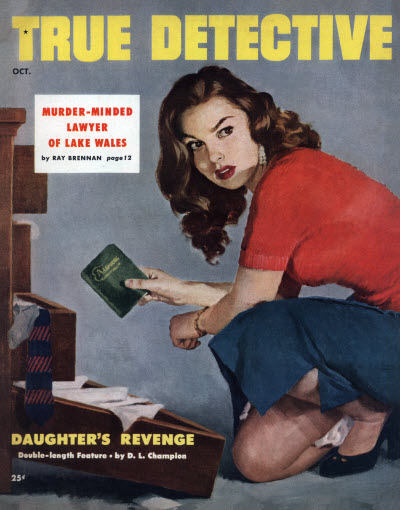
Some weeks back James Reasoner wrote a review of an issue of Two-Fisted Detective Stories on his blog, and I couldn't help noticing that one of the writers in that magazine was one Art Crockett. I remembered having seen the name somewhere before. I did some brain-work and I sure remembered that it was in the introduction to a true crime anthology Murder Plus that was edited by Marc Gerald in 1992.

Gerald writes about the time when he was recruited to work for True Detective magazine that was focused on true crime. He goes on for quite a while about Crockett:

My boss was Art Crockett. Pushing seventy, he wore a fedora over his horseshoe of hair and a cardigan vest over white starched shirts. He walked with a cane, had a lame eye, a wisecrack for every occasion, and a two-pack-a-day
cough though he'd recently cut down to a half a pack a day. Doctor's orders.

If Art looked and acted the part of the wizened, tough-guy editor, he had a right to. He had lived the life.

Raised a few blocks up from our office, Art received a Bronze Star and a Purple Heart as a radioman with the 100th Infantry Division in World War II. After his discharge, he worked a series of unsatisfying jobs - in a salt factory, a refrigeration plant, and as an elevator repairman. Then, with a wife and two kids to support, Art quit his day job, rolled the dice, and began hammering out plots fast and for money - a penny a word.

His first stories appeared in second-generation detective fiction pulps like Manhunt, Pursuit, Menace and Conflict. In the early 1960's, he edited a bizarre string of
sex-cum-violence magazines, unreasonable facsimiles of legitimate men's adventure titles like Argosy and True that featured lavishly illustrated covers of dolled-up girl-Nazis equipped with leather, whips and chains. When they folded, Art left for greener pastures of the True West publications. It was a short stay, for they, too, closed up shop, and when they did he turned to True Detective.

Art was a considerable literaty talent although thirty-five years of high-speed writing had taken its toll. When necessary, he could still knock out a masterful yarn. Mostly,
he just churned out tawdry blurbs and titles on his Royal manual, circa 1936, something he could do like nobody's business. ("The poor joker on the floor was literally beaten to death. That was bad enough. But what his blood-dimmed eyes beheld before the end came may have been even worse." Or "It was the ultimate humiliation for the man who was obsessed with sex, and no power on earth could stop her as she approached him with her menacing knife.")

Gerald also says that Crockett died of a heart attack in June 23, 1990. If Crockett was in his seventies in 1988, when Gerald came to work for True Detective, he must've been born in 1918 or thereabouts.

Gerald mentions also other writers who wrote lots of true crime stories: Jack Heise, Bud Ampolsk, Bill Kelly, Bill Cox and Walt Hecox. Of the names, I can find real fiction writing credits only for Walter Hecox. (The Bill Cox here seems to be Bill G. Cox, so he's not the pulp and paperback writer William R. Cox.) Gerald calls Jack Heise "all-time pulp great", but I can't find any support for the claim of him being a pulp writer. But then again, Gerald seems to equate true crime mags and pulp mags. (This guy may be the same Bill Kelly Gerald refers to.)

Here's a list of Art Crockett's and Walter Hecox's crime stories from the Fictionmags Index.

By the way, Gerald's book is a great anthology: it features stories by writers like Robert Bloch, Jim Thompson, Bruno Fischer, Lionel White, Dashiell Hammett and Harlan Ellison, almost every story being pulled from a true crime magazine. Mention is also made of Charles Burgess and Robert Faherty, whose rare entries in book-length writing Gerald speaks of admiringly. Has anyone read Burgess's The Other Woman, published by Beacon in 1960, or Faherty's Swamp Babe, published by Crest in 1958?

Edit: Based on what Allen Hubin found, it seems probable that Art Crockett was born in 1921.

Arthur Lyons dead

American private eye writer and film noir enthusiast Arthur Lyons has died. He's one of those American crime writers who have mysteriously been untranslated in Finnish. Almost only sign of him in Finnish is the video release of Slow Burn (1986), a TV film based on one of his Jacob Asch novels (the Finnish title of the movie is also Slow Burn). I haven't seen it myself, but I've talked about it with Tapani Maskula, the Turun Sanomat movie critic and one of the best experts on American crime cinema in Finland (and maybe in the whole world as well), and he said he liked the film very much.

Here's a lengthy piece by J. Kingston Pierce at The Rap Sheet, and here's Steve Lewis and Mystery*File, providing bibliographic info.

Wednesday, March 19, 2008

Poe's Arthur Gordon Pym

I read the recent Finnish translation of Edgar Allan Poe's only novel, The Narrative of Arthur Gordon Pym (it came out from Teos, translated by Jaana Kapari, who's most famous for her work on the Harry Potters). It's the first translation almost in hundred years, since the last one came out in 1915, if I remember correctly (it came out in two parts and I've seen it only once, and then it was only the first part and it had no covers and was missing some of the last pages - so you can gather it's pretty scarce; the actual first edition from 1903 I haven't seen).

The book isn't exactly a part of the Poe canon. There are parts which are boring as hell. Some of the bits are powerful. Everyone thinks the book stops in the middle of the action - maybe it was due to Poe's alcoholism or something like that. Poe constructs, however, a pretty thick theoretical (and also rather jokey) frame around the narrative that's supposedly written by the real Pym, and ending the book as it does must've been Poe's deliberate decision. Nevertheless, the ending with the scream "Tekeli-li!" is sure to get stuck in the reader's mind.
I found out that Poe got some inspiration from J.C. Symmes's theory of Hollow Earth that were circulating around the time Poe wrote his novel. It makes the ending even more powerful. No wonder that Jules Verne wrote a sequel to the novel, called The Antarctic Mystery. (Here's a pace of Poe-related fan fiction, there may be some stuff related to the Pym adventure.)

I wrote a review of the novel for the Kulttuurivihkot magazine. It will be out only in some months, so I thought it would be appropriate to already post it. It's here (in Finnish, of course). Note on the text: I didn't think that the translator Kapari had much evidence for her suggestion that the book might be autobiographical, but there seem to be others who think the same, and actually it seems it's a consensus on the book. I don't really see much relevance to the idea of reducing the book to Poe's life, and I can't quite gather how all this relates to the idea of the United States's identity, as some scholars seem to say. Maybe I should've gone to greater lengths about this.
(By the way, here's my earlier take on Poe's short stories.)

Wednesday, February 06, 2008

John Cleland's Fanny Hill

Sorry for absence. Been busy.

I finished John Cleland's pornographic classic Fanny Hill: Memoirs of a Woman of Pleasure (1749) couple nights back. It's a classic, all right, but still I couldn't get to liking it. The book is so wildly overwritten, with purple so prose every Western pulpster would've been flushing in shame (they would've been flushing anyway for the content). But nevertheless, for historical reasons it's a very intriguing novel: written in the first decades of the new form, novel, but still very much un-novel-like, in composition, in drama, in language and in narration. It has several allusions to other works of the same era (it was published in 1749), especially Henry Fielding's pseudonymous mocking of Richardson, Shamela. Some seem to think it's a parody of Daniel Defoe, and there are similarities between Fanny Hill and, say, Moll Flanders, but still I think Defoe wins hands down. Some also seem to think highly of Cleland's style, but that must because it seems now so other-worldly.

The cover on top is a pirated American edition from 1910 and the accompanying illustration is from the Finnish edition from 1969. The illo is by Seppo Polameri, who's been one of the foremost Finnish book illustators. My copy of Fanny Hill is jacketless, so I can't produce that one.

I just have this to say: beware of the written word, especially the old reference works! I first checked a Finnish reference work on writers from the early seventies (MMM: Maailman kirjailijat), thinking it's a reliable source. It said that Cleland was a scholar of languages and a playwright. Okay, I gathered, so he wrote Fanny Hill for quick money. Then I googled and came upon the Wikipedia article, which was rich in detail. And lo and behold! Cleland turned out to be a nutcase who claimed that Celtic is the mother language of all the languages of the Western civilization, and his plays were never produced.