Wednesday, October 23, 2013

The Lando series as by Tex Kirby?

One of the Finnish Landos:
"Don't Show Mercy, Lando"
There are fourteen books published in Finnish paperback series as by "Tex Kirby". The books are westerns and they feature one Brad Lando as the hero. Now, there seems to be at least two Lando books published by British cheapo publisher John Spencer (in their Badger paperback imprint), called Lone Gun Renegade (see photo below) and Arizona Manhunt (both 1971). But I can't seem to be able to find any info on the other Brad Lando books. In the Finnish editions they are clearly announced to be translated from English as they have such original titles as "Wildcat Breed" and "Trial by Gunsmoke". For some reason or another, Lone Gun Renegade isn't one of the Finnish Landos.

But there's nothing on them in any place I can think of. Pat Hawk's pseudonym catalogue credits John S. Glasby having written two Lando titles, but there simply are no other Tex Kirbys or Landos in Abebooks for sale - I even went through all the "original" titles in the Finnish Tex Kirby books and checked whether Abebooks had them.


These could of course be anything: something penned by German writers with hoax English titles; something written by English writer or writers, but left unpublished in the UK and published only in Scandinavia (or even only in Finland); something penned by someone else entirely, but published for some reason in Finnish under different name or title. Similar things have happened in the past.

Edit: I edited this, since there were some errors in my posting. Pat Hawk's pseudonyms catalogue does indeed list Lone Gun Renegade and Arizona Manhunt as written by John S. Glasby, but other than that, there's nothing.

Tuesday, October 22, 2013

Tuesday's Overlooked Film: Shock Corridor (1963)

Samuel Fuller's Shock Corridor must've been quite a shock for the audience of its day: the in-your-face attitude of this hardboiled anti-thriller is baffling even to viewers of 2013. I just saw this recently for the second time (both times on big screen) and was again mesmerized, even more this time than the previous.

Shock Corridor is a sordid tale of a newspaperman who wants to get Pulitzer and thinks about doing it by being planted into a loony bin. He talks his girlfriend and his editor-in-chief into the plot and rehearses going crazy with a shrink, but the second he's in he notices he might be going insane himself. Or wait, he doesn't notice it, his girlfriend does, but can't do nothing about it.

The film is somewhere between downright trashy sleaze and avantgarde (as, as it feels sometimes, only the best art is) as Fuller doesn't shy away from using the most ridiculous stuff of the day's pulpy fiction, like the nympho patients of the female ward and the zombie-like lunatics manning the corridors of the asylum. The zany acting (especially of Peter Breck in the lead), the fierce rhythm of the editing, the harsh photography of Stanley Cortez and the dream sequences in colour, leftovers from Fuller's unfinished documentary projects all make this into a dynamite of a film. Here's Jonathan Rosenbaum on the subject.

I'm not sure whether there will be a compilation post of Overlooked Films. Could it be somewhere else than Todd Mason's blog?

Wednesday, October 16, 2013

Oh, my new novel just came out

You think I'm productive? Not all the books that were supposed to come out this Fall didn't work out as planned, but I'm still putting out some seven books. One of these was the Lovecraft novel I mentioned earlier, another one is a sword and sorcery novel that came out roughly the same time Haamu/Ghost came out.

Sword and sorcery novel? Yeah, Viimeinen bjarmialainen/The Last Bjarmian (Bjarmia is a mythical place in the north-east region of Finland) is something I've always wanted to do and now here it is. This story came out first in five installments in the Seikkailukertomuksia/Adventure Stories mag I edited and published some years back. I wrote my serial set in ancient Finland almost from a scratch and later on I realized the story resembles westerns a lot: a lone swordsman comes into a small town, finds the town people corrupt, but still has to fight some bad guys that threaten the town from outside. But these bad guys are weird gigantic white monsters, not your basic Injuns or robbers. And they have a mysterious leader, living in a cave no one has ever seen... It's a bit like Hammett's Red Harvest coupled with Lovecraft.

The serial went through quite many edits before it hit the print, and I still think there remained lots to be done. The main problem was that the battle scenes resemble each other too much, but last week I figured out how it could've been avoided - two weeks after the book had come out. I guess this happens a lot.

There's also my foreword telling how the story got into print. (I posted the foreword here - in Finnish, of course.) The cover illo is another one by Aapo Kukko, who's really good at these things. He said he wanted to draw my hero, a guy called Pesäri, with Alain Delon in his mind. And I think he got it exactly right.

Writing these things - this and my collection of Joe Novak private eye stories and the one novel about Joe Novak - is more like a hobby to me, though it takes a considerable amount of time. Writing this kind of stuff is practicing my craft, practicing how to narrate a story, construct the dialogue, keep the story moving. In the gone days of pulp and paperback publishing you could do this for money, now you have to self-publish or rely on your friends' micropublishing outfits, like in this case. Tuomas Saloranta does a good work with his Kuoriaiskirjat, and I've already agreed on doing another book - a small anthology - for him. Here's hoping someone finds reading Viimeinen bjarmialainen as much fun as I had writing the story!

Tuesday, October 15, 2013

Tuesday's Overlooked Movie: Shivers AKA They Came From Within

I'm not a huge fan of David Cronenberg, but I've liked some of his films. One of these is his early horror film - I think his first real feature film - called Shivers. It also goes by the name of They Came From Within, which is fitting for a film that depicts weird creatures that take control of a human body and transform people into sex monsters.

The film is crude and full of inconsistencies, but it's still very effective. It's also very silly at times, but I think Cronenberg knows this and plays the film up as a black comedy. There's slapstick, there's some intentionally stupid dialogue and the scientific explanation behind all this is pure hokey, but don't let that fool you. Cronenberg's dark and disturbing vision is right behind every frame.

Trivia: the film was produced by Ivan Reitman and the special make-up effects were done by Joe Blasco!

More Overlooked Movies here. (Oh, I guess no one was compiling the links for this week!)

Monday, October 14, 2013

Sarah Weinman's Troubled Daughters, Twisted Wives

I've had this on my laptop for some time now, but I only now delved into Sarah Weinman's new anthology Troubled Daughters, Twisted Wives that has been out for a month so. As you probably know, this anthology covers the ground I've mined here in this blog from time to time: noir written by women and about women, not noir written about hardboiled and cynical men, but noir written about good, ordinary women who have babies and their work and what not. Most of the stories in the book come from the period between the 1940s and the 1970s, but there are some exceptions.

I've only read Sarah Weinman's foreword and the author introductions, but the book seems like a very solid piece of research, and the short story choices feel balanced. I think I can safely say this comes highly recommended from me. Check also Sarah Weinman's great website for the book, it has lots of additional information on the authors and their work. For my other pieces on female noir - or domestic suspense, if you will -, navigate via keywords.

Wednesday, October 09, 2013

Peter Chester: Murder Forestalled

As many of you may remember, I've been doing a book on British paperback crime writers for years now – actually for over ten years... I now decided as I'm kind of between jobs that I'll finish the book no matter what and publish it myself before the next summer.

I don't have the time to read all the books I don't find necessary to read. I've already read six or seven books by Dennis Phillips (1924–2006) who wrote under many aliases. His Peter Chambers (sic) books are light-fare private eye novels and his Philip Daniels books are mediocre thrillers. I noticed I hadn't read Murder Forestalled (1960) that came under his Peter Chester by-line. I found a small description of the book's plot at Amazon and decided to help future historians by blogging it. These kind of descriptions are hard to come by on forgotten British crime fiction. The Thrilling Detective site has an entry for Mark Preston who was "Peter Chambers's" private eye hero, but not for Johnny Preston who featured in "Peter Chester's" books.

I don't seem to be able to find the original cover, so here's the Finnish paperback cover (which is by Robert McGinnis and from altogether different book).

So, here you go: "Barbara Porter came into private eye Johnny Preston's office because she was in trouble. She was being blackmailed and some crook was demanding a thousand dollars from her...money she just didn't have. She wanted Preston to get rid of the blackmailer...but when she told him the crook's name was Jack Mahoney, he knew someone had already attempted the job. As Mahoney lay dying in hospital another mobster came in and finshed him off. And with the blackmailer well and truly dead, Preston found himself right back on the case again."

And oh, by the way, don't mix this Peter Chester with the convicted murderer. Nice to see some traffic here, though!

Monday, October 07, 2013

Harry Hobson and the Hank Janson series

I just posted the bibliography of Harry Hobson's outings in the British Hank Janson series on my bibliography blog here. Anyone know anything about Hobson? Nothing much seems to be available.

Tuesday, October 01, 2013

Tuesday's Overlooked Movie: Alphaville (1965)

Woody Haut once wrote that both poetry and pulp fiction start from scratch. One film that is right in the middle between poetry and pulp fiction is Jean-Luc Godard's Alphaville. In the film the hero kills the evil central computer by reading it Paul Éluard's poetry.

The film stars Eddie Constantine as Lemmy Caution, the hero of cheap French crime flicks, originating from Peter Cheyney's once-popular novels. Alphaville is a mix of parody, pastiche, deconstruction and homage to the cheap genre, timed to the rhythm of the Lemmy Caution's gun, Paul Misraki's pounding but jazzy music, hysterical car drives through the suburbs of Paris. The film is at times pure poetry in motion: the image changes into negative all of sudden, people stagger strangely in the corridors of the central computer building, the lights flicker, the screen is filled with neon-light words.

Seems like Todd Mason isn't doing his usual Tuesday round-up, but I'll post this anyway and add a link to his blog here.

Sunday, September 29, 2013

My forthcoming novel about Lovecraft

Monday sees my new book coming out. It's a very short novel or a novella in which horror writer H. P. Lovecraft is the main character. The book, simply called Haamu ("Ghost"), with the subtitle Kertomus Hollywoodista ("A Tale of Hollywood"), is a case of alternate history: in the book, Lovecraft didn't die from cancer in 1937. After he's been miraculously cured, he decides he's had too much of horror stories in his life, sells his house and library and moves on to Hollywood where he desperately tries to break as a screenwriter. He's living in a beat-up hotel and writes pulp stories but in different genres than before (crime, romance, even mainstream stuff) and tries to keep up his letter writing, mainly with Clark Ashton Smith.

The book is fragmentary and shows us glimpses of Lovecraft trying to write and earn his living. There are also some scenes on a desolate block where Lovecraft finds a dead mole. There are also some real-life Hollywood characters, mainly other writers from B-studios, but also director Edgar G. Ulmer whom Lovecraft meets at a party. There's also Earl Peirce Jr., who's also trying to work in Hollywood and comes up with an idea he tries to sell to Lovecraft. Some of the scenes in the book are more surreal and some of them may seem like Lovecraft is hallucinating, and he's not at all times the most reliable narrator. There's no horror in the book, though, and it has no supernatural elements. It's not a genre novel.

What's the idea behind the book? The vision of Lovecraft working in Hollywood has been with me for years. I think someone suggested it almost ten years ago at the Fictionmags e-mail group where I once was an active member (still am, but not a very active one). At the time, the writer (I can't remember who it was) suggested Lovecraft might've worked in Hollywood already in the early twenties, but I decided to make this an alternate history, set in 1941. (One book that had some influence on how the novel turned out was Joan Didion's Play It As It Lays, her novel on Hollywood that I read prior to starting work on Haamu.)

But there's still something I can't really explain in the book - in my own book! Doesn't art exist to make you wondrous? I'm sure many Lovecraft aficionados will tell me that my Lovecraft isn't the real Lovecraft, and I'm sure they're right. There are of course things that I decided should be according to how he was in real life, but then I also decided I don't have to act as if this was the real Lovecraft - after all, he's gone through a sickness that was supposed to kill him. His writing style has changed drastically, but that came also because I didn't want to emulate or parody Lovecraft's unique style - there are comments on this in the text. There are also subtle hints he's not really alive, as if this were a dream, but I won't give anything away.

The cover for Haamu is by Aapo Kukko, a young graphic artist. He's a very capable guy. Coming out from Turbator, Haamu has a very small print run, so be sure to grab it! Any foreign agents reading this? (Insert smiley here.)

Thursday, September 19, 2013

Erica Jong: Fanny

Been working on another book on erotica and reading said stuff. I just finished Erica Jong's Fanny, a long picaresque novel on Fanny Hackabout-Jones, better known as John Cleland's Fanny Hill. This was an entertaining book, somewhat long-winded and full with anachronistic feminism, but I didn't mind. Here's a contemporaty review from the New York Times.

Wednesday, September 18, 2013

Age of television and reading magazines

Many years I picked up a book from the fifties called The Age of Television. I'm not sure what I was thinking I was going to do with it, but there were these somewhat fascinating diagrams of magazine reading (and reading in general) in accordance to television watching. I'm sure someone will find these of interest. The diagram that shows changes in the circulation of magazines is the most interesting one.


Tuesday, September 17, 2013

Help needed identifying cartoon characters

I just bought a miserable old VHS cassette with five short animated cartoons. All the five films in the bunch were without opening titles, and I could recognize only one of the cartoons (a Filmation Popeye), some others were probably Terrytoons. I'll have to check into them later, but here's a photo I took of the first one. Does anyone recognize the characters in the picture? There's also a third cat, who's a kid brother or a nephew of the two in the picture. The cats spoke English under the lousy Finnish dubbing. I'm thinking this might be something Gene Deitch cooked up with Yugoslavian animators in the mid-to-late sixties.


Saturday, September 14, 2013

Wanted: railroad detectives!

Jim Doherty over at the Rara-Avis e-mail list was asking about railroad detectives in fiction. He's been able to come up with these titles, but needs more. Any suggestions?

"The Second Challenge" by MacKinlay Kantor (REAL DETECTIVE TALES AND MYSTERIES, Feb 1929)
"You Pays Your Nickel" by Cornell Woolrich (ARGOSY, 22 Aug 1936), also known as "The Phantom of the Subway"
"Ride 'Em, Mokawk" by William Rohde (SHORT STORIES, Oct 1950)
"The Girl in Car 32" by Thomas Walsh (EVENING POST, 7 Nov 1953)
"Yard Bull" by (MANHUNT, Aug 1954)
"The Ghost Station" by Carolyn Wheat (A WOMAN'S EYE, edited by Sara Paretsky)
"The Right Track" by R.T. Lawton (WOMEN'S WORLD, 26 Oct 2009)

Friday, September 13, 2013

More Finnish fantasy

Review of the first English-language collection of Jyrki Vainonen's silently surrealistic fantasy stories, out now. Recommended: Jyrki is a good writer (and a personal friend, but don't let that fool you).

Wednesday, September 04, 2013

Steven Torres: The Concrete Maze

As some of you may remember, I had some trouble reading some new noirish e-books - they were lacking style, substance and coherence. As I had some holiday left, I decided to try another one, as I didn't yet want to start reading work-related books. I chose The Concrete Maze by Steven Torres, and it proved to be a good choice.

It's a very realistic, almost minimalistic piece, about a 13-year old Puerto Rican girl who goes missing, and his father goes searching for her. The first person narrator is a young guy over 20, the nephew of the girl's father. His narrator's voice is somewhat melancholic in all its no-nonsense curtness. And the melancholy sure fits the novel, since it's full of grief, misery and tragedy. I was hooked by the guy's voice. This could be a vigilante novel in the style of the seventies' Death Wish clones, but even though the young guy and his uncle show courage in the course of the book, they are no heroes and some of their conduct is suspicious as they torture some of the suspects.

All this said, I must say that the book drags somewhat in the middle, when nothing new seems to be happening, and the final revelation in the climax is a bit too much. There was something in there I didn't buy. But still, The Concrete Maze comes highly recommended by me.

Here's Allan Guthrie's interview with Torres.

I read also Elmore Leonard's Get Shorty to finish my holiday reading (and to give him his due), but from now it's only work books for me.

Tuesday, September 03, 2013

Tuesday's Overlooked Movie: True Confessions (1981)

True Confessions, by Ulu Grosbard, is a rare film, at least in Finland. It's never been shown in Finnish television and it's been released only in VHS in the mid-eighties. It was released in cinemas, but I'm not sure how widely it was shown. I remember my dad liking the film a great deal.

I just bought the VHS I mentioned from a thrift store and got around to watching the film the other day. I read the John Gregory Dunne novel this is based on some years ago (here are some of my reflections), but I noticed I didn't remember much of it. The film is based loosely on the Black Dahlia case, and both the novel and the film seem to offer an explanation to the case, but in the film it was shown in a very oblique fashion, as was typical in the more artful crime films of the seventies and early eighties. Really: I had to check the Wikipedia article for the film to realize what went down in the end of the film!

That said, True Confessions is not a bad film at all. It's all been done on purpose. The lead actors, Robert Duvall and Robert DeNiro are quite good (and DeNiro is not hamming it up as usual, he plays the Catholic priest in a very subdued note), and they are packed with a nice bunch of character actors. There's a gritty realism to the police work in the film, and it also shows the shady side of politics, construction, Catholic church and prostitution linked with the police force. This is a very nuanced view of being a police in the late 1940's America.

There's not much action in the film, nor much suspense, but it's still catchy and interesting to the end - even though I didn't fully realize just what happened. Who got busted and who walked? Should probably read Dunne's novel again.

The film was scripted by Dunne himself and his wife, Joan Didion, who's probably now the better known of the duo. (And only her works have been translated in Finnish.)

More Overlooked Movies here. And damn, I only now notice that Frederik Pohl died yesterday. He sure lived a full life.

Tuesday, August 27, 2013

Tuesday's Overlooked Movie: The Innocents (1961)

I just saw the new haunted house film The Conjuring. I thought it was pretty good, frightening even, save for the ridiculous ending with all the Catholic Christian cliches about the Satanic evil in the world thrown in. I even wrote a review of The Conjuring saying that the film might draw a comparison with some of the classic ghost films à la The Innocents by Jack Clayton. The director of the film, James "Saw" Wan, showed remarkable restraint compared to his earlier films, and some of the scenes in The Conjuring are quite chilling.

I shouldn't've said that, since I hadn't seen The Innocents! I just watched it for the first time last night, and I must say that The Conjuring is pretty far from away from Clayton's film in restraint. In The Innocents, we are merely being shown two figures from a distance. There are no tricks James Wan is fond of, it's all in the mind. And we are never really told whether the ghosts of the film are true or whether they are imagination of the protagonist, the tutor (played by Deborah Kerr). The film might be even more scarier of that.

Beware of a slow pace! This is not your typical fast ride through nightmares all the horror films are now bound to be.

Based on a Henry James novella "Turn of the Screw". Now that I mentioned that, I might add that I finally finished the translation of H. P. Lovecraft's essay "Supernatural Horror in Literature" and sent the final edits to the publisher yesterday. Another one goes down!

Here's what Lovecraft writes of James's story: "In The Turn of the Screw Henry James triumphs over his inevitable pomposity and prolixity sufficiently well to create a truly potent air of sinister menace; depicting the hideous influence of two dead and evil servants, Peter Quint and the governess Miss Jessel, over a small boy and girl who had been under their care. James is perhaps too diffuse, too unctuously urbane, and too much addicted to subtleties of speech to realise fully all the wild and devastating horror in his situations; but for all that there is a rare and mounting tide of fright, culminating in the death of the little boy, which gives the novelette a permanent place in its special class." (Hey, no one said Lovecraft is easy to translate!)

More Overlooked Movies here.

Finnish fantasy free for Kindle

Jeff VanderMeer supports Finnish new weird writing giving away free e-book copies of famous Finnish fantasy writer Leena Krohn's short novel Tainaron. Check it out, it's a great book, full of wisdom, beauty and marvel. epub format also available.

Friday, August 16, 2013

Friday's Forgotten Book: Livia Reasoner: The Vampire Affair

I won this book from Livia Reasoner, James Reasoner's wife, some years ago in a blog or a Facebook contest. I got around to reading it only now, but luckily it still seems to be available as an e-book, though I believe these Silhouette books have a short shelf life.

This is the only paranormal Silhouette book Livia has written, but I don't know why this is, since The Vampire Affair is a solid book, fast-paced thriller with enough vampires, romance and erotic love. It's a clearly work of a professional. The main characters are a young and eager female journalist and a mysterious millionaire who turns out to be a vampire hunter and a bit of a vampire himself. This may sound cliched (and indeed many parts of the book are), but Reasoner writes deftly and keeps the story running. The book is quite short, so the cliches don't get in the way. In the end Livia throws some American Indian mystique in the mix, and it works, too!

The Vampire Affair could've also easily started a series, since both major characters could well play leading parts in coming books as well. Here's hoping it will happen!

More Forgotten Books here on Patti Abbott's blog.

Wednesday, August 14, 2013

Kevin Wignall's Dark Flag finally out

Remember Kevin Wignall's Dark Flag? I had a hand in publishing the book in Finnish translation some years back as Lipun varjo ("The Shadow of the Flag"). The book wasn't actually a success in Finland, even though it's a very good novel, and it vanished quickly. To this day, it hasn't been published in English language, but finally it's available as an e-book from Amazon. I really advise you to pick it up. This isn't one of those sloppily written and edited e-books I was talking about earlier.

(And thanks for comments on that post, I'll reconsider my stance.)

Saturday, August 10, 2013

Negative reviews on e-books?

I've been reading some stuff on my Kindle, mainly stuff I've picked free from Amazon, new gritty and noirish crime fiction from both side of Atlantic. I've liked a lot some of the stuff I've acquired, for instance Juaréz Dance by Sam Hawken and Tony Black's bleak novella The Storm Without (of which I didn't do a blog post). I also liked Lawrence Block's short story "Keller on the Spot" quite a bit.

But I've recently dropped two novels by new noir writers I was reading on Kindle. The other one was sloppily written and edited, and the other one had ridiculous characters and the police work depicted in the book wasn't believable. I was going to post a review of the books, but then I got to thinking I wouldn't be doing much of a service to the writers and their publishers (the other one of the two writers has just a book out from a small publisher working actively in the neo-noir business). Then I got to thinking that as a critic that's just what I should be doing: pointing out what these writers and their publishers are not doing very well and keeping readers out of the bad or mediocre stuff, but then I got to thinking again and then I decided not to post.

What do you think? I'm really an outsider in these circles, since I'm essentially a foreigner to all American, British and Scottish writers mining this area, but then again, someone might benefit from my point of view.

Thursday, August 08, 2013

The Counselor

Here's the trailer for Ridley Scott and Cormac McCarthy's film The Counselor, coming next October. I'm not really that keen on Scott, but this looks kinda promising.

Wednesday, August 07, 2013

Pulp writer Earl Peirce Jr.

Doing my first book, Pulpografia (2000), I encountered one or two Finnish translations of short stories by one Earl Peirce Jr. His name may have been written "Pierce" in the Finnish magazines. I didn't find any info on him, except that he wrote for Weird Tales and later on crime pulps, such as Detective Tales. I googled him earlier today (for a purpose I'll reveal later) and found out this post on a genealogy site. Someone has really done good work on Peirce, a really little known writer!

I put up Peirce's tentative bibliography here in my bibliography blog.


Tuesday, July 30, 2013

Tuesday's Overlooked Movie: Godzilla (1998)

Roland Emmerich's reworking of the famous Japanese monster wasn't a critical success (I think it wasn't a success even commercially), but my kids just saw it and they liked it. I believe my son (who's soon to be 9 years old) loved it. He also loves the Jap movies of which he's seen five, including the original one. 

There are some moments I also happen to like ("love" might be too strong a word here): Godzilla's leap into Hudson River, the drive into Godzilla's mouth, when Godzilla fools the submarines, the sequence at Madison Square Garden with the Godzilla babies. I also like Jean Reno's hardboiled character. My son says: "The best moment is the ending." He always feels sympathy for the baddies in the film when they fall. 

More Overlooked Movies here

Friday, July 26, 2013

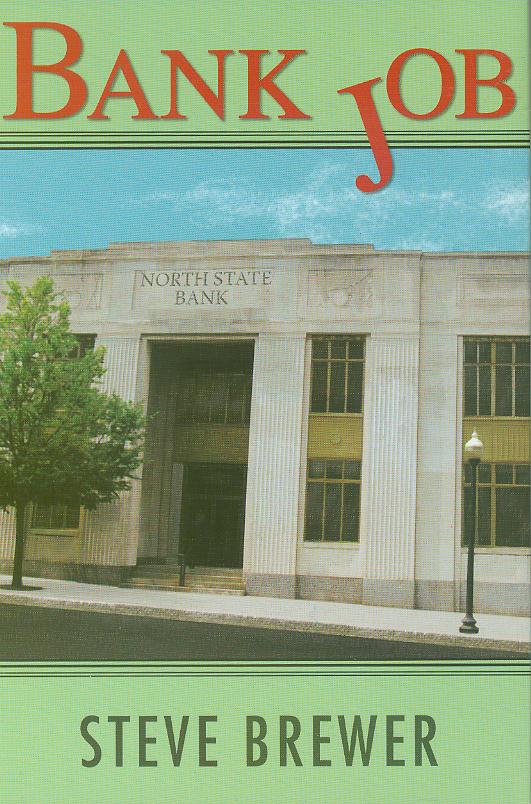
Steve Brewer: Bank Job


I just finished this hardboiled thriller reminiscent of Elmore Leonard's work the other day. It was the first book I read by Steve Brewer, but I liked it well enough to read more of his books later on.

Bank Job (2005) is one of those books that start rapidly, race along with a good speed and develop into a satisfying climax. Three low-life criminals are on a crime spree doing stupid things. One of them gets hit by a whiskey bottle during an attempt to rob a liquor store. The guys end up in a lonely house with an old couple living in it. The old guy of the house has a secret up his sleeve, and much action and mayhem ensue. There's plenty of violence that really hurts, and there are also some sudden twists and turns.

Brewer creates memorable characters with just few touches, a bit of dialogue, descriptions of how people move, act, keep a book in their hands. It's quite nice that the lead character is someone over 60. The young hoodlums are also depicted very nicely, they are fully human though they are quite worthless and almost evil. The plot moves on with a nice pace and slows down only in the last 20 or 30 pages. Comes highly recommended, even with the very stale front cover.

Edit: Oops! I meant to publish this on Saturday, but I accidentally pushed the Publish button and can't take it out anymore. So it's two book posts on the same day, but I don't really think anyone minds. 

Friday's Forgotten Book: Sébastien Japrisot: The Lady in the Car With Glasses and a Gun

Still suffering from a bad back, I finished lying on a sofa the French writer Sébastien Japrisot's thriller La Dame dans l'auto avec des lunettes et un fusil (1966). I had a beat-up copy I'd found somewhere cheap, and upon noticing I already have a better copy I decided to throw this away - most certainly something I wouldn't normally do.

This is a very good crime novel. I once read somewhere that if you're a male writer, don't try a woman's point of view (unless you're Cornell Woolrich). Japrisot does it and does it very well. Of course some of the stuff in the book depicting a young woman's sexual and social disorientation is dated, but they didn't overrun the reading experience. The book reminded me a bit of Gillian Flynn's Gone Girl, which I liked to a certain point, but I also got weary of its longevity. Not so with Japrisot's novel, as it clocks at about 250 pages. The book starts in the middle of the woman's noir nightmare of which the characters and the reader can't possibly fathom what's going on. Japrisot likes to toy with the reader's expectations and this is far more exciting and surprising than Gone Girl. Japrisot also writes in a very French style that's both hypnotic and diffuse at the same time. This is a very engaging book and although the prose isn't the most straight-forward one, you can't help but read the book in one sitting.

The book was made into a British movie in 1970 with Samantha Eggar and Oliver Reed. Haven't seen it, though. Seems like there's no decent DVD on it. Here's a good blog post on the film.

More Forgotten Books coming up here.

Edit: I forgot to mention it, but I read the Finnish translation from 1967. The title means "The Woman in the Car". Guess this was clear to anyone. Crime Club (with the nice logo) was a quality paperback series from the large Finnish publishing house Otava back in the late sixties. 

Tuesday, July 23, 2013

Tuesday's Overlooked Film: The Hooked Bear (1956)

Suffering from a bad back I watched some VHS tapes with old animations in them and spotted this Disney cartoon previously unknown to me. I don't know how this has happened - the explanation is perhaps that I've seen some of the Humphrey the Bear cartoons, but forgotten all about them. Nonetheless, this was a pretty entertaining little film, directed by Jack Hannah.

 More Overlooked Films here.

Tuesday, July 16, 2013

Tuesday's Overlooked Movie: Cause for Alarm (1951)

I caught this little film noir on a Finnish television just the other night. It's a slightly enjoyable suspense story starring Loretta Young as the disturbed housewife of a crippled man (Barry Sullivan) who begins to think Young is trying to kill him for his insurance money.

There are some implausibilities in the plot, and Loretta Young's behaviour when she tries to get back the letter his husband sent to the district attorney is pretty much all over the place, but this still fits in with the phenomenon I've dubbed "female noir". I think "domestic suspense" used by Sarah Weinman in her upcoming anthology is actually better for this. The images of Loretta Young under her sociopathic and bitter husband are pretty disturbing.

That said, the ending of the film should've been infinitely stronger. The director was Tay Garnett, the screenplay was by Mel Dinelli, who specialized in film noir. See also the Wikipedia article for the film.

More Overlooked Movies here.

Friday, July 12, 2013

Friday's Forgotten Book: Dean Koontz: Shattered (1973)

I've never read much Dean Koontz and my impression of his later and longer work (see here) has not been very good, but Shattered proved out to be short, gripping and brisk. It's one of Koontz's early books, published initially under his K. W. Dwyer pseudonym (and later on published as Dean Koontz), and still it tells a full-bloodied tale of full-bloodied people.

The premise is not very different from Richard Matheson's and Steven Spielberg's Duel which is two years senior, so Koontz may have had it in mind. Shattered also differs from Matheson's work in that the chase is personal in tone. A dark, mysterious van is behind two drivers, a young boy and the boyfriend of his older sister, who's a father figure to the kid. They don't know who drives the van, but Koontz shows he's a menace in the chapters narrated through the mysterious driver.

The ending is a bit too abrupt and there are some characters of which I didn't know whether they really were necessary. But Shattered is still a
suspenseful book that feels for its doomed characters.

This came out in Finnish in 1994 from Book Studio under the title Varjostaja. See the Finnish cover here.

More Forgotten Books here.

Wednesday, July 10, 2013

Joseph Rosenberger

When I wrote my first book, Pulpografia (2000), I decided to include some of the better-known men's adventure writers from the seventies and eighties. The genre doesn't do much for me, and Joseph Rosenberger's Richard Camellion books proved out to be the worst of the worst. I can see where the later cult fame rises from, but sometimes I have hard to see beyond those qualities.

Here's a personal letter from Rosenberger, who seems like he wasn't a very nice guy. Some quite interesting takes on politics and race and also some stuff on publishing. If you're into men's adventure genre in general, take a round in the Glorious Trash blog, you might find lots of interest. Here's also an interview with Rosenberger in the same blog.

Monday, July 08, 2013

New book out!

I have a new book out. It's a collection of werewolf stories by Finnish writers (mostly new, but with two old ones thrown in), edited by me. It looks dandy with its 340 pages and a nice cover by Jukka Murtosaari. The title means  "The Dark Side of the Moon", which is the title of Johanna Sinisalo's great story in the book. Here's more info on the book (in Finnish).

Tuesday, July 02, 2013

Tuesday's Overlooked Film: Multiplicity (1996)

I didn't much like Groundhog Day when I saw it, but I've come to realize the film enjoys a bit of a cult following nowadays. I haven't seen it since, but not long ago I read an interesting essay on Ramis's work, so I decided I should dip into an old VHS cassette I found some years ago from the trash bin containing Ramis's later Multiplicity.

Multiplicity is a bit like Groundhog Day, with its idea of cloning a person to make life easier. Having many Michael Keatons is not far away from Bill Murray living one particular day all over and over again. Both films are amiable, but contain some sharp notes on the middle-class way of life. The basic situation in Multiplicity allows many amusing moments and at times the films is a lot like a classic screwball comedy. All in all Multiplicity is an entertaining film, but I'm not sure whether I'd watch it again. Andie McDowell is not very interesting as the female lead, and the overall result is a bit too sweet to my taste.

A word of warning: if you don't like Michael Keaton, you probably won't like Multiplicity. I'm not one of his fans, but I could stand him in this, even when there were four of him on the screen.

More Overlooked Films at Todd Mason's blog here.

Friday, June 28, 2013

Friday's Forgotten Book: Jack Williamson: Darker Than You Think

I'm writing this before I've finished the book, so I don't know the outcome and how it will play out, but here goes nevertheless.

Jack Williamson's Darker Than You Think (published first in 1940 in Unknown, then in book form in 1948) is a werewolf classic and as such it seems dated now, though it must've been pretty ground-breaking at the time, for all its realism and psychological acuteness. Williamson even strives for a plausible explanation of lycanthropy, but the explanation of course seems dated now.

The title of the book is a lot like many film noirs with its emphasis on dark, and sure enough one could see this as a film noir, especially with the red-haired femme fatale of the book, April Bell. The hero of the book, Will Barbee, is an ordinary sap, hacking newspaper stories and drinking whiskey and waking up to a nightmare of his life.

More Forgotten Books here at Patti Abbott's blog. There's an Elmore Leonard week, but I wasn't able to participate in that.

Tuesday, June 25, 2013

Tuesday's Overlooked Movie: The Lord of the Rings by Ralph Bakshi (1978)

I watched Ralph Bakshi's early animated version of Tolkien's saga with my son, who's on a Tolkien binge, having watched Peter Jackson's film twice (or even thrice!). I could see he wasn't thrilled, but he managed through. Maybe he was interested in the differences between the versions.

I'm not sure whether I was, since I found Bakshi's film boring, clumsy and pretentious. I'd seen it before (on big screen), but the film proved to be duller than I remembered. I don't really know what one gets out of it, if one hasn't read Tolkien's book (or seen Jackson's version!), since Bakshi's film is lacking in good, solid narration. I don't know whether anyone seeing the film will care much for the faith of the Ring or the characters.

I promised my son I would try to seek the unofficial Bass-Rankin sequel to Bakshi's film, but Lord help from finding it!

More Overlooked Movies here at Todd Mason's blog.

Richard Matheson RIP

I'll probably be the last blogger to register the death of Richard Matheson, but he was so influential and so good, I can't let it to unnoticed.

I'm just dropping off to do some vacation-time, so here's only a short list of some of his work I've really liked:

Duel: both Spielberg's movie and Matheson's original short story plus his screenplay.
I Am Legend: unbelievably suspenseful, yet tight and relentless, very short (only some 150 pages), but still packs quite a punch, a model for many vampire and zombie novels and films to come.
Someone Is Bleeding: the original novella (later published in book form) reprinted in the great anthology American Pulp, goes to show Matheson was a very good noir crime writer.
short story "Gunsight" (Dime Western, 1951), published in Finnish as "Sokean sheriffin kaupunki" (meaning "The Town of the Blind Marshal"): hypnotic Western story of a blind hero.


Sunday, June 23, 2013

Letter from paperback writer Len Levinson

Since I mentioned Len (Leonard) Levinson in a longish post three years ago, this merits reblogging: Len Levinson has sent a letter to the blogger at The Post Modern Pulp blog, and I thought I'd share the link.

Thursday, June 20, 2013

John Connolly: Dark Hollow

Dark Hollow was the first book I've ever read by John Connolly, even though I've known about him for quite some time now. I remember Kevin Wignall being very surprised about the fact that Connolly hasn't been translated in Finnish, he's pretty big in the UK.

Though he's an UK author, his books - at least some of them - are set in the US. Dark Hollow stars his private eye anti-hero Charlie "Bird" Parker, who encounters serial killers in the books. Maybe that's why I haven't been very interested in Connolly's work, as serial killers are pretty much a bore to me. (Especially in a series. How could that possibly happen?)

But Dark Hollow was strong enough to warrant more reading from him. The book was too long, though, especially in the beginning where it took over 50 pages to get the story even started and almost 100 pages to get the backstory out of the way. I don't really care for that kind of thing, even though Connolly clearly thinks Charlie Parker's own traumatic story needs to be told and retold. There was some padding also after the story got going (and I'm not sure whether Connolly got all his sideplots going and whether they were necessary, then again I'm not very good at analysing plots), but the story still kept my interest going. And it was epic, like with Ross Macdonald or James Ellroy, with the hidden crimes being committed decades ago and still reflecting their dark nature into the present day. Some of the scenes are very suspenseful, almost out of a horror novel. Connolly can create a monster that feels human. 

I'll intend to read more John Connolly. 

Wednesday, June 19, 2013

Keith Rawson on Scott Phillips

Keith Rawson's fabulous post on Scott Phillips, the writer of The Ice Harvest and The Adjustment, both great novels.

Saturday, June 15, 2013

Antti Tuomainen's The Healer

Not long ago I mentioned Antti Tuomainen and his success in the big world. Here's a very positive review of his dystopian noir thriller, The Healer.

Gillian Flynn: Gone Girl

Lots have already been said about Gillian Flynn's book that's proved to be a bestseller. (Here's Keith Rawson pretty good essay on the book.) It just came out in Finnish and I read it in almost a jiffy. In two days, actually. I've been sick, otherwise I might've read it in one sitting. The plotting is that clever.

Except that the book's too long. Gone Girl - in Finnish translation at least - is over 440 pages. I should say it could've been at least 100 pages shorter and we wouldn't miss a thing. There's too much information we can't use as a reader, too much lingering on details that are not very relevant. This is especially case in the beginning. If I didn't know there was something to expect, I might've dropped the book before the page 100.

Of course one can say that the ending wouldn't be strong enough if the first part weren't so fully detailed. I'm not so sure about that.

But there are enough chilling moments to account for those empty moments when nothing much seems to be happening.

Wednesday, June 12, 2013

Spring Breakers


Harmony Korine's Spring Breakers is the quintessential neo-noir movie for the 2010's. Why? Because it's a perfect dissection of the society of the spectacle and the futile dreams of the said society we live in. There's no psychological motivation to drive the action, because the psychological motives don't move us anymore. There are only some meaningless ulterior motives, like money, which makes your pussy wet.

And all this is crusted with the abrasive music of Skrillex and the hyper-active editing of YouTube-era party videos.

Friday, June 07, 2013

Four books in a week


As you've may have noticed, I haven't relly been blogging lately (not even in my Finnish-speaking blog, Julkaisemattomia). It's been due to an enormous amount of work I've immersed myself in lately. I've finished four books in a week and I still have the new issue of the Ruudinsavu/Gunsmoke magazine (plus some book reviews) to finish off before I can drop off to spend the Summer holidays with my family. 

What are the four books, you ask. Well, one of them is a double book, but still a pretty mean piece of work, if you ask me. I compiled an anthology of old Finnish hate speech, from the first five decades of the 20th century, focusing on the aftermath of the Finnish Civil War. There will be two books (or one double-sided, I'm not 100 % at the moment), one focusing on the Leftist hate speech and one on the right-wing hate speech. The latter one includes some samples by the Finnish Nazis, and let me tell you it wasn't fun to work with that stuff. Ugly, nasty, paranoid, stupid, even though there seemed to be some attempt to authorize the hate with intellectual reasoning. 

The other two books: a collection of old pulp crime and adventure stories by the famous Finnish writer, later singer-songwriter Reino Helismaa (forthcoming under the title Kolme luurankoa/Three Skeletons; see the cover illustration by Timo Ronkainen above) and the last entry in my own sleaze paperback quartet, called Varissuon varvimestarit (a friend of mine already dubbed this "The Cum-Masters of Crow Moor", Crow Moor being a part of the Turku city). I haven't really finished that, though, I only wrote the first version - I typed the last five or six pages in a feverish state, fingers flying on the keyboard. (Insert smiley here.) I've still got loads of editing to do with the novel. It's some 22,000 words long (in English, it might be something like 30,000 words), so it's not long. The earlier titles: Lausteen himokämppä ("The Lust Cabin of Lauste"), Mynämäen motellin munamällit ("The Spunk Gang of the Mynämäki Highway Motel") and Runkkuloma Rivieralla ("Getting It Off at Riviera"). 

At times I find myself thinking, "how do I manage this?"

Monday, June 03, 2013

The third generation of the Nummelin family on a Tolkien binge

We watched Peter Jackson's The Hobbit when my daughter was last on vacation in Finland with us (she lives with her mother out of Finland most of the time), and my son was so excited about the film, he wanted to watch Jackson's The Lord of the Rings as well. And so we did, just the two of us. (My daughter had already left Finland at that time.)

Boy, was he excited! I'm very happy my son has an eye for grand adventure and thrilling moments of battle. Afterwards he wanted to know everything about elves, old kings, the lineage of everyone mentioned in the film. I told quite many details of the film beforehand so as not to make them too suspenseful. And then he said he wants to hear The Hobbit as a bedtime story, so we started it. Then he said that when the book is done, he wants to move over to The Lord of the Rings. So be it, we said. (And just yesterday when we stopped by a thrift store, I picked up a battered copy of the novel for him to take away when he moves out. If the book holds up to that day.)

I read the European graphic novel version of Tolkien's novel (or rather, Ralph Bakshi's animated film) already when I was 10 or so. My daughter saw Jackson's films when she was 11 or 12 - afterwards she read the book in two or three days. Now my son is on a Tolkien binge when he's soon 9.

I'm just pondering here whether we should watch Bakshi's animated film and its appalling sequels and read the afore-mentioned graphic novel... I'm also thinking whether I should revisit Silmarillion myself - it's been almost 30 years since I last read it!

Thursday, May 23, 2013

What Finnish crime writers should be translated?

I ran across a blog post over at Rap Sheet talking about Finnish crime writers who should be translated in English. Linda L. Richards, who wrote the post, mentioned Reijo Mäki who has just received the Vuoden Johtolanka (The Clue of the Year) prize from the Finnish Whodunit Society. Richards writes: "This recent win has likely (hopefully?) already put into motion the forces that will change that [Mäki being unknown in the US - JN]. Still, it seems at least a little inexplicable that we haven’t heard much about Mäki before, because he’s kind of a big deal in his home country. Eight of his nearly 30 novels have been adapted for the screen. Four of the resulting films have opened in Finnish theaters and another four are still to be released."

Mäki is indeed very popular in Finland and his popularity doesn't seem to be fading in the near future. His books are slightly parodic hardboiled private eye books that usually don't do well in the US or UK markets nowadays, and the large sociological and political questions, not to mention questions regarding to gender and minorities, that characterize most of Scandinavian crime fiction are largely missing from his work. The films based on his work have also been popular, but also very much criticized for being sloppy and clichéd. This is not to say someone shouldn't try translating them in English; maybe that would help some other writers break the barrier.

There are some Finnish crime writers, though, who really should be translated in English. Antti Tuomainen is breaking good in seemingly anywhere in Europe and the US, and I can heartily recommend his work: it's good, solid noir. I'm sure many who are into hardboiled crime might like Harri Nykänen's Ariel Kafka novel Nights of Awe out from Bitter Lemon Press (I haven't read it myself). Many seem to like Marko Kilpi's serious police novels, but I didn't like his first one, Jäätyneitä ruusuja ("Frozen Roses"), which I found deeply over-written and pretentious.

Here are some names for you, though. Mind you, I'm not interested in cozies or huge international thrillers. Both have their writers and their fans in Finland, though.

Tapani Bagge writes hardboiled action like no other writer in Finland. His long series of career criminals and sore losers of cold small towns of Finland is very good. Bagge (who's a personal friend of mine) is well-read in hardboiled crime and noir, and he sure knows how to spin the plot. He can also create memorable characters: they are touching, fragile and capable of violence at the same time. Bagge really cares for the people he writes about. Tapani also has a four-part series of historical crime, set in the 1930s and 1940s and the political mischief at that time, but I've only read the first in the series, so can't really comment on that. Tapani's been popular in Germany.

(As some of you might remember, I tried to translate Tapani's first crime novel Puhaltaja into English (with the tentative title The Jack), but it didn't work out so well in the end. Tapani's well-represented by his agent, though, so I don't mind.)

Marja-Liisa Heino is one of the most original Finnish crime writers, whose four books differ greatly from each other. I just finished her latest novel, called Astuit väärään autoon ("You Stepped into a Wrong Car"). It's an absurd Dostoyevskian play of guilt, written in prose that's both diffuse and clear at the same time. Lots of things go by unexplained. The story of a rapist who gets out from the prison and moves in with one of his victims (and makes renovations in the woman's house!) is pretty weird, but also very engaging. There's also some police procedural stuff, but I thought the parts with the rapist were better.

Of the other Finnish private eye writers than Reijo Mäki, Markku Ropponen might be an interesting one, but I'm not sure if his work translates well.

Many readers of this blog are into very dark and tough hardboiled fiction. They might want to try Juha Seppälä's Super Market. It was already published in 1991, but many of its pieces still feel relevant. Some of the more absurd stories set in the Finnish army might not work in English, but some of his violent ultra-short stories about criminals and other lowlife could very well resonate with someone who likes to read ThugLit or Flash Fiction Offensive. Seppälä's first novel, Hyppynaru ("The Skipping Rope", 1986) could also be seen as a non-genre crime novel. He's becoming more experimental these days, though, but his work still retains the darkness of his early work.

Harri V. Hietikko's first novel in years (he wrote a trilogy of supernatural private eye novels for a very small publisher in the 1990s), called Lausukaa Paranoid (the title is a joke that doesn't work in English), is, according to his own words, an update of Sergio Leone with Harley-Davidsons. I haven't read it as yet, but it seems interesting.

There are also some more marginal writers, some of which are more into horror and fantasy. Petri Salin's excellent Jim Thompson-esque short novel Toinen nainen ("The Other Woman", 2009) would work very well as an e-book. (Sadly Petri has made himself non-available for the time being.) Tuomas Saloranta is more a horror writer, but he can spin a mean crime tale any time he wants to. His horror stories, published mainly online and in anthologies, have a very, very dark edgy side to them, though they are also humorous at the same time.

Of the horror writers, I'm sure Juha-Pekka Koskinen and Marko Hautala would find audience translated in English. Koskinen has tried his hands also in crime writing, producing one good novel, called Eilispäivän sankarit ("The Heroes of Yesterday"), and also one book related to the Spanish Civil War and the political anxieties in Finland in the thirties and fourties. (I haven't read that one, though.) Koskinen's horror stories in my anthologies have been uniformly good.

Oh, by the way, here's something I've probably forgotten to post. It's a canon of Finnish noir fiction, posted in one of my Finnish-language blogs. I compiled it with the help of some of my friends, including Tapani and Antti. (I might be a bit biased saying good things about their work, but then again, this is my blog.)

Tuesday, May 21, 2013

Tuesday's Overlooked Movie: Femme Fatale (2002)

Femme Fatale is one of the latest efforts by Brian De Palma, whose films I've generally liked, with some exceptions. This wasn't one of those exceptions.

Femme Fatale was made in France, possibly because De Palma couldn't raise the money in the USA. There's certain Europeanness in the film, so I'm not sure if it suits the American taste. There's something that reminds me of a Luc Besson or a Jan Kounen in this.

The film is full of technical trickstery and magistery that's characteristic of De Palma: camera drives, odd angles, long shots, shots through different filters, all that. The plot - what I could make of it - was suited to the feverish camera work. Femme fatale of the title is a career criminal, sexy as hell (played by Rebecca Rominj, who looks a bit too much the early 2000's, but I don't mind), who's on the loose from her fellow gangsters. The plot is full of twists one just can't see coming - and the last one is actually pretty absurd, but I think it fits the general mood of the film. There's some thematics on voyeurism that's also characteristic of De Palma, but I'm not sure what De Palma wants to say with the film. People - especially women - are being watched and this watching becomes more mechanistic via surveillance cameras and such, but then what? Women can also take advantage of them being watched, but it's unclear what kind of nature De Palma is saying this vantage point could be. This kind of uncertainty of thematics is also characteristic of De Palma.

More Overlooked Films at Todd Mason's blog here. (For once I managed to do this in time!)

Wednesday, May 15, 2013

Tuesday's Overlooked Movie: Knife in the Darkness

The 72-minute episode of the TV series Cimarron Strip, released on VHS (in Finland as Kaupunki kauhun kourissa / The City in the Hands of Horror or some such nonsense; see photo) has some assets, some downsides.

The assets:
- the cleverish script by Harlan Ellison
- Bernard Herrmann's music, made especially for this episode, not Herrmann's best by a long shot, but still Herrmann
- Stuart Whitman in the lead, very young Tom Skerritt in a small but significant role

The downsides:
- the dire direction by Charles Rondeau
- too little violence or suspense

The biggest problem is that you pretty much guess what's going on after you've seen 10 or 15 minutes of it. In 1968 this must've been something.

Here's Marty McKee in a more detailed blog post about the same flick. More Overlooked Films here.

Saturday, May 11, 2013

Don Easton's Jack Taggart books

Based on recommendations on Bookgasm (and some personally from one of Bookgasm's contributors, Bruce Grossman) I ordered a couple books by Don Easton. He's a Canadian writer, a former Mountie working undercover in drug-related cases. The books sounded interesting in all their violence.

But I was sorely disappointed. I've managed to get on page 67 on Loose Ends and I find the language and the narration stilted. The dialogue, not to mention the inner monologue, is stilted. The characters, including Taggart himself, are not far from being clichéd.

Sorry, I'll have to drop these and move on to something else. Anyone want two Don Easton books? The other one is Loose Ends, the other one is - well, something else. (It's in a stack on the floor, I can't see it at the moment.)

Friday, May 03, 2013

The Noir Dorian Gray

Remember when I was pondering about whether Oscar Wilde's The Picture of Dorian Gray might merit as a noir novel? I repeat: it's about an individual transcending the boundaries and suffering from the consequences. Okay, seems like I'm not the only one. I stumbled on some sketches by a Finnish artist called Jarmo Mäkilä and his exhibition based on The Picture of Dorian Gray. He has envisioned Wilde's characters as heavies from a gangster movie.


Sunday, April 28, 2013

Bought some books

It's a rare occasion when I can take some four or five hours to take a good look at the used bookstores around here in Turku, but whenever I can, it can be this good.

(The book on bottom is a Finnish anthology of sword and sorcery stories by writers like Robert E. Howard and L. Sprague de Camp. It's called The Witches' Empire.)